
OTR Tester Setup: ASTM D3985 Dry vs Controlled-Humidity (ASTM F1927) Conditions
Configure an oxygen transmission rate tester for dry ASTM D3985 and humidified ASTM F1927 flat barrier film evaluation.
Setting up an oxygen transmission rate tester for flexible packaging starts with choosing the right conditioning protocol before clamping a film specimen into the permeation cell. ASTM D3985 (dry) and ASTM F1927 (controlled RH) are coulometric flat-film OTR methods often cross-referenced with ISO 15105-2, JIS K7126-2, GB/T 19789 and DIN 53380-3; those cross-refs are not full equivalences—GB/T 19789 and DIN 53380-3 track dry coulometric film practice and do not by themselves cover F1927 humidified conditions, while ISO 15105-2 / JIS K7126-2 are equal-pressure gas-transmission standards under dry (D3985) or humidified conditions (F1927). Moisture-sensitive samples (such as EVOH, polyimides and coated paper) have oxygen transmission rates impacted by humidity, and test duration ranges from a few hours to a few weeks depending on the barrier structure and verify-equilibrium graph of OTR versus time.
For packaging engineers comparing barrier and mechanical performance across candidate film structures, this guide details coulometric sensor principles, dry versus humidified method selection, diffusion cell hardware, specimen conditioning, steady-state judgment, and unit conversions. It connects flat-sheet oxygen permeation setup to companion workflows across our testing and specification guides, including water vapor transmission rate method selection, seal strength evaluation, and hot tack jaw-window setup.
Quick method selection by barrier structure and package format
Under Scope section 1.1, this test method covers a procedure for determination of the steady-state rate of transmission of oxygen gas through plastics in the form of film, sheeting, laminates, coextrusions, or plastic-coated papers or fabrics, determining (1) oxygen gas transmission rate (OTR), (2) the permeance (PO 2), and (3) the oxygen permeability coefficient (P’ O 2) for homogeneous materials. The enclosed Table 2 Statistical Summary of Data demonstrates this quantitative method to be effective for measuring the oxygen transmission rate of materials from 0.063 cc/(m2 x day) to 64.4 cc/(m2 x day). Because ASTM D3985 only applies to oxygen permeability testing of a specimen under drying condition (relative moisture less than 1% RH), any test performed under wet condition can refer to ASTM F 1927.
Scroll horizontally to view all columns if needed. ↔
| Method designation | Primary test scope and specimen geometry | Edition and committee metadata |
|---|---|---|
| ASTM D3985-24 | Active Standard Test Method for Oxygen Gas Transmission Rate Through Plastic Film and Sheeting Using a Coulometric Sensor | Last updated Jul 16, 2024 under BOS Vol. 15.10 Committee F02 ($ 72.00) |
| ASTM F1927-20 | Active Standard Test Method for Determination of Oxygen Gas Transmission Rate, Permeability and Permeance at Controlled Relative Humidity Through Barrier Materials Using a Coulometric Detector | Last updated Aug 03, 2020 under BOS Vol. 15.10 Committee F02 ($ 72.00) |
| ASTM F1307-20 | Active Standard Test Method for Oxygen Transmission Rate Through Dry Packages Using a Coulometric Sensor | Last updated Aug 03, 2020 under BOS Vol. 15.10 Committee F02 ($ 72.00) |
| ASTM F2622-20 | Active Standard Test Method for Oxygen Gas Transmission Rate Through Plastic Film and Sheeting Using Various Sensors | Last updated Jul 27, 2020 under BOS Vol. 15.10 Committee F02 ($ 72.00) |
| ASTM F392/F392M-23 | Conditioning levels A, B, or C are typically used for flex-formed pinholes (referencing Practice E171 and Guide F2097) and Conditions D and E are typically used for barrier properties | Last updated Nov 09, 2023 ($ 64.00) under Clauses 5.1 and 5.2 |
Under section 5.1, the OTR is an important determinant of packaging protection, and the test method is suitable as a referee method of testing provided that the purchaser and the seller have agreed on sampling procedures, standardization procedures, test conditions, and acceptance criteria. Sections 1.2 and 1.3 state that this test method does not purport to be the only method for measurement of OTR and that the values stated in SI units are to be regarded as standard.
How a coulometric oxygen transmission rate tester works
In flat-film permeation testing, one side of the flat film sample is challenged by an oxygen test gas (usually 100% O2), while the other side of the sample is swept by a nitrogen carrier gas to a coulometric detector, with common OTR units of cc/(m2 • day) or cc/(100in2 • day). The ASTM D3985 test system utilizes a carrier gas mixture of nitrogen and hydrogen, which passes through a catalyst to remove residual oxygen in the carrier gas stream (this is critical for low-level OTR testing). Specifically, ASTM D3985 requires mixed N2/H2 carrier gas used with a catalyzer for a clean background, whereas using 99.999% UHP N2 with no catalyzer results in 1 ppm O2, which allows a 2.8 cc/m2 • day OTR background.
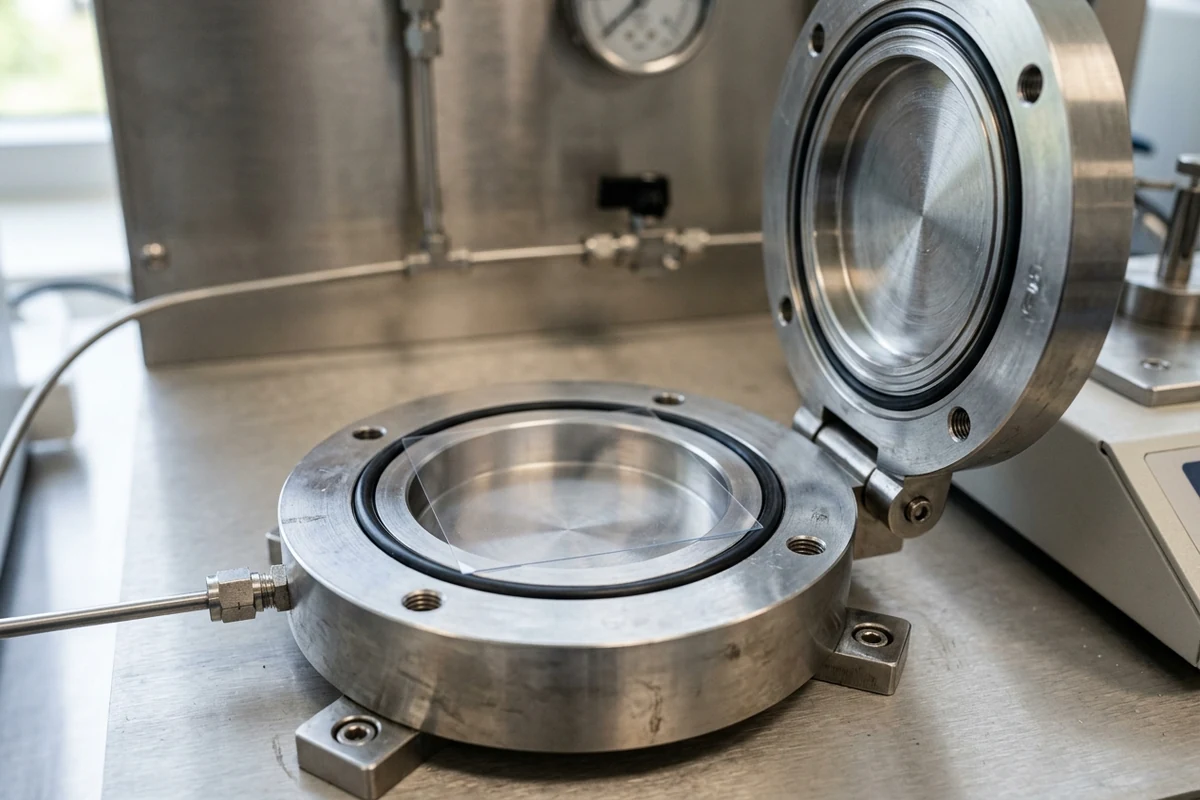
In ASTM D3985, the intrinsic coulometric sensor quantitatively converts oxygen that reaches it to an electrical signal (often described near 95%–98% conversion efficiency in secondary summaries); Faraday-law quantification is why sensor calibration is typically not required—do not read “all molecules” and “95%–98%” as conflicting absolute claims. ASTM D3985 requires 100% of the carrier gas to be analyzed by an intrinsic coulometric sensor with sensor calibration not required, whereas other coulometric sensors sweep only partial flow to the sensor and require calibration due to variable flow rate. Under section 5.2, limited statistical data on correlations with Test Method D1434 manometric methods are available, although the OTR of a standard reference material (see 12.1) as determined manometrically by NIST is in good agreement with the coulometric interlaboratory test.
Comparing the Equal Pressure (Isostatic) Method (ASTM D3985, F1307, F1927, F1249, F2622) with the Differential Pressure (Manometric) Method (ASTM D1434), isostatic coulometric analyzers (such as the OX-TRAN 10X) achieve low-end detection of 0.0005 cc/(m2day) and repeatability of ±0.0005 cc/(m2day) or ±1%, whereas manometric D1434 testing has a low-end detection of 0.5 cc/(m2*day) and repeatability of up to 20%.
For facilities evaluating non-coulometric analyzers, ASTM F2622 allows alternative sensors such as electrochemical and zirconia oxygen sensors that sample a fraction of transmitting oxygen in ultra-high-purity N2 (99.997%) with an O2 absorber, which are recommended above 100 cc/(m² • day) and are less accurate below 1 cc/(m² • day). Under section 5.2, testing which has compared select instruments with other sensors to the instruments specifically described in Test Method D3985 is shown in Section 16. Section 1.3 notes that this test method has intentionally been prepared to allow for the use of various sensors, and the precision and bias of each design needs to be individually established.
Dry ASTM D3985 vs controlled-humidity ASTM F1927 conditions
Under Scope section 1.1, the controlled-humidity test method covers a procedure for determination of the rate of transmission of oxygen gas, at steady-state, at a given temperature and %RH level, through film, sheeting, laminates, co-extrusions, or plastic-coated papers or fabrics, which extends the common practice dealing with zero humidity. Under Scope section 1.1, this test method provides for determination of oxygen gas transmission rate (O 2 GTR), the permeance (PO 2), the permeation coefficient to thickness (P“O 2), and the oxygen permeability coefficient (P’O 2) for homogeneous materials, and Section 1.2 states the values stated in SI units are to be regarded as standard. Under section 5.1, O 2 GTR at a given temperature and %RH is an important determinant of package protection, and the method is suitable as a referee method of testing provided that purchaser and seller have agreed on test conditions and acceptance criteria.
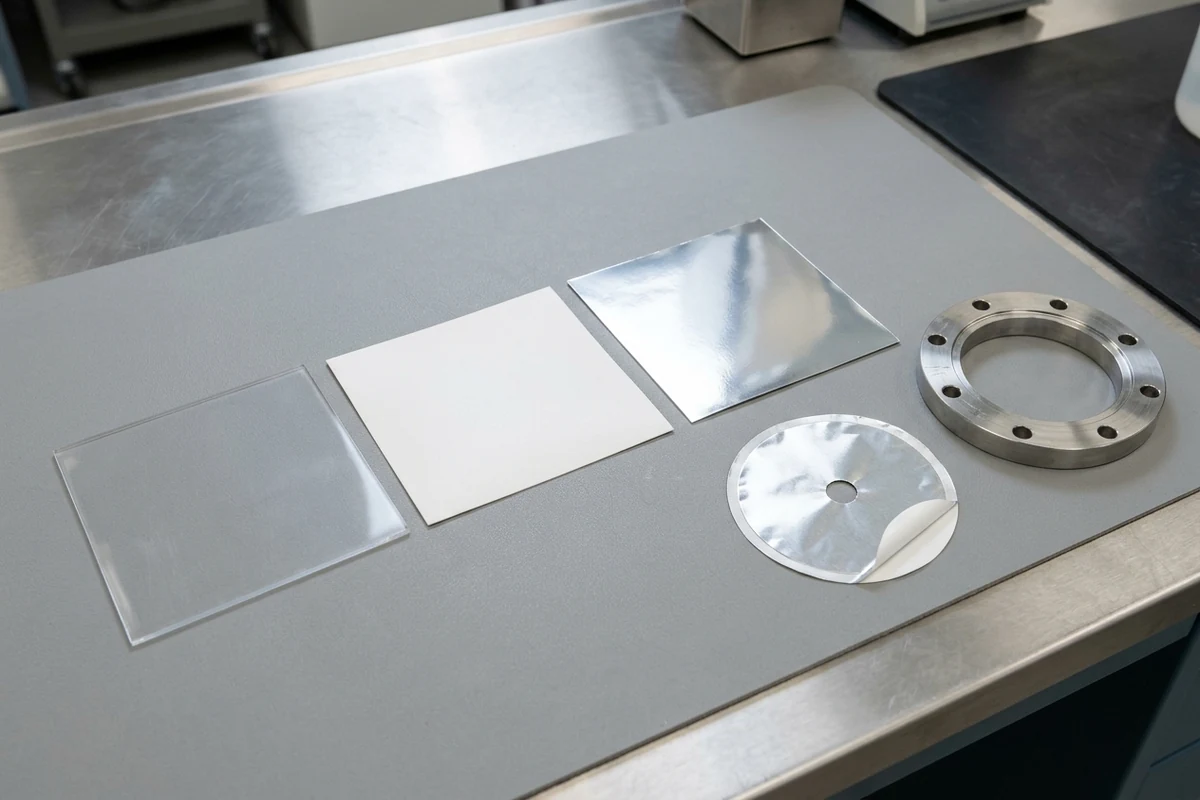
ASTM F1927 extends the capabilities of D3985 for moisture-sensitive materials like EVOH film, nylon film and coated paper by incorporating humidification of both test gas and carrier gas supply before the test chamber. Fickian materials, which include polyolefins, or any material with a hydrophobic nature, would not be affected by the change of RH, whereas Non-Fickian hydrophilic materials absorb moisture that swells up the polymer chains and increases gas permeability. As generalities in permeation behavior, for every 10°C increase in temperature, transmission rate doubles, humidity causes Non-Fickian behavior for hydrophilic materials (such as EVOH with moisture), and transmission rate is proportional to the driving force and reversely proportional to material thickness.
In the Effects of Humidity on Oxygen Transmission Rate comparison, OTR values at 0% RH and 100% RH remain unchanged for hydrophobic polymers: ABS is 0.06 at 0% RH and 0.06 at 100% RH, HDPE is 6.6 at 0% RH and 6.6 at 100% RH, and LDPE is 28.8 at 0% RH and 28.8 at 100% RH. In the same comparison from 0% RH to 100% RH, the OTR of polar polymers increases sharply: Nylon 6 rises from 0.06 to 0.3, PVA rises from 3.3 to 9.0, EVOH rises from 0.0006 to 1.5, and Coated paper rises from 0.5 to 12.0.
When mechanical abuse during converting or distribution is a concern, flex-conditioning sections 5.4, FIG. 1, and 5.4.1 state that supplementary permeation testing using gas or water vapor can be combined with flex conditioning on a 30.70 mm [1.20 in.] diameter shaft to measure loss of ply integrity, avoiding severities that produce greater than 50 or less than five pinholes per sample. Whole rigid or flexible containers can then be verified under package permeation sections 5.1 and 1.1, which cover a referee method procedure applicable to packages that in normal use will enclose a dry environment. ASTM F1307 is designed to test oxygen transmission through complete packages using typically 20.9% or 100% oxygen and high flow-rate purge capability (20.9 % O2) to reduce testing time.
Diffusion cell hardware, specimen masking, and gas supply setup
The linear response of the ASTM D3985 coulometric sensor supports readings from as low as 0.0005 to 2000 cc/(m2 · day) down to below ppb level (where 1 ppm is equivalent to 2.8 cc (m2 · day)), making individual zero measurements critical to eliminate system bias. High-permeating materials can be evaluated by reducing the test area (masking) or using lower oxygen concentration (<100% O2), as the intrinsic linear sensor measures 100% of carrier gas over 7 magnitudes and Individual Zero is ideal below 1 cc/(m² • day). Across the standard method comparison table, measurement ranges span 1 000 - 0.00001 cc/m2 · day for ASTM D3985, 1000 - 0.00001 cc/m2 · day for ASTM F1927, and 1 - 0.000025 cc/pkg · day for ASTM F1307.
Commercial diffusion cells offer standard 50 cm2 and reduced-area (20, 10, 5.6 and 1.3 cm2) film cartridges, Edge Effect (50 and 5 cm2) and Edge Compression (10 and 5 cm2) cartridges for 2/22 analyzers, and 50 cm2, 10.0 cm2, 5.0 cm2, and 1.0 cm2 Edge Effect cartridge options for 2/28 analyzers. On the OX-TRAN 2/22 Series 2-Cell analyzer, TruSeal gas-flushed perimeter sealing provides a gas flush of the sample mounting seal that protects chamber integrity and lowers background level, reducing the need to run individual zero. On the OX-TRAN 2/22, the upper detection limit of 200 cc/(m 2 × day) can be extended using the reduced area film test cartridge (factor × 9) or atmospheric oxygen in place of normal 100% O 2 (factor of 4.8).
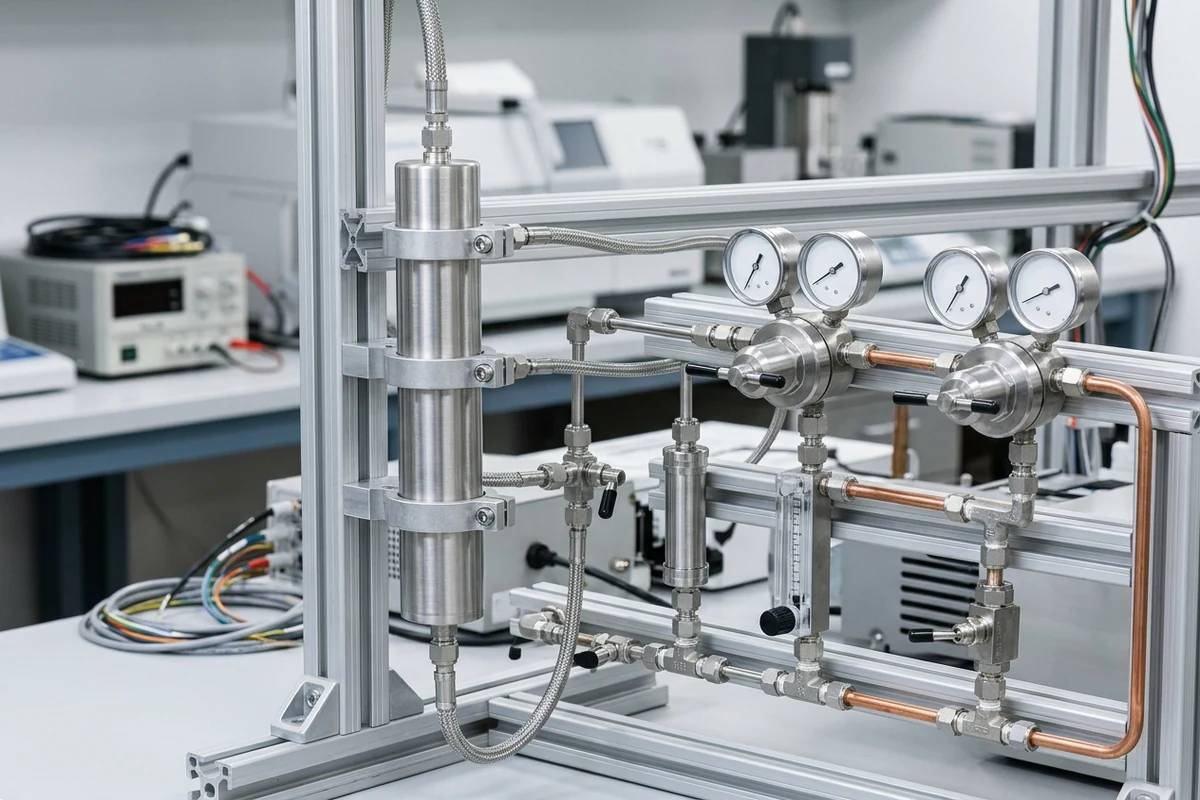
Hardware specifications and gas supply parameters across commercial coulometric OTR testers include the following verified benchmarks:
- At the 50 cm2 standard test area, OX-TRAN 2/22 Series test ranges are 0.0005 to 200 cc/(m2 × day) (0.00003 to 12.9 cc/(100 in2 × day)) for Model 10x, 0.005 to 200 (0.0003 to 12.9) for Model L, and 0.05 to 200 (0.003 to 12.9) for Model H.
- At the 5.6 cm2 reduced test area, OX-TRAN 2/22 ranges are 0.0044 to 1770 cc/(m2 × day) (0.00027 to 114.0 cc/(100 in2 × day)) for Model 10x, 0.044 to 1770 (0.0027 to 114.0) for Model L, and 0.44 to 1770 (0.027 to 114.0) for Model H, while 5.0 cm2 masked ranges reach 0.005 to 2000, 0.05 to 2000, and 0.5 to 2000 cc/(m2 × day).
- For the OX-TRAN 2/22 Series, package test ranges are 0.0000025 to 1.0, 0.000025 to 1.0, and 0.00025 to 1.0 cc/(pkg × day), resolution at 50 cm2 is 0.0001 cc/(m2 × day), and repeatability is 0.0005 or 1%* (Model 10x), 0.002 or 1%* (Model L), and 0.02 or 1%* (Model H) cc/(m2 × day).
- All OX-TRAN 2/22 Series analyzers specify test temperature from 10 °C to 40 °C ± 0.2 °C, controlled RH from 0% to 90% ± 3%, film size of 4” x 4” (2”x2” optional), film thickness up to 120 Mil, film test area of 50 cm2 (5.6 cm2 optional), Nitrogen/Hydrogen Mix (98%/2%) carrier gas at 25 PSI (1.72 Bar, 172 kPa), and 100% Oxygen (purity 99.9%) test gas at 25 PSI.
- For 4-Cell OX-TRAN 2/28H and 2/28HR analyzers, the 50 cm2 test range is 0.05 to 200 cc/(m2day) (0.003 to 12.9 cc/(100 in2day)), the 5 cm2 range is 0.5 to 2000 (0.03 to 129.0), resolution at 50cm2 is 0.0001, and repeatability is 0.02 or 1%*.
- Between these two high-throughput models, the 2/28H operates at 20° to 60°C ± 0.2°C and 0% RH, whereas the 2/28HR operates at 20° to 40°C ± 0.2°C with 0%, 50-90% +/- 5% RH on the test gas only, accommodating film thickness up to 20 Mil for 50 cm2 and up to 120 Mil for 5.0 + 10 cm2 cartridges.
- Multi-cell coulometric analyzers such as the Labthink C206H specify a 50cm2 test range of 0.02 to 200 cc/(m2·day) (up to 400000 customized, 0.2 to 2000 with a 5cm2 mask, and 1 to 10000 with a 1cm2 mask), resolution of 0.0001, repeatability of 0.02 or 1%, temperature of 15 to 50 °C (5 to 60 optional) with ±0.15 °C fluctuation, and humidity of 0% and 5 to 90%±2% %RH.
- The 6-cell C206H accepts 4.4” x 4.4” (11.2cm x 11.2cm) specimens with thickness up to 120 Mil (3mm) over a 50cm2 area, using 99.999% Nitrogen and 99.5% Oxygen at ≥40.6 PSI / 280 kPa (instrument port ≥79.7 PSI / 550 kPa) with an optional GP-01 gas purifier.
- Similarly, the 3-cell coulometric OTR-O3 analyzer specifies a film test range of 0.01 to 6500 (cc/m2.24h), resolution of 0.001, permeable area of 50 cm2, specimen thickness of ≤3 mm, temperature range of 5°C to 95°C (temperature control device optional; accuracy ±0.1°C), and 99.999% High-purity Nitrogen at 0 to 100 mL/min and ≥0.2MPa.
Baseline purge, steady-state equilibrium, and analyzer configurations
In ASTM D3985 testing, both chambers are first purged with nitrogen until the residual oxygen signal falls to a stable baseline, and after oxygen or air is introduced, the signal is tracked until it plateaus at steady state; the two things that ruin OTR results are a leaking seal and calling a measurement finished before it reached steady state. In multi-cell coulometric operation, the minimum sensor exam time per cell is 15 min for OX-TRAN 2/22 H, 20 min for 2/22 L, 30 min for 2/22 10X, and 15 min for 2/28 H and 2/28 HR, with an approximate sensor life of 4 years (based on 80% usage) and a 4 pro-rated year warranty.
For external commercial testing, Measurlabs performs plastic film and sheeting OTR measurements on two parallel samples simultaneously (typically at 23 °C and 0% RH per ASTM D3985, or at 38 °C and 90% RH per ASTM F1927), with selectable temperature from 15 °C to 50 °C and RH either 0% or 10% to 90% across 0.01 and 5000 cm3 / (m2 * day) for sheets up to 2.5 mm thick (requiring 3-5 Sheets of A4, Minimum 12 x 12 cm). Published commercial lab testing fees are 420 € per sample for plastic films and sheeting (plus a 97 € order fee), 492 € for paper and board tested on three identical samples under ASTM D3985 or ASTM F1927, and 745 € for finished packages under ASTM F1307 (15 to 55 °C, 0% or between 5 and 90% RH).
Scroll horizontally to view all columns if needed. ↔
| Analyzer configuration | Test area and oxygen transmission range | Temperature, relative humidity, and gas supply |
|---|---|---|
| OX-TRAN 2/12 R and T Models | At 50 cm^2 @100%O2, 0.05 to 28,800 cc/(m2 × day) (0.44 to 255,300 at 5.6 cm^2) with resolution 0.05 and repeatability 0.05 or 1.5%* for R Model, and 200 to 65,000 (1770 to 576,200 at 5.6 cm^2) with resolution 2.0 and repeatability 25 or 1%* for T Model | 10° to 40°C ± 0.2°C and 0 to 90% ± 3% RH (R Model) or 10° to 35°C ± 0.2°C and 0% RH (T Model) |
| OX-TRAN 2/12 Gas and Standards | Complying with ASTM F2622, ISO 15105-2:2003, JIS K 7126-2, and DIN 53380-3 | 100% Nitrogen supply and 100% Oxygen (purity 99.9%) test gas at nominal 29 PSI (2.0 Bar, 200 kPa) |
| OX-TRAN 2/40 Package Ranges | @20.9% O2 ranges of 0.005 to 200 and 0.05 to 200 cc/(m2 x day) (0.000025 to 1.0 and 0.00025 to 1.0 cc/(pkg x day)); Compensated to 100% O2 ranges of 0.0025 to 1000 and 0.25 to 1000 (0.000125 to 5.0 and 0.00125 to 5.0 cc/(pkg x day)) | Resolution of 0.002 and 0.02 with repeatability of 0.002 or 1%* and 0.02 or 1%* |
| OX-TRAN 2/40 Environmental Chamber | 25.5”W x 17”D x 12”H package chamber operating from 10° C to 50° C ± 0.2 ° C with 5 to 90% ± 4% test RH and 0 to 90% ± 4% carrier RH | Nitrogen/Hydrogen Mix (98%/2%) at 25 PSI (1.72 Bar, 172 kPa) and ISO 8573-1:2010 [1:3:1] compressed air at 85 PSI (5.86 Bar, 586 kPa) |
| OX-TRAN 2/40 H and 2/48H Multi-Cell | 4 cells on OX-TRAN 2/40 H and OX-TRAN 2/40 L (30 and 45 minutes exam time) and 8 (4+4) cells on OX-TRAN 2/48H and OX-TRAN 2/48L (15 and 30 minutes exam time) | 10 to 50 ± 0.5 °C with 5 to 90 ± 5 Controlled RH and 0 to 90 ± 4 (or Dry / 30 to 90 ± 5) Carrier Gas RH |
Reporting units, conversion factors, and specification checklist
Converting between SI, metric, and US customary units requires exact dimensional factors for pressure, thickness, and area.
Scroll horizontally to view all columns if needed. ↔
| Conversion or cross-standard scope | Exact factor or listed designations | Engineering application |
|---|---|---|
| Standard atmosphere (atm) to SI pressure | Multiply atmosphere, standard (atm) by 1.013 25 E+05 to obtain pascal (Pa), or by 1.013 25 E+02 to obtain kilopascal (kPa) | Converts oxygen partial-pressure differential into pascals or kilopascals |
| Film thickness in mil (0.001 in) to SI length | Multiply mil (0.001 in) by 2.54 E-05 to obtain meter (m), or by 2.54 E-02 to obtain millimeter (mm) | Converts US gauge thickness into millimeters or meters for permeability coefficient calculations |
| Area in square inch (in 2) to metric area | Multiply square inch (in 2) by 6.4516 E-04 to obtain square meter (m 2), or by 6.4516 E+00 to obtain square centimeter (cm 2) | Converts US customary square-inch area denominator into square meters or square centimeters |
| OX-TRAN 2/28H and OX-TRAN 2/28HR compliance | Test Standard Compliance lists ASTM D3985, ASTM F2622, ISO 15105-2:2003, JIS K-7126-B, DIN 53380-3, and GB/T 19789-2005 | Cross-references international flat-film oxygen permeation designations |
| Labthink C206H listed conformance | Standard conformance lists ASTM D3985, ASTM F1307, GB/T 19789, GB/T 31354, DIN 53380-3, JIS K7126-2-B, and YBB 00082003-2015 | Cross-references flat-sheet and package oxygen transmission standards |
When issuing a laboratory test request or writing a film procurement specification, include all key parameters to prevent ambiguous test reports:
- Complete material identification, including layer sequence, nominal total thickness, and individual barrier layer thickness for coextrusions.
- Governing method designation: dry (D3985) or humidified conditions (F1927) along with equivalent ISO 15105-2, JIS K7126-2, GB/T 19789 or DIN 53380-3 reference where applicable.
- Cell temperature and relative humidity (such as 23 °C and 0% RH per ASTM D3985, or 38 °C and 90% RH per ASTM F1927).
- Dual-stream humidification confirmation under ASTM F1927, verifying humidification of both test gas and carrier gas supply before the test chamber for EVOH, nylon and coated paper.
- Specimen orientation in the diffusion cell, identifying which film surface (print face or sealant face) faces the oxygen test gas and whether asymmetric humidity is applied.
- Test gas oxygen concentration (usually 100% O2) with nitrogen carrier gas sweep to a coulometric detector and reporting unit in cc/(m2 • day) or cc/(100in2 • day).
- Active film cartridge test area, such as standard 50 cm2 or reduced-area (20, 10, 5.6 and 1.3 cm2) or Edge Effect (50 and 5 cm2) on 2/22; 50 cm2, 10.0 cm2, 5.0 cm2 or 1.0 cm2 Edge Effect on 2/28.
- Individual zero and steady-state verification, confirming that both chambers were purged with nitrogen to a stable baseline and tracked until the signal plateaus under ASTM D3985.
Sources
- ASTM D3985-24: Standard Test Method for Oxygen Gas Transmission Rate Through Plastic Film and Sheeting Using a Coulometric Sensor
- ASTM F1927-20: Standard Test Method for Determination of Oxygen Gas Transmission Rate, Permeability and Permeance at Controlled Relative Humidity Through Barrier Materials Using a Coulometric Detector
- ASTM F1307-20: Standard Test Method for Oxygen Transmission Rate Through Dry Packages Using a Coulometric Sensor
- ASTM F2622-20: Standard Test Method for Oxygen Gas Transmission Rate Through Plastic Film and Sheeting Using Various Sensors
- ASTM F392/F392M-23: Standard Practice for Conditioning Flexible Barrier Materials for Flex Durability
- NIST Guide to the SI, Appendix B: Conversion Factors for Metric and Customary Units
- AMETEK MOCON, OX-TRAN 2/22 Series Coulometric Oxygen Permeation Analyzer Technical Specifications
- Measurlabs, Oxygen Transmission Rate (OTR) Testing Service Overview (ASTM D3985 and ASTM F1927)
- MatX Lab, ASTM D3985 Oxygen Transmission Rate Testing Procedure Overview
Continue reading
Related articles
WVTR Tester Method Selection: ASTM F1249 Infrared vs Gravimetric Cup (ASTM E96)
Choose a water vapor transmission rate tester by method, both-side humidity and usable range. Compare ASTM F1249 infrared with ASTM E96 cup testing.
Seal Strength Tester Setup: ASTM F88 Tail Support (Technique A, B, C) and Acceptance Records
Configure a seal strength tester under ASTM F88/F88M-23 by locking tail support (Technique A, B, or C), strip width, and Clause 10.1 acceptance records.
Hot Tack Tester Setup: Mapping ASTM F1921 Delay Time to Seal-Jaw Window
Set up an ASTM F1921 hot tack tester by aligning delay time, dwell, jaw geometry, and peel speed with your VFFS seal-jaw temperature window.