
Nylon Packaging Film: BOPA and Cast PA Explained
Nylon packaging film gives puncture and flex-crack resistance with moderate oxygen barrier. See BOPA vs cast PA, humidity effects, uses and structures.
Using nylon as an EVOH moisture shield can leave barrier and curl behavior misunderstood. PA adds mechanical support; PE or PP layers provide moisture resistance and sealing, with performance checked on the complete structure.
This page distinguishes oriented BOPA plies for lamination from unoriented cast or coextruded PA candidates for forming. Match forming depth and conditioning to the supplied film; BOPA is not a substitute for every deep-draw lower web.
BOPA vs cast and coextruded PA
Scroll horizontally to view all columns if needed. ↔
| Feature | BOPA (biaxially oriented) | Unoriented cast or coextruded PA |
|---|---|---|
| Process | Stretched in two directions after extrusion | No orientation step in this comparison; confirm the supplied film |
| Typical use | Outer or middle ply laminated to a sealant | Thermoforming films, vacuum pouches, coextruded barrier films |
| Strength and stiffness | Measure MD/TD for the actual oriented grade | Measure formability and strength for the supplied stack |
| Thickness | Specify the selected ply, without a universal range | Specify each layer and total formed-web gauge |
| Printing | Printable and laminable, often with treated surfaces | Commonly printed on an adjoining layer or reverse-printed on a laminated web |
| Seal | Not heat-sealable on its own in most grades | Often part of a sealable coextrusion with PE |
| Oxygen barrier | Better than most polyolefins, humidity sensitive | Similar chemistry, so similar humidity sensitivity |
The main difference is orientation. BOPA is stretched in MD and TD. Unoriented PA may be incorporated in a forming web with a separate sealant; coextrusion alone does not mean a film is unoriented. Confirm the supplied construction and barrier requirement.
What polyamide film is
Polyamides are polymers with repeating amide groups. The grades used in film are mainly PA6 and PA6,6, and copolymers such as PA6/66. In packaging, nylon packaging film is often called polyamide film, PA film, or, when biaxially oriented, BOPA film.
Compared with polyolefins, nylon has higher melting temperature, higher strength and much better resistance to oils and fats. Compared with PET, it is tougher against pinholes and flexing but takes up more water.
Main properties of nylon film
Typical behavior, to be confirmed with supplier data:
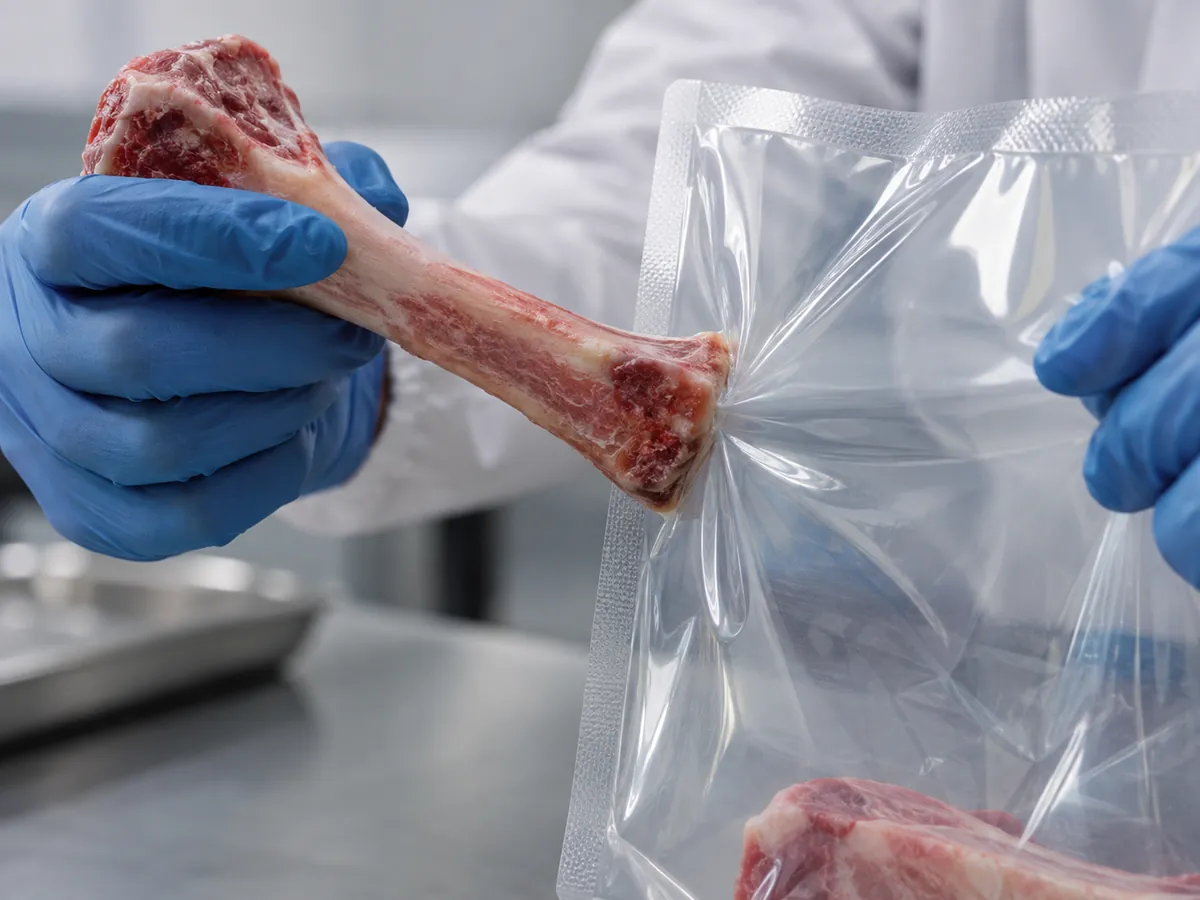
- Puncture resistance is among the best of common films. Bone, sharp edges and hard granules are less likely to pierce a nylon layer. See puncture resistant film. ASTM F1306-21(2025) measures slow-rate penetration; compare the same probe, gauge and conditioning.
- Nylon tolerates repeated flexing better than foil, metallized layers and oxide coatings, which is why it is used for pouches that get handled and shipped.
- Oxygen barrier is moderate when dry. It is better than polyolefins but well below EVOH, PVDC or foil.
- Nylon absorbs water. A manufacturer’s public comparison shows standard BOPA OTR rising when RH changes from 65% to 90% at 20°C; it does not establish a rate for your laminate. Read OTR with grade, gauge and humidity; see OTR.
- Moisture barrier is modest. Nylon does not stop water vapor well, so it relies on the PE or PP layers in the structure.
- Unoriented PA-containing lower webs can be candidates for thermoforming; check draw depth and local gauge after forming.
- Aroma and oil resistance are generally good.
Moisture uptake and curl
Nylon’s affinity for water shows up on the line as well as in the barrier data. Uneven moisture uptake can change dimensions; inspect curl and registration after conditioning the actual laminate. Dry rolls and wet rolls can behave differently on the same machine.
On the line:
- Keep rolls in their wrapping until use and let them reach room temperature first.
- Avoid wide swings in storage humidity.
- Ask the supplier about conditioning and moisture content at shipment.
- In laminates, the PE or PP layers slow moisture exchange, but exposed edges can still pick up water.
Curl-risk schematic: different moisture exposure across the laminate → unequal dimensional response → possible edge curl. This is a mechanism to investigate, not a measured diagnosis of the pictured pouch.
Where nylon film is used
- Vacuum pouches: nylon with PE gives puncture resistance and enough barrier for vacuum packs. See vacuum pouch packaging.
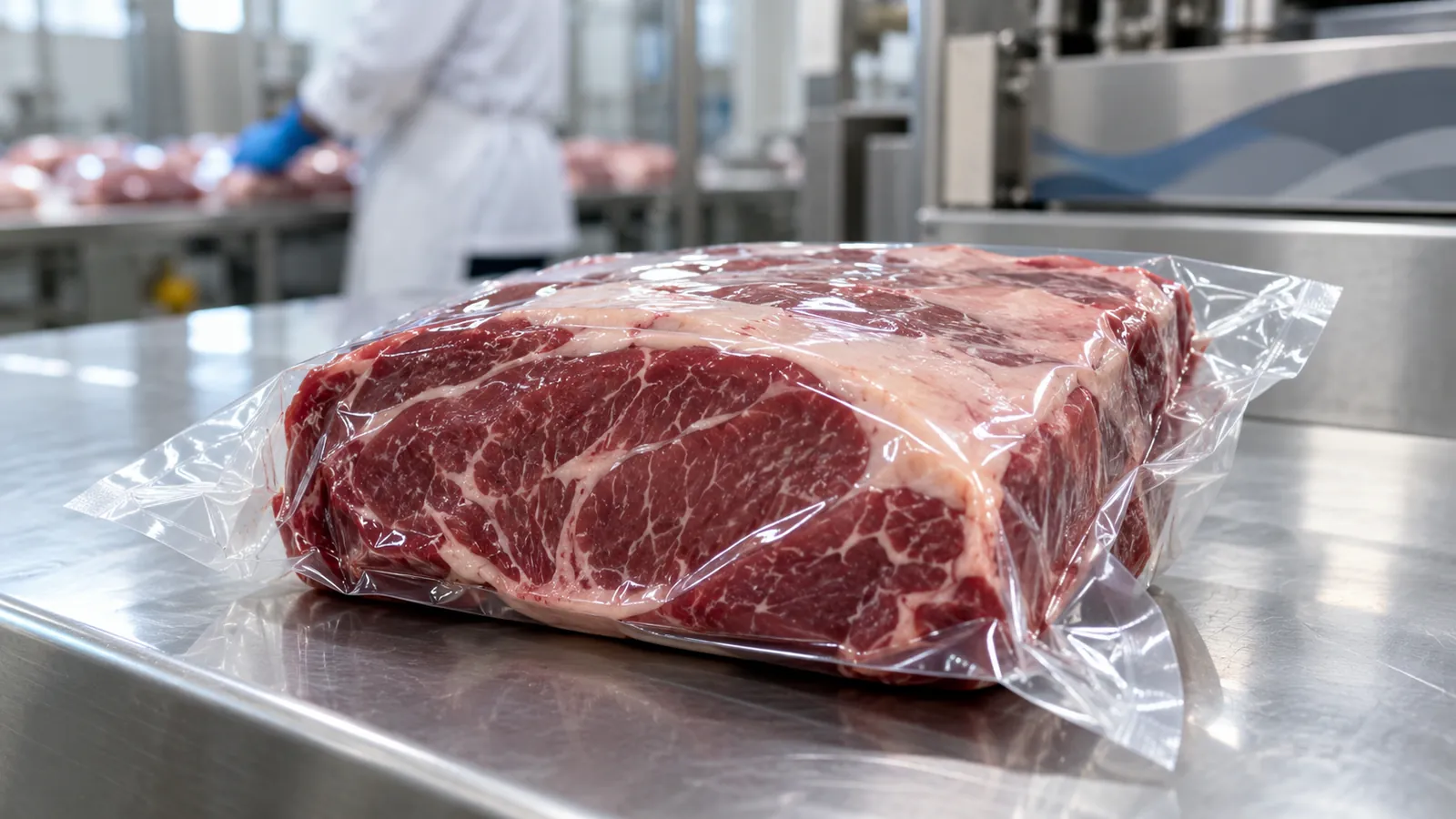
- Meat and cheese: bone-in cuts and hard cheese corners need puncture and abrasion resistance. See meat packaging and cheese packaging.
- Retort pouches: BOPA in the laminate adds toughness and resistance to drop and flex after sterilization. See retort pouch.
- Liquid packs: pouches and bag-in-box liners that hold liquids need puncture, drop and flex strength.
- Thermoformed packs: the PA layer in a lower web helps the film draw without thinning to pinholes.
- Frozen foods: nylon structures tolerate cold handling; see frozen food packaging.
Typical structures
A manufacturer’s public catalogue lists PE/PA/EVOH/PE for transparent sealable top film, PP/PA/EVOH/PP for retort, and PA/EVOH/PE for soft thermoformable lower web. These are abbreviated layer stacks, with ties omitted; obtain the complete construction.
Layer-role schematic, outside to product: PE → PA → EVOH → PE. PA supplies mechanical support, EVOH oxygen barrier and PE moisture resistance plus the sealable surface. PA is not being credited with the PE moisture-barrier function. See EVOH barrier film.
A retort or forming designation identifies an application candidate. Validate the actual gauge, adhesives, sealant, draw geometry and heat cycle; do not transfer results between an oriented BOPA laminate and an unoriented forming web.
Nylon and recycling
Nylon is a different polymer family from PE and PP. A PE/PA structure is not a mono-material, and the nylon layer can interfere with polyolefin recycling streams, depending on its share and how the structure is designed. Check current guidelines from bodies such as RecyClass and APR, and your market’s rules. Where recyclability matters, ask whether a mono-PE or mono-PP alternative with a different barrier can meet the need. See recyclable flexible packaging.
What to settle before choosing nylon film
- Name the hazard: puncture, flex, thermoforming depth, or barrier.
- Decide on BOPA lamination or a coextruded PA film.
- Request OTR data at your storage humidity (ASTM F1927-20 for controlled humidity) as well as dry values.
- Plan the sealant: PE, CPP or other, and test seals.
- Check storage and conditioning to manage curl and moisture.
- Test flex or abuse performance on finished packs.
- Review recycling constraints early.
Barrier film covers the wider range of barrier options.
Put those checks into the film specification comparison record, with conditioning and post-forming results beside each candidate.
Sources and method
Reviewed October 8, 2026. A manufacturer’s public barrier-film comparison reports standard BOPA at 20°C and different humidity levels; its results are informational, not a guarantee for every PA film. A manufacturer’s PA processing reference distinguishes oriented and non-oriented production. The public layer catalogue distinguishes top film and thermoformable lower web. The EVOH technical brochure identifies PE/PP moisture shielding and compares OPA/EVOH/PE with OPP/EVOH/PE. ASTM public scopes above cover controlled-humidity oxygen and slow-rate penetration. No universal BOPA thickness or deep-draw performance is specified.
Continue reading
Related articles
Alu-Alu Blister Packaging: When Full-Foil Blisters Make Sense
Alu alu blister packaging uses a cold-formed foil cavity and foil lid for near-total barrier. See when it is chosen and how it compares with PVC blisters.
Aluminum Foil Packaging: Foil Laminates, Gauges and Uses
Aluminum foil packaging explained: why foil gives near-complete barrier, layer thickness and temper, laminate structures, uses and recycling limits.
Barrier Film for Packaging: Oxygen, Moisture, Light and Aroma Barriers
Barrier film slows the passage of oxygen, water vapor, light and aroma through packaging. See which materials block what and how barrier is measured.