
Aluminum Foil Packaging: Foil Laminates, Gauges and Uses
Aluminum foil packaging explained: why foil gives near-complete barrier, layer thickness and temper, laminate structures, uses and recycling limits.
Aluminum foil packaging uses a very thin sheet of rolled aluminum, usually laminated between plastic or paper layers, to block light, oxygen and moisture. A continuous, defect-free foil layer is a practically complete barrier, which no plastic film matches at similar thickness. That is why foil shows up wherever shelf life depends on keeping product dry, dark and oxygen-free: coffee, retort foods, pharmaceutical sachets and blisters, and many lidding applications.
Foil is only as good as its integrity. Pinholes, flex cracks and poor seals are where real packages lose barrier, so most of the engineering around foil goes into protecting it.
Foil, metallized or transparent barrier?
Scroll horizontally to view all columns if needed. ↔
| Route | Selection reason | Restriction |
|---|---|---|
| Foil laminate | Opaque metal barrier layer | Validate pinholes, folds, seals and any thermal process |
| Metallized film | Deposited metal coating on a polymer | Compare post-converting barrier; do not assume equivalence to foil |
| Transparent barrier film | Product visibility with a gas/moisture barrier | Check grade, flex durability and light protection separately |
Why foil is used as a barrier layer
Plastic films pass gases and vapor by diffusion through the polymer. Metal does not behave that way. As long as the foil layer is continuous, transmission through it is negligible, and what gets through a package is leakage through defects, edges and seals. Foil also blocks light entirely, which matters for light-sensitive products such as some pharmaceuticals, dairy powders and fats.
Foil also holds a crease (dead-fold), conducts heat well for sealing and induction sealing, and gives a clean surface for printing or lamination. The trade-offs are cost, opacity, no see-through window, structure-specific heating limits, and difficult recycling.
To compare foil with polymer barriers in numbers, use oxygen transmission rate and water vapor transmission rate. Test conditions (temperature and relative humidity) matter whenever you compare numbers.
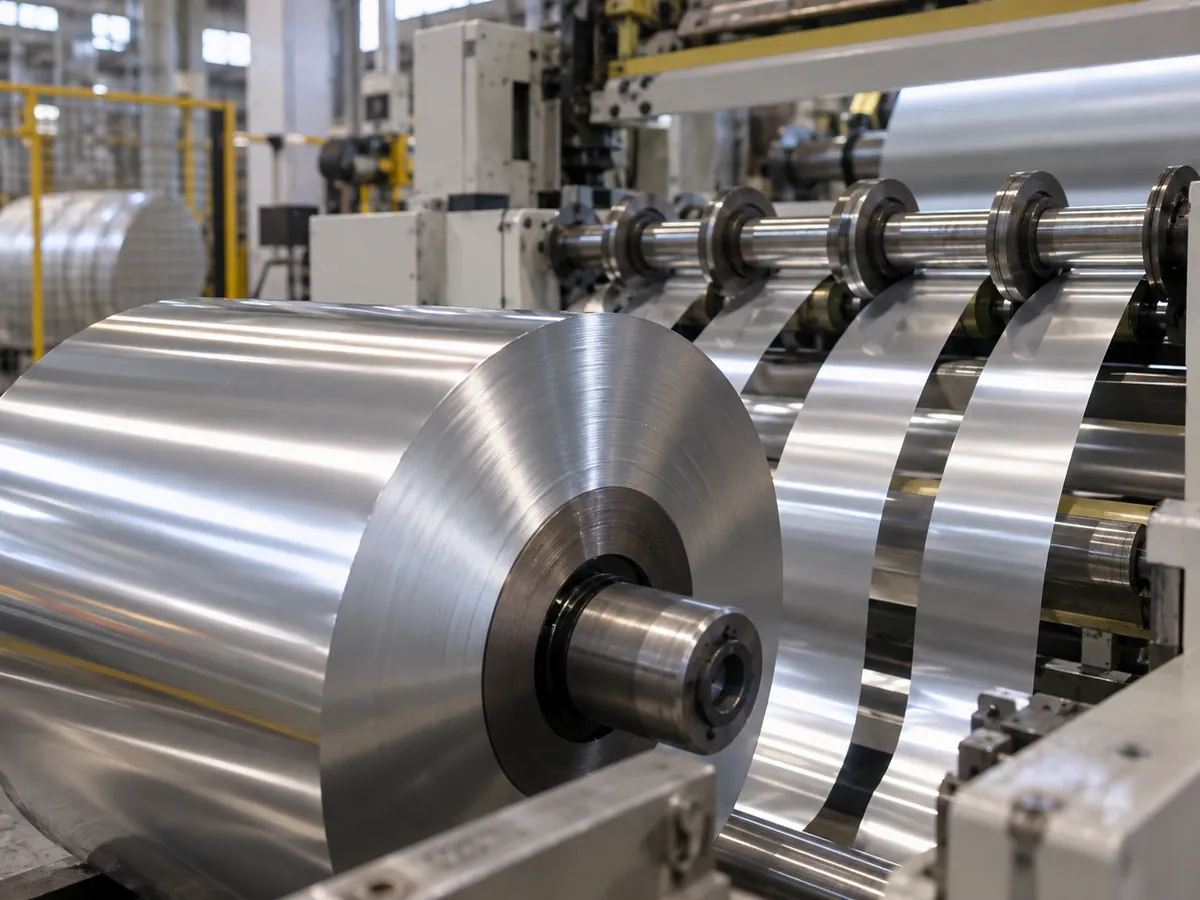
Foil gauges, alloys and temper
Specify foil-layer thickness separately from total laminate thickness. Alloy, temper, tolerances and permitted defects depend on the product and forming or sealing operation; confirm them on the selected material’s data sheet. A nominal laminate thickness does not identify its aluminum content.
Temper is also an application-specific input:
- Soft (fully annealed, “O” temper): flexible, dead-folds well, used in laminates and for forming. Also needed for processes that stretch the foil.
- Hard (as-rolled, “H” temper): stiffer, tears cleanly, used where the foil must break, such as push-through lidding (see blister foil).
Pinholes and flex cracking
Pinhole count rises as foil gets thinner, because rolling reduces thickness while tiny inclusions in the metal stay the same size. At very thin gauges a laminate can show a measurable pinhole density, and the barrier then depends on the plastic layers around the holes. Specifications often set a maximum pinhole count per unit area.
Flex cracking is the other failure. Foil that is folded, creased or flexed repeatedly, as in a stand-up pouch gusset or a shipped bag, can crack. Flex conditioning under ASTM F392/F392M-23 is a common way to check a laminate for this. A protective layer such as nylon or PET on the outside, plus sensible bag design, reduces the risk.
Typical foil laminate structures
Foil is rarely used alone in a pack. It is bonded to a printable outer layer and a heat-sealable inner layer, sometimes with an added strength layer.
Scroll horizontally to view all columns if needed. ↔
| Structure | Typical use | Role of each layer |
|---|---|---|
| PET / AL / PE | Pouches, sachets, stick packs | PET prints and protects, foil barrier, PE seals |
| PET / AL / PA / CPP | Retort pouches | PET outer, foil barrier, nylon for puncture and flex, CPP seals and survives heat |
| Paper / AL / PE | Sachets, wrapped portion packs | Paper for print and feel, foil barrier, PE seal layer |
| PET / AL / PET / PE | Coffee and dry goods pouches | Added PET for stiffness and abuse resistance |
| Coated foil (heat-seal lacquer) | Lids, strip packs | Foil with lacquer on the sealing side, often printed outside |
Layers are joined with adhesive lamination, and retort structures need adhesives that hold up at sterilization temperature. The retort pouch page shows how those structures are used in the format.
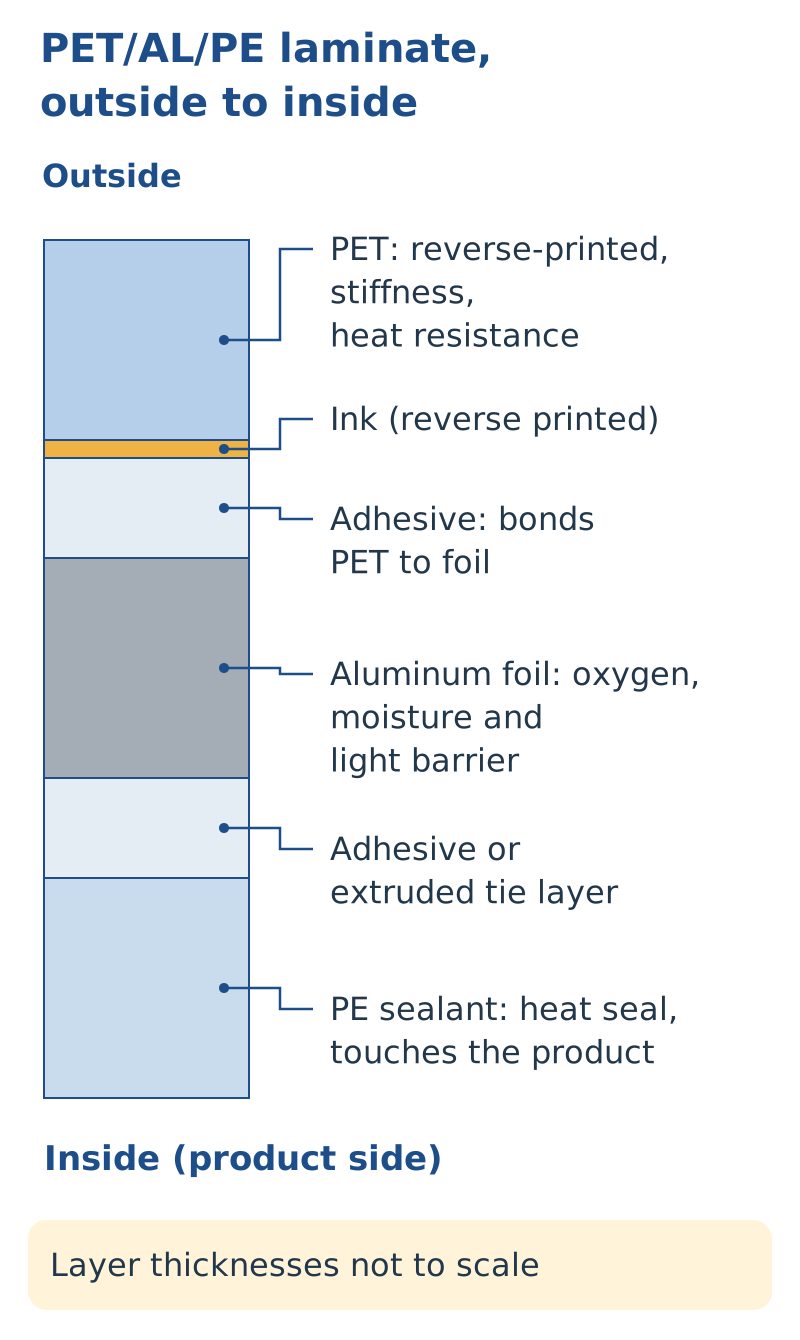
How a PET/AL/PE laminate is built, layer by layer
PET/AL/PE is the reference structure for laminated foil packaging film, and reading it from outside to inside shows why each layer is there.
- PET outer film. Usually reverse printed, so the ink sits between the PET and the next layer instead of on the outside surface where it would scuff. PET also adds stiffness and heat resistance, so the outer face does not stick to the seal jaws.
- Adhesive. Bonds the printed PET to the foil. Bond strength between these layers is what keeps a pouch from delaminating at a fold or after filling.
- Aluminum foil. The barrier layer for oxygen, moisture and light. It has little strength of its own and is protected on both sides.
- Adhesive or an extruded tie layer. Bonds the foil to the sealant. Adhesive lamination and extrusion lamination are both used, and the choice affects bond strength and resistance to aggressive products.
- PE sealant. The inside layer that melts and fuses in the heat seal and touches the product. Its grade sets the seal window and how well it seals through powder or liquid in the seal area.
Variations swap one layer for a reason. A qualified retort CPP grade is one sealant option for heat-processed packs; validate the full laminate and process. Nylon is added between foil and sealant for puncture and flex-crack resistance. Paper replaces PET where the look or feel matters more than abrasion resistance. Each added layer brings another interface that has to bond, which is why delamination and seal-through-contamination tests belong in the specification. For lamination methods in general, see laminated packaging.
Types of foil packaging
“Foil packaging” covers several distinct products, and they are not interchangeable:
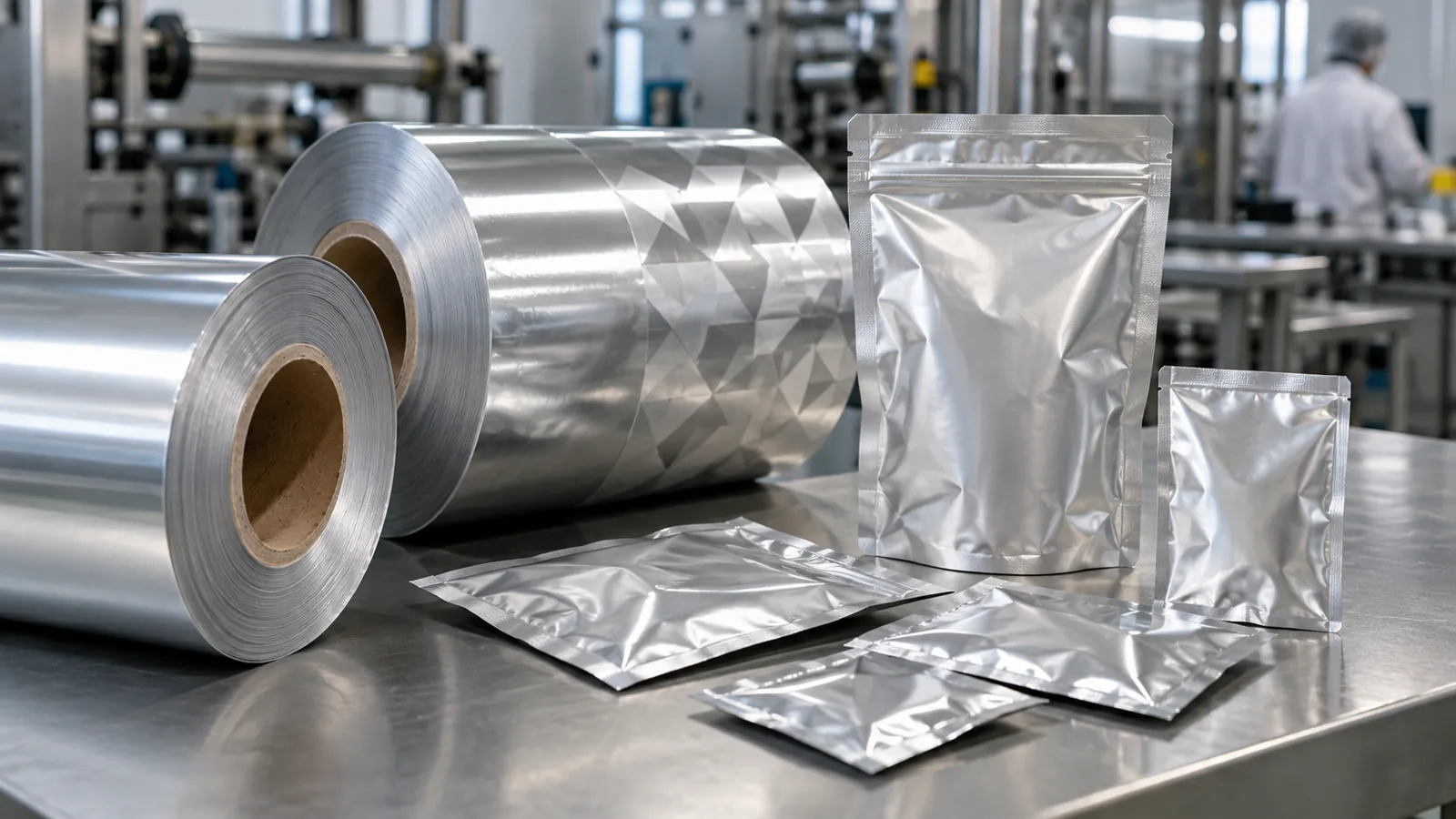
- Foil laminates on a reel or as premade pouches: the PET/AL/PE family above, used for pouches, sachets and stick packs.
- Foil lidding: foil coated with a heat-seal lacquer and sealed onto cups, trays, tubs and blister cavities; peelable or push-through depending on temper and coating.
- Cold-form foil: a thicker laminate, commonly OPA/Al/PVC, that is pressed into blister cavities without heat; see cold form foil.
- Formed foil containers: trays and dishes pressed from thicker foil. These are semi-rigid packs rather than flexible packaging.
- Plain foil wraps: unlaminated foil used to wrap products such as some chocolate bars, where dead-fold matters more than a seal.
Downsides of aluminum foil in packaging
Foil’s barrier comes with costs that decide whether it is the right layer for a product:
- Barrier depends on integrity. Pinholes at thin gauges and flex cracks at folds let gas and moisture through, so the real barrier of a pack can be well below that of flat foil.
- It is opaque. The product cannot be seen through the pack, and windows are not possible in the foil area.
- Microwave suitability depends on the finished pack and oven instructions; use only a combination explicitly approved for that purpose.
- It complicates inspection. Foil interferes with conventional metal detection, so check which inspection method the line can use on a foil pack.
- It adds cost and weight compared with metallized or coated polymer barriers.
- It is hard to recycle once laminated to plastics, as covered below.
Where these downsides outweigh the need for a near-complete barrier, the options are compared in the next section.
Uses of aluminum foil packaging
- Coffee: foil laminates keep out oxygen and light and hold aroma. Some coffee bags use a thin foil layer, others use metallized or high-barrier films (see coffee packaging materials).
- Retort foods: foil-based pouches require a laminate, adhesive, seal and process validated for the intended treatment and shelf life.
- Pharmaceutical packs: sachets, strip packs, blister lidding and cold-form blisters, covered in the pharmaceutical packaging overview and the pharma foil selection guide.
- Lidding: foil lids on cups, trays and tubs, peelable or permanently sealed.
- Stick packs and sachets: single-serve powders, sugars and nutritional products.
Foil vs metallized film
Foil is a rolled metal sheet; metallized film has a deposited coating on a polymer. Neither material name specifies finished-package barrier or durability.
Scroll horizontally to view all columns if needed. ↔
| Property | Foil laminate | Metallized laminate |
|---|---|---|
| Metal layer | Record foil gauge | Record coating specification and base film |
| Light protection | Opaque foil area | Measure transmission for the selected coating |
| Gas/moisture barrier | Check defects and finished seals | Check deposition quality and converted structure |
| Flex durability | Test after folds and handling | Test after folds and handling |
| Cost and weight | Compare actual laminate and yield | Compare actual laminate and yield |
| Recycling | Check whole structure and local acceptance | Check whole structure and local acceptance |
For an oxygen-sensitive drug or thermally processed pouch, evaluate foil against the required post-forming barrier and product stability results. A material choice cannot guarantee shelf life. High barrier film and barrier film cover alternative structures.
Recyclability limits
Foil laminates are hard to recycle. The thin aluminum layer is bonded to plastics with adhesive, and common sorting and reprocessing streams for flexible packaging cannot separate them cleanly. Collection and recycling schemes differ by region, so check what applies to your market. Design-for-recycling work generally pushes toward replacing foil with other barrier solutions where the product allows it, as covered in recyclable flexible packaging. Where foil remains necessary for product protection, the sustainability case usually rests on preventing product waste and on thinner gauges.
What to put in a foil laminate specification
- Alloy, temper and nominal foil thickness with tolerance
- Maximum pinhole count and the method used to measure it
- Full laminate structure and layer thicknesses
- Heat-seal layer, seal initiation temperature and seal strength (ASTM F88/F88M-23)
- Adhesive type and, for retort, the processing conditions it must survive
- Flex-crack resistance if the pouch will be shipped or flexed
- Barrier values with stated test conditions
- Food-contact or pharma compliance documentation for your destination market
Record damage checks separately from acceptance decisions:
Scroll horizontally to view all columns if needed. ↔
| Check | Conditions/sample | Result | Agreed acceptance basis |
|---|---|---|---|
| Pinholes | Lot, area and inspection method: ___ | Count/locations: ___ | Limit/reference: ___ |
| Fold/flex damage | Laminate, fold or flex protocol: ___ | Defects and barrier after stress: ___ | Limit/reference: ___ |
| Thermal processing | Full cycle and pack: ___ | Post-process barrier, seals and stability: ___ | Product/process criterion: ___ |
Confirm each point against the supplier’s data sheets. To compare offers like for like, use the film specification comparison guide.
Sources and method
ASTM F392/F392M-23 concerns flex conditioning; ASTM F88/F88M-23 concerns seal strength. The European Aluminium Foil Association’s microwave overview describes tested foil containers, not permission to heat any foil laminate. Sources checked October 8, 2026. No generic alloy or foil-gauge range is specified here.
Continue reading
Related articles

Alu-Alu Blister Packaging: When Full-Foil Blisters Make Sense
Alu alu blister packaging uses a cold-formed foil cavity and foil lid for near-total barrier. See when it is chosen and how it compares with PVC blisters.
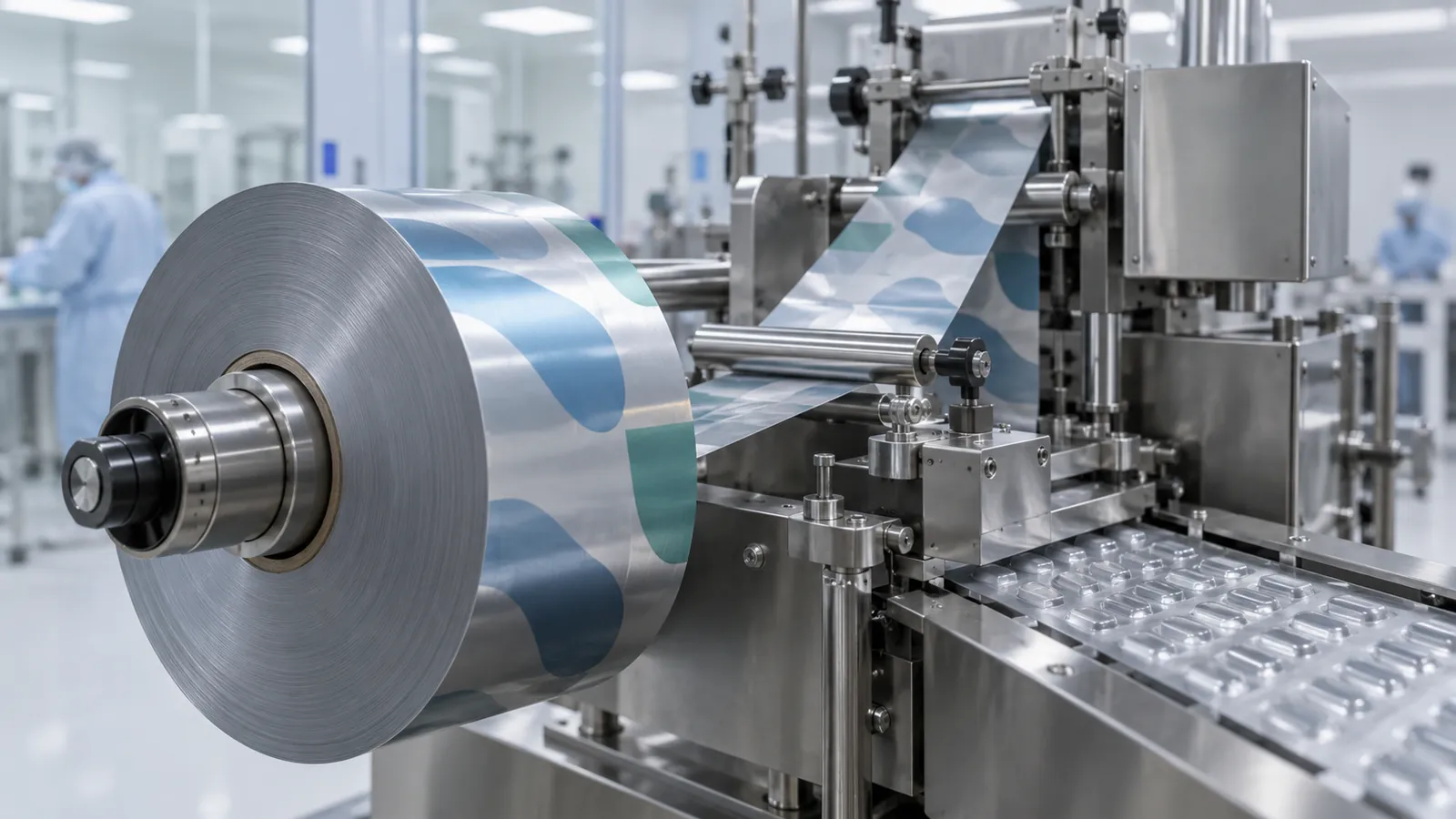
Cold Form Foil: Laminates for Alu-Alu Blisters
Cold form foil is a soft aluminum laminate pressed into blister cavities without heat. Learn the OPA/Al/PVC build, forming limits, defects and checks.
High Barrier Film: Structures, Materials and When You Need One
High barrier film keeps oxygen and moisture transmission very low. See common structures, trade-offs, typical products and how to specify one.