
Retort Pouch: Structures, Processing and Uses
A retort pouch is a filled, sealed flexible pack sterilized in a retort. Learn the structures, seal integrity needs, regulations and typical uses.
An ambient seal result does not show whether the filled pouch survives retort processing. A retort pouch is a flexible pouch that is filled with food, sealed and then heat sterilized in a pressurized vessel called a retort. Shelf stability depends on the validated process and intact closure; a retort pouch shape alone establishes neither. The pouch must tolerate steam or water at high temperature and pressure while keeping its seals and barrier intact.
Scroll horizontally to view all columns if needed. ↔
| Validation input | Source / record | Why it matters |
|---|---|---|
| Qualified process authority | Scheduled process and responsible reviewer | Establishes the product-specific process |
| Thermal cycle and critical factors | Approved process and actual run log | Temperature alone is insufficient |
| Filled-pouch thickness and rack restraint | FDA Form 2541d fields and validation drawing | Defines the heat-penetration configuration |
| Post-process seal and integrity | Agreed methods and acceptance record | Checks the treated package |
How retort pouch packaging works
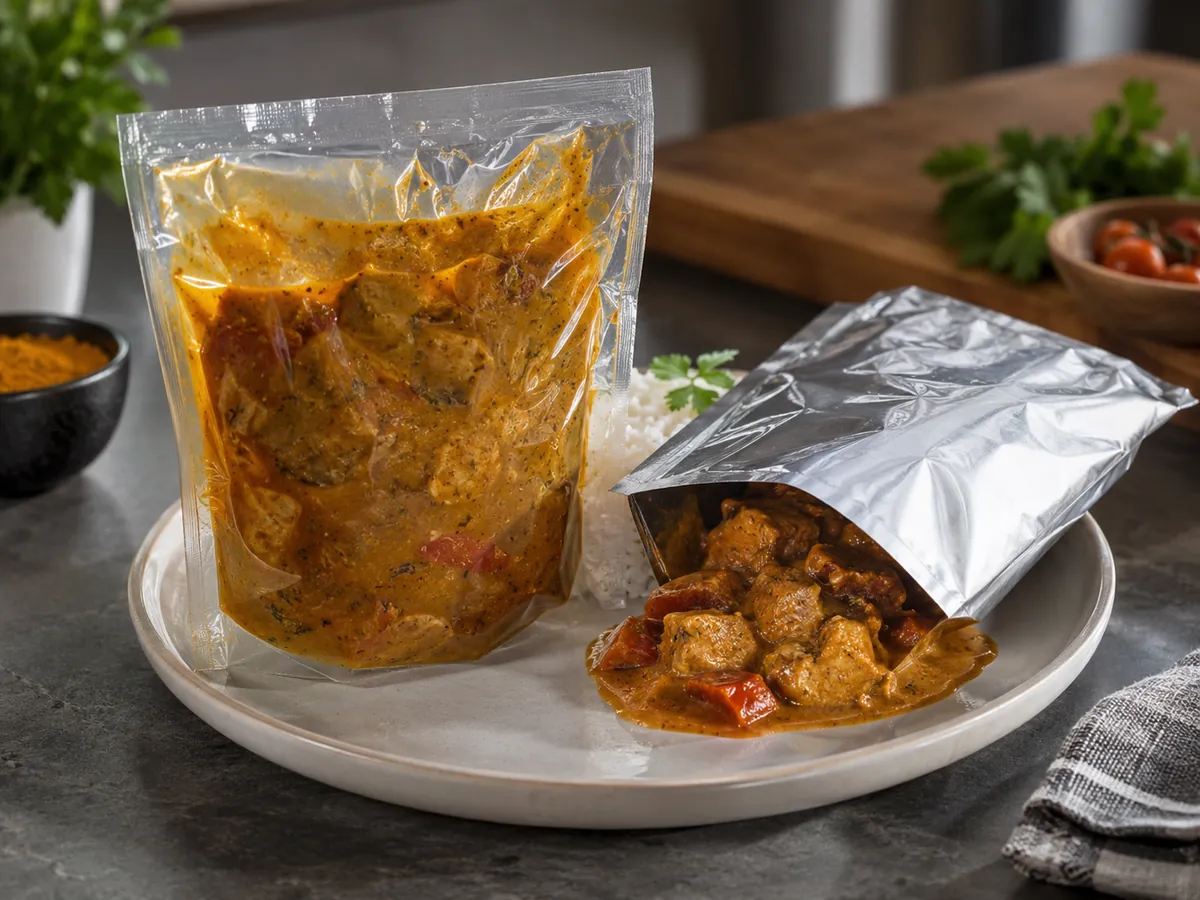
The pouch is filled, usually leaving little headspace, then sealed. Residual air is kept to a minimum because trapped gas expands during heating and stresses the seals. The sealed pouches go into trays or racks that keep them flat and prevent ballooning, and are sterilized in a retort with overpressure to counter the pressure rising inside the pack.
Takeaway: About 121 °C is a temperature example used in FDA retort guidance, not a universal set point or a process recipe. Under 21 CFR 113.83, qualified persons establish scheduled processes for applicable low-acid foods. Time and critical factors follow that product-specific process. FDA Form 2541d asks about flexible-pouch thickness and restraint during retorting; retain the validated fill and loading configuration. After heating, the pouches are cooled under pressure, dried and inspected.
Retort pouch material structures
A retort pouch is a laminate, and each layer has a job.
- A manufacturer’s public brochure illustrates PET / aluminum foil / CPP as an opaque candidate; verify its full grades and layer order for the project. The outer PET layer carries print and gives stiffness. The aluminum foil is a near-complete barrier to oxygen, moisture and light. PA may be specified in other designs; confirm it in the actual layer drawing. The inner layer is the sealant.
- A transparent high-barrier structure replaces the foil with PET coated with aluminum oxide (AlOx) or silicon oxide (SiOx), which gives a clear pack with good barrier. These coatings are thin and can be sensitive to flex and heat, so supplier data and trials matter. High barrier film explains the principles behind coated and foil barriers.
- CPP film is a sealant example, not a mandatory polymer for every retort design. A manufacturer’s public barrier-film brochure illustrates a PET-based retort laminate with CPP. Obtain the specific retort-compatible grade and adhesive system, then validate the finished pouch through the actual cycle; polymer name or melting point alone does not establish suitability.
Takeaway: Laminate adhesives must also be rated for retort, because a structure that passes at ambient can delaminate under steam. Aluminum foil packaging and PET films cover the layers in more depth.
Seal integrity and residual air
Seal condition is one critical part of retort-pouch performance. During heating, internal pressure pushes the seals apart, and the overpressure in the retort balances it. In practice:
- Keep seals clean; product caught in the seal is a leading cause of failure.
- Control headspace so that air and vapor do not stress the seal.
- Use a seal width and pattern suited to the fill weight.
- Check seal strength before and after retort, using a method such as ASTM F88, and run burst or creep tests where the application requires.
- Inspect for delamination, wrinkles and channel leaks after the cycle.
Retain both the before-retort baseline and post-retort strength and integrity results. The seal-strength guide explains ASTM F88/F88M seal-strip separation force; it is not a complete-package leak or process-adequacy test.
Takeaway: Also record the pouch dimensions and fill volume used in validation, because a change in the thickness of the filled pack can alter heat penetration and the cycle that was approved.
Retort pouch versus other retort packaging
Retort trays and cups are rigid and hold their shape. The filled geometry changes heat penetration, so any process-time or product-quality comparison requires matched validation. The trade-off is less mechanical protection, so a pouch needs careful secondary packing, such as cartons, to survive distribution.
Takeaway: Filling, sealing and racking also differ from canning lines, so plan equipment and operator training from the start.
Regulatory context
In the United States, thermally processed low-acid foods in hermetically sealed containers fall under FDA 21 CFR Part 113. It covers the process, equipment, records and the container closure. Other markets have their own rules, so confirm the requirements for your destination market and have the process validated by a qualified process authority.
Takeaway: Food-contact compliance of every layer, adhesive and ink is a separate check.
Microwavable retort pouches
Heat the food in its pouch only when the finished product is explicitly labelled for microwave use, and follow its opening, venting, time and handling instructions. “Foil-free” does not automatically mean microwave-safe: the whole structure, inks, closures and use conditions matter. A material-maker’s microwave-capable barrier example does not approve another finished pouch.
Takeaway: If the instructions require transfer to a microwave-safe dish, do so.
Typical uses
Retort pouches are used for:
- Ready meals and curries
- Pet food
- Cooked rice and grains
- Sauces and soups
- Tuna and other fish
- Baby food and purees
Retort pouch compared with can and glass jar
Scroll horizontally to view all columns if needed. ↔
| Retort pouch | Metal can | Glass jar | |
|---|---|---|---|
| Weight | Light | Heavier | Heaviest |
| Barrier | High with foil or coated film | Excellent | Excellent |
| Heat penetration | Validate filled thickness and loading | Validate size and product | Validate size and product |
| Shipping and storage | Compact, flat when empty | Rigid, stackable | Rigid, fragile |
| Opening | Tear notch, often easy | Pull-tab or opener | Twist-off lid |
| Visibility | Possible with clear structures | None | Full |
| Puncture risk | Higher; needs care in handling | Low | Low, but breakable |
| Recycling | Difficult; laminates | Well established | Well established |
Takeaway: Sustainability trade-offs differ by market and collection system. Recyclable flexible packaging gives the current picture.
Retort-pouch validation record
This is a record checklist, not a validated thermal-process prescription. Acceptance limits and sampling come from the qualified process and packaging team.
Scroll horizontally to view all columns if needed. ↔
| Item | Evidence to retain | Verification record |
|---|---|---|
| Process authority / revision | Scheduled process and critical-factor list | Responsible review and change disposition |
| Cycle and loading | Approved temperature, time, pressure and rack arrangement | Actual batch log and deviations |
| Fill and maximum thickness | Product, fill, residual air and restraint definition | Measured configuration against validation |
| Full laminate / adhesives | Grade-specific retort data and food-contact documents | Batch identity and qualification |
| Post-retort seals / body | Strength, integrity and delamination methods | Results and agreed disposition |
| Heating instructions, if applicable | Finished-product microwave label and instructions | Intended-use verification |
Takeaway: The first pouch order risk checklist helps keep the material, approved sample and lot records together; it cannot approve the scheduled process.
Sources and method
- 21 CFR 113.83: official process-establishment requirements for applicable low-acid foods.
- FDA Form 2541d: flexible-pouch shape, restraint and maximum-thickness fields.
- FDA retort inspection guidance: example of 121 °C in equipment guidance, not a pouch process recipe.
- Film manufacturer, barrier-film brochure, page 6: manufacturer PET/aluminum/CPP and coated-PET/PA/CPP examples; not approval of unspecified grades.
- ASTM F88/F88M-23: seal-strip strength scope; no whole-pack or sterilization approval inferred.
- USDA packaging guidance: follow package instructions and use appropriate containers.
Accessed 8 October 2026. Process and pack validation remain product-specific; no cycle duration, pressure or test-pass value is supplied by this article.
Continue reading
Related articles

Flat Bottom Pouch: Box-Style Pouches Explained
A flat bottom pouch has a rectangular base and two side gussets that make a boxlike, self-standing pack. See construction, features and how it compares.
Quad Seal Bag: Four Corner Seals and When to Use Them
A quad seal bag has four vertical corner seals that give a squared, stable shape. Learn how it is made, where it is used and how it compares to side gusset.
Rollstock vs Premade Pouches: Which Is Right for Your Line?
Rollstock vs premade pouch compared on material cost, inventory, changeovers, pack quality and features, with a checklist to pick the right supply route.