
First-Order Risk Checklist for Printed Pouches and Rollstock
A compact checklist for controlling specification, payment, quality and shipment risk on a first order of printed pouches or rollstock.
Approving bulk production before a line trial can leave you with unusable pouches or rollstock. Follow payment checks → sample and trial approval → production → shipment → receipt, recording a release at each stage. This is an editorial procurement-record checklist; it does not set contract terms or universal acceptance limits.
Scroll horizontally to view all columns if needed. ↔
| Stage | Record before release |
|---|---|
| Before payment | Seller, specification and artwork versions, milestones and trade terms |
| Sample and trial approval | Sample lot, machine conditions, results and signed production authorization |
| Production | Approved version, batch ID and in-process inspection results |
| Before shipment | Release report, retained samples, packing list and documents |
| After receipt | Counts, damage, measured checks and acceptance or hold decision |
Before payment
- Confirm the legal seller name and the payment beneficiary
- Freeze the structure layer by layer, with dimensions
- List every feature: zipper, tear notch, hang hole, gusset
- Set the quantity and the accepted overrun and underrun tolerance
- Record the unit price and what it includes
- Record the approved artwork version and the color standard
- Confirm trade terms and the point where risk transfers
- Agree what starts the lead-time clock, for example artwork approval or plate or cylinder making
Freeze the specification
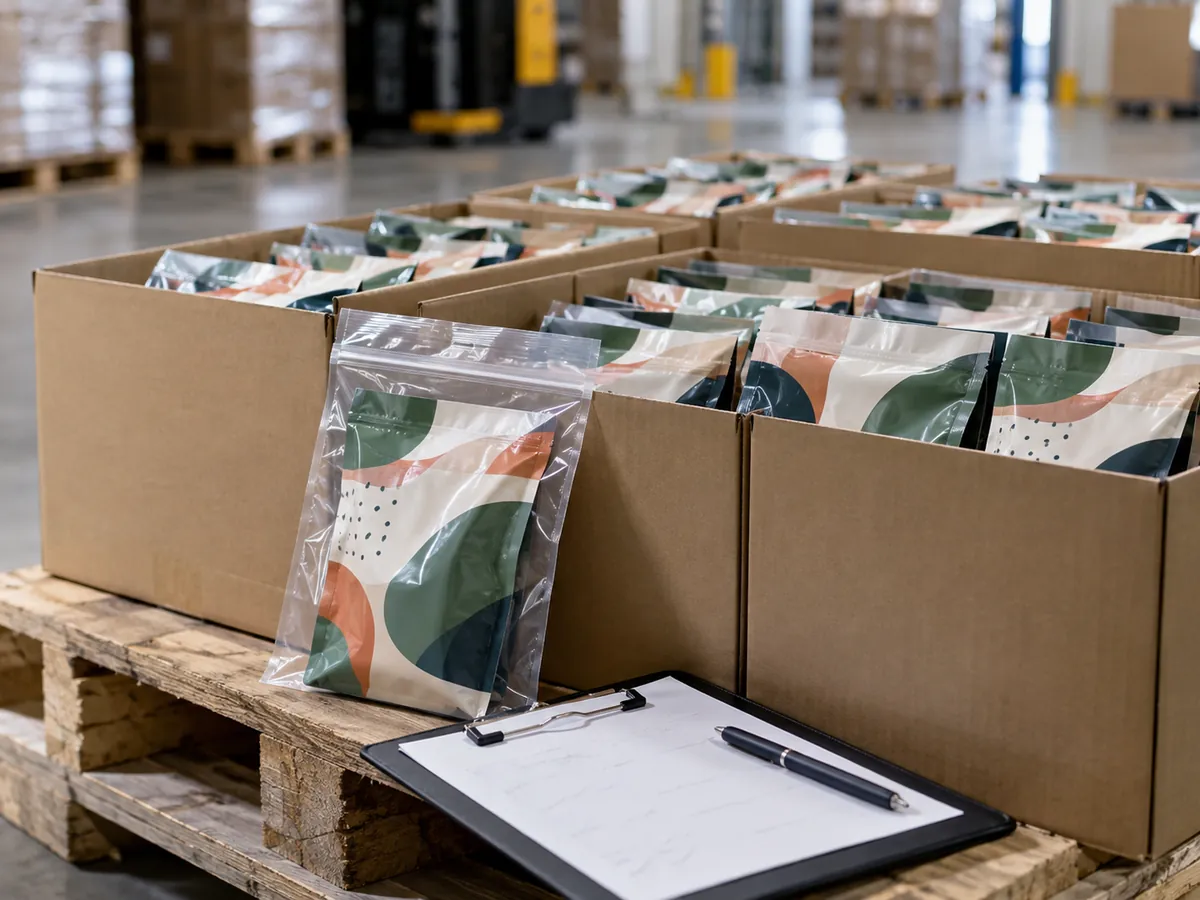
A vague specification makes an acceptance disagreement harder to resolve. Write the structure with each layer, material and thickness, and state the total thickness in one unit; the film thickness page explains how microns, gauge and mils relate. Add the barrier targets with test conditions, because an OTR or WVTR value without temperature and humidity cannot be checked later. Specify the sealant and any required seal strength, so that a pouch that peels open at a modest load is a defined nonconformance and not an opinion. To compare two structures, use the method in how to compare film specifications.
Artwork and color approval
Decide exactly what is approved and by whom: the artwork file version, the proof type and the color standard. A digital proof shows layout but not how ink lays down on film, so agree whether you will rely on a press proof, a physical drawdown or a signed standard sample. State the color tolerance in writing, together with the viewing conditions used to judge it. Also record barcode grade requirements, legal text and the position of registration marks, because changes after cylinders or plates are made usually cost money and time.
Quantity, overrun and underrun
Printed and converted goods are rarely delivered at exactly the ordered quantity. Agree an acceptable overrun and underrun range, and whether you pay for what is delivered or for the order quantity. Clarify how rejected goods are counted, because a shipment that is within quantity but includes defective units may not be within your usable quantity.
Roll and pouch specifications
For rollstock, record width, core diameter, maximum outer diameter, unwind direction, print position and how splices are flagged. A complete roll specification is shown on the rollstock packaging page. For finished pouches, list dimensions with tolerance, seal width, notch and hole positions, zipper position and fill-opening style. For stand-up pouches and similar styles, state the bottom gusset or seal design so the samples you approve match production.
Payment, terms and lead time
Match the payment milestones to the risk. If tooling is charged separately, record what it covers and who holds the cylinders or plates afterward. Be clear on which events start the lead-time clock, since artwork changes, late proof approval or a failed color match can restart it. Record the Incoterms® rule, edition, named destination and delivery point separately from who pays for carriage and insurance. ICC’s CPT definition distinguishes delivery to the contracted carrier, where risk transfers, from the destination to which the seller pays for carriage. Do not infer risk transfer from freight payment. If the first order is for a food or pharmaceutical product, add a line to the order confirming the documents that must accompany the goods.
Run a machine trial on your line
Before you commit the full order to production, run a trial on your actual packing line. A film or pouch that passes inspection on a table can still behave differently on the machine. For roll-fed lines, compare the sample with the requirements in VFFS film. For premade pouches, check opening, fill and sealing behavior against premade pouch materials. Record the sealing temperature range that worked, line speed, registration or tracking issues, stoppages and the seal and leak results from the packs you made.
Plan the trial with a pass or fail rule, a defined quantity and a named person who records the results. If the line needs adjusting to run the new material, note the settings so that the next order can be run the same way. The results also give you data for a cost-per-good-pack comparison, which is how you see when a cheaper film costs more.
Production release
Authorize bulk production only after the agreed sample and machine-trial criteria are met. Link the authorization to the frozen specification and artwork; record any deviation and who approved it. Keep production checks tied to that version and batch.
Before shipment
- Check the print against the approved standard
- Check dimensions and seals on samples from the run
- Confirm roll data: core, outer diameter, unwind direction and how splices are marked
- Reconcile carton and pallet counts with the packing data
- Confirm shipping marks and destination documents
- Keep retained samples and photos of the finished goods
Ask the supplier to send photos or a sample set from the start, middle and end of the production run before the goods leave. Retained samples are your reference if a dispute arises months later, so keep a labeled set from the same lot and store them away from heat and light. For food products, also check that the food-contact paperwork matches the goods being shipped. The food contact packaging regulations overview can help you decide what to request for your market.
Use one record per check and stage; duplicate the blank row for print, dimensions, seals, roll data and counts. An empty result is pending, not approval.
Scroll horizontally to view all columns if needed. ↔
| Stage / check | Owner | Spec version / batch | Requirement | Evidence location | Result / release |
|---|---|---|---|---|---|
| ___ | ___ | ___ | Method, sample count and limit: ___ | Report / photo / retained sample ID: ___ | Measured result: ___; pass / hold: ___; approver / date: ___ |
After receipt
Record defects, shortages and transit damage immediately, with photos. A written receiving report speeds up the remedy discussion and gives you data for the next order. Compare delivered goods against the specification and the retained pre-shipment samples, and keep the cartons, labels and any damaged outer packaging until the claim is settled. Then compare what actually happened with the checklist in how to evaluate a flexible packaging supplier, so the second order can start from facts.
Method and source
The release sequence and blank record are editorial suggestions; agree project criteria with the supplier before ordering. ICC’s official Incoterms® 2020 CPT explanation supports the distinction between carriage costs and risk transfer. Accessed 8 October 2026.
Continue reading
Related articles
How to Evaluate a Flexible Packaging Supplier Before a First Order
Check printing process, in-house converting, documentation and communication before you place a first order for printed film or pouches.
Flexible Packaging Film Problems: A Troubleshooting Guide
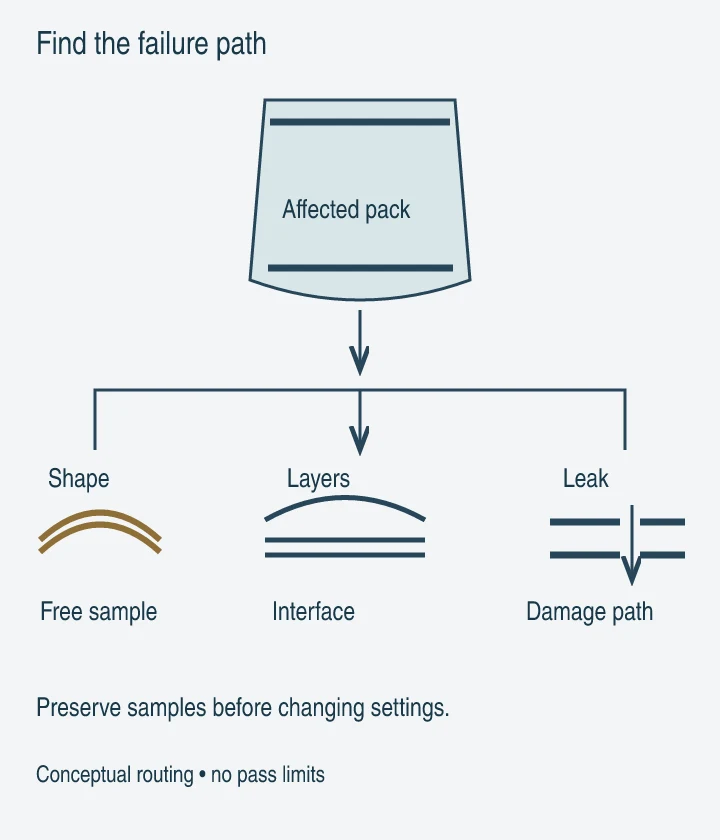
Film defects can cause scrap, leaks and repeat downtime. Locate the failure and preserve comparison samples before choosing a test or changing materials.

How to Choose Flexible Packaging Film: A Step-by-Step Selection Guide
An end-to-end engineering guide to selecting flexible packaging films: product barrier risks, machine kinematics, substrate structures, and trial verification protocols.