
Rollstock Packaging: Specifying Film on the Roll
Rollstock packaging is printed film supplied on reels and formed into packs on your line. Learn which machines use it and what a roll spec must include.
Wrong reel dimensions or winding direction can stop an otherwise compatible film from running. Rollstock packaging is flexible film supplied as a continuous web wound on a core. The packing machine unwinds it, forms it into a bag, wrap or lid, fills the product and seals it in one cycle. Rollstock is also called roll stock or rollstock film, and it is the delivery form for most high-speed food, medical and consumer packaging.
Because the package does not exist until the machine makes it, the roll itself has to be specified as carefully as the film structure. A good film on a badly wound or badly dimensioned roll can still stop your line. This page covers what goes on a roll specification. For how the film structure is built, see flexible packaging film. For how the film is made before it reaches the roll, see how flexible packaging is made.
Scroll horizontally to view all columns if needed. ↔
| Roll input | Value source | Why it matters |
|---|---|---|
| Web width and repeat, mm | Pack drawing and machine format set | Forming and registration |
| Core ID and maximum OD, mm | Unwind manual | Shaft fit and clearance |
| Maximum roll mass, kg | Unwind and handling equipment ratings | Handling and loading |
| Face out/in and leading print edge | Attached, marked winding drawing | Film orientation |
| Splice policy | Agreed specification | Detection and removal |
Which machines use rollstock film
- Vertical form-fill-seal (VFFS): film is pulled over a forming collar into a tube, sealed at the back, filled from above, and sealed and cut at the ends. See VFFS packaging film.
- Horizontal form-fill-seal (HFFS): film forms a pouch or tube moving horizontally, sometimes with a zipper fed in. Some versions pair a formed bottom web with a top web.
- Flow wrappers: film wraps a single item with a fin or lap seal and end seals. See flow wrap film and flow wrap packaging.
- Stick pack and sachet machines: narrow reels formed into small multi-lane packs. See stick pack film and sachet film.
- Thermoform lidding lines: a lidding web is sealed onto trays or formed cavities. The base web may also be rollstock.
Takeaway: Each machine sets its own limits on width, stiffness, friction and seal window, so the same film is rarely right for all of them.
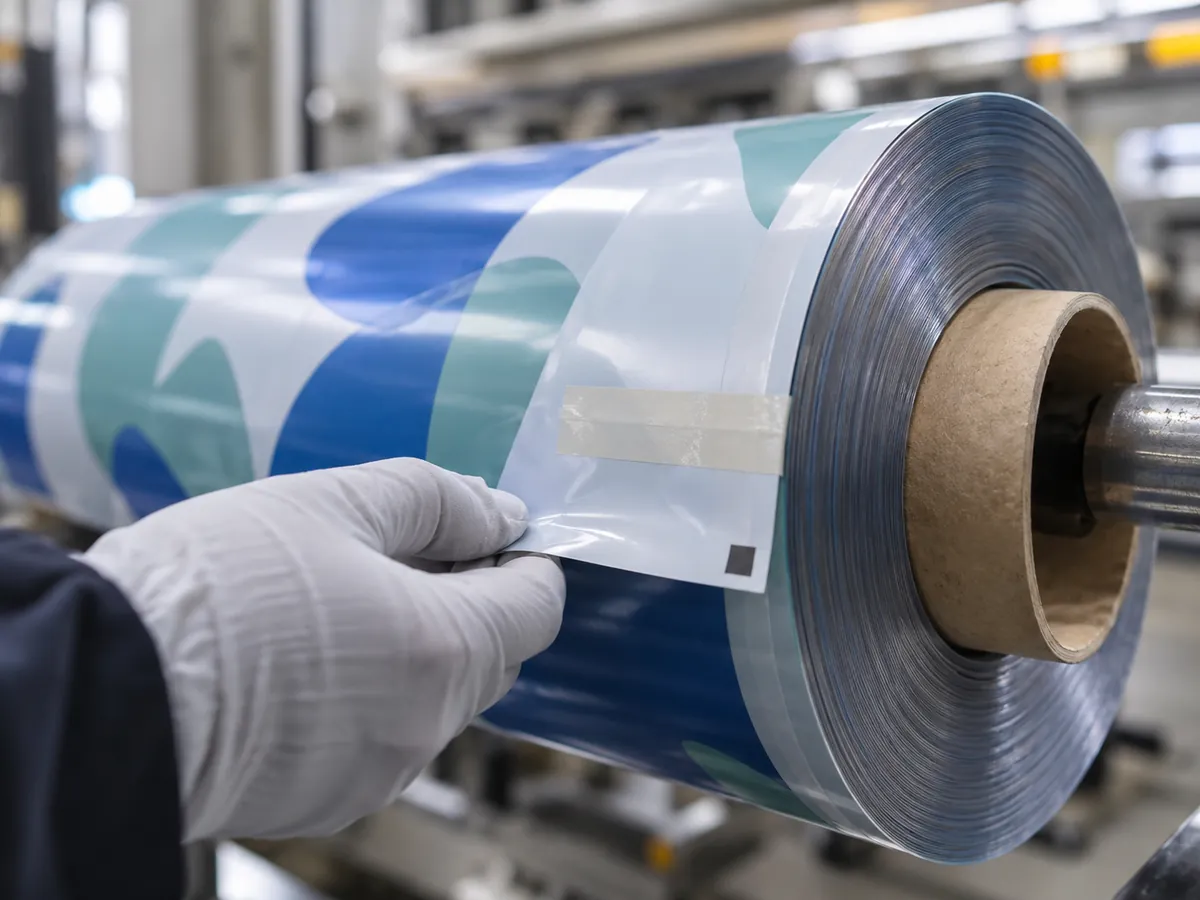
Unwind direction and winding position
Unwind direction is the single roll item most likely to be misunderstood between a buyer, a converter and a machine operator, because each looks at the roll from a different side. Settle it with a drawing, not a phrase.
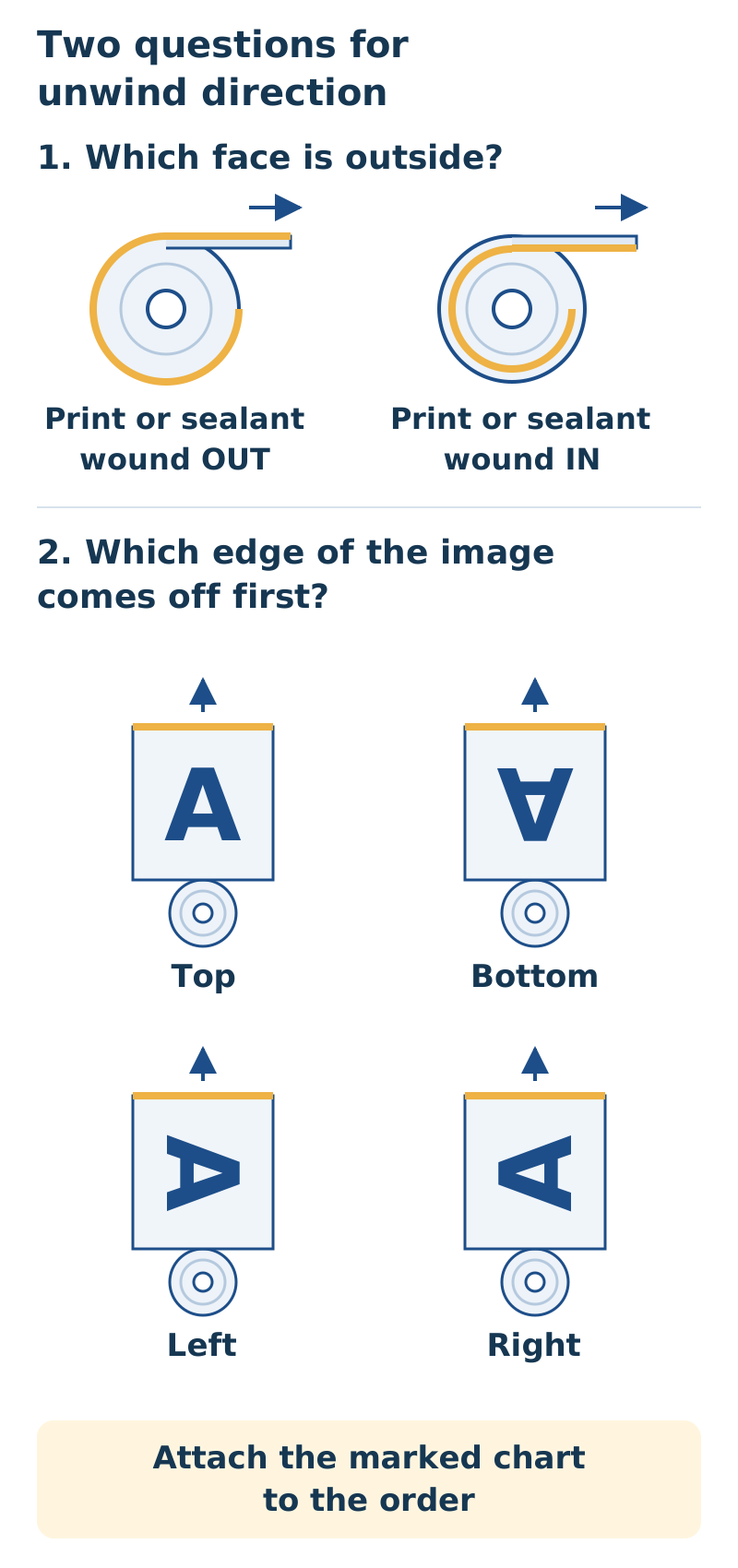
There are two separate questions:
- Which face is outside the roll. For unprinted film with a sealant or coating on one side, the order states whether that side is wound out or wound in, sometimes written as Top (Out) and Bottom (In). The right answer depends on how the web travels through your unwind and whether the sealant has to face the product, the tray or the opposite web.
- Which way the print runs off the roll. For printed film, industry winding charts show eight positions: four with the print wound out and four with the print wound in. Within each group of four, the difference is which edge of the image comes off the roll first: the top, the bottom, the left side or the right side.
The chart number is only a shorthand for a drawing, so do not send the number alone. Attach the chart your machine maker or converter uses to the specification, mark the chosen position, and keep a sample of correctly wound film or a photo of the roll on the unwind for the next order.
Takeaway: If the film passes through more than one unwind before it reaches the packing machine, for example a rewind or inspection step, specify the direction for the roll as it arrives at your site and let the converter plan the steps before that.
Print repeat and registration
Printed rollstock has a repeat length, which is the distance between identical points in the printed image along the web. On a VFFS machine the repeat usually sets the bag length, and the machine cuts at a registration mark. The mark is read by a photo-eye, which needs enough contrast between the mark and its surroundings.
- Specify repeat length and its tolerance. Cylinder-based print methods give fixed repeats.
- Define the registration mark: size, location, color and the clear area around it.
- Leave a dead zone on the seal area so artwork and ink do not sit where the seals will form. Heavy ink in a seal area can hurt seal quality.
- Ask for a tolerance on print-to-print registration if the design has close color boundaries.
- Check that the mark stays readable through the structure. Reverse-printed marks inside a laminate, over a metallized layer, can be harder to read than marks on the surface.
Repeat accuracy and film stretch interact.
Takeaway: A film that stretches under tension can drift away from the mark, so tension settings matter as much as the print itself.
Storage and handling
Keep rolls in their protective packaging and follow the film supplier’s storage, conditioning and release instructions. Protect edges and cores, and inspect damaged reels before loading.
Handling method is a separate specification. Packline’s public reel-handling documentation describes both core-gripping spindles and outer-diameter clamps; a ban on all core lifting would be incorrect. Manual lifting needs a site assessment of roll mass, shape and frequency; this page gives no universal hand-lift limit. For a shaft or chuck, use the equipment maker’s approved core engagement, orientation and load rating. For forklift transport, follow the pallet support arrangement or the rated roll attachment’s operating guide, such as Cascade’s roll-clamp guide; do not improvise support with bare forks.
Record the approved handling equipment and procedure alongside the roll dimensions.
Takeaway: Laminated packaging explains why adhesive release conditions also belong in the receiving record.
Rollstock vs premade pouches
Scroll horizontally to view all columns if needed. ↔
| Factor | Rollstock | Premade pouches |
|---|---|---|
| Forming | On your machine | At the converter |
| Cost per pack | Record film, forming losses and run costs | Record pouch, filling losses and run costs |
| Line speed | Confirm at the specified film and pack size | Confirm at the specified pouch and fill |
| Format range | Limited by the machine’s forming tools | Wide: stand-up, spouts, zippers, shaped pouches |
| Storage | Compact rolls | Bulky cartons |
| Machine requirements | Form-fill-seal or flow wrap machine | Premade pouch filler |
| Change-over | Record actual tooling and film changes | Record actual handling and fill changes |
| Repeat and registration on the roll | Fixed at the converter |
Rollstock suits long runs at high speed on an installed machine, and premade pouches suit formats or volumes that rollstock cannot reach.
Takeaway: Premade pouch materials covers the other side of this choice, and the rollstock vs premade pouch page turns it into a decision checklist.
Rollstock specification and receiving record
ASTM F99-21, section 5.2, distinguishes initial qualification from routine production and receipt requirements. The SPMC white paper dated 06/21 explains roll dimensions, winding, splices and change control. The following record is an editorial checklist based on those sources, not a universal acceptance standard. Fill in the agreed value and actual result for each lot.
Scroll horizontally to view all columns if needed. ↔
| Field / unit | Agreed value and source | Receiving result / record |
|---|---|---|
| Layer order / thickness, µm | Approved film specification and data sheet | Lot report and thickness result |
| Machine / format / packs per minute | Equipment manual and qualified trial | Machine and trial record |
| Web width / repeat / tolerances, mm | Drawing and registration requirements | Measured widths and repeats |
| Core ID / width / wall, mm; material | Shaft or chuck specification | Fit and damage check |
| Maximum OD, mm, or roll length, m | Unwind limits and agreed order | OD measurement or length record |
| Maximum roll mass, kg; handling method | Equipment ratings and site procedure | Label mass and handling check |
| Face out/in; leading print edge | Marked winding drawing attached | Chart and retained sample match |
| Eye-mark size / position, mm | Artwork and sensor requirements | Position and detection result |
| Splice count / tape / marking | Agreed policy, not an assumed count | Flags and label checked |
| Winding / COF / seal window | Supplier specification and line trial | Lot data and start-up result |
| Traceability / packing / storage | Quality agreement and supplier guidance | Lot, roll ID and damage record |
SPMC’s roll-dimension section advises choosing OD or length rather than prescribing both; winding and gauge affect their relationship. Width tolerances must suit the actual forming or gripping system. Attach the marked unwind drawing, not just a winding-chart number.
The June 2021 white paper’s splice example overlaps at the 500 mm boundary. This page therefore gives no numerical splice allowance or 300/500 mm bands: agree the count, boundary, tape and detection policy for the project.
Takeaway: SPMC’s summary of F99 section 6.8.3 also supports a written agreement for changes to materials, processes and supply sources.
Common mistake: Copying another line’s roll limits instead of checking the installed unwind and handling equipment.
What to send film manufacturers when requesting laminated rollstock
When you ask a converter or film manufacturer to quote laminated film on the roll, the quote is only comparable if every supplier receives the same information. Send:
- The product, fill method and any heat treatment or cold chain it will see.
- The machine make and model, pack format, pack dimensions and target speed.
- The structure you use today, or the barrier, seal and stiffness needs if the structure is open.
- Artwork status, number of colors, and whether print is on the surface or reverse printed inside the laminate.
- The roll fields from the checklist above, including the marked winding chart.
- Annual volume, order size and how often artwork changes.
- The documents you need with each delivery, such as certificates of analysis or food contact declarations; see food contact packaging.
Ask each supplier to state any field they cannot meet rather than quoting around it. The supplier evaluation guide covers how to compare the answers, and when cheaper film costs more explains why the lowest roll price is not always the lowest cost on the line.
Takeaway: Before committing to volume, run a trial on the actual machine; the first-order risk checklist sets out how.
Sources and method
- ASTM F99-21 official scope and significance: standard publisher; section 5.2 supports qualification versus routine receipt, and 5.4 supports mutually agreed requirements. Accessed 8 October 2026.
- SPMC, A Guide to Writing Rollstock Specifications: council-authored original PDF, dated 06/21, hosted by IoPP. Roll-dimension and splice sections support the fields above; summary supports change control. Accessed 8 October 2026.
- Packline, Reels and Rolls: manufacturer documentation for core and outer-diameter gripping; accessed 8 October 2026.
- Cascade, Sliding Arm Clamp Operator’s Guide, 6823497 R1: manufacturer forklift-attachment instructions; accessed 8 October 2026. Handling follows the specific equipment manual, not a method devised here.
Continue reading
Related articles

Flexible Packaging Film: Monolayer, Coextruded and Laminated Films
Flexible packaging film is built as monolayer, coextruded or laminated webs. Learn how layers, printing and rollstock affect performance.

How Flexible Packaging Is Made: From Resin to Finished Pouch
How flexible packaging is made, step by step: extrusion, printing, lamination, coating, slitting, pouch making and the quality checks at each stage.

Flexible vs Rigid Packaging: How to Compare Them
Flexible vs rigid packaging compared on material use, transport, protection, shelf impact, filling lines, cost and recycling, plus when rigid still wins.