
Flexible Packaging Film: Monolayer, Coextruded and Laminated Films
Choose monolayer when one layer meets the product's protection, sealing and mechanical needs, coextrusion when seal performance plus some barrier or strength must be formed in one web, and lamination when the pack needs premium print, high barrier, foil, paper or another material that cannot be coextruded. Layer count does not establish recyclability.
Flexible packaging film is the thin plastic web that becomes a pouch, wrap or lid. It can be a single polymer layer, several polymers melted together in one extrusion step, or separate films bonded into a laminate. The route depends on what the package must do: seal, carry print, resist puncture and block oxygen or moisture.
This page covers how webs are built. For which polymer does what, see packaging film types and the individual material pages. For finished pack shapes and material families, see types of flexible packaging.
Construction quick comparison
The three constructions differ on a few dimensions that decide most projects:
Scroll horizontally to view all columns if needed. ↔
| Question | Monolayer | Coextruded | Laminated |
|---|---|---|---|
| How many layers? | One polymer or blend | Two or more, formed in one extrusion pass | Two or more webs made separately |
| How are layers joined? | Not applicable | Melt bonding, with tie layers where polymers do not bond | Adhesive, or an extruded polymer layer |
| Can it include foil or paper? | No | No | Yes |
| Usual print position | Surface print | Surface print | Reverse (trapped) print |
| Main limit | One layer must meet the required functions | Resins and tie layers must suit the process | Additional joining steps; assess every component and recycling stream |
What flexible packaging film means
Flexible packaging film is any thin, pliable web that is converted into a package which changes shape as it is filled or used. “Flexible film”, “flexible plastic film”, “plastic packaging film” and “film packaging material” are used for the same thing in most buying conversations, but they are not perfectly equal. Three boundaries are worth knowing before you compare quotes:
- Film vs sheet. ASTM terminology (D883, as quoted in ASTM D6988-21) treats film as an optional term for plastic sheeting with a nominal thickness no greater than 0.25 mm (0.010 in.). Thicker material is usually sold as sheet and used where the plastic must hold its own shape. See film thickness for the units and the boundary.
- Plastic vs non-plastic layers. A flexible packaging film is often mostly plastic, but a laminate can contain aluminum foil, paper or a vacuum-deposited coating. “Plastic film” describes only the polymer layers.
- Film vs finished pack. The film is the material. A pouch, sachet or flow wrap is the format made from it, either on your packing line from rollstock or by a converter as a premade pouch.
So when a supplier says “flexible packaging film”, ask which construction it is (monolayer, coextruded or laminated), what each layer is, and in what form it will be delivered. The rest of this page explains each of those answers. If you are still deciding whether a flexible pack fits your product at all, start with flexible vs rigid packaging.
Three ways to build a flexible packaging film
The distinctions below follow the barrier-packaging terminology in ASTM F17-20, Standard Terminology Relating to Primary Barrier Packaging, available in a public preview. It describes coextrusion as simultaneous formation from multiple plastic streams, lamination as bonding flexible barriers, and a multilayer structure as two or more continuous layers. “Monolayer” here simply means one layer; it is not presented as a separately quoted F17 definition.
Monolayer film
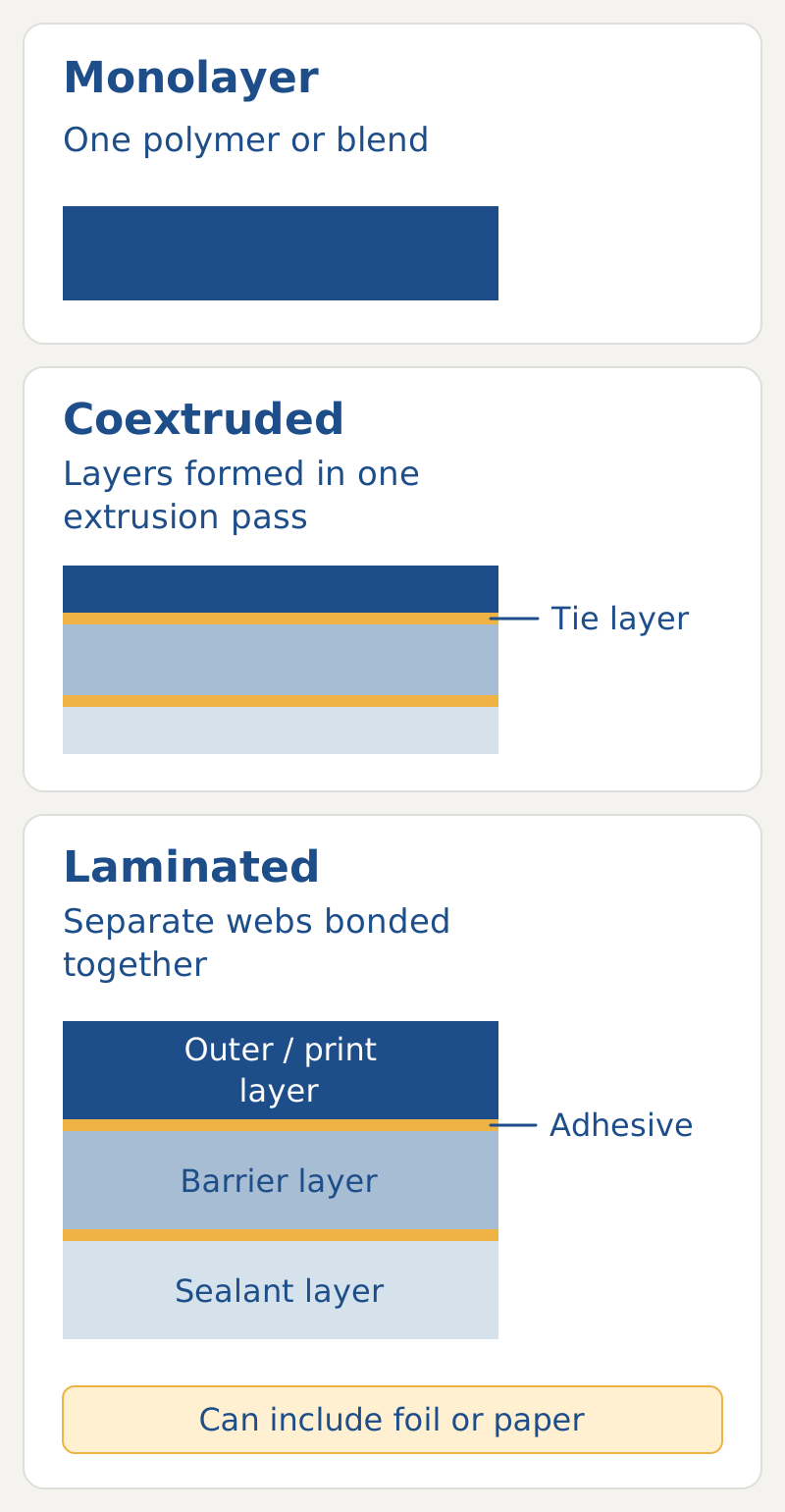
A monolayer film has one continuous layer, which may contain one polymer or a blend. Layer count does not establish recyclability: additives, printing, product contamination and the available collection and recycling stream still matter. Compare its sealing, barrier and mechanical properties against the product’s requirements rather than assuming that fewer layers make it suitable.
Coextruded film
Coextrusion brings two or more plastic melt streams through shaping openings to form one continuous multilayer web. Unlike adhesive lamination of separate webs, it forms the layers together; adhesive tie-layer polymers may still be needed between incompatible layers. There are two main processes:
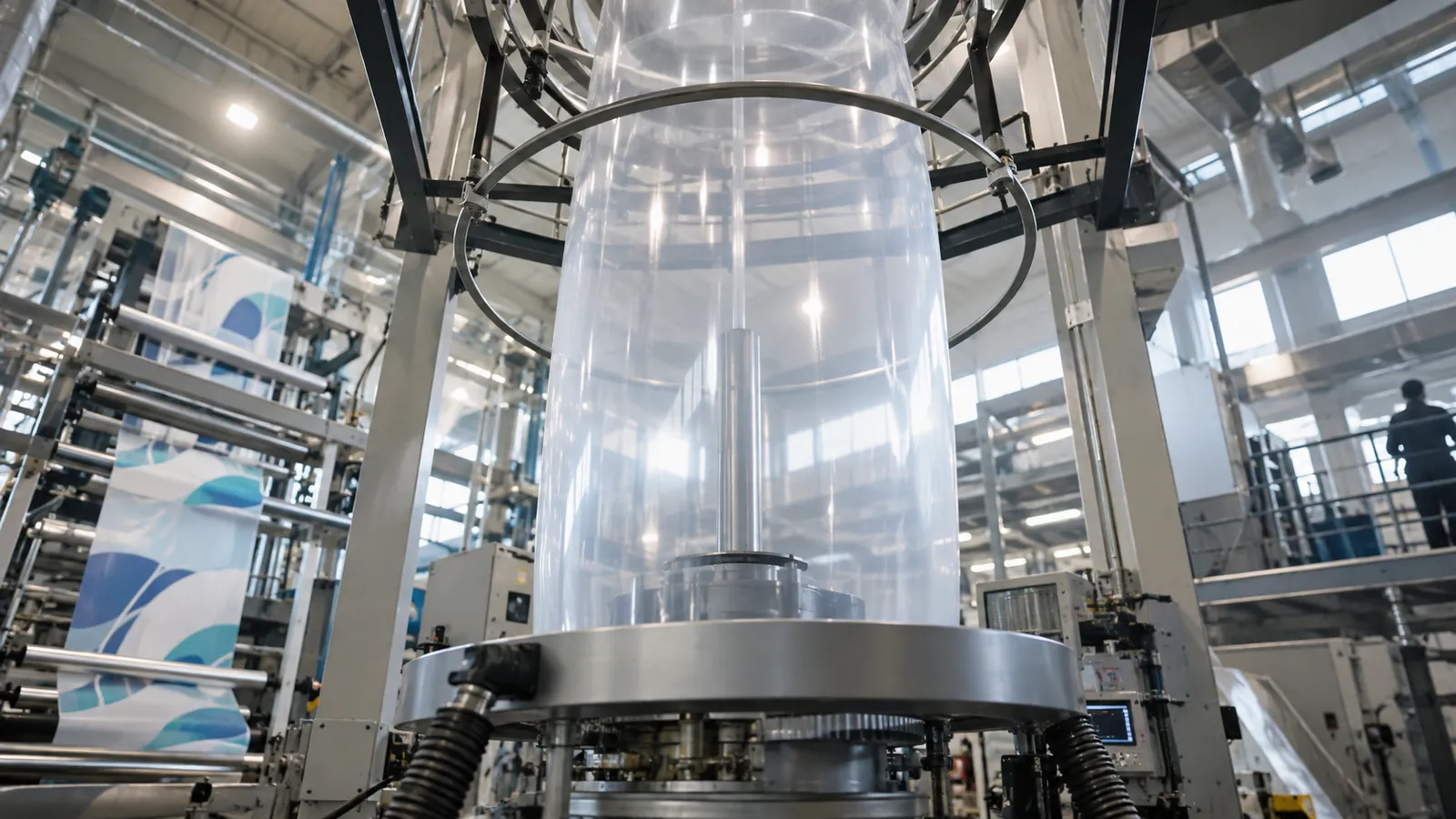
- Blown film: the melt is extruded as a tube and inflated with air. Blown film is common for polyethylene and gives balanced strength in both directions.
- Cast film: the melt is extruded through a flat die onto chilled rolls. Cast film is usually clearer and more uniform in thickness, and polypropylene (CPP) is typically made this way.
Typical coextrusions use three, five, seven or more layers. A nylon/EVOH/nylon core inside PE skins is a well-known barrier construction.
Laminated film
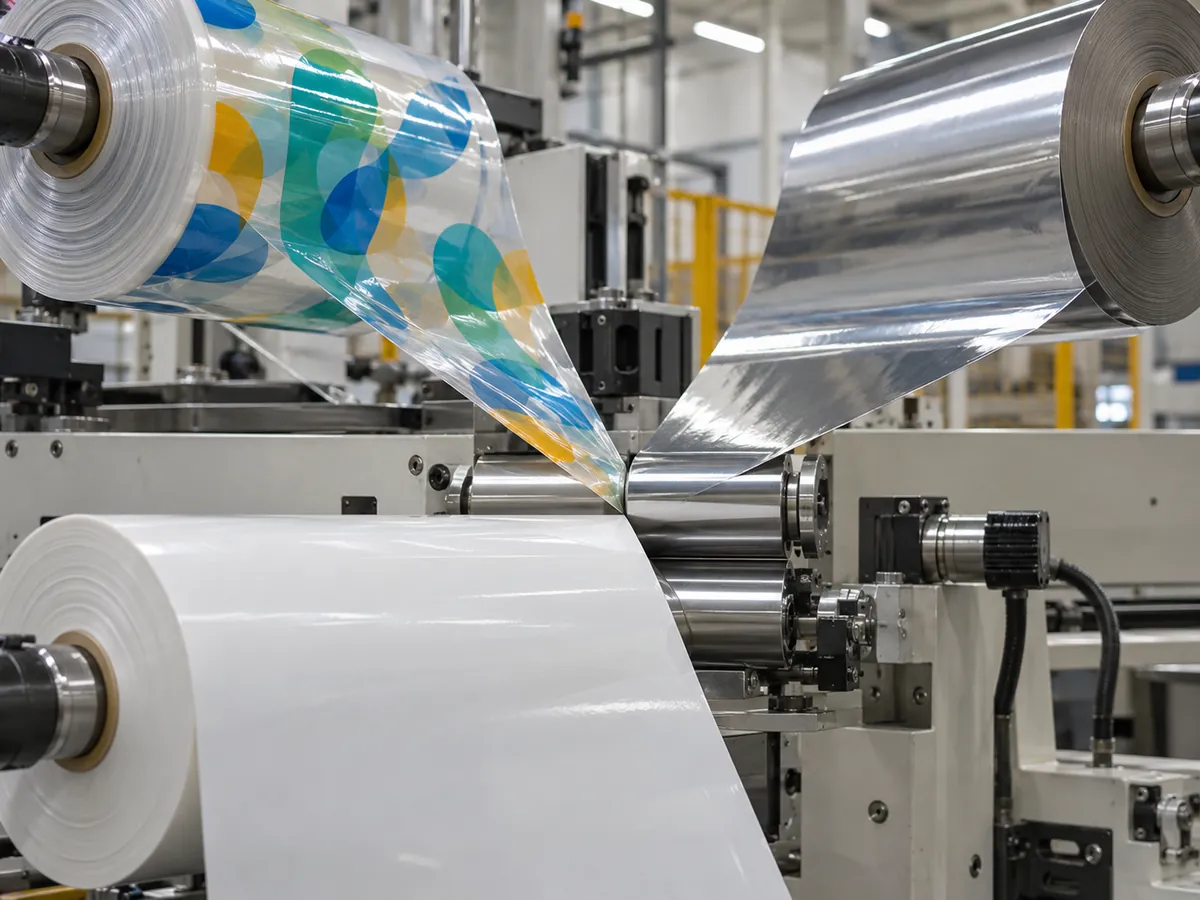
A laminate bonds two or more webs that were made separately. Lamination lets a converter combine independently made webs, such as a printed PET film and a PE sealant film, or a film and aluminum foil. Two main methods are used:
- Adhesive lamination: a solvent-based, solventless or water-based adhesive bonds the webs, which then cure. This is the usual route for combining a printed outer film with a sealant film.
- Extrusion lamination: a molten polymer, often PE, is extruded between the two webs and acts as both the bond and an additional layer.
A related process, extrusion coating, applies a polymer directly onto one web. Laminates are the usual choice when a package needs good print, strong sealing and high barrier all at once. For the converting steps behind these webs, see how flexible packaging is made.
What each layer does
Even a simple laminate gives each layer its own job.
Scroll horizontally to view all columns if needed. ↔
| Layer | Typical role | Common materials |
|---|---|---|
| Outer or print layer | Carries the artwork, gives stiffness, heat resistance and gloss | PET, BOPP, paper, sometimes nylon |
| Barrier layer | Slows oxygen, moisture, light or aroma | EVOH, aluminum foil, metallized film, oxide-coated film, PVDC |
| Strength layer | Puncture and flex resistance | Nylon, oriented PET |
| Tie layer | Bonds polymers that do not stick to each other in coextrusion | Adhesive polymers, such as modified polyolefins |
| Sealant layer | Forms the heat seal and contacts the product | PE, CPP, sealant-grade copolymers |
Surface print vs reverse (trapped) print
Print can sit on the outside of the film or inside the laminate.
- Surface print: ink is on the outer face and exposed to rubbing, moisture and handling. It is common on simple monolayer or coextruded films, usually protected by an overprint varnish.
- Reverse (trapped) print: ink is printed on the inside face of a transparent outer film, then laminated to another layer. The film itself protects the ink from scuffing, and the outer surface gives gloss. Most printed laminates use this method.
Reverse printing needs a transparent outer layer, which is one reason PET and BOPP are so common as the outermost web.
Rollstock film vs converted pouches
Rollstock film is delivered as reels of printed, slit film. The customer’s packing machine forms, fills and seals the package. A vertical form-fill-seal machine, for example, pulls film from a roll over a forming collar. Rollstock has to meet machine requirements for width, core size, tension behavior, friction and seal window; see VFFS packaging film and flow wrap film.
Converting turns the film into premade pouches or bags at the converter, which adds cutting, side or bottom sealing and often a zipper or spout fitment. Filling lines then handle the finished pouches. See premade pouch materials for those requirements.
How to describe a film structure
Packaging structures follow a standard shorthand. State layer order explicitly, commonly outside to inside with slashes. Microns (µm) express thickness; coating mass belongs in mass per area (for example g/m²), with dry or wet basis stated.
Hypothetical notation example, assumed inputs: PET 12 µm / adhesive / PE 70 µm. These are not a recommended recipe or measured specification.
- PET 12 is a 12 micron polyester print layer on the outside.
- Adhesive is the laminating adhesive. Record dry coat mass separately, or measured bond-line thickness in µm if available; mass per area and thickness cannot be interchanged without the appropriate density and solids basis.
- PE 70 is a 70 micron polyethylene sealant layer that faces the product.
A hypothetical barrier notation might add AL and PA layers; their actual gauges must come from the project specification. Some people write layers in the other direction, or use abbreviations with thickness in microns or gauge, so state the convention and the direction when you share a structure with a supplier. Total thickness is the sum of the layers plus adhesive, and rough comparisons should use the same units.
For a purely hypothetical coextruded-web example, PE/tie/EVOH/tie/PE at 20/10/10/10/20 µm means five assumed layer thicknesses totaling 70 µm, not percentages or a recommended formulation. If numbers describe a ratio instead, label it as a ratio and state total gauge separately. Ask the supplier which resins are used in each layer. Suppliers often give only a resin family name, for competitive reasons.
Choosing between monolayer, coextruded and laminated
Use the quick comparison above to remove options, then apply these rules:
- Evaluate monolayer when one layer meets the product’s protection, sealing and mechanical needs. For a recycling priority, check every component and the actual collection/reprocessing stream; layer count alone proves nothing.
- Choose coextruded when you need seal performance plus some barrier or strength in one web, without adhesive, such as for bulk, frozen or industrial packaging.
- Choose laminated when you need premium print, high barrier or a combination of materials that cannot be coextruded.
What to collect when requesting or comparing film quotes
- Structure with layer order, material and thickness, in a written notation.
- Construction method: monolayer, blown or cast coextrusion, adhesive or extrusion lamination.
- Print method and position: surface or reverse print, and whether there is an overprint varnish.
- Barrier values with test conditions, such as OTR and WVTR.
- Sealant type and seal initiation temperature.
- Delivery form: rollstock with width, core size and maximum roll diameter, or premade pouches with dimensions.
- Machine, speed and format it must run on.
- End-of-life assumptions, including whether a mono-material option is acceptable.
Once the quotes arrive, the film specification comparison guide explains how to read the numbers.
Flexible packaging film FAQ
Is flexible packaging film the same as plastic film?
Not always. Many flexible packaging films are all-plastic, such as a PE bag film or a coextruded PE/EVOH/PE web. Others combine plastic with aluminum foil, paper or a metallized or oxide coating, so calling the whole structure “plastic film” hides layers that change barrier, recyclability and how the film behaves on a machine. Ask for the full layer list, as described in how to describe a film structure.
Is a multilayer film always better than a monolayer film?
No. More layers add functions such as oxygen barrier, puncture resistance or protected print, but each layer also adds cost, process steps and, for mixed materials, recycling limits. If the product only needs moisture protection and a reliable seal, a monolayer or simple coextruded film may be the better choice. Decide from the product’s protection needs, not from the layer count.
What should I check in a flexible packaging film for food?
Start with the layer that touches the food, usually the sealant. Ask the supplier which food-contact rules the complete structure was assessed against for your market, your food type and your use conditions, such as freezing, hot filling or microwaving. Then check barrier with stated test conditions (OTR and WVTR), and confirm shelf life with your own product. The food contact packaging page explains which documents to request.
When does a film become a sheet?
Under ASTM D883 terminology, film is plastic sheeting with a nominal thickness no greater than 0.25 mm (0.010 in.). Other standards, specifications and trade names may draw the line differently, so check which definition a contract uses. Film thickness covers the units and conversions.
Method and sources
The layer numbers above are assumed notation examples, not supplier data. ASTM F2217-02(2012), a historical coating-weight practice, expresses coat amount per area; it supplies no project acceptance value. ASTM D6988-21, Note 1, supports the quoted film/sheet terminology; its scope concerns test-specimen thickness, not a universal commercial classification. RecyClass design guidelines assess components and specified recycling routes. Sources reviewed 8 October 2026.
Continue reading
Related articles
How Flexible Packaging Is Made: From Resin to Finished Pouch
How flexible packaging is made, step by step: extrusion, printing, lamination, coating, slitting, pouch making and the quality checks at each stage.
Laminated Packaging: How Lamination Works and Why It Matters
Laminated packaging bonds films, foil or paper into one web for print, barrier and seal. Learn dry, wet and extrusion lamination, curing and bond strength.
Rollstock Packaging: Specifying Film on the Roll
Rollstock packaging is printed film supplied on reels and formed into packs on your line. Learn which machines use it and what a roll spec must include.