
Oxygen Transmission Rate (OTR): Units, Test Methods and How to Read It
Oxygen transmission rate (OTR) measures how much oxygen passes through a film. Learn the units, test methods, conditions and how OTR relates to shelf life.
Oxygen transmission rate (OTR) is the volume of oxygen that passes through a unit area of film in a given time under defined conditions. A lower OTR means a better oxygen barrier. The number only makes sense with its test temperature and relative humidity attached, and a film’s OTR differs from the oxygen ingress of the finished package.
OTR report quick check
Scroll horizontally to view all columns if needed. ↔
| Input | Record before comparison |
|---|---|
| Area basis | cc/(m²·day) or cc/(100 in²·day) for film |
| Package basis | cc/(package·day), with no area denominator |
| Temperature / humidity | Temperature and RH on each side |
| Oxygen driving force | Concentration, partial-pressure difference and any per-atm normalization |
| Specimen | Grade, structure, thickness; flat film or finished package |
What oxygen transmission rate means
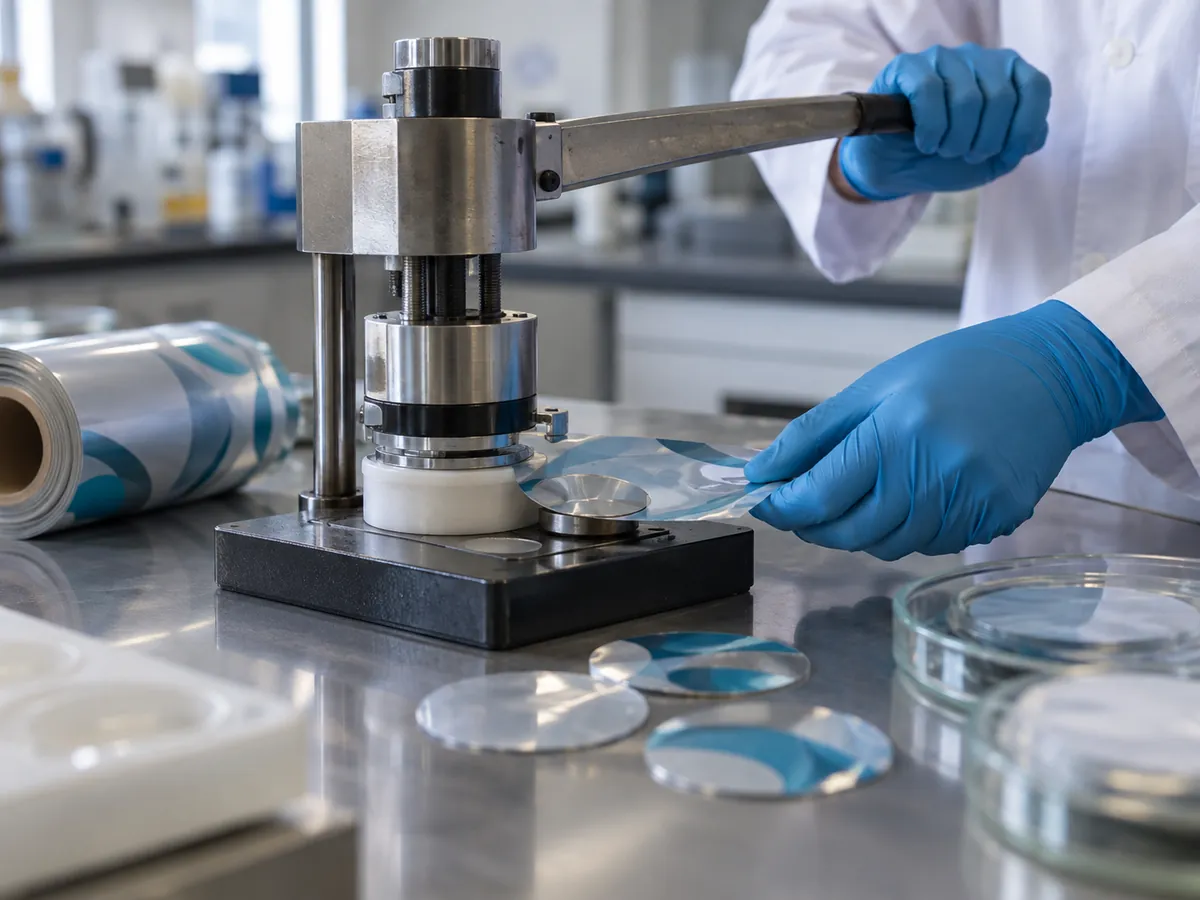
Oxygen permeates polymer films by dissolving into one surface, diffusing through the material, and leaving at the other side. OTR reports the net result: how much oxygen crosses per square meter per day, with a defined oxygen partial pressure difference across the film. Because it depends on film thickness and structure, OTR is reported for the specific film or laminate tested, not for a polymer in general. Material-level permeability values are normalized by thickness and are a different quantity.
OTR is relevant wherever oxygen damages the product: fats and oils turn rancid, coffee loses aroma, cured meats change color, vitamins and some drugs degrade, and aerobic spoilage organisms can grow. Materials that provide this protection are covered under barrier film and high barrier film.
OTR units and conversion
The most common unit is cm³/(m²·day), often written cc/m²/day, with the stated gas and pressure conditions, not an assumed atmosphere. Some sources report it per atmosphere of oxygen partial pressure, for example cm³/(m²·day·atm). Check which basis is used, because testing in pure oxygen and testing in air (about 21% oxygen) can produce different numbers for the same film unless the partial pressure is accounted for.
Some US data sheets use cc/100 in²/day. To convert, remember that 1 m² is about 15.5 times 100 in² (a square meter is roughly 1,550 in²). So a value in cc/m²/day is about 15.5 times larger than the same value expressed per 100 in². Divide a per-m² number by 15.5 to get the per-100 in² value, and multiply to go the other way. Assumed forward example: 2.0 cc/(100 in²·day) × 15.50003 ≈ 31.0 cc/(m²·day). Reverse example: 31.0 ÷ 15.50003 ≈ 2.00 cc/(100 in²·day). These convert area units only; temperature, RH and oxygen pressure stay unchanged.
OTR test methods
Scroll horizontally to view all columns if needed. ↔
| Official reference | Specimen and scope |
|---|---|
| ASTM D3985-24 | Steady-state oxygen transmission through film/sheet using a coulometric sensor |
| ASTM F1927-20 | Barrier material at specified temperature and controlled RH |
| ISO 15105-2:2025 | Gas transmission through films/laminates, equal-pressure method |
| ASTM F1307-20 | Steady-state package transmission where normal use encloses a dry environment |
For wet products or MAP, agree a method and internal gas/humidity conditions appropriate to the actual package; the F1307 dry-environment scope cannot be transferred automatically.
Why temperature and humidity must be stated
Temperature raises permeation. As a rule, the same film shows a higher OTR at higher temperatures, and the increase can be substantial across the range from refrigerated storage to hot climates. A number measured at one temperature should not be used to judge performance at another without data.
Humidity response depends on the grade and layer structure. Request results at relevant internal and external RH levels, particularly when screening a moisture-sensitive barrier. F1927-20 provides a controlled-humidity method; a dry-condition OTR alone does not establish wet-use performance.
Qualitative material categories
These are candidate barrier mechanisms, not a best-to-worst ranking. Compare actual structures at matched layer thickness, temperature and humidity.
Scroll horizontally to view all columns if needed. ↔
| Material category | Evidence needed |
|---|---|
| Aluminum foil | Thickness, pinholes and post-fold package results |
| Oxide-coated or metallized film | Coating quality, substrate and post-flex transmission |
| EVOH or PVDC barrier layer | Grade, barrier-layer thickness and RH-dependent data |
| Nylon / PET structural film | Actual laminate OTR; do not treat a structural layer as a high-barrier specification |
| PE film / BOPP | OTR for the intended thickness; confirm whether a separate oxygen barrier is needed |
Material labels cannot establish an OTR tier. Request a report identifying the tested specimen and conditions.
Film OTR versus package OTR
A film’s OTR is measured on a flat, undamaged sample. A package is different. Oxygen can enter through:
- Seals, where the sealant is the only barrier and the seal edge exposes the cross-section.
- Folds, creases, and gussets, where barrier layers may crack.
- Pinholes and cracks from flexing, particularly in thin barrier layers such as metallized films, oxide coatings, and foil. Flex durability can be checked with ASTM F392.
- Closures, zippers, valves, and punctures.
- Leaks from incomplete seals or product trapped in the seal area.
As a result, the package OTR is often higher than the film OTR would predict. For shelf-life work on a finished pack, package-level testing within the selected method’s scope is more representative, and shelf-life trials in real storage conditions are the final check.
Oxygen budget screening record
For a quality-screening estimate, time (days) = (quality oxygen budget − initial oxygen) / package ingress, with oxygen volumes on the same stated reference-temperature/pressure basis. Initial oxygen includes headspace plus dissolved or entrained oxygen. This assumes constant ingress and no changing product chemistry; it is not a food-safety dating method.
Scroll horizontally to view all columns if needed. ↔
| Variable | Unit and source | Entry |
|---|---|---|
| Quality failure budget | cc O₂/package; product study | _____ |
| Headspace oxygen at sealing | cc O₂/package; volume and measured fraction | _____ |
| Dissolved / entrained initial oxygen | cc O₂/package; product measurement or justified estimate | _____ |
| Film-only ingress estimate | Film OTR × area (m²) = cc/day, at matched conditions | _____ |
| Measured finished-package ingress | cc/(package·day); scoped method and storage conditions | _____ |
| Storage / reference conditions and duration | °C, RH, oxygen pressure; days | _____ |
Choose the film-area estimate or measured whole-pack rate as the ingress basis; adding both counts the film twice. If initial oxygen exhausts the quality budget, the calculation gives no positive storage allowance. Confirm results through real storage trials; moisture, light and temperature also matter, with moisture covered on the WVTR page.
What to put in an OTR specification
- State OTR with the unit, test temperature, relative humidity, and oxygen concentration.
- Name the method (for example ASTM D3985, ASTM F1927, or ISO 15105-2) and whether the sample is flat film or a package.
- Ask for values after flex or conversion if the structure uses metallized, oxide-coated, or EVOH layers.
- Define the product’s oxygen budget and storage conditions before choosing a barrier level.
- Do not over-specify: a foil-level barrier on a product with a short shelf life adds cost and may hurt recyclability.
- Validate with real packs and storage trials.
Other film tests are listed in the performance overview.
Sources and method
Reviewed October 8, 2026 against the official public method references above. Unit conversion derives from the NIST exact inch definition: 100 in² = 0.064516 m². Material categories intentionally replace unsupported family-wide rankings; no matched-grade OTR comparison is claimed. Budget arithmetic is a screening model with the assumptions stated above, not a measured shelf life.
Continue reading
Related articles
Oxygen Barrier Packaging: Choosing the Right Level of Protection
Oxygen barrier packaging should match what the product can tolerate. Learn how to size protection, use nitrogen flushing and scavengers, and validate shelf life.
Packaging and Shelf Life: How Film Choice Affects It
Packaging film shelf life depends on oxygen, moisture, light and seal integrity. Learn the failure modes, real-time vs accelerated tests and a study checklist.
Puncture Resistant Film: Materials and Test Methods
Puncture resistant film explained: how puncture is tested (ASTM F1306, D1709), which materials help with sharp products, and how to specify and trial it.