
Packaging and Shelf Life: How Film Choice Affects It
Packaging film shelf life depends on oxygen, moisture, light and seal integrity. Learn the failure modes, real-time vs accelerated tests and a study checklist.
Using flat-film data as a shelf-life claim risks product loss or an unsafe date. Finished-product shelf life needs evidence for the actual product, package and storage route; barrier measurements alone cannot establish it.
What limits packaging shelf life
Quality life ends at a defined sensory or quality limit; food safety needs a separate hazard assessment and validation. A rancidity or texture result cannot establish microbiological safety. Record both endpoints, using the earlier applicable limit for the product’s date.
Scroll horizontally to view all columns if needed. ↔
| Failure mechanism | Evidence needed |
|---|---|
| Oxidation or aroma change | Product endpoint, headspace oxygen and package barrier |
| Moisture gain or loss | Product moisture/texture endpoint and WVTR at stated conditions |
| Light damage | Product stability under the expected light exposure |
| Seal or handling failure | Leak checks before and after distribution stress |
| Microbial hazard | Product-specific safety assessment, process and storage validation |
Takeaway: Set quality and safety criteria separately before selecting a film.
Main failure modes and what controls them
Name the failure that limits the product, then specify the corresponding evidence. Oxygen and moisture transmission are covered on the OTR and WVTR pages; oxygen barrier and moisture barrier explain the design choices. Compare rates only at matching temperature and humidity.
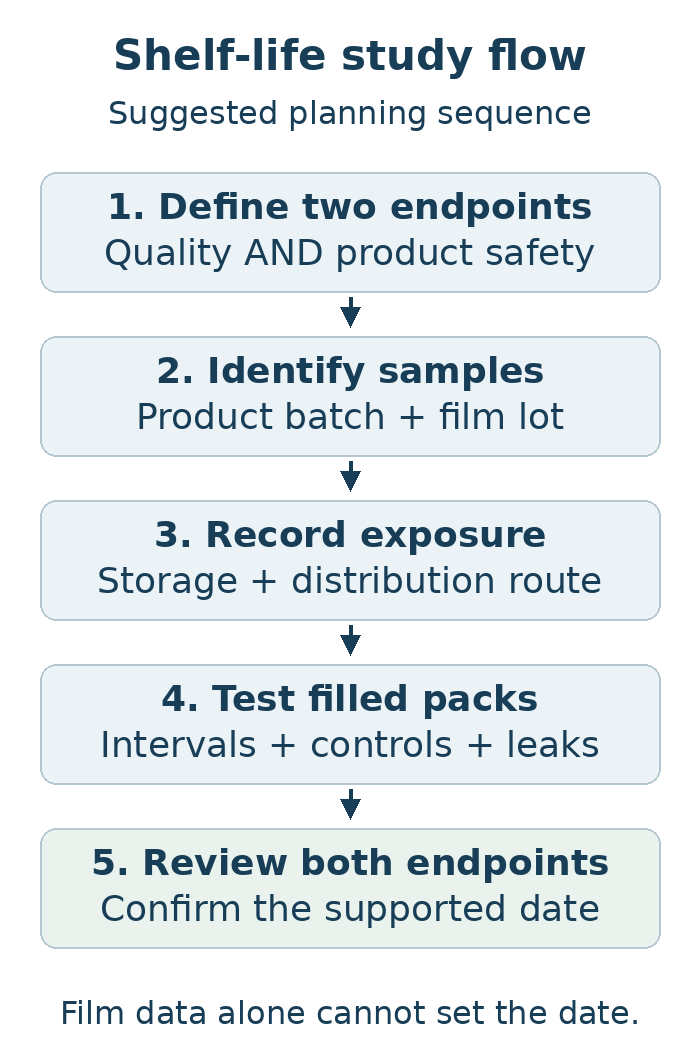
Takeaway: Select evidence for the limiting mechanism, then carry it into the study record.
Seals, leaks and package-level barrier
A film’s barrier figure applies to a flat piece of film. The package can behave worse. Seals, folds, gussets, zippers, valves and pinholes all add paths for gas and moisture. Leakage is a separate failure path; a barrier number does not demonstrate package integrity.
So when you plan the study:
- Check seal integrity as well as barrier, starting with seal strength.
- Consider flex and puncture damage during distribution. Barrier layers such as metallized layers can lose performance after flexing, so look at puncture resistant film too.
- Select a method within its scope: ASTM F1307-20 measures oxygen transmission into dry packages; D3078-02(2021)e1 checks gross leaks in flexible packs with headspace gas; F2096-11(2019) uses internal pressurization for gross leaks. A negative gross-leak result does not exclude smaller leaks.
- Allow for contamination in the seal, such as fat, powder or moisture, which can create channel leaks on a real line.
Takeaway: Choose a package test within its stated scope; keep barrier and leak results separate.
Distribution and storage conditions
The same pack ages differently in a temperate warehouse and a hot container. Temperature speeds up chemical reactions and increases gas and vapor permeation. Humidity changes moisture driving force and can reduce the barrier of humidity-sensitive layers such as EVOH or nylon. Light on a retail shelf can drive color and flavor loss in a clear pack. Altitude and pressure changes can stress seals.
Define the route: factory, warehouse, transport, retail, home. Include the worst realistic conditions, such as summer trucks or unconditioned storage. The destination market sets the climate, so a pack designed for one region may need a different structure in another.
Takeaway: Record the route and storage extremes before choosing test conditions.
Real-time vs accelerated shelf life testing
Shelf life testing comes in two forms.
- Real-time testing stores packs under expected conditions and checks them at intervals until the product fails. It directly observes performance at those conditions.
- Accelerated testing stores packs at higher temperature, humidity or both to speed up deterioration, then uses a product-specific model to estimate life at intended conditions.
The difficulty is the acceleration factor. How much faster a product ages at a higher temperature depends on the product’s chemistry and the failure mode. Fats, flavors, vitamins, colors and texture each respond differently. Barrier layers can also change behavior at high temperature or humidity, so the package itself may not age in proportion. An original accelerated-study paper explains that normal and accelerated deterioration need matching patterns; its results concern one processed food, not all products. There is no universal conversion. Use accelerated data to compare designs and screen candidates, and confirm the final claim with real-time data or a validated, product-specific model.
Takeaway: Validate the acceleration model for the product and endpoint before using it for a date.
What to record and test in a shelf-life study
Copy this planning record for each study arm. Set intervals and sample numbers for the product and batch variation rather than borrowing a generic schedule.
Scroll horizontally to view all columns if needed. ↔
| Field | Entry |
|---|---|
| Product / fill batch / film lot | ____ / ____ / ____ |
| Structure / thickness / seals / closures | ____ |
| Line / fill temperature / atmosphere | ____ |
| Storage route / temperature / RH / light | ____ |
| Quality endpoint / pass-fail criterion | ____ |
| Safety hazard / validation evidence | ____ |
| Check interval / sample count / control pack | ____ |
| OTR / WVTR / method / conditions | ____ |
| Headspace oxygen / leak checks / handling stress | ____ |
| Responsible person / results / decision date | ____ |
Matching the film to the failure mode
Choose the barrier that matches the failure mode instead of the highest barrier available. A dry snack may need strong moisture and light protection, while oxidation-sensitive coffee or nuts may need low oxygen transmission and good aroma retention. Options are listed under high barrier film and barrier film, and applications under coffee packaging materials and snack packaging film.
Takeaway: Match the candidate structure to the measured endpoint and confirm it with filled packs. If the supplier offers a cheaper structure, require evidence at the same conditions. The guide on comparing film specifications explains how to line the numbers up.
Questions and answers
How does accelerated shelf life testing work?
Higher storage temperature or humidity speed a selected deterioration mechanism, then a model relates it to normal storage. Do not extrapolate where heating changes the mechanism, damages the pack, or the model lacks validation. Quality acceleration does not replace food-safety validation.
Sources and method
Method scopes are linked above; public abstracts do not replace the full laboratory procedures. The accelerated-study paper supplies a methodological example, not a shelf-life recommendation. For food-safety planning, 21 CFR 117.130 requires a hazard analysis for covered food facilities; applicability and product validation need qualified review. Reviewed for this page: 8 October 2026.
Continue reading
Related articles
Moisture Barrier Packaging: Protecting Dry and Moist Products
Moisture barrier packaging keeps dry products crisp and moist products fresh. See how to match film structures, desiccants and seals to the product and climate.
Oxygen Barrier Packaging: Choosing the Right Level of Protection
Oxygen barrier packaging should match what the product can tolerate. Learn how to size protection, use nitrogen flushing and scavengers, and validate shelf life.
Oxygen Transmission Rate (OTR): Units, Test Methods and How to Read It
Oxygen transmission rate (OTR) measures how much oxygen passes through a film. Learn the units, test methods, conditions and how OTR relates to shelf life.