
Puncture Resistant Film: Materials and Test Methods
Puncture resistant film explained: how puncture is tested (ASTM F1306, D1709), which materials help with sharp products, and how to specify and trial it.
Puncture resistant packaging film resists sharp-point penetration from bones, pasta or hardware. Puncture resistance is more than tensile strength or thickness. It depends on the polymer, how the film is oriented, the layer structure and how fast and where the load arrives. A pinhole in a barrier pack is a functional fault, because it can let in oxygen, moisture and microbes.
Match the damage to the test
Scroll horizontally to view all columns if needed. ↔
| Test route | Measures / conditions | Does not establish |
|---|---|---|
| Slow puncture | Probe penetration at a defined speed | Survival of every sharp product geometry |
| Dart impact | Failure mass under specified drop conditions | Slow sharp-point puncture resistance |
| Flex conditioning | Repeated bending/twisting before a damage or barrier check | Complete distribution or leak integrity by itself |
What puncture resistance means in packaging
Puncture happens when a small, concentrated load pushes through the film instead of being spread across it. Compare deformation, force and energy to failure on the actual specimens; resin names or stiffness alone do not establish resistance.
In practice puncture rarely occurs in isolation. A sharp product pressed against the film during filling, vibration in a case or a drop onto a corner can all combine. So treat a lab number as a screening tool and test with the real product.
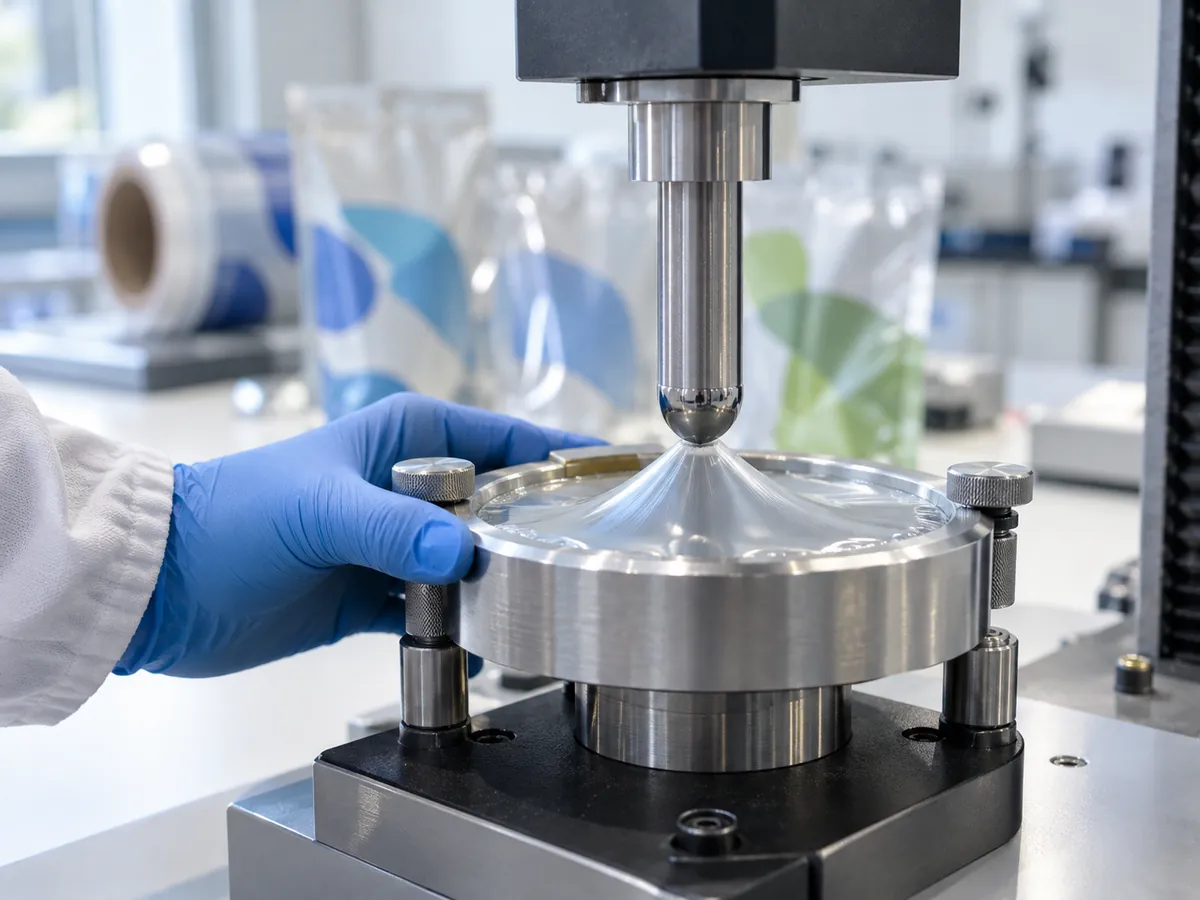
Slow-rate puncture vs dart impact
Two common tests measure different things.
Scroll horizontally to view all columns if needed. ↔
| Test | Standard | What it does | What it tells you |
|---|---|---|---|
| Slow-rate puncture | ASTM F1306-21(2025) | A probe is pushed through a clamped film sample at a controlled slow speed | Force and energy to puncture, and how much the film stretches before failure |
| Dart impact | ASTM D1709-24 | A dart is dropped from a set height onto a clamped film sample | The weight at which about half of the samples fail, a measure of impact toughness |
Slow-rate puncture simulates a sharp item pressing into the film, such as a bone or a corner during filling or stacking. Dart impact measures how the film handles a sudden blow, which relates to drops and rough handling. Compare specimens at matched probe geometry, speed and conditioning. The overview of film performance tests shows how these fit with other mechanical properties such as tensile (ASTM D882).
Materials that improve puncture resistance
- Nylon (BOPA). Consider oriented polyamide where puncture and abrasion are a concern, often as a layer within a laminate or coextrusion (see nylon film). Nylon absorbs moisture, which can change its mechanical properties and barrier behavior, so check performance at your storage humidity.
- Metallocene LLDPE. Consider metallocene-catalyzed linear low-density polyethylene as a tough-layer candidate; compare actual grade/structure data rather than assuming superiority over LDPE. See LLDPE film and the wider PE film overview.
- Thicker webs. More material gives more energy absorption, but at a cost in weight, price and machine behavior.
- Coextruded structures. A coextruded film can place a tough layer where it is needed while keeping a sealant layer for sealing. Layer arrangement matters as much as total thickness.
- Laminates. Combining a tough outer or middle layer with a sealant can raise puncture resistance without making the whole structure thick. Details are in laminated packaging and flexible packaging film.
- Vacuum and shrink structures. Where a pack is under vacuum or shrinks tight around the product, the film is pressed against sharp edges, so puncture resistance is a main requirement for the structure. Vacuum pouch covers that format.
Higher stiffness is not always better. Some stiff films crack under a sharp impact rather than stretching. A softer, tougher layer may work better.
Flex crack vs puncture
Both failures can end in a pinhole, but the causes differ.
- Puncture is a single, localized event caused by a sharp object.
- Flex cracking is damage from repeated bending, creasing or vibration, which fatigues brittle layers such as metallized layers, foils or some barrier coatings. It can happen during shipping with no sharp object involved. ASTM F392/F392M-23 provides flex conditioning; the subsequent damage or barrier test is specified separately.
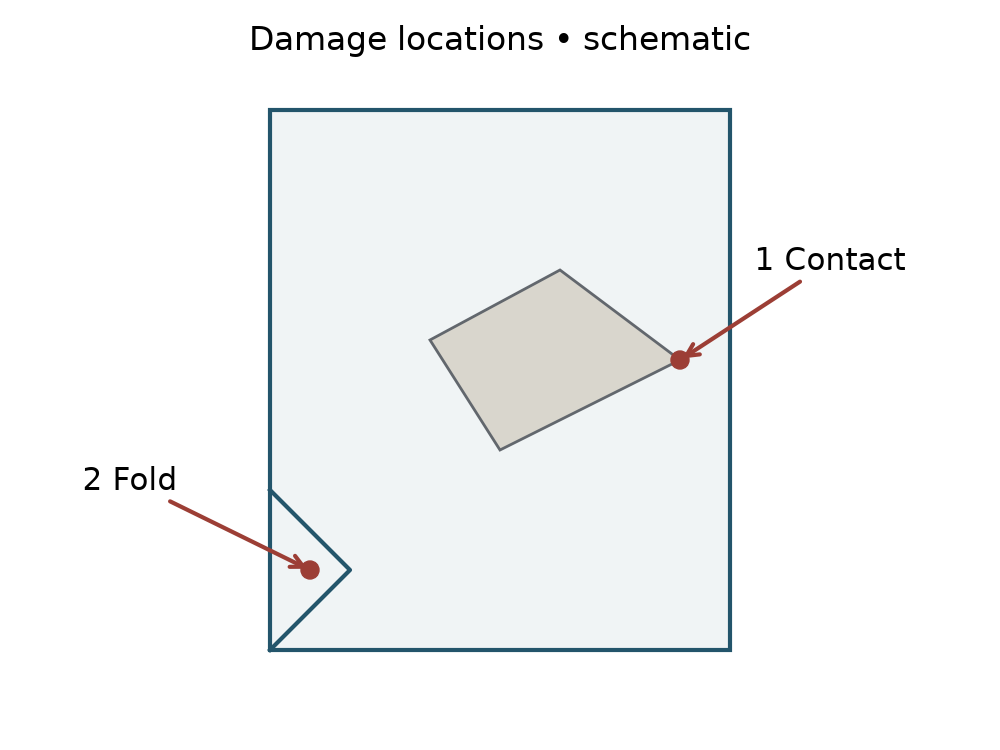
If pinholes appear at folds, gussets or crease lines, think flex. If they appear where product edges contact the film, think puncture. A film can pass one test and fail the other. Barrier layers in particular can lose performance after flexing even when the film looks intact, as described under barrier film.
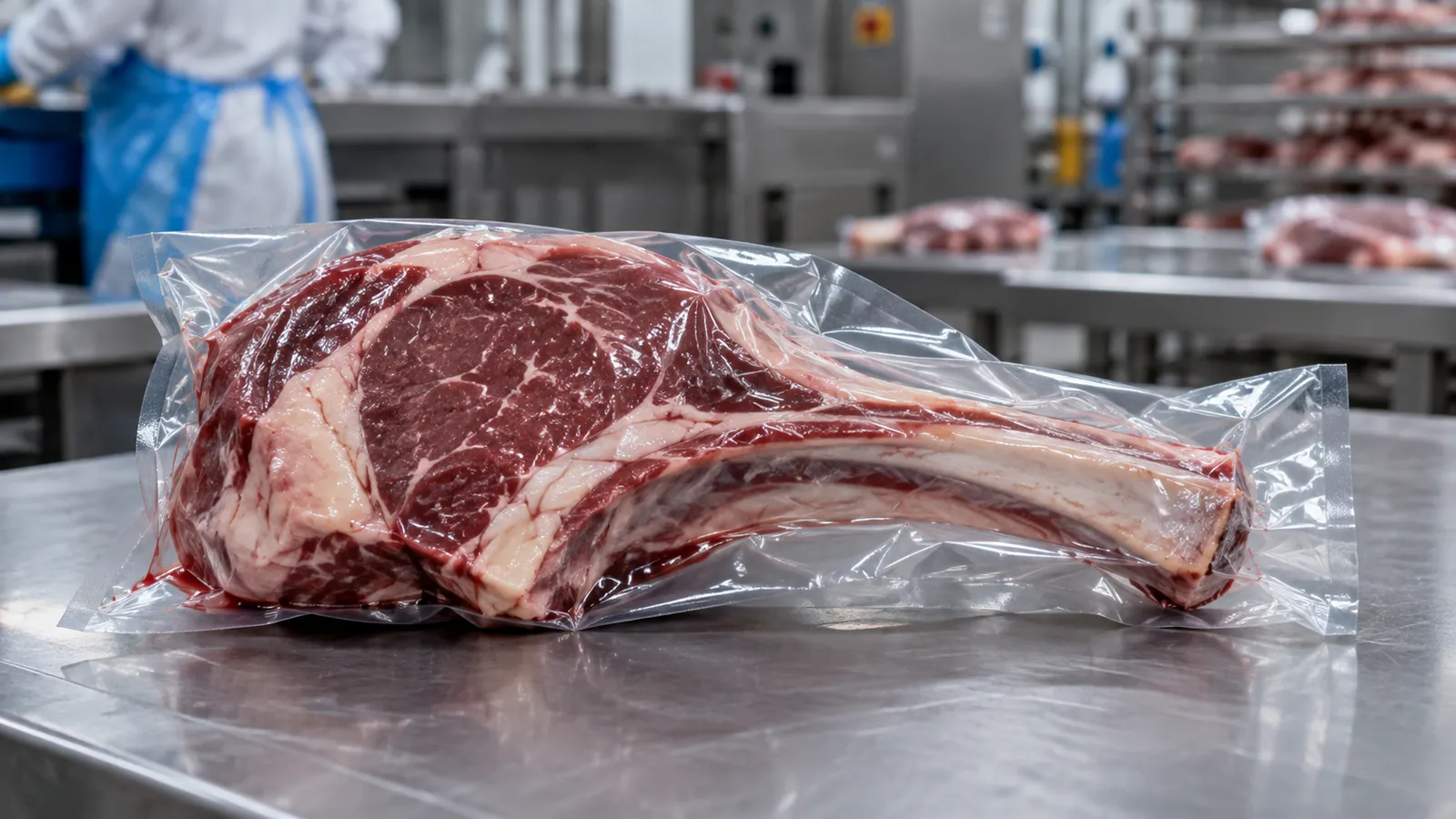
Puncture risk by product
Scroll horizontally to view all columns if needed. ↔
| Product | Main risk | Approach to consider |
|---|---|---|
| Bone-in meat | Sharp bone ends pierce the film, especially under vacuum or shrink | Nylon-containing coextrusion or laminate, bone guards, thicker film at contact points. See meat packaging |
| Dry pasta | Rigid spikes and long pieces pierce corners and seals | Tougher film, lower fill density, corner design, gusset style |
| Nuts and granola clusters | Hard, angular pieces rub and indent the film | Thicker or tougher inner layer, check abrasion |
| Hardware (screws, nails) | Hard points, weight, impact on drops | Heavy-duty coextrusion or laminate, consider sack or box |
| Frozen products | Brittle film at low temperature, ice shards | Sealant and tough layer rated for cold, test frozen |
| Cheese with rind or hard corners | Corners and rind pierce under vacuum | Toughness and puncture-tested structure. See cheese packaging |
These are starting points to test, since the right structure depends on the product, the pack format and the distribution route.
How to specify and test puncture resistance
Lab numbers help rank candidates, but real-product trials decide.
- Describe the hazard: shape, hardness, orientation and fill density of the sharpest item.
- Ask the supplier for ASTM F1306 and ASTM D1709 data, with test conditions and sample temperature.
- Request tests at the temperature the pack will see, including cold chain if relevant.
- Fill real packs on the real machine at target speed and run them through distribution tests such as vibration, drop and compression.
- Select a leak method with demonstrated sensitivity for the actual pack. ASTM D3078-02(2021)e1 uses bubble emission on flexible packs containing headspace gas; small leaks or product-plugged holes may escape detection. ASTM F2096-11(2019) supplies internal air pressure to detect gross leaks. Its public scope reports 250 µm sensitivity with 81% probability in the studied conditions, not guaranteed detection of every microhole. Record pressure/vacuum, headspace, contents and known-defect controls; a pass cannot prove all pinholes absent.
- Check seals near the sharp product, because product caught in the seal can weaken it and puncture the film.
- Inspect the barrier after the trial as well as the film surface.
Thinner film is often where puncture complaints start, so if a change in structure aims to reduce thickness or cost, look at when a cheaper film costs more before approving it.
Puncture and integrity trial record
Scroll horizontally to view all columns if needed. ↔
| Field | Agreed condition / result |
|---|---|
| Lot, layer structure and total / tough-layer thickness | _____ |
| Conditioning time, specimen temperature and RH | _____ |
| F1306 probe geometry, speed; force / energy / displacement | _____ |
| D1709 method, dart geometry, drop height and result | _____ |
| F392 conditioning and subsequent damage / barrier test | _____ |
| Real-product sharp point, fold location, load and pack orientation | _____ |
| Filled-pack drop / vibration / compression conditions | _____ |
| Leak method, pressure/vacuum, headspace and demonstrated sensitivity | _____ |
| Known-defect controls, failure location and barrier after trial | _____ |
| Pass criteria agreed before testing; outcome | _____ |
Choose the lab loading mode from the observed hazard, then validate damage and leakage on filled packs. A gross-leak pass is only as informative as the method’s demonstrated detection capability.
Sources and method
Reviewed October 8, 2026 against the public scopes of F1306-21(2025), D1709-24, F392/F392M-23, D3078-02(2021)e1 and F2096-11(2019), linked above. Their specimens, loading modes and leak sensitivity differ; these references do not approve a package or substitute for the full test procedures. Material choices are candidates for comparison, not an unsupported resin-family ranking.
Continue reading
Related articles
Oxygen Transmission Rate (OTR): Units, Test Methods and How to Read It
Oxygen transmission rate (OTR) measures how much oxygen passes through a film. Learn the units, test methods, conditions and how OTR relates to shelf life.
Packaging and Shelf Life: How Film Choice Affects It
Packaging film shelf life depends on oxygen, moisture, light and seal integrity. Learn the failure modes, real-time vs accelerated tests and a study checklist.

Water Vapor Transmission Rate (WVTR): Units, Test Methods and Interpretation
Water vapor transmission rate (WVTR) measures how much moisture passes through a film. Learn units, test conditions, ASTM F1249, E96 and how to read the number.