
Cheese Packaging Film: Ripening, Vacuum and MAP
Cheese packaging film explained: gas-permeable ripening films, vacuum bags for blocks, MAP for sliced and shredded cheese, reclosable packs and structures.
A film that traps ripening gas can swell; one that admits unwanted oxygen can spoil the intended surface. First identify whether ripening continues in the pack, then validate that cheese’s gas exchange and storage route.
Scroll horizontally to view all columns if needed. ↔
| Cheese state | CO2 / oxygen route | Storage and validation inputs |
|---|---|---|
| Ripening in pack | Cheese-specific exchange; not one universal O2 strategy | Ripening temperature; gas, rind, mold and weight over full cycle |
| Mature block | Candidate vacuum barrier; confirm remaining gas release | Intended cold chain; corners, swelling and leak tests |
| Sliced | Candidate MAP barrier and reclose | Chilled storage; residual gas, seal and repeated-opening tests |
| Shredded | Candidate barrier pouch with MAP / zipper | Chilled storage; moisture, mold and greasy reclose tests |
What goes wrong with cheese
- Mold: surface mold needs oxygen, so oxygen barrier is the first defense for cut and sliced cheese. Mold also appears when a pack leaks or when the cheese was handled badly before packing.
- CO2 release: many ripened cheeses, especially those with eyes or active cultures, produce carbon dioxide. A fully sealed barrier film can swell, so the film needs enough gas permeability or the pack has to hold the pressure or let it out.
- Moisture loss and rind drying: cheese that dries out becomes hard and cracked. The film needs adequate moisture barrier, and how much depends on the cheese type.
- Fat and oil: oil and fat in the seal area can weaken seals and attack some adhesives, and grease can migrate to printed surfaces.
- Light: it can cause off-flavors and fading in some cheeses, particularly sliced products on a lit shelf.
- Odor and flavor transfer: strong cheeses can scalp flavor into the film, and the film should not transfer its own odor to the cheese.
- Purge and whey: fresh and soft cheeses can leave whey in the pack, so seals must tolerate wet contamination.
Ripening: gas-permeable versus barrier films
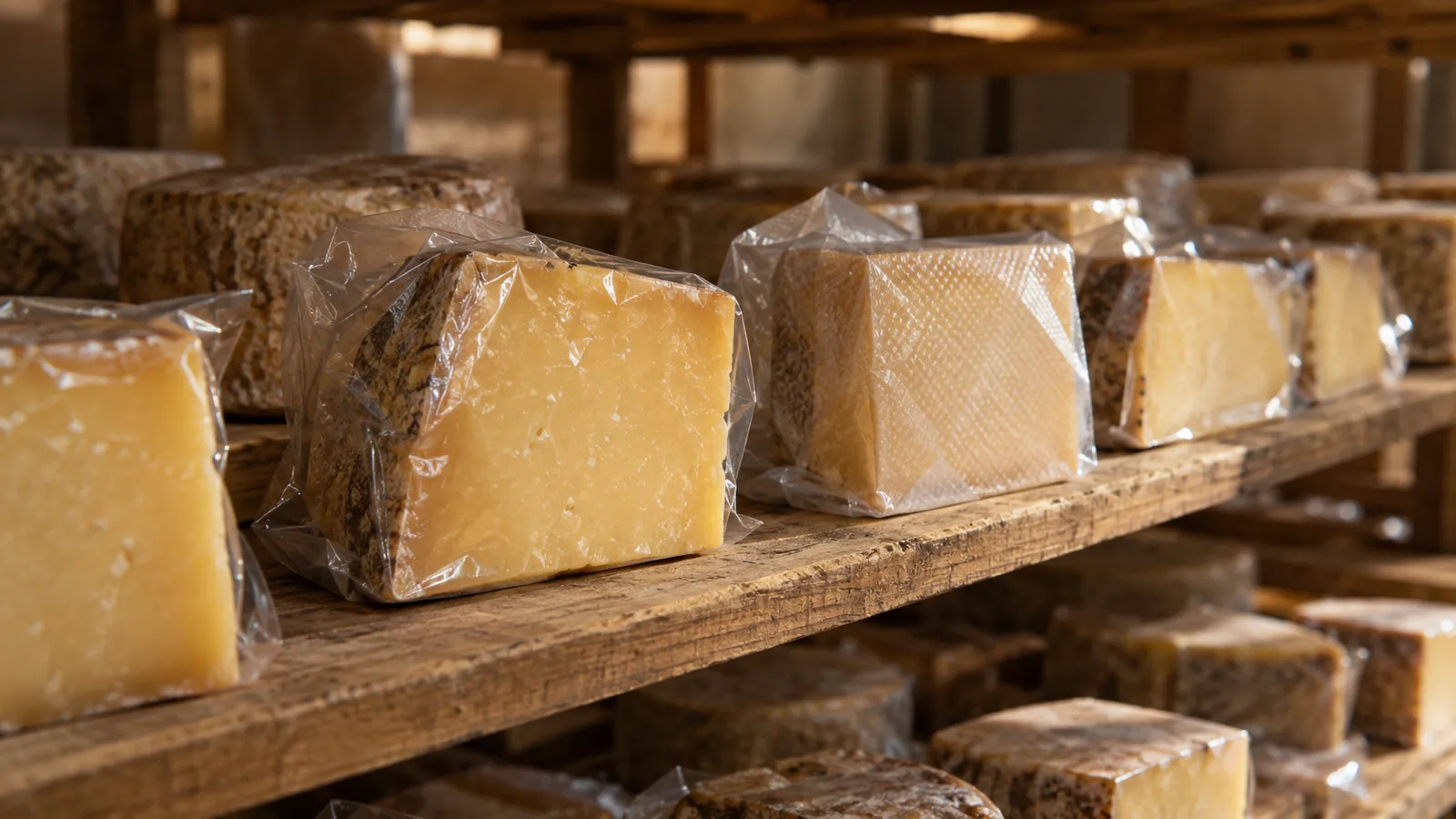
Match the gas strategy to the cheese and ripening process. Controlled CO2 release does not imply that every ripening cheese needs the same oxygen entry. A film manufacturer’s public sheet for gassing-cheese bags reports oxygen and CO2 transmission separately and at different test conditions; those values cannot be treated as a universal permeability ratio.
A valve manufacturer’s public brochure includes cheese among degassing applications. Its general valve documentation describes outward gas release while limiting external air contact. That is an example of a gas-handling component, not proof that a coffee valve or any barrier pouch suits a given cheese. Check the valve grade, liquid contact, attachment seal and required gas behavior through the full ripening cycle. Coffee packaging materials explains the valve principle.
Takeaway: Select the cheese process first; then test film permeability or a documented valve system against it.
Cheese packaging materials: typical structures
Cheese films use polyethylene or similar on the inside for sealing, often with nylon or EVOH in the middle for barrier. Confirm all property values against supplier data sheets, because OTR and WVTR results depend on test temperature and humidity.
Scroll horizontally to view all columns if needed. ↔
| Cheese pack | Common structure | Why it is used |
|---|---|---|
| Hard and semi-hard blocks, vacuum | PA / PE or PA / EVOH / PE barrier pouch or shrink bag | Oxygen barrier against mold, puncture resistance at corners, tight fit |
| Ripening cheese in the pack | Gas-permeable coextruded film, PE or polyamide based | Allows controlled CO2 and oxygen exchange |
| Sliced cheese, MAP | Thermoformed barrier base web plus barrier lidding film, with a reclosable label or zipper | Holds the gas mix, shows the product, reseals |
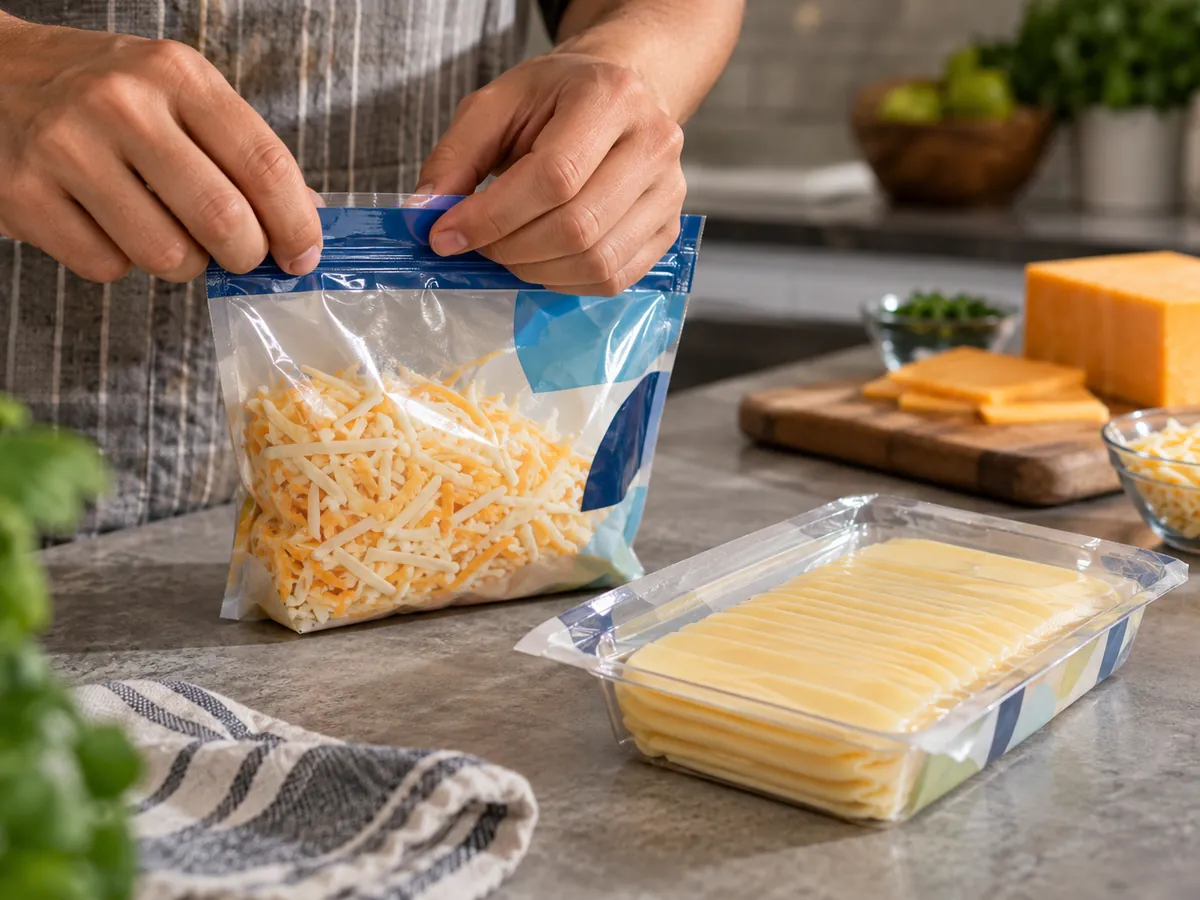
| Shredded cheese | Barrier bag, often a stand-up pouch with zipper, with MAP flush | Oxygen barrier plus anti-caking environment, reclosable |
| Portions and snacks | Metallized or opaque laminate for a flow wrap | Light and moisture protection, good machinability |
| Cream and soft cheese | Lidded cup or tray with barrier lidding, or soft pouch | Moisture and oxygen barrier, peelable lid |
Barrier film explains how the barrier layers work, and nylon film covers the layer used in many vacuum cheese bags.
Vacuum packs for blocks
Hard and semi-hard cheeses are often packed in vacuum bags. Vacuum reduces air in the pack and draws film against the cheese; it does not eliminate every source of spoilage. The bag needs enough puncture and flex resistance at the corners of a block, where a sharp edge presses against the film. For some cheeses a shrink bag is used, so the film tightens after sealing and leaves a neat pack with few wrinkles. The format is covered in vacuum pouch packaging.
MAP for sliced and shredded cheese
Sliced and shredded cheese have large surface areas and are handled often, so mold risk is higher. Modified atmosphere packs replace the air with a gas mix, typically nitrogen and carbon dioxide, which slows mold. Shredded cheese often contains an anti-caking agent, so the pack also needs a good moisture balance. The gas mix and the shelf life depend on the cheese and on the local market, so confirm both for your destination. A film that holds the gas but fogs when chilled hides the product, so anti-fog performance matters for clear lidding.
Reclosable packs and flow wrap for portions
Consumers open sliced and shredded cheese several times, so the pack has to reclose. The options are a zipper in a pouch, a peel-reseal label on a lidding film, or a press-to-close strip. These parts have to be compatible with the film’s sealant, and the reseal strength must survive repeated openings with a greasy surface. The pouch format is covered in zipper pouch packaging.
Single portions, cheese sticks and snack cheese are often wrapped in a flow wrap, which needs a film that runs on a horizontal machine and seals reliably despite fat. Flow wrapper film covers the machine side and flow wrap packaging covers the format.
Machines
- Chamber vacuum machines and shrink tunnels for blocks and wedges.
- Thermoform-fill-seal machines for sliced cheese with vacuum or gas flush.
- Vertical and premade pouch machines for shredded cheese in zipper bags.
- Horizontal flow wrappers for portions and sticks.
Fat on the seal area is a recurring issue, so test seals on contaminated product, and use a sealant layer with a wide seal window. The seal initiation temperature page explains why that matters at line speed.
What to settle before choosing a cheese film
Scroll horizontally to view all columns if needed. ↔
| Check | Record for each sample / time point | Result / action |
|---|---|---|
| Trial identity | Cheese / batch; ripening state; film grade, valve and pack size | Set cheese-specific acceptance criteria |
| Full storage cycle | Temperature / time; headspace gas or pressure; swelling | Investigate deviation before approval |
| Product condition | Mold / rind observations; weight change; light exposure | Record by time point |
| Seal and corners | Clean / fat / whey contamination; leak result and location | Compare before and after handling |
| Reclose | Opening count; greasy surface; seal and moisture result | Do not assume original MAP remains after opening |
Common questions
Why is my cheese package puffed up?
Appearance alone cannot distinguish gas release, spoilage and seal failure. During development, pair gas/pressure observations with a leak test and product assessment at the same time points. Swelling can coexist with a leak; hold an unexplained result for investigation.
Method and sources
Examples establish distinct gas-handling options, not interchangeability or validated cheese shelf life. Gas-handling documents reviewed 2026-10-08; no ripening trial is reported.
Continue reading
Related articles
Bakery Packaging Film: Keeping Bread and Cakes Fresh
Bakery packaging film explained: how staling, moisture loss and mold shape film choice for bread, cakes, cookies and tortillas, plus formats and machines.
Coffee Packaging Materials: Barrier, Valves and Pouch Formats
Coffee packaging materials explained: oxygen and aroma barrier, one-way degassing valves, nitrogen flushing, pouch formats and machine fit.

Flexible Cosmetic Packaging: Sachets, Refill Pouches and Wipes
Flexible cosmetic packaging explained: sample sachets, refill pouches, wet-wipe packs, chemical compatibility, premium print and typical structures.