
Zipper Pouch Packaging: Reclosable Features Compared
Zipper pouch packaging adds a reclosable feature to a bag. Compare press-to-close, slider and pocket zippers, how they are sealed, and recyclability.
Treating a reclosed zipper as the original sealed barrier can leave the product exposed. A zipper pouch has a reclosable track for repeated access; initial package sealing and consumer reclosing are separate checks. The most common type is the press-to-close zipper, made of two interlocking profiles. Resealable pouches and reclosable bags are used for snacks, coffee, pet food, frozen food, cheese, wipes and many other products where the pack is not emptied in one use.
Closure types compared
Scroll horizontally to view all columns if needed. ↔
| Closure | How it works | Typical uses | Notes |
|---|---|---|---|
| Press-to-close zipper | Two profiles interlock when pressed together | Snacks, coffee, nuts, frozen food, cheese | Needs finger pressure; test engagement |
| Slider zipper | A plastic slider moves along the track to close it | Frozen vegetables, larger snack bags, bulk dry goods, pet food | Easier for people with limited dexterity; adds a part and cost |
| Pocket zipper | Zipper sits inside a pocket of extra film | Premium coffee, pet food, flat bottom pouches | Hidden and protected until opened; adds material and complexity |
| Hook-and-loop style closure | Fine hooks and loops engage when pressed | Some specialty and household packs | Not a standard food zipper; less common; check feel and sealing |
| Child-resistant zipper | Needs a pinch, slide or multiple steps to open | Cannabis, some pharmaceutical and household products | Rules vary by market; see below |
| Adhesive reclose strip | Pressure-sensitive adhesive | Wipes, labels, some bakery bags | Not a zipper, but the same purpose; sensitive to dust and moisture |

Press-to-close zippers
The profiles are extruded in a polyolefin resin, usually PE or PP, and applied to the film. Different profile shapes (single track, double track, flange types) affect closing feel and how well they stay shut. A manufacturer describes stronger retention for its own dual-track design, but that does not establish a universal closing-force ranking. Compare closing/opening forces, inside retention and leak results for the named profile, after the same conditioning and contamination challenge.
Slider zippers
A slider is a small plastic piece that rides on the zipper track. It presses the profiles together as it moves and separates them when moved back. It suits larger pouches and users who find pressing along a long track tiring. A slider zipper pouch needs a slider-compatible zipper profile and a stop at each end so the slider does not come off. Check machine compatibility, because sliders are usually fitted by the converter and the filler must not damage them.
Pocket zippers
A pocket zipper is built into a pocket in the pouch. The zipper is sealed to a separate film strip, and the pocket is attached inside the front panel. The zipper is hidden and protected by an extra layer while the pouch is sealed, and the tear line is above it. It is common for coffee and premium dry goods, and for flat bottom pouches.
Child-resistant closures
Child-resistant zippers need a more complex action to open, so a young child is unlikely to open them but an adult can. They are used for regulated products such as cannabis and some medicines and household chemicals. Whether a pack must be child-resistant, and what testing and certification are needed, depends on the product and the destination market. Confirm the requirements for your market before specifying.
Zipper position and tear lines
- In the top-filled layout shown below, the zipper sits below the top seal, with space above it for the tear and below for the product. Distance matters: too close and the top seal and zipper interfere; too far and product catches in the track.
- A notch or laser score above the zipper lets the consumer tear off the top seal cleanly and expose the zipper. Score depth must give easy tearing without hurting the barrier.
- The flange is the part of the zipper sealed to the film. Flange width alone does not establish attachment strength; record the weld geometry, compatible materials, process settings and measured separation result.
- Powders, crumbs or oil in the track cause poor closing. Leaving a gap between product and zipper, or using a pocket design, helps.
Sealing zippers on machines
For a top-filled pouch with the zipper below the top seal, the final heat seal joins the film faces above the zipper. It does not cross the profiles. A bottom-filled pouch can instead arrive with that top seal already made; other layouts need an individual drawing.
Inspect three distinct areas:
- Top seal: the initial film-to-film closure in this layout.
- Zipper-end side seals: where each profile ends in the side-seal area; controlled flattening/welding can prevent an end channel. This is not a jaw crushing the working zipper along its whole length.
- Flange welds: the zipper-to-film attachment on each face; confirm compatible sealant and weld conditions.
Use seal initiation temperature and seal-strength testing to define process and acceptance records. VFFS film and premade pouch materials cover different supply routes. Keep product out of seal regions and inspect the actual end transitions.
Zipper materials and recyclability
Identify the zipper, slider and pouch materials, then evaluate the full assembly against the destination scheme. Same-family PE/PE or PP/PP can be a design starting point, but material names alone do not establish recycling compatibility. Amounts, barriers, adhesives, decoration and sorting behavior also matter; a mixed assembly is not automatically rejected solely by the zipper name.
The RecyClass Natural PE Film guideline, March 2026, evaluates closure systems and other components within a defined European PE-film stream. Its criteria are not a promise of local collection. Read mono-material packaging and design for recycling for the assessment boundary.
Food-contact documentation should cover the specific zipper material and intended market, as well as the film.
Typical pouch types with zippers
Zippers are fitted to stand-up pouches, flat bottom pouches, side gusset bags and flat pouches. Each uses a different zipper style depending on the shape and the product. For coffee packs, see coffee packaging materials.
Choosing a zipper step by step
- Define how often the consumer will reclose the pack and how easy it must be.
- Pick the type: press-to-close for general use, slider for large or frequent-use packs, pocket for premium packs.
- Decide whether child resistance is required and confirm the market rules.
- Match the zipper polymer to the pouch for recycling and sealing.
- Specify zipper position, tear notch and distance from the top seal.
- Check the final filling seal and the separate zipper-end side seals and flange welds.
- Test closing after filling, including product contamination in the track, and run a trial on the real line.
Record sample/lot, conditioning and acceptance limits beside these checks:
Scroll horizontally to view all columns if needed. ↔
| Check | Record |
|---|---|
| Opening and closing | Cycle count ___; forces/method ___; failure to engage ___ |
| Track contamination | Product/type/amount ___; cleaned or challenged condition ___ |
| Flange and end seals | Weld settings ___; separation result ___; failure location ___ |
| Whole-pack leakage | Before opening ___; after reclosure ___; method and conditions ___ |
Are zipper bags reusable?
A reclosable pack can be opened and closed again, but reusing the closure does not automatically restore the unopened pack’s airtightness. Validate the actual zipper with product in the track and a whole-pack leak check; repeat-use suitability depends on the pack and product. Use the first-order checklist to retain the drawing and trial record.
Method and sources
Manufacturer public documents distinguish open-zipper-end and top-presealed/bottom-filled pouches, describe a product-specific dual-track design, and illustrate zipper-end side-seal land. These are supplier design statements, not our tests or proof of universal force/strength rankings. Source URLs are retained in the evidence record reviewed October 8, 2026. The recycling reference is the RecyClass March 2026 PE-film guideline linked above. The section drawing is an editorial schematic of one top-filled layout.
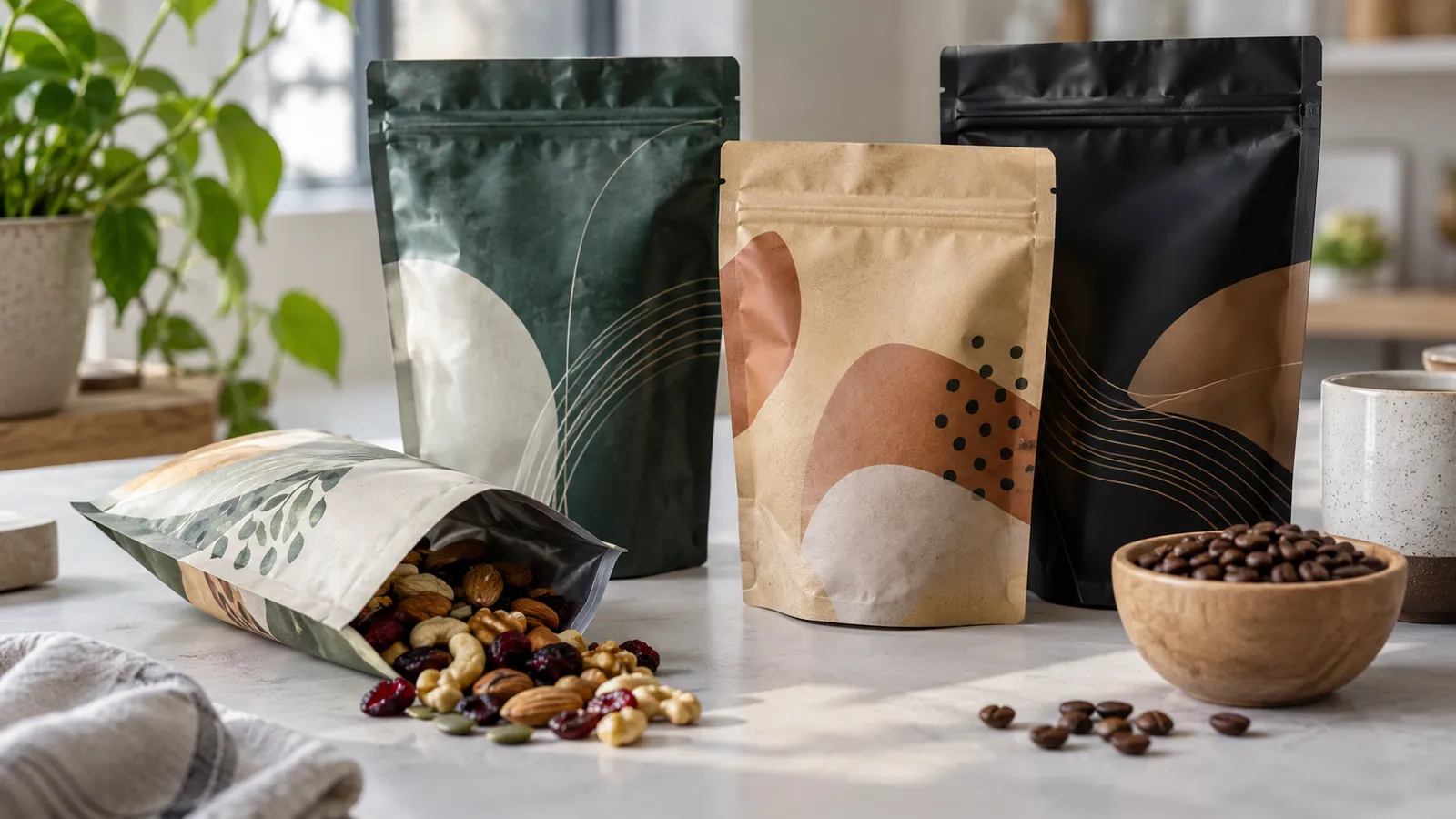
Continue reading
Related articles
Spouted Pouch: Spout Types, Materials and Filling
A spouted pouch is a flexible pouch with a plastic spout fitment for pouring or squeezing. Compare spout and cap types, structures, filling and recycling.
Stand-Up Pouch: Types, Materials and Features
A stand up pouch has a bottom gusset that lets it stand on shelf. Learn gusset styles, closures, laminate structures and filling considerations.

Flat Bottom Pouch: Box-Style Pouches Explained
A flat bottom pouch has a rectangular base and two side gussets that make a boxlike, self-standing pack. See construction, features and how it compares.