
Design for Recycling: A Checklist for Flexible Packaging
Design for recycling means building a pack to fit a recycling stream. Use this checklist for polymers, barriers, inks, adhesives, fitments and testing.
A compatible film can lose its recycling assessment when a label or closure changes. Start with the sales market and recycling stream, select the matching protocol, check every component, then assess the finished pack. Design compatibility does not establish that local services collect and recycle it; recyclable flexible packaging covers that separate decision.
Scroll horizontally to view all columns if needed. ↔
| Order | Record before proceeding |
|---|---|
| Market and stream | Destination; flexible PE, PP or another route; collection evidence |
| Protocol | Body, edition, stream and applicable clauses |
| Components | Complete BOM and mass shares, including print and fitments |
| Finished pack | Assessment scope, tests, line trial and claim evidence |
Guidelines and assessment bodies
Scroll horizontally to view all columns if needed. ↔
| Guidance | Region and stream | Edition or revision to record |
|---|---|---|
| CEFLEX D4ACE | Europe; flexible PE, PP and polyolefin structures | Phase 2, September 2025 |
| RecyClass PE / PP | Europe; natural flexible films for household/commercial packaging | March 2026; choose the separate coloured-film guideline when applicable |
| APR PE Flexible | North America; PE flexible packaging | Online guide updated September 30, 2026; record the individual test-protocol revision |
These are different systems, not a shared pass/fail threshold. Use the selected document’s material, colour and component rules; do not borrow a favourable limit from another protocol. APR’s PE film guidance is not a flexible-PP approval. Review the assessment against the edition used and confirm collection separately.
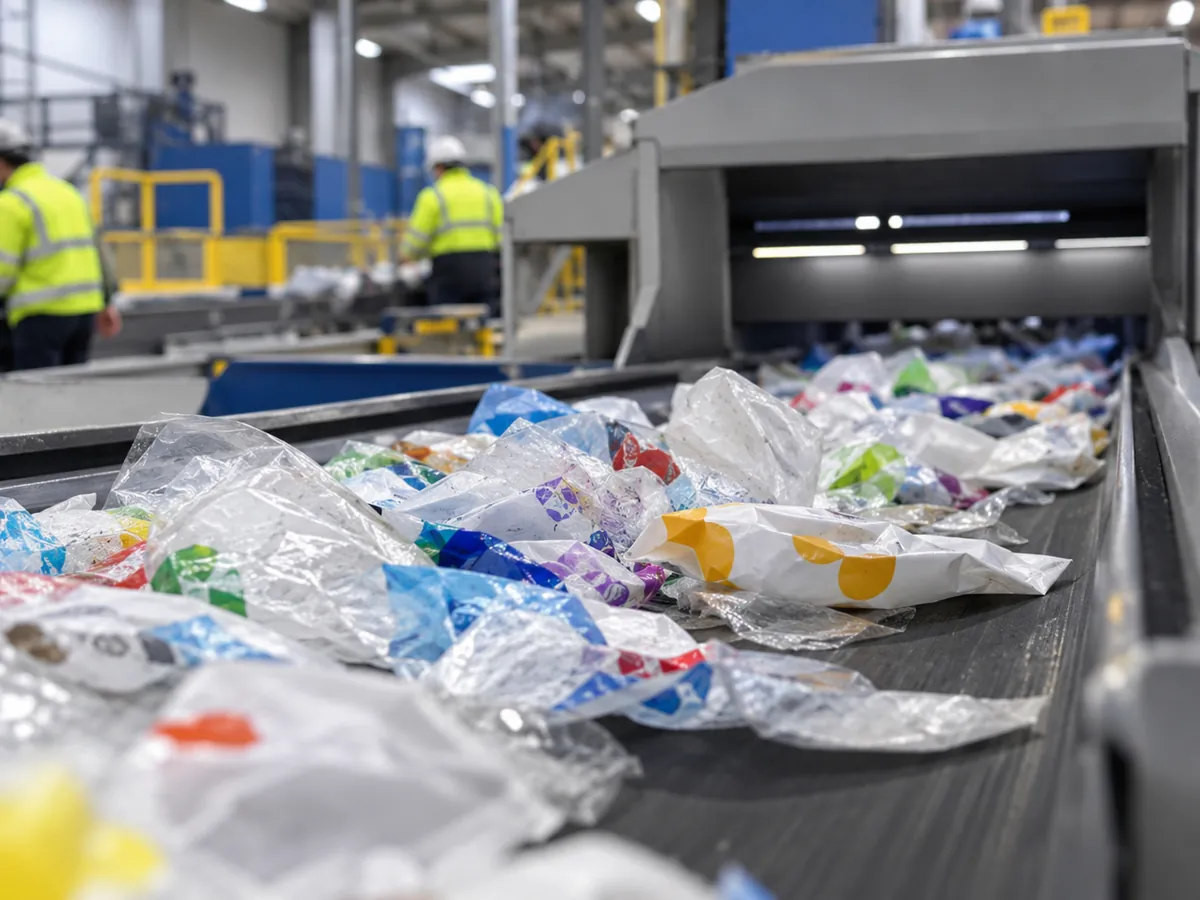
Design choices by component
Treat the pack as a component map: outer web → bond/barrier layers → sealant, with print, label and closure attached. This is a conceptual arrangement, not an approved recipe. CEFLEX’s component guidance and the selected RecyClass or APR document determine which combinations need testing.
Copy one row per component. Calculate its mass share as component mass divided by finished-pack mass; record the protocol’s own calculation basis if it differs.
Scroll horizontally to view all columns if needed. ↔
| BOM item / grade | Mass, g / share, % | Protocol clause | Test or declaration | Result / owner |
|---|---|---|---|---|
| Outer web / polymer: ____ | ____ / ____ | ____ | ____ | ____ / ____ |
| Barrier / tie layers: ____ | ____ / ____ | ____ | ____ | ____ / ____ |
| Adhesive / coat weight: ____ | ____ / ____ | ____ | ____ | ____ / ____ |
| Sealant / polymer: ____ | ____ / ____ | ____ | ____ | ____ / ____ |
| Inks / coating / pigment: ____ | ____ / ____ | ____ | ____ | ____ / ____ |
| Label / sleeve / adhesive: ____ | ____ / ____ | ____ | ____ | ____ / ____ |
| Zipper / spout / valve: ____ | ____ / ____ | ____ | ____ | ____ / ____ |
| Other parts / residues: ____ | ____ / ____ | ____ | ____ | ____ / ____ |
For the principal films, compare mono-PE and mono-PP. For product protection, specify the required barrier before considering a coating or metallization. Neither a thin layer nor a familiar adhesive process establishes acceptance.
Record a label’s substrate and adhesive as separate BOM items. Include every part of a zipper pouch or spouted pouch; a closure assessment does not describe the film around it. For sachets and stick packs, also check the protocol’s size and sorting requirements. Pigment identification matters where optical sorting is part of the route.
The completed map should account for the entire pack mass. Missing ink, tie-layer or valve information is an unresolved item, rather than a zero entry.
How to test and document
- Write the bill of materials. List every layer, polymer, thickness, adhesive, ink, coating, label and fitment, with supplier names and identifiers kept in your records.
- Run the assessment. Use the body’s online tool or request formal assessment under the protocol for your region. Some programs include sample testing.
- Keep the evidence. Store the assessment report, the guideline version used, and the approved bill of materials together. A later substitution of an ink, adhesive or label can invalidate the result.
- Test on the line. A recyclable structure still has to seal and run. Check seal strength, hot tack and leak resistance, and shelf life. See seal strength.
- Re-check after changes. Review the assessment whenever a component changes or a guideline is updated.
Why PPWR raises the stakes
Regulation (EU) 2025/40, Article 71, sets general application from 12 August 2026. Article 6 phases in design-for-recycling grades and recycling-at-scale requirements later; general application is not the deadline for every recyclability obligation. Use the claims and timing guide before interpreting an industry assessment as regulatory compliance.
Common mistakes
Scroll horizontally to view all columns if needed. ↔
| Mistake | Why it causes trouble | Better approach |
|---|---|---|
| Adding a different polymer for stiffness | May change compatibility | Check the exact structure and clause |
| Carrying a barrier into a redesign | Acceptance is protocol-specific | Check its chemistry, mass and test route |
| Fitment assessed by family name alone | Composition and scope are missing | Record the grade and assessment limits |
| Full-body sleeve or label in another polymer | Can disqualify the pack | Direct print or same-family label |
| Checking only the film, not the finished pack | Components are assessed together | Assess the whole pack |
| Using an outdated guideline version | Limits change | Check the current version each time |
| Claiming “recyclable” without regional availability | Collection varies by market | Qualify claims and confirm collection |
| Changing an ink or adhesive after approval | May put the new BOM outside its scope | Reassess the substitution |
What to put in a design-for-recycling brief
Keep the market, collection route, protocol edition, completed BOM table, assessment report and product-protection trial record together. Assign an owner to every unresolved clause. A blank result means “awaiting evidence,” not “passed.” Use the existing common-mistakes table as a final review before signing off the design.
Frequently asked questions
What are the different Recyclability certifications?
RecyClass distinguishes semi-finished material, finished-pack design and country-specific recyclability assessments. Read the certificate’s scope: a design assessment is not proof of collection in every market. Its official FAQ explains the separate routes.
What is the difference between a Technology Approval and Recyclability Certifications?
A technology approval evaluates a feature against a specified recycling process. Finished-pack certification considers the package under its applicable scheme. Adding an approved feature does not certify every pouch that contains it.
Sources and method
Official guidance editions are linked above; reviewed October 9, 2026. The CEFLEX design principles support stream-specific design. This checklist records evidence; it does not issue a certification, establish local collection or replace product and line validation.

Continue reading
Related articles
Recyclable Flexible Packaging: What Makes a Pouch Recyclable
Recyclable flexible packaging explained: design factors, collection reality, verification protocols, claim rules and a checklist for converting a laminate.

Compostable Flexible Packaging: Materials, Standards and Limits
Compostable flexible packaging breaks down under defined composting conditions. Learn the standards, common materials, barrier limits and when it makes sense.

Mono PE vs Multilayer Film: Recyclability vs Performance
Mono PE vs mixed-material multilayer film compared on recyclability, barrier, seal window, print and cost, with guidance on which structure suits your product and line.