
Compostable Flexible Packaging: Materials, Standards and Limits
Compostable flexible packaging breaks down under defined composting conditions. Learn the standards, common materials, barrier limits and when it makes sense.
A compostable pack needs three checks: a local organics route that accepts it, performance that protects the product, and certification covering the final packaging. Industrial certification alone does not establish home compostability or local acceptance. Check collection first before investing in a film change.
Decide whether the route fits
- Confirm that the destination collector and facility accept this packaging format.
- Set product barrier, shelf-life and machine targets; test the exact candidate structure.
- Confirm that certification covers the final grade, thickness, coatings, inks and other components.
Scroll horizontally to view all columns if needed. ↔
| Decision field | Project entry |
|---|---|
| Market / collector / facility / acceptance date | ___ |
| Product / required life / storage conditions | ___ |
| Film grade / complete structure / thickness | ___ |
| OTR / WVTR / temperature and both-side humidity | ___ |
| Filled-pack and line-trial results | ___ |
| Final-pack certificate / standard / scope / validity | ___ |
| Food-contact declaration / intended use | ___ |
| Disposal instruction / evidence owner | ___ |
Takeaway: Confirm acceptance first, then complete the performance and certificate checks.
What compostable means, and what it does not
“Biodegradable” without a specified environment, time and outcome does not establish compostability. EN 13432:2000 addresses biodegradation, disintegration, effects on biological treatment and compost quality. ASTM D6400-23 covers plastics and products intended for municipal or industrial aerobic composting where thermophilic conditions occur.
Scroll horizontally to view all columns if needed. ↔
| Check | Industrial route | Home route |
|---|---|---|
| Environment | Managed facility; aerobic, thermophilic conditions within D6400’s scope | Backyard conditions differ from the controlled industrial process |
| Evidence | Applicable industrial standard and exact certified packaging scope | Separate evidence covering the home-compost claim |
| Collection | Confirm facility acceptance of this film or pouch | Confirm the claim and disposal instructions for the intended use |
The FTC Green Guides call for qualification where an item cannot be composted safely and in time at home, or where suitable facilities are not widely available. Industrial evidence is not proof of a backyard outcome.
Takeaway: Keep industrial and home claims separate.
Common materials for compostable flexible packaging
Candidate grades can use PLA, compostable polyester blends, regenerated cellulose, paper with polymer coatings or starch blends. Those names do not establish a barrier level, sealing window or compostability claim. Request the composition and exact-grade data sheet, plus the finished-pack certificate scope, rather than ranking these families by generic properties. For coated paper, see paper-based flexible packaging.
Cellulose film in packaging
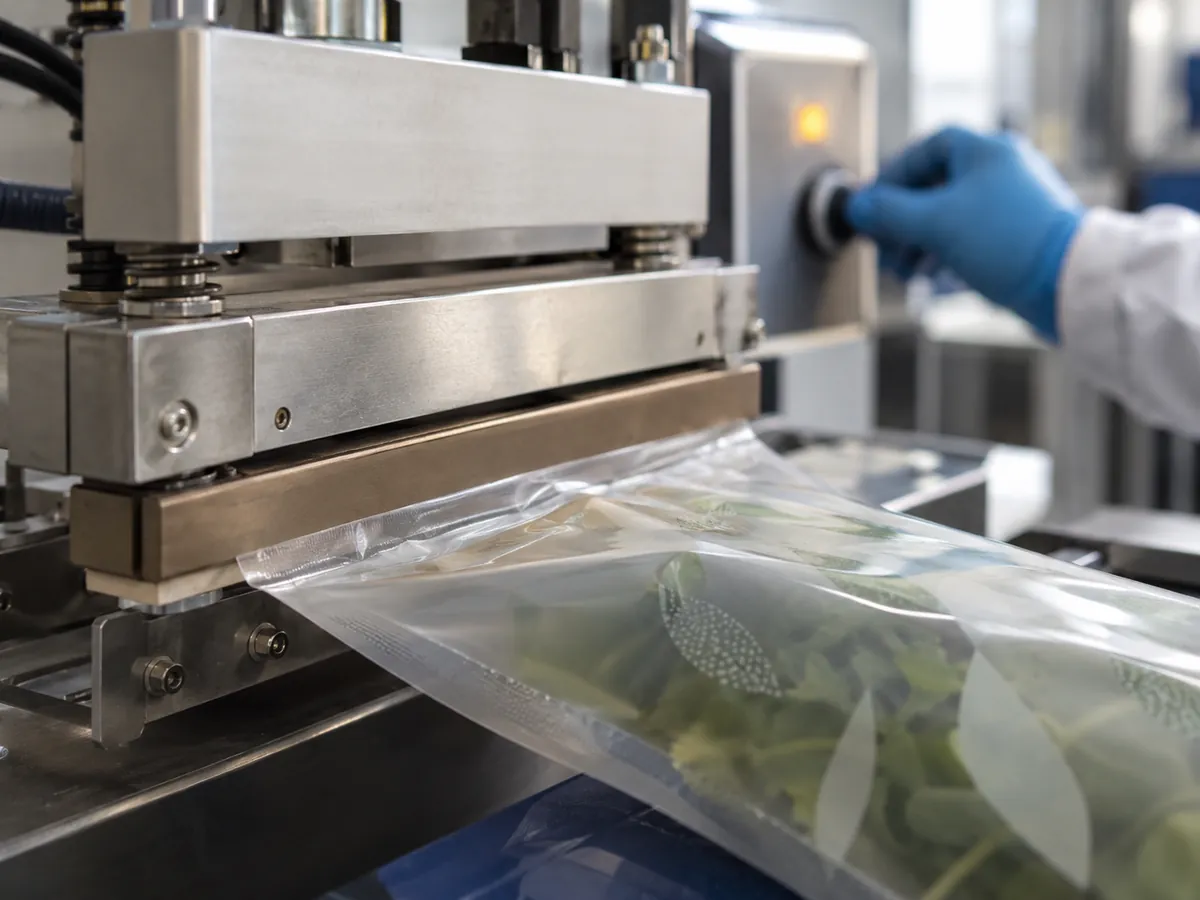
Regenerated cellulose film is a thin cellulose-based sheet that may be coated on one or both sides. Confirm the base material and each surface layer; a clear appearance does not identify the structure.
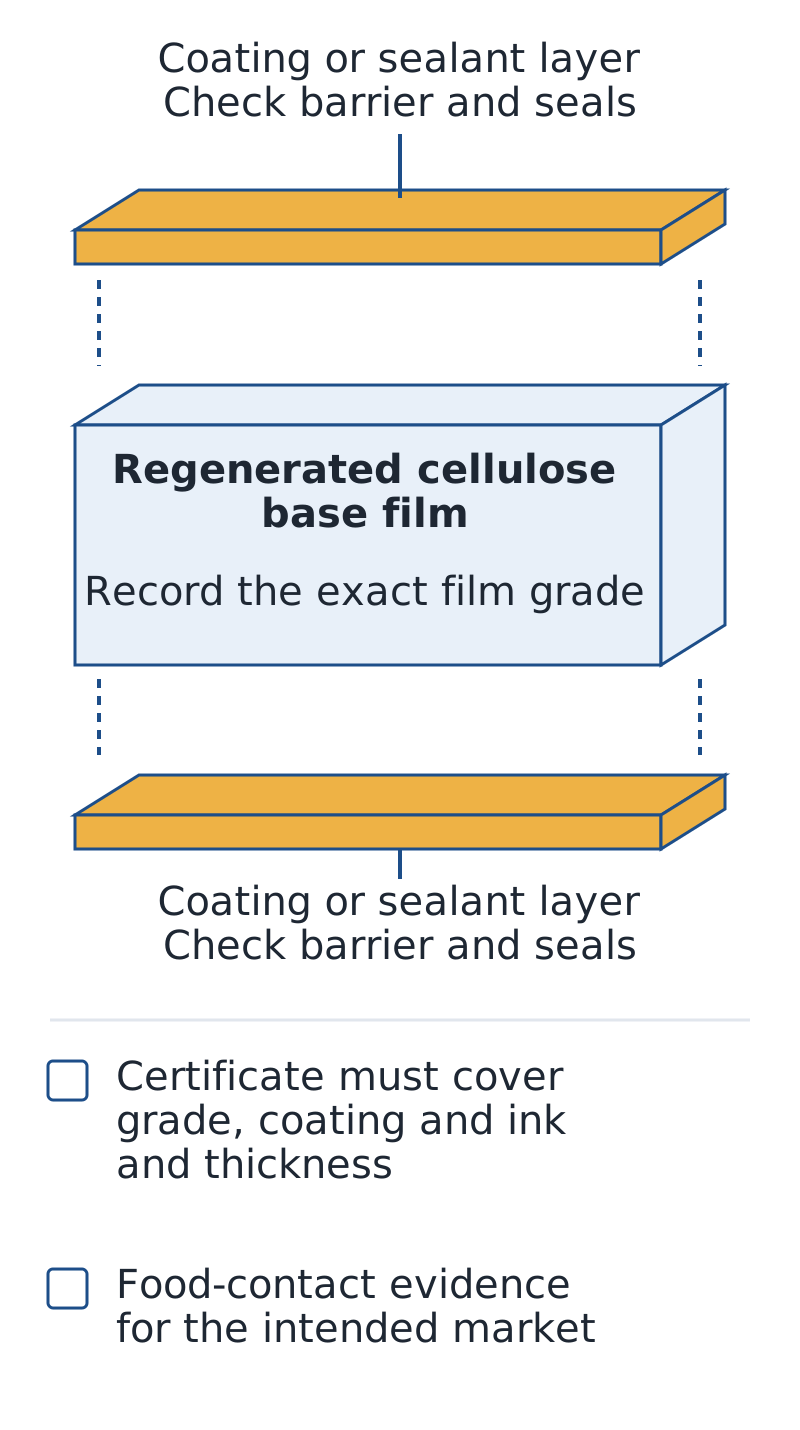
For a coated grade, ask which layer provides the intended barrier and sealing function. Record thickness, temperature and humidity with each transmission result, and the recommended temperature, dwell and pressure for the actual sealant. Validate these conditions on filled packs rather than assuming that all cellulose films behave alike.
A base-material result does not certify the final pack. ASTM D6868-21 covers end items with plastic or polymer coatings/additives on paper and other substrates for municipal or industrial aerobic composting. EN 13432’s whole-pack scope also matters when non-compostable components are present. Match the certificate to coatings, print, adhesive, seals and thickness.
Food contact is a separate question with its own rules. In the United States, 21 CFR 177.1200 sets the conditions under which cellophane, a regenerated cellulose base sheet with permitted optional substances and coatings, may be used for packaging food. In the EU, regenerated cellulose film is covered by Directive 2007/42/EC, Articles 1-6 and Annex I, a specific measure under Regulation (EC) No 1935/2004, which distinguishes uncoated film, film with a cellulose-derived coating and film with a plastic coating. The directive excludes synthetic regenerated-cellulose casings. Ask for the relevant compliance basis for your market, food and contact conditions; compostability is a separate assessment.
If you are comparing cellulose film suppliers or manufacturers, ask each for the same set of documents: the grade data sheet with barrier conditions, the compostability certificate and its scope, the food-contact declaration, the recommended sealing range, and roll storage conditions. Then run the grade on your own machine before committing to a structure.
Takeaway: Match certification and food-contact evidence to the complete grade.
Barrier and shelf-life limits
A compostability certificate does not specify moisture or oxygen transmission, and the material family does not establish an equivalent to a particular foil or EVOH laminate. Compare the candidate grade with the current film at the same temperature and humidity, recording thickness and full construction. See OTR, WVTR and barrier film for the measurement questions.
Use the intended product, seals and storage route for filled-pack validation. Set separate quality and safety endpoints where relevant; the shelf-life guide provides a study record.
Takeaway: Choose against the measured protection target, not a generic “compostable versus conventional” barrier ranking.
Collection reality
Certification does not arrange collection. Confirm acceptance with the actual collector and receiving facility, including the format, certificate, food residue and labeling. Keep a dated acceptance record; do not infer acceptance from the existence of an organics bin.
The certified composting outcome should not be assumed for landfill or an unrelated plastic-recycling process. Match disposal instructions to the verified local route.
Takeaway: Keep the receiving facility’s dated acceptance with the disposal instruction.
Labeling and claims
Compostability claims are regulated or guided in many markets, and rules differ. Points to watch:
- Use the claim that matches the certification: industrial or home, and only where it applies.
- Say what the consumer should do with the pack, and avoid implying it can go anywhere.
- Avoid generic claims such as “eco-friendly” or “planet-safe” without support.
- Keep certificates current and tied to the exact structure, including inks and adhesives.
- Confirm labeling and claim requirements for each destination market, and with your own regulatory advisers.
Regulations on packaging are changing, including the EU’s Packaging and Packaging Waste Regulation, Regulation (EU) 2025/40, which applies generally from 12 August 2026 and addresses compostable packaging for some product categories. Confirm what applies to you rather than relying on a summary.
Machine considerations
Use the supplier’s exact-grade recommendations as starting conditions, then record jaw temperature, dwell, pressure, line speed, friction, hot tack, final seal strength and leakage. Confirm roll storage conditions and shelf life before use. See seal initiation temperature and machine compatibility.
There is no universal slower speed or narrower sealing window for all compostable films. Approve the candidate only after its filled packs meet the project’s acceptance criteria.
Takeaway: Approve the actual line trial, not a material-family processing assumption.
Compostable versus recyclable packaging
Scroll horizontally to view all columns if needed. ↔
| Question | Compostable | Recyclable |
|---|---|---|
| End-of-life route | Industrial (sometimes home) composting | Mechanical recycling in a plastic or paper stream |
| Needs a specific collection system | Yes, organics collection that accepts it | Yes, collection and sorting for that material |
| Protection evidence | Exact-grade barrier and filled-pack validation | Exact-grade barrier and filled-pack validation |
| Food residue | Confirm facility acceptance with the residue present | Confirm collection and reprocessing requirements |
| Certification | EN 13432, ASTM D6400 and similar | Scheme-based design guidance and tests |
| Risk if collected wrongly | Contaminates recycling or goes to landfill | Ends up in landfill or contaminates other streams |
For the recycling side, see recyclable flexible packaging.
Takeaway: Compare measured protection and verified local routes for both candidates.
When compostable packaging makes sense
Compostable options fit best when a collection route exists for the pack and the product.
- Food-contaminated packs that are hard to recycle, where the pack and the food waste can be collected together in an organics stream.
- Tea bags, coffee pods and similar items that are used and discarded with organic residue. Check coffee packaging materials for barrier needs before and after use.
- Closed or controlled settings, such as events, campuses or institutions, where the collection is arranged.
Compare a recyclable candidate when a suitable recycling route exists or compost collection is uncertain. Neither route removes the need to prove protection for the intended product.
Steps to decide whether a compostable pack fits
Use the decision record above for each destination and final structure. Compare alternatives with the same product, required protection and disposal assumptions; flexible packaging LCA explains the comparison boundaries.
The sustainability hub covers the other routes.
Questions and answers
Can compostable packaging go in food waste?
Only where the collector and receiving facility accept that packaging. A certificate alone does not authorize placement in every food-waste bin; confirm the local instruction for the exact format.
Can compostable packaging be recycled?
Do not infer compatibility with a plastic-recycling stream from compostability. Follow the local collector’s instructions for the actual material and format.
Common mistake: Using the certificate for the base film after changing a coating, ink, adhesive or thickness. Confirm whether the final construction remains within its scope.
Methods and sources
Checked 8 October 2026. Public standard scopes define the intended process; full procedures and certificates determine the applicable assessment.
- EN 13432:2000 public scope, ASTM D6400-23 and ASTM D6868-21, linked above: industrial compostability and whole-item scope.
- 21 CFR 177.1200 and Directive 2007/42/EC, linked above: food-contact conditions for regenerated cellulose, not compostability certification.
- FTC Green Guides, linked above: qualification of compostable claims and limits of home/facility availability.
- PPWR, Regulation (EU) 2025/40, Article 9 and 71: specified compostable-packaging obligations and application dates.

Continue reading
Related articles

Design for Recycling: A Checklist for Flexible Packaging
Design for recycling means building a pack to fit a recycling stream. Use this checklist for polymers, barriers, inks, adhesives, fitments and testing.
Mono PE vs Multilayer Film: Recyclability vs Performance
Mono PE vs mixed-material multilayer film compared on recyclability, barrier, seal window, print and cost, with guidance on which structure suits your product and line.
Mono-Material Packaging: Mono-PE and Mono-PP Flexible Structures
Mono material packaging explained: how mono-PE and mono-PP structures are built, their barrier limits, and what they change on the packaging line.