
Mono-Material Packaging: Mono-PE and Mono-PP Flexible Structures
Mono material packaging explained: how mono-PE and mono-PP structures are built, their barrier limits, and what they change on the packaging line.
Replacing a mixed laminate without checking protection and sealing can produce leaks or shorten shelf life. Mono-material packaging uses predominantly one polymer family, usually PE or PP, but the complete structure still needs product and machine validation. This is a comparison of design routes from public guidance, not a report of our testing.
Scroll horizontally to view all columns if needed. ↔
| Candidate | Starting use | Gate before selection |
|---|---|---|
| Mono-PE | Replacement of a PE-sealed laminate | Outer-web stability, barrier and sealing trial |
| Mono-PP | Review of a PP-based wrap or pouch | Grade-specific sealing and temperature exposure |
| Mixed-material laminate | Retain where a candidate cannot protect the product | Confirm actual performance and disposal route |
Product protection and a passing line trial are prerequisites for a switch. Neither a polymer name nor a recycling assessment supplies that evidence.
What counts as a mono-material structure
A mono-material structure is made mostly from a single polymer family. In practice that means outer film, sealant, adhesive and often the print and any barrier layer are chosen so that the whole pack falls within a recycling stream for that polymer. Barrier layers, inks, adhesives and attachments have separate restrictions under the selected protocol; small amounts are not automatically acceptable.
Use CEFLEX D4ACE Phase 2, September 2025 for European flexible-packaging design, or the relevant RecyClass PE / PP film guidance, both updated March 2026. For North American PE film, APR PE Flexible was updated September 30, 2026. Record the stream and edition; these schemes do not share a universal polymer-percentage threshold. Local collection remains a separate check under recyclable flexible packaging.
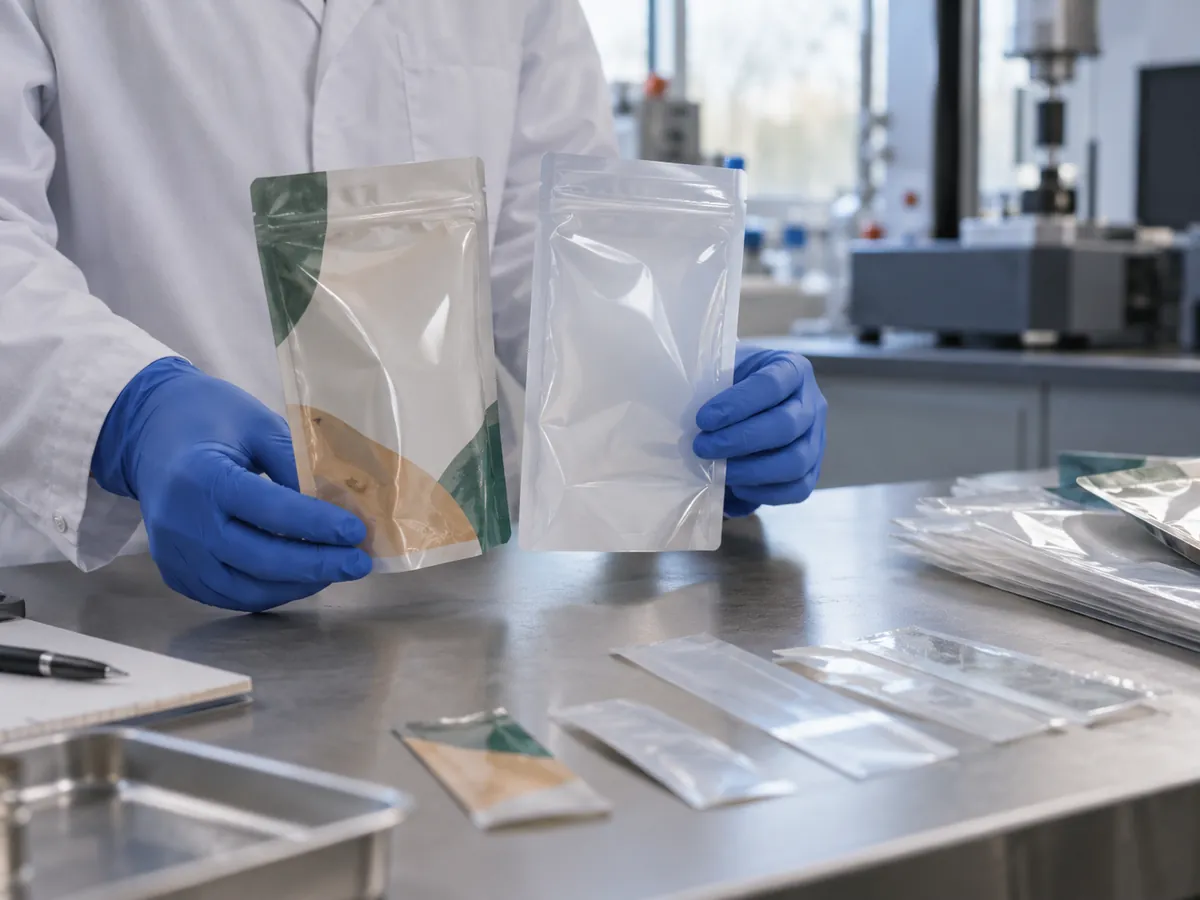
How mono-PE structures work
In a mono-PE pouch, the layer that would have been PET is replaced by a PE film that gives enough stiffness and print quality. Two approaches are common:
- Machine-direction oriented PE (MDO-PE): orientation in the machine direction; request directional properties for the chosen grade.
- Biaxially oriented PE (BOPE): orientation in both directions; compare actual gauge, directional properties and shrinkage, rather than assuming a performance ranking.
Choose the sealant and outer film as a pair. Confirm that the outer web remains stable at the temperature, pressure and dwell needed to form the seal. For the polymers themselves, see PE film.
How mono-PP structures work
A PP route may combine a BOPP outer web with a CPP sealant, or use a sealable coextruded web. A manufacturer’s public BOPP resin summary, dated July 2025, separates homopolymer core grades from terpolymer seal-layer grades. It supports specifying different layer functions, not a universal PP-over-PE ranking. BOPP film explains the oriented web; finished-laminate data is still needed.
Barrier options and their limits
Replacing PET, foil or metallized PET removes barrier that the old laminate relied on. Typical ways to restore it:
- Thin EVOH layers. Coextruded EVOH gives strong oxygen barrier but is moisture sensitive and, in guidelines, is allowed only within limits.
- Barrier coatings. Thin coatings on the film can reduce oxygen or moisture transmission without adding a separate polymer layer.
- Metallization. A thin metal deposit improves barrier and light block. Its acceptability depends on the guideline and recycling stream you are targeting.
Compare the candidate with the actual laminate being replaced, including converted-pack damage. The barrier achieved should be confirmed with OTR and WVTR data, stated at the test temperature and humidity, and then with a shelf-life study on the real product. The barrier film page covers how these options compare. Paper-based structures take a different route, covered in paper flexible packaging.
What mono-material changes on the machine
The operating window belongs to the selected structure and machine. Measure seal formation and outer-web distortion together; do not assume a mono-material window is always narrower. Trial checks include:
- Temperature range. Record the passing interval and jaw-temperature uniformity. See seal initiation temperature for how the sealing window is defined.
- Dwell time and pressure. Both may need retuning, and line speed may drop on some machines.
- Jaw release. Release coatings on the jaws or tapes can help prevent sticking.
- Forming and tracking. A less stiff outer film can behave differently over a forming collar. Check the points covered in VFFS film.
- Seal integrity. Test seal strength and leak resistance at the edges of the running window as well as at the center.
How to specify and trial a mono-material pack
Use one record for each structure revision. Confirm product protection before comparing line performance, then submit the finished BOM for recycling assessment.
Scroll horizontally to view all columns if needed. ↔
| Trial field | Requirement / evidence | Result / owner |
|---|---|---|
| Layers, grades and gauge | BOM: ____; barrier/adhesive: ____ | ____ / ____ |
| Product and storage | Shelf life: ____; exposure: ____ | ____ / ____ |
| Barrier | OTR/WVTR method, temperature/RH: ____ | ____ / ____ |
| Machine and seal window | Speed, temperature, dwell, pressure: ____ | ____ / ____ |
| Integrity and handling | Seal, leak, drop and shelf-life criteria: ____ | ____ / ____ |
| Recycling | Region, protocol/edition and full-pack scope: ____ | ____ / ____ |
Frequently asked questions
What is mono-material packaging?
It is packaging dominated by one material family, not necessarily one layer. An outer film, sealant and optional barrier can form a multilayer mono-material structure only within the chosen protocol’s restrictions. The label alone proves neither compatibility nor local recycling.
Sources and method
Official design guidance and the manufacturer’s July 2025 layer-grade summary are linked above; reviewed October 9, 2026. Manufacturer information describes its own grades and is not a recommendation. No finished-pack comparative measurements or generic sealing-temperature limits are asserted.
Continue reading
Related articles
Mono-PE Packaging: Polyethylene-Based Pouches and Laminates
Mono PE packaging replaces PET/PE laminates with polyethylene-based films. See the outer webs, barrier options, seal window and machine changes involved.
Mono PE vs Multilayer Film: Recyclability vs Performance
Mono PE vs mixed-material multilayer film compared on recyclability, barrier, seal window, print and cost, with guidance on which structure suits your product and line.
Mono-PP Packaging: Polypropylene-Based Structures
Mono-PP packaging uses a PP-dominant structure. Check outer and sealant grades, cold-use and retort evidence, barrier, and recycling-stream compatibility.