
Paper-Based Flexible Packaging: Barrier Coatings and Machinability
Paper flexible packaging uses coated paper for pouches and wraps. See how barrier coatings, recyclability and machine behavior compare with plastic laminates.
Choosing coated paper from a flat-sheet barrier value can lead to leaking folds, lost shelf life or a slower line. Choose the structure from the product’s dry or wet exposure, then verify barrier after forming, seal performance and the intended recycling route. Paper-based flexible packaging combines a paper substrate with coatings or other layers; those additions determine its practical use.
Scroll horizontally to view all columns if needed. ↔
| Route | Product screen | Evidence before selection |
|---|---|---|
| Paper with thin coatings | Start with dry-product requirements | Barrier after creasing; coating sealability |
| Paper/plastic laminate | Check wet-contact and barrier needs | Layer composition; filled-pack and recycling tests |
| Plastic laminate | Compare where paper candidates fail | Equivalent protection; actual disposal route |
No route has a universal barrier or line-speed ranking. Treat the comparison as a test plan for the specific construction.
What is barrier paper?
Barrier paper is paper that has been coated, treated or combined with another layer so that it resists something plain paper lets through: grease, water vapor, liquid water, oxygen or aroma. In flexible packaging the term usually also implies a heat-seal function, so the paper can close on a pouch or wrapping machine. The barrier comes from the added layer, not from the paper, so two papers sold as “barrier paper” can perform very differently. Always ask which barrier is meant and how it was measured.
The name is also used outside packaging, for example for building vapor-barrier papers and protective sheet papers. Those products are not designed for food packing or machine sealing, so check that a data sheet refers to a packaging grade.
A barrier paper for flexible packaging is described by four things:
- The base paper: its weight, fiber type and surface, which affect stiffness, print and how the coating lies.
- The barrier coating or layer: what it is made of, its coat weight, and whether it is on one side or both.
- The sealing method: a heat-seal coating, a cold-seal adhesive or a thin polymer layer.
- The evidence: barrier test results with temperature and humidity, and, if a recycling claim is made, the recycling test protocol and result for that exact structure.
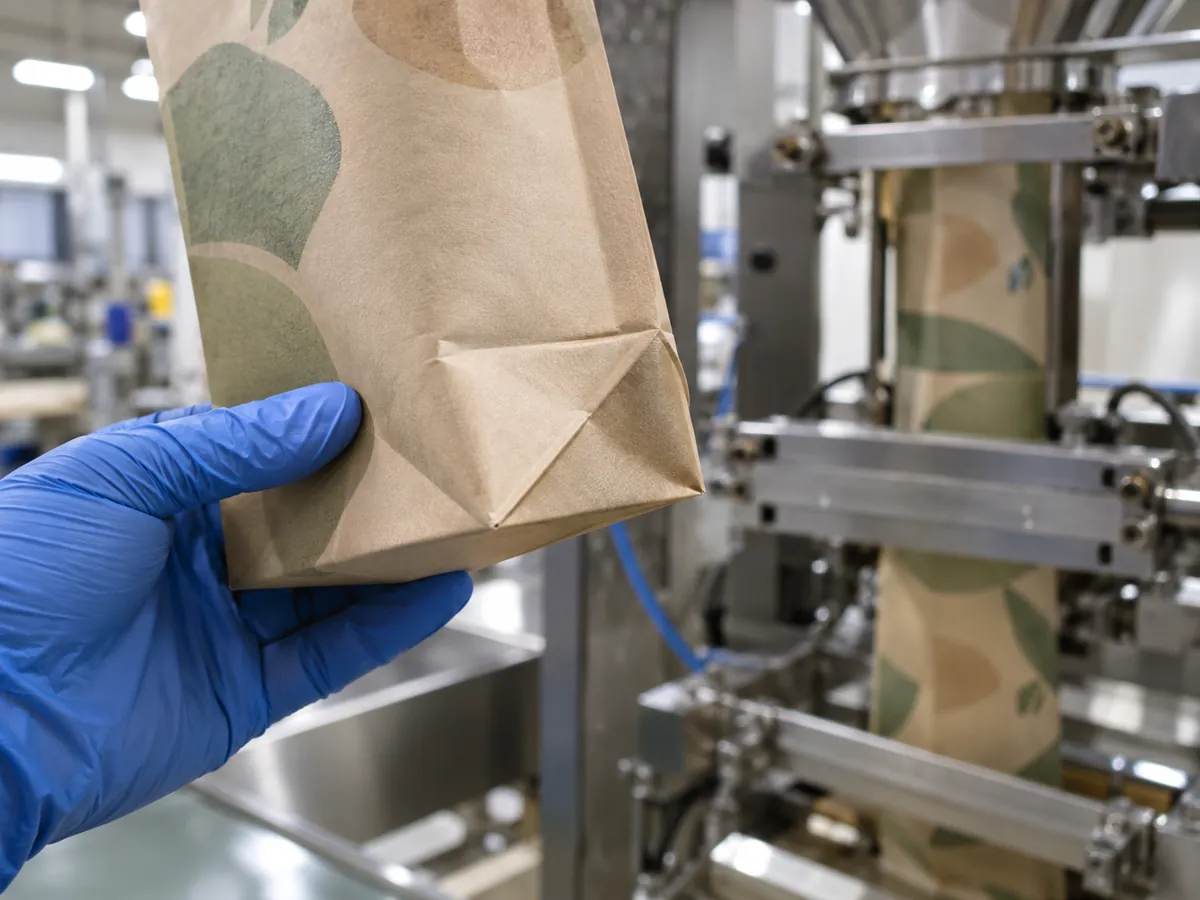
Scroll horizontally to view all columns if needed. ↔
| Position in the layer path | Damage to investigate |
|---|---|
| Paper at a tight fold | Substrate fracture or local deformation |
| Barrier coating across a crease | Loss of coating continuity |
| Sealing layer at a folded corner | Uneven contact or a channel in the seal |
Inspect these locations after forming and transport, then test the relevant barrier or integrity requirement. The layers above are schematic roles, not a supplier recipe.
What paper-based packaging is made of
Most paper-based packaging sits on a spectrum, and the labels used in the market are not always precise.
- Paper with a dispersion or water-based coating: record the actual coating function and coat weight on each side.
- Paper with a heat-seal lacquer: a sealable coating, applied in a pattern or over the full surface, lets the paper close on a form-fill-seal machine or a flow wrapper.
- Paper extrusion coated or laminated to a thin film: a layer of PE, or a thin film with a barrier, brings back conventional sealing and barrier. Neither barrier nor paper-stream acceptance can be inferred from the plastic share alone.
- Paper with a metallized or vacuum-coated layer: used where a light barrier is wanted. Check how the supplier treats it in recycling terms.
A standard plastic laminate, described on the laminated packaging page, is different: a printed film is bonded to a sealant film and the layers can be tuned independently.
When a coating ingredient carries a carbon claim, the paper-coating announcement review identifies the product boundary and the separate functional evidence to request.
Select samples by their named paper grade, coating chemistry, added-layer mass and sealing method.
Recyclability in paper streams
Brands mostly look at paper because it might go into the paper recycling stream. That depends on how well the coated paper breaks down in a pulper and what the leftover coating does to the process. Four things matter.
- Repulpability testing: paper mills and recycling schemes use laboratory repulping and screening tests to check whether fibers separate and how much coating or plastic remains as reject. Test methods and pass criteria are defined by schemes and by individual guideline bodies, so ask which protocol was used and whether the result is on your exact structure, not a similar one.
- Fiber content thresholds: schemes and guidelines differ on how much of the pack must be paper fiber for it to count as recyclable in the paper stream, and the thresholds are not the same across regions or organizations. Do not assume a single number. Ask for the threshold in the scheme you target.
- Coating type: identify it and obtain a test on the finished construction; “water-based” or “thin” is not a recycling result.
- Collection: a pack can pass a lab test and still not be collected. Whether households put flexible paper pouches in a paper bin, and whether sorters leave them in the paper stream, varies by location.
Choose the test route that matches the destination mill. Cepi’s February 2025 Version 3 method covers paper and board for mills with a conventional process; its scope is not every mill technology. Obtain the exact-structure report and confirm collection separately. Recyclable flexible packaging and design for recycling explain the broader checks.
Barrier limits: grease, moisture and oxygen
Coating chemistry, continuity and exposure determine the barrier. Compare data for the actual grade:
- Grease: coatings on paper can give good grease resistance. It is one of the stronger areas for paper structures, relevant for baked goods, some confectionery and dry mixes with oils.
- Moisture: compare the complete coated-paper and film constructions at matching conditions; do not rank them by substrate name. WVTR is the measure to look at.
- Oxygen: uncoated paper is not an oxygen barrier. Oxygen barrier coatings on paper exist, but results depend on coating continuity, humidity and what happens at folds and seals. Where oxygen control is critical, look at the oxygen transmission rate.
Test conditions (temperature and relative humidity) matter a great deal when you compare numbers, and paper-based barriers are often more humidity-sensitive than film. Confirm figures with supplier data sheets and test your own filled packs.
Machine issues with paper structures
Paper behaves differently from film on a machine. These points come up most often in trials.
- Stiffness: paper is stiffer than most film in the machine direction and can be less forgiving around forming shoulders, collars and tight radii. Pouch formers set up for film may need adjustment.
- Cracking at folds: barrier coatings can crack where paper is creased, at gussets and at the corners of a pouch. A crack in the coating is a leak path for moisture or grease, even if flat-sheet barrier looks good.
- Dust and fibers: paper sheds fiber and coating dust, which can end up on sealing jaws and in the product area, so cleaning intervals may be shorter.
- Seal strength: measure the selected seal system using ASTM F88/F88M-23 with the specified strip and support method. ASTM F2029-16(2021) covers making laboratory heat seals to assess heat sealability; laboratory preparation is not a production-speed trial or proof of package integrity. The seal strength page lists what to ask for.
- Sealing window and speed: record temperature, dwell, pressure and throughput together. Confirm jaw release and package quality at the planned settings instead of assuming a fixed speed penalty.
- Static and web tracking: humidity changes paper dimensions, so web tension and registration can drift.
Run filled packs on the actual machine at target speed and record the first limiting defect before committing.
Where paper-based packaging works
Paper structures tend to fit where the product tolerates modest barrier and the pack format is simple.
- Dry goods such as flour, sugar, rice, pasta, dry mixes and some tea, where moisture exposure is limited and shelf life is moderate.
- Confectionery wraps, where grease resistance and a natural look are wanted and the product has a short or moderate shelf life.
- Some flow wraps for bars and baked items. Flow wrap packaging and flow wrapper film show how those lines treat the web.
- Sachets and small pouches for dry powders, where the format is flat and folds are limited.
Paper is a harder fit for oxygen-sensitive products, wet or liquid products, long shelf-life goods, and formats with deep gussets or many folds.
Questions to answer before requesting paper samples
Copy this record for each sample. Specify barrier requirements and acceptance criteria before the trial.
Scroll horizontally to view all columns if needed. ↔
| Record field | Requirement / record | Result / evidence |
|---|---|---|
| Structure and sample | Paper grade, basis weight, layers/coat weights, lot: ____ | ____ |
| Target market | Country; collection and mill/test route: ____ | ____ |
| Product protection | Dry/wet contact, shelf life and storage: ____ | ____ |
| WVTR / OTR | Method, units, temperature/RH and conditioning: ____ | ____ |
| Folding and forming | Format, crease locations and barrier after forming: ____ | ____ |
| Sealing and machine | Speed, dwell, pressure, temperature; acceptance: ____ | ____ |
| Filled-pack transport | Leak/drop/transit exposure and acceptance: ____ | ____ |
| Recycling | Exact-structure protocol/version and criterion: ____ | Report / owner: ____ |
Blank fields are for project inputs; no example performance values are implied. Reject or revise a structure that fails its agreed protection, sealing or handling criteria. The sustainability overview connects these checks with other material routes.
Frequently asked questions about barrier paper
What are barrier coatings?
They are added layers providing a specified barrier or sealing function. Record their chemistry and amount; the structure section distinguishes coatings from added films.
Is barrier paper recyclable?
Only a scoped test and the destination’s acceptance can answer for a particular pack. Use the paper-stream checks, not the word “paper” on a data sheet.
Are barrier papers free of PFAS?
FDA’s February 28, 2024 notice reports that PFAS grease-proofing substances were no longer sold for food-contact use in the US market. It is not global proof that a paper is PFAS-free. Obtain product-specific evidence for the destination’s rules.
Can barrier paper replace a plastic laminate?
It can be a candidate when the required protection survives folding, sealing and transport. Use the opening route table and sample record; validate the filled pack before switching.
Sources and method
FDA’s 2024 US market notice, Cepi’s February 2025 Version 3 method, ASTM F88/F88M-23 and F2029-16(2021) official public scopes are linked above; reviewed October 9, 2026. Test scopes do not establish a material ranking or certify this pack. The layer path and inspection locations are conceptual; no measured barrier, seal or machine-speed results are presented.

Continue reading
Related articles
Mono-Material Packaging: Mono-PE and Mono-PP Flexible Structures
Mono material packaging explained: how mono-PE and mono-PP structures are built, their barrier limits, and what they change on the packaging line.
Mono-PE Packaging: Polyethylene-Based Pouches and Laminates
Mono PE packaging replaces PET/PE laminates with polyethylene-based films. See the outer webs, barrier options, seal window and machine changes involved.
Compostable Flexible Packaging: Materials, Standards and Limits
Compostable flexible packaging breaks down under defined composting conditions. Learn the standards, common materials, barrier limits and when it makes sense.