
Recyclable Flexible Packaging: What Makes a Pouch Recyclable
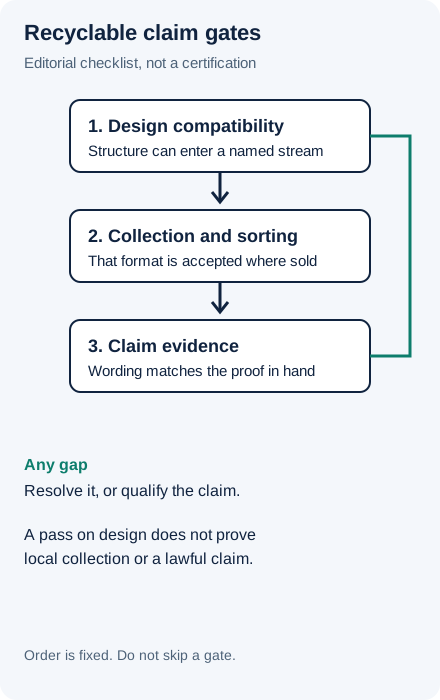
Check design compatibility, local collection and sorting, and claim evidence as three separate gates. A compatible structure can still be a misleading claim where that route is not collected.
This page covers design, verification and claims. Mono-material packaging covers how the structures themselves are built.
Three gates before a recycling claim
Scroll horizontally to view all columns if needed. ↔
| Gate | Evidence | If missing |
|---|---|---|
| Design compatibility | Finished BOM, stream and protocol/edition; assessment scope | Resolve components or request testing |
| Local collection and sorting | Current acceptance for this format in the sales market | Do not imply local access |
| Claim substantiation | Coverage, assessment limits and applicable wording rules | Review or qualify the claim |
The sequence is design, then the actual route, then a supported claim.
Recyclable in principle and in practice
Two questions matter. First, can the material be reprocessed if it reaches the right facility? Second, will it reach one? Collection, sorting and reprocessing infrastructure for flexible packaging varies by region. In some markets, flexible packaging is not accepted in curbside collection and is collected through store drop-off programs instead. A design can be recyclable in principle and still have low real-world recycling if consumers cannot easily return it. Both facts affect what you can say on the pack.
Design factors that affect recyclability
- Polymer choice: a pack made mostly from PE or PP, rather than a mix of PET, nylon, PE and foil, fits recycling streams better. See PE film and BOPP film.
- Barrier layers: thin EVOH, coatings and some oxide layers may be acceptable within guideline limits. Foil and thick nylon layers usually are not.
- Inks and adhesives: heavy ink coverage, certain inks and adhesives can affect recycled material quality or wash-off behavior.
- Metallization: metallized layers can be tolerated or restricted depending on the guideline.
- Labels and sleeves: a label of a different polymer, or one that is hard to separate, can disqualify a pack.
- Fitments: record the exact polymer grades, amounts and applicable component rules for zippers, spouts and valves. The stand-up pouch page shows typical fitment arrangements.
The mono-material packaging page shows how the film structure is built around these constraints. The design for recycling checklist goes through each component in turn. Paper-based packs follow different rules, and paper flexible packaging covers how coated paper is treated in paper streams.
Verifying recyclability
For North American PE film, use APR’s PE Flexible guide, updated September 30, 2026, and record the revision of any test protocol used. It is not PP-film guidance. For Europe, RecyClass natural PE and natural PP film documents were updated March 2026; select the appropriate coloured-film guidance where relevant.
Record the market, stream, edition, complete BOM and certificate or report scope. A component result cannot be transferred to an assembled pack without checking the assessment’s limits. These industry evaluations do not issue a global recycling guarantee.
Claims and labeling
The 2012 US FTC Green Guides summary calls for qualifying recyclable claims when appropriate facilities are unavailable to at least 60% of consumers or communities where the product is sold. Lower availability needs stronger qualification. This is a US claims rule, not a material-compatibility threshold; check applicable state rules too.
The EU PPWR original text, Regulation (EU) 2025/40, separates these dates:
Scroll horizontally to view all columns if needed. ↔
| Requirement | Article | Timing in the regulation |
|---|---|---|
| General application | 71 | 12 August 2026 |
| Design-for-recycling criteria / grades A to C | 6(2) and (3) | 1 January 2030 or 24 months after the relevant delegated acts enter into force, whichever is later |
| Collection/sorting; recycled at scale | 6(2) | Collection/sorting from 1 January 2035; scale requirement from that date or five years after the implementing acts, whichever is later |
| Material-composition sorting label | 12(1) | 12 August 2028 or 24 months after relevant implementing acts enter into force, whichever is later |
| Grades A to B only | 6(3) | 1 January 2038 |
Confirm scope, exceptions and the relevant secondary measures before choosing a deadline or printing a label. An industry assessment does not establish every PPWR obligation. Sources reviewed October 9, 2026.
Recyclable pouches and rollstock film in practice
Check the complete pouch, including its zipper, label, printing and valve; rollstock assessment still includes coatings, adhesives and barrier layers. Keep the approved BOM with the assessment so that substitutions can be checked. Supplier declarations for separate parts do not describe the assembly automatically.
For each market, record how a consumer can return the exact format and what the collection service accepts. Neither a familiar polymer symbol nor a film supplier’s certificate establishes this route.
Recyclability and the packaging line
A recyclable redesign can change the operating window, stiffness and barrier. Measure the candidate rather than assuming a narrower window or lower performance. A mono-material structure, for example, may need tighter jaw temperature control (see seal initiation temperature). The sustainable flexible packaging overview covers material options, regulation and machine effects together.
Steps for converting an existing laminate to a recyclable structure
- Document the current structure: every layer, adhesive, ink, coating, label and fitment.
- Identify the target recycling stream and region, and the guideline you will design to.
- List the barrier requirements that the current laminate meets and the shelf life you must keep.
- Choose a candidate structure, such as mono-PE or mono-PP, and a barrier approach that meets the guideline limits.
- Match fitments, labels, inks and adhesives to the same family and check their limits.
- Run seal, line and barrier trials, including worst-case conditions.
- Run shelf-life testing on the real product.
- Request a recyclability assessment under a recognized protocol.
- Check collection availability in each market and decide how the claim will be qualified.
- Have claim wording reviewed against current rules before launch.
Frequently asked questions
What is recycle-ready packaging?
Treat the phrase as a design claim whose scope needs explanation. Compatibility with a recycling process does not establish local collection. Use the three gates above before replacing it with an unqualified “recyclable” claim.
What is the difference between a Technology Approval and Recyclability Certifications?
RecyClass’s official FAQ distinguishes evaluation of a packaging technology from certification routes. A closure or film approval alone does not certify the full pouch with its other components and artwork.
Sources and method
Official legal texts, guidance editions and the certification FAQ are linked in their relevant sections; reviewed October 9, 2026. The three-gate sequence is an editorial checklist, not a certification protocol. The gate diagram added 11 October 2026 restates it. No local collection rates or results for a particular pack are asserted. Keep the component checklist with your claim evidence.
Continue reading
Related articles

Design for Recycling: A Checklist for Flexible Packaging
Design for recycling means building a pack to fit a recycling stream. Use this checklist for polymers, barriers, inks, adhesives, fitments and testing.

Compostable Flexible Packaging: Materials, Standards and Limits
Compostable flexible packaging breaks down under defined composting conditions. Learn the standards, common materials, barrier limits and when it makes sense.

Mono PE vs Multilayer Film: Recyclability vs Performance
Mono PE vs mixed-material multilayer film compared on recyclability, barrier, seal window, print and cost, with guidance on which structure suits your product and line.