
Polyethylene (PE) Packaging Film: LDPE, LLDPE, HDPE and mLLDPE
Polyethylene packaging film explained: how LDPE, LLDPE, mLLDPE and HDPE differ, sealing and COF checks, and how to specify a grade.
An oxygen-sensitive product can fail its shelf-life target if PE is treated as the whole barrier solution. Polyethylene packaging film is a family of polyolefin films made from low-density, linear low-density, metallocene and high-density grades. They are usually blended and coextruded to hit a target balance of clarity, toughness, stiffness and sealing behavior. PE is used as a sealant layer; its useful sealing window depends on the blend and structure. It is a weak oxygen barrier, so on its own it protects against water vapor but not against oxidation.
This page covers the main PE grades, how the film is made, the additives that change how it runs on a machine, and where PE fits in a structure. For the wider set of film families, see packaging film types.
PE film grades compared
“PE film” rarely means one resin. A typical blown or cast film is a blend or a multilayer coextrusion of several grades, each chosen for a job.
Scroll horizontally to view all columns if needed. ↔
| Grade route | Task to evaluate | Evidence to request |
|---|---|---|
| LDPE blend | Processing and sealant skin | Blend, gauge, optics and seals |
| LLDPE blend | Puncture and handling | Same-gauge mechanical results |
| mLLDPE / plastomer blend | Sealing under line conditions | Hot tack and actual contaminant trials |
| HDPE-containing film | Stiffness and moisture control | Structure and WVTR conditions |
All of these are commonly available in food-contact grades, but confirm the status for your destination market with the supplier.
LDPE film
Low-density polyethylene has long, branched chains. That structure gives it good melt strength, so it blows easily into film with good clarity and softness. LDPE film is common in bags and liners, and it is blended into LLDPE to stabilize the bubble and improve optics. It is also the usual resin for extrusion coating and extrusion lamination.
The LDPE detail page covers blend selection; compare finished films rather than assuming a resin name fixes toughness.
LLDPE film
Linear low-density polyethylene has short, regular branches. In film, that means higher tensile strength, better puncture and tear resistance, and stronger seals than LDPE at the same thickness. This is why LLDPE lets converters downgauge: a thinner film can survive the same abuse.
The trade-off is processing. LLDPE has lower melt strength and higher extrusion pressure, so it is generally blended with some LDPE. For penetration resistance, ASTM F1306-21(2025) provides a public method scope; state the film gauge and test conditions. The LLDPE detail page explains the route. The LDPE vs LLDPE film page compares the two side by side.
Metallocene LLDPE and plastomers
A metallocene or plastomer label alone does not establish seal-through-contamination performance. For the proposed blend and gauge, request:
- A seal initiation curve with jaw temperature, pressure and dwell.
- Hot tack under ASTM F1921/F1921M-12(2023).
- Seal strength under ASTM F88/F88M-23, with laboratory seals prepared using ASTM F2029-16(2021).
- Separate trials for the actual powder, fat or liquid near the sealing interface.
Do not infer a faster line or a lower jaw setting from the resin family. The blend, contamination level and seal loading determine whether a candidate meets the application.
HDPE film
High-density polyethylene has little branching, higher crystallinity and a higher melting point. It gives stiffness, a better water vapor barrier than the other PE types, and more heat resistance. HDPE is often used as a core layer in coextruded PE films, in thin gauges for carrier bags and liners, and as the stiff component in mono-PE laminates.
Check the clarity and handling of the proposed film. The HDPE detail page covers its role in blends and structures.
Moisture barrier and oxygen barrier
PE is a good barrier to water vapor relative to most other plastics, and a poor barrier to oxygen. Higher-density PE has lower permeability, and thickness and test conditions matter too. Any WVTR or OTR figure is only meaningful with the temperature and relative humidity stated, so never compare numbers from different conditions.
If a product is oxygen-sensitive, PE has to be paired with a barrier layer such as EVOH, metallized film, aluminum foil or a coated film. See barrier film for those options.
Blown film versus cast film
PE film is made by two main routes.
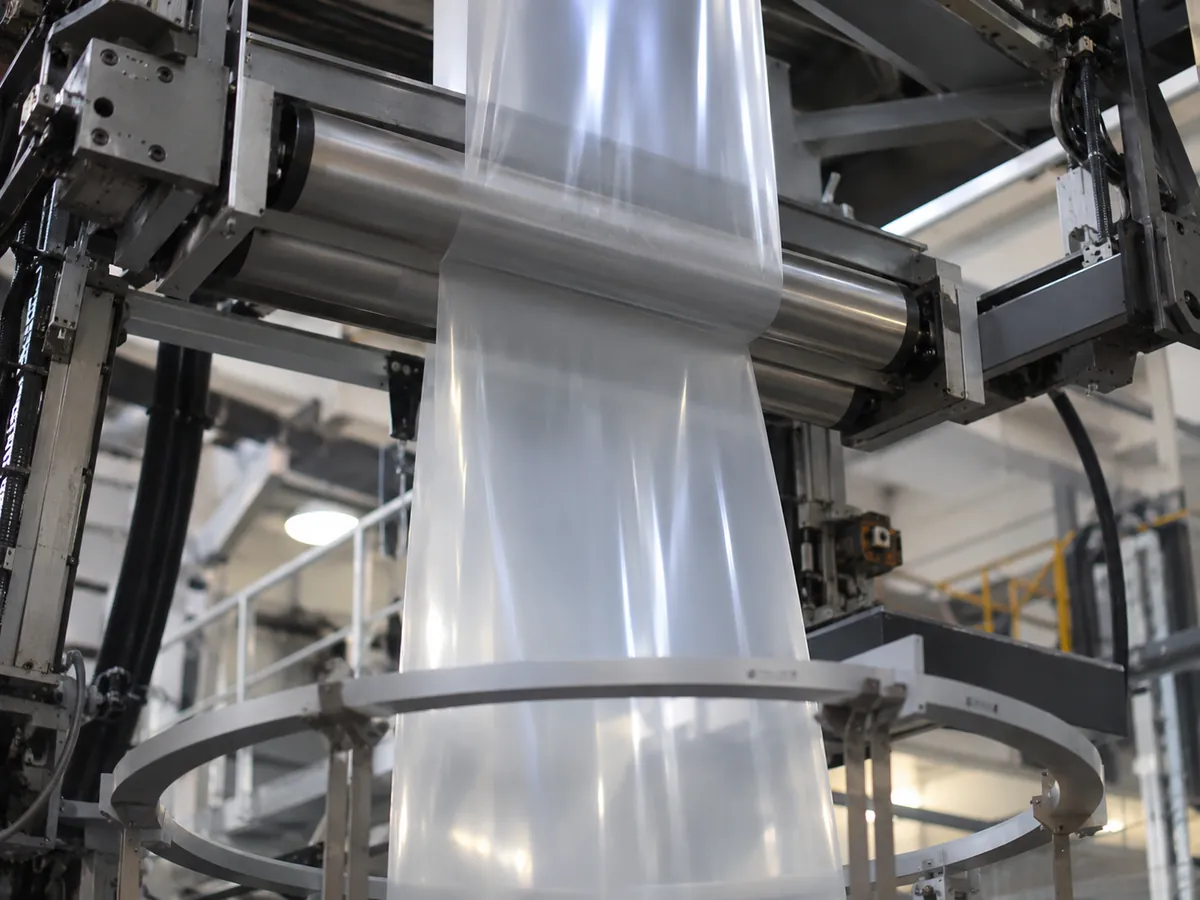
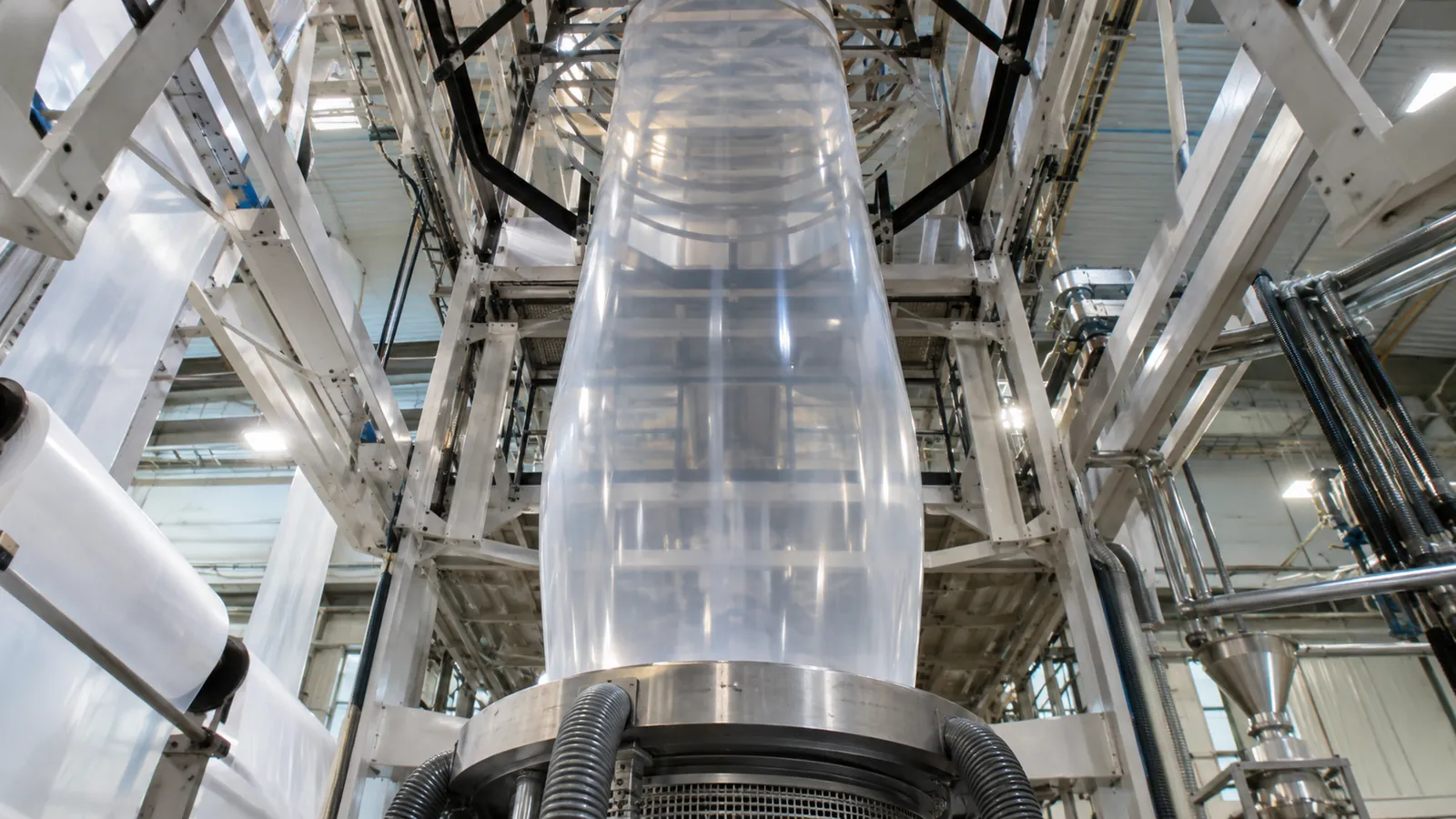
Blown film: molten resin is extruded through an annular die, inflated into a bubble and cooled by air. Blown film has balanced properties in both directions, suits tough, thick bags and liners, and can be made in many widths. It tends to be slightly hazier.
Cast film: resin is extruded through a flat die onto chilled rolls. Cast film cools faster, so it has better clarity and gloss, tighter gauge control and a more uniform surface. It is common for sealant webs that will be laminated and for high-clarity wraps.
Both routes can produce multilayer coextrusions with three, five, seven or more layers. A converter can put a tough LLDPE in the core, a sealable mLLDPE blend on the inside and a printable or glossy skin on the outside.
Slip and antiblock additives
A manufacturer’s public additive guidance describes migratory slip moving from the film bulk to the surface, where it reduces friction. Other slip systems are non-migratory. Excess slip can affect treatment, printing and sealing. Antiblock particles reduce contact between adjacent film surfaces; do not assume a fixed haze or seal-temperature penalty for every formulation.
Illustrative migration sequence: film bulk → surface bloom → changed film-to-film or film-to-metal friction. This is a process sketch, with no fixed migration time.
Measure COF using ASTM D1894-24, record static and kinetic results separately, and state the contact surface, film age, conditioning and measurement date. Repeat the measurement after the intended storage period.
Takeaway: specify when and against what surface COF is measured, with the target number tied to that basis.
Where PE film is used
- Sealant webs in laminates: a PE or mLLDPE layer is laminated to BOPP, PET or nylon to give the structure its heat-seal layer.
- Bags and liners: bulk bags, pallet liners, produce bags and bread bags use monolayer or coextruded PE directly.
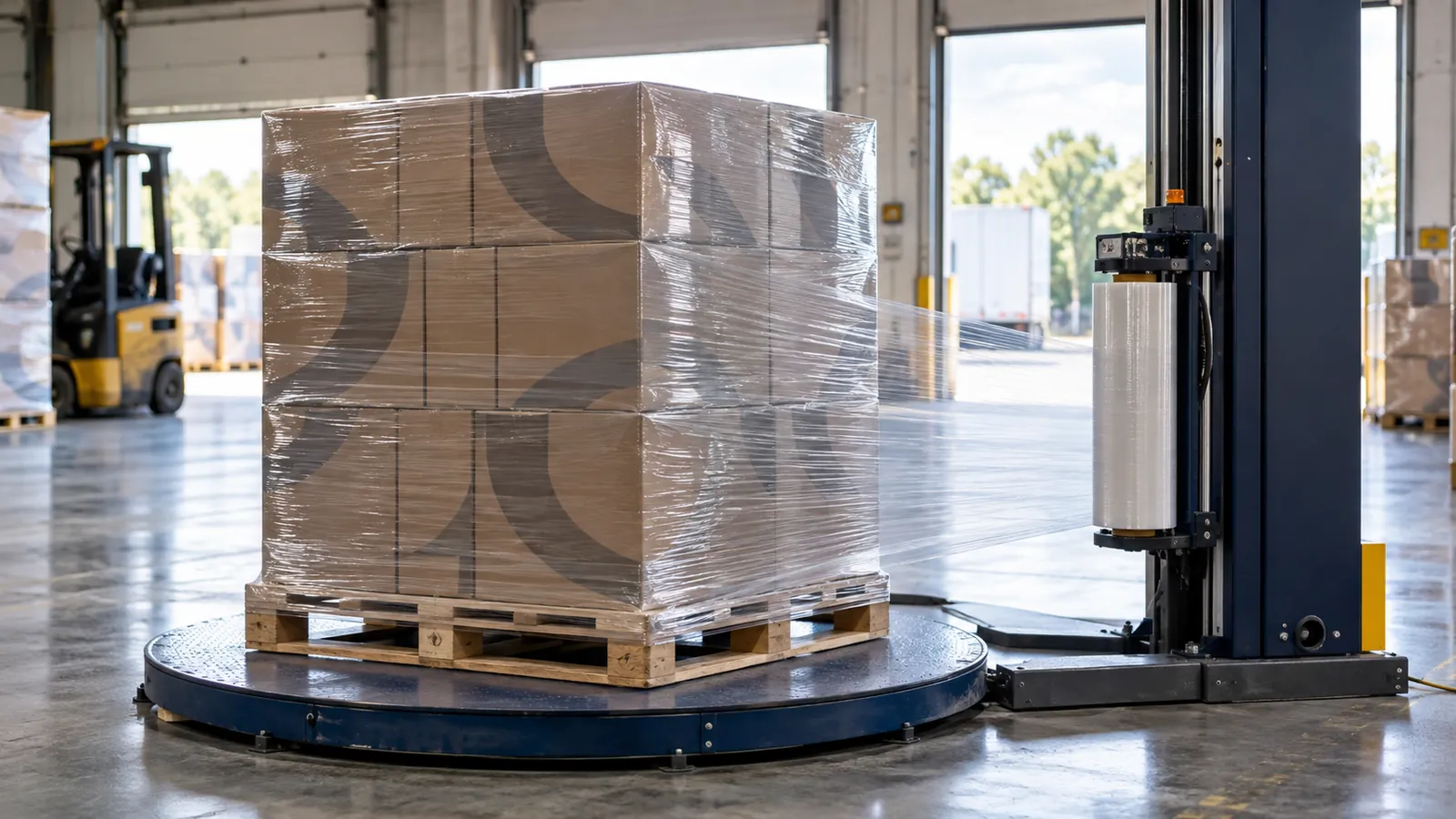
- Shrink and stretch film: cross-linked or oriented PE films are used for collation wraps and pallet stretch.
- Form-fill-seal film: coextruded PE and PE laminates run on VFFS machines for powders, liquids and frozen food.
Mono-PE structures and MDO-PE
Traditional laminates pair PET or BOPP with a PE sealant. Because the layers are different polymers, they are difficult to recycle together. Mono-PE structures replace the outer layer with a PE film that is stiff and clear enough to print, so the entire pouch is polyethylene.
The enabling technology is machine-direction oriented PE (MDO-PE). Orientation and annealing are separate process stages. Do not assume MDO automatically increases heat tolerance: request MD/TD shrinkage under the actual printing and sealing conditions, together with the heat-setting history. The proposed outer web still needs a separate sealant-side check. The remaining challenge is the barrier layer: a mono-PE pouch for oxygen-sensitive food needs a thin barrier that does not stop the pack being recognized as PE in recycling streams.
See mono-material packaging for the design principles and the recycling questions, and check local guidance and any applicable regulation, since requirements differ by market.
PE specification record
Use the fields below alongside the role and performance checks:
Scroll horizontally to view all columns if needed. ↔
| Field | Your record |
|---|---|
| Grade / blend / structure / gauge | ____ |
| Layer role / sealing face / contact material | ____ |
| Seal temperature / dwell / pressure / hot tack | ____ |
| Contamination type / amount / seal result | ____ |
| COF static / kinetic / method edition | ____ |
| Film-to-film or metal / tested face | ____ |
| Extrusion date / measurement date / conditioning | ____ |
| Storage age / temperature / repeat COF | ____ |
| OTR / WVTR / temperature / RH | ____ |
| Mechanical / optics / destination-market declarations | ____ |
To compare the numbers suppliers return, use the guide on how to compare film specifications. For how PE sits inside coextruded and laminated constructions, see flexible packaging film.
Sources and method
A manufacturer’s slip guidance and antiblock explanation support the additive discussion, not a recommendation. A public MDO equipment brochure separates stretching from annealing. Checked October 9, 2026; ASTM links cover public scopes, not a claim that any film has passed a test. No universal contaminated-seal or MDO heat-resistance advantage is assumed.
Continue reading
Related articles
BOPP Film for Packaging: Types, Properties and Uses
BOPP packaging film explained: what biaxial orientation does, the main grades from clear to metallized, sealing options and typical uses.
LDPE Packaging Film: Properties, Processing and Uses
LDPE packaging film explained: branching, processing roles, blend trials and the matched optics, mechanical and seal evidence needed to compare candidates.
LLDPE Packaging Film: Toughness, Sealing and Uses
LLDPE packaging film explained: grade choice, comonomers, hot tack, contaminated-seal testing and the evidence needed for sealants, stretch film and sacks.