
PET Packaging Film: BOPET Properties, Grades and Applications
PET packaging film explained: BOPET properties, treated, coated and metallized grades, why it is the printable outer web in laminates, and PET vs BOPP.
Using ordinary outer-web BOPET as the sealing face can leave a package unsealed. Choose PET by its job: printed outer web, barrier carrier or a specifically heat-sealable grade. BOPET means biaxially oriented polyethylene terephthalate; the selected grade and complete structure determine its operating limits.
- Outer web: check surface treatment, print register and the actual jaw-contact window.
- Barrier carrier: select the coating or metallization, then confirm converted-pack OTR/WVTR.
- Heat-sealable PET: identify the seal face and compatible tray or film; ordinary outer-web PET is not interchangeable.
This page covers PET grades and the records needed to specify them, rather than a universal PET/BOPP ranking.
What makes BOPET useful
Use grade-specific data to confirm the properties required by the pack.
- Heat behavior: confirm that the outer PET web remains stable at the temperature, dwell and pressure needed to seal the inner layer. A melting point alone does not establish a no-stick window.
- Dimensional stability: request MD/TD shrinkage and register results at the intended tension and heat exposure.
- Stiffness and strength: it is tough in thin gauges and gives a pouch its crisp feel.
- Clarity and gloss: clear grades show the print underneath, or the product, with high gloss.
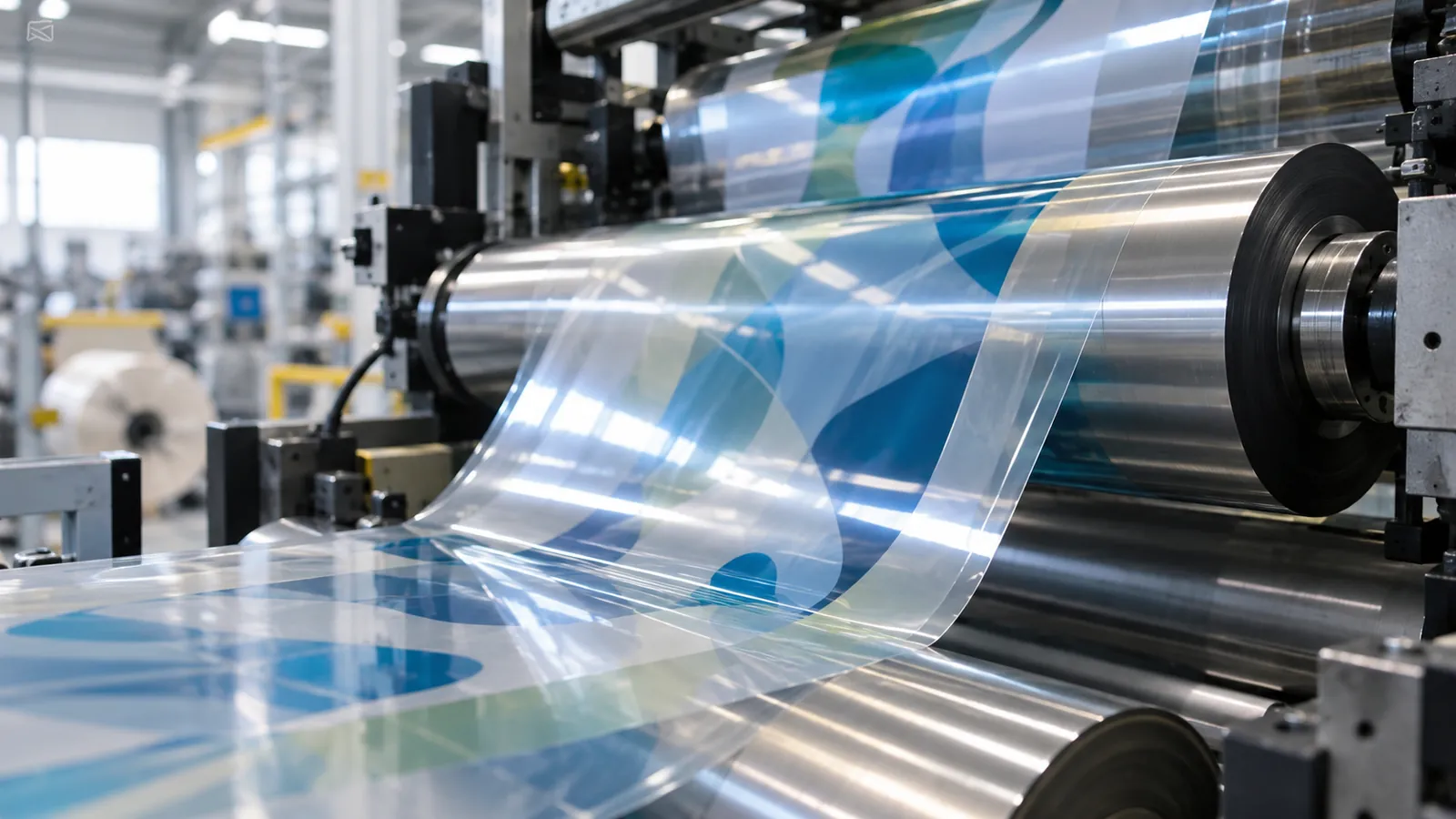
- Print quality: treated or primed surfaces take solvent-based, water-based and energy-curable inks with good adhesion and fine detail.
- Aroma and grease resistance: PET resists oils and holds aroma well, which helps in coffee and snack applications.
Plain, coated and metallized PET have different barrier results. Compare the selected grades at matching gauge and test conditions; see OTR and WVTR.
Heat sealing and PET
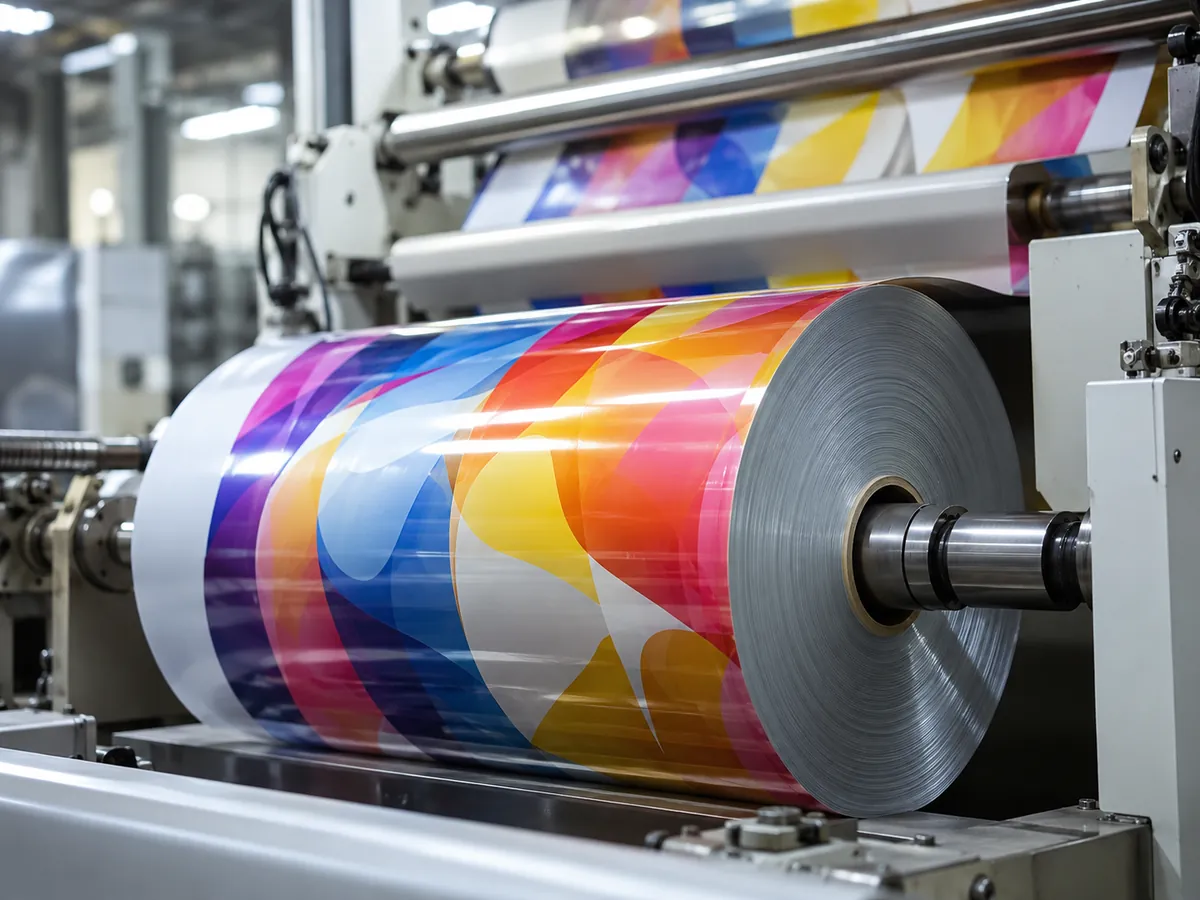
Standard BOPET does not heat seal the way PE does, because it melts too high and does not soften in the narrow window a sealer provides. It sits on the outside of a laminate, bonded to a sealant such as PE, mLLDPE or CPP.
There are exceptions. Heat-sealable PET grades, often with an amorphous or copolyester coating or skin, can seal to themselves or to PET trays. These are used for lidding and for some all-PET structures. A manufacturer’s public packaging page documents specialty sealable polyester films; it does not establish the sealing behavior of every BOPET web. For comparisons of sealant behavior, see seal initiation temperature.
Grades of PET film
Scroll horizontally to view all columns if needed. ↔
| Grade | What it is | Typical use |
|---|---|---|
| Plain (untreated) | Base film, one or both sides left as made | Industrial and technical films |
| Corona-treated | Surface energy raised for ink and adhesive wetting | Printing and lamination |
| Chemically primed | Coating that improves adhesion to inks, coatings or metal | High-speed print, metallizing, coating |
| Heat-sealable | Co-polyester or amorphous layer that seals | Lidding, tray sealing, some pouches |
| Coated (PVDC) | Chlorinated barrier coating | Barrier outer web for moisture- and oxygen-sensitive food |
| Coated (AlOx, SiOx) | Thin ceramic layer, transparent | Clear barrier laminates, retort pouches, microwaveable pouches |
| Metallized | Vacuum-deposited aluminum layer | Snack and coffee laminates, light and oxygen barrier |
Names differ between suppliers, so treat the table as a map, not a catalog.
Coated PET with PVDC, AlOx and SiOx
For PVDC-coated grades, check the intended market and measured barrier. AlOx and SiOx are oxide barrier coatings; request the actual coating specification rather than assuming a common thickness. They give a clear barrier film suitable for transparent packs and, in some structures, for retort. Oxide layers are sensitive to flexing and handling, so the barrier of the finished pouch can be lower than the film’s as-made value. Compare barrier before and after the intended converting, flexing and thermal processes, with the test conditions recorded. See barrier film for the wider comparison and high barrier film for options beyond a single coated layer.
Metallized PET
Metallized PET (a thin aluminum layer on BOPET) cuts light transmission and substantially reduces oxygen and water vapor transmission compared with plain PET. It gives a metallic look and is widely used as a barrier layer in coffee and snack laminates. As with any metallized film, results depend on optical density, adhesion and how the layer survives lamination and flexing.
Typical applications
- Snack and coffee laminates: printed PET laminated to a metallized film or foil with a PE sealant. See snack packaging film and coffee packaging materials.
- Retort pouches: a PET outer layer bonded to foil or a ceramic-coated barrier with a PP sealant, designed to withstand sterilization. See retort pouch.
- Lidding: heat-sealable PET lidding on PET trays and cups. Peelable and weldable versions exist, depending on the tray material.
- Stand-up pouches and premade pouches: PET provides the stiff, printable face. See premade pouch materials.
- All-PET structures: a PET outer web laminated to a heat-sealable PET film so the full pack is a single polymer. This is a growing direction for PET-tray lidding and some pouches, with recycling acceptance that depends on the region and the tray stream.
PET versus BOPP
Select a grade for the required role before comparing polymer families. This comparison identifies evidence to collect rather than assigning fixed performance scores.
Scroll horizontally to view all columns if needed. ↔
| Decision | BOPET candidate | BOPP candidate |
|---|---|---|
| Jaw contact | Check MD/TD shrink and surface sticking | Check MD/TD shrink and surface sticking |
| Direct sealing | Specify a heat-sealable grade or separate sealant | Specify a sealable skin or separate sealant |
| Barrier | State coating, gauge and OTR/WVTR conditions | State coating, gauge and OTR/WVTR conditions |
| Cost per usable area | Record gauge, density and line losses | Record gauge, density and line losses |
Takeaway: no-stick behavior and barrier belong to the tested grade and structure, not to the PET name. The BOPP film guide and PET vs BOPP comparison cover the other route and cost basis.
When considering another polyester for a food-pack project, the PEF evidence review separates polymer identity, application results and conditional supply.
What to define when specifying PET film
Illustrative laminate sequence, outside → product: PET print web → adhesive → PE or CPP sealant. This text schematic is not to scale and omits optional barrier layers; it is not a validated food-contact structure.
Scroll horizontally to view all columns if needed. ↔
| Field | Your record |
|---|---|
| Outer / adhesive / sealant grades and gauges | ____ |
| PET surface / printed face / sealing face | ____ |
| Coating or metallization / OTR / WVTR | ____ |
| Barrier test method / temperature / RH | ____ |
| Jaw temperature / dwell / pressure / seal result | ____ |
| MD/TD shrink / sticking / register result | ____ |
| Retort or hot-fill cycle / post-process bond and barrier | ____ |
| Destination market / contact declaration / end-of-life claim | ____ |
To compare supplier numbers like for like, use the guide on how to compare film specifications. For where PET fits among other options, see packaging film types and flexible packaging film.
Sources and method
A manufacturer’s public packaging documentation describes specialty sealable PET, including lidding and flow-wrap applications. It is cited as grade-specific evidence, not a recommendation or this site’s testing. Checked October 9, 2026. Neither a universal outer-web gauge nor an oxide-coating thickness is assumed here.
Continue reading
Related articles
PET vs BOPP Film: Which Outer Web Fits Your Pack?
PET vs BOPP film compared on barrier, heat resistance, stiffness, print, sealing, recyclability and cost, with guidance on which outer web fits your pack.

Alu-Alu Blister Packaging: When Full-Foil Blisters Make Sense
Alu alu blister packaging uses a cold-formed foil cavity and foil lid for near-total barrier. See when it is chosen and how it compares with PVC blisters.
Aluminum Foil Packaging: Foil Laminates, Gauges and Uses
Aluminum foil packaging explained: why foil gives near-complete barrier, layer thickness and temper, laminate structures, uses and recycling limits.