
Alu-Alu Blister Packaging: When Full-Foil Blisters Make Sense
Alu alu blister packaging uses a cold-formed foil cavity and foil lid for near-total barrier. See when it is chosen and how it compares with PVC blisters.
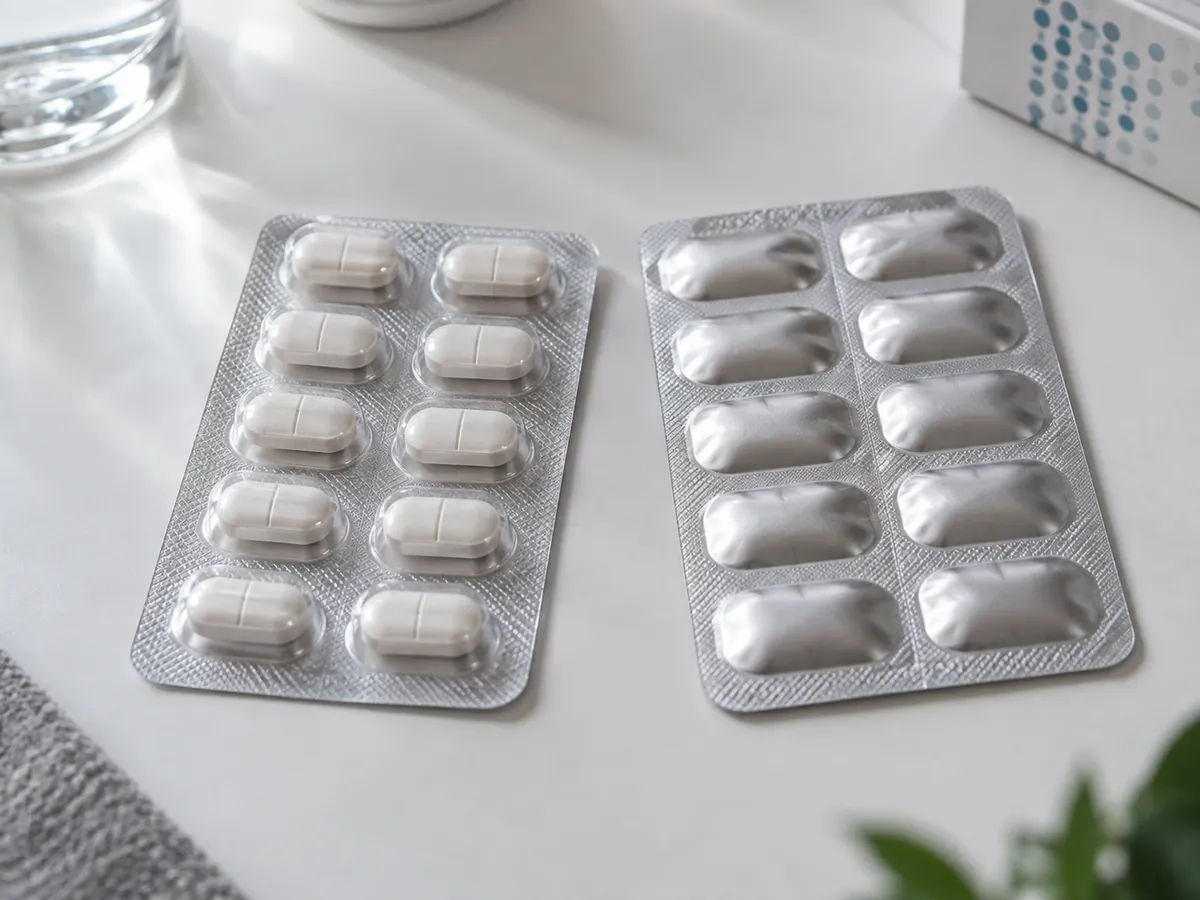
Alu alu blister packaging is a blister pack in which both the cavity and the lid are aluminum-based. The cavity is cold-formed from an aluminum laminate, and a foil lid is heat-sealed over it. With no clear plastic in the barrier path, it gives near-complete protection from moisture, oxygen and light. It is usually chosen for sensitive drugs and for hot, humid markets, at the cost of an opaque, larger and more expensive pack.
The material itself is covered in cold form foil. This page is about the pack choice. For how the lid and the cavity web differ, read blister foil vs cold form foil.
Alu-alu selection at a glance
Scroll horizontally to view all columns if needed. ↔
| Decision | Check before choosing |
|---|---|
| Transparency | A foil cavity hides the dose; confirm whether inspection or patient visibility requires a clear web |
| Barrier need | Use product stability and finished-pack results, not a material-name ranking |
| Cold-form capability | Confirm the machine, tooling and deepest cavity can form the selected laminate |
| Pack volume | Compare actual cavity layout, flange and carton dimensions |
What an alu alu blister is
An alu alu foil blister has two parts:
- Bottom web: a cold-form laminate, commonly oriented polyamide, aluminum and PVC, pressed into cavities by a plug without heating.
- Lid: aluminum-based lidding, with hard-temper foil for push-through designs, coated with a heat-seal lacquer matched to the inner layer of the bottom web (see blister foil).
The two are sealed around each cavity. If the formed foil remains intact, the pack’s performance depends on seal quality and pinhole-free forming. The general format is explained on the blister packaging page, and the pharma-specific use is in pharmaceutical blister packaging.
When alu alu blister packs are chosen
- Moisture-sensitive drugs: products that degrade, soften or lose potency with humidity, including some effervescent and hygroscopic tablets.
- Light-sensitive products: the foil blocks all light, so no tinted or opaque plastic is needed.
- Oxygen-sensitive formulations: the aluminum layer stops oxygen ingress through the cavity wall.
- Hot, humid distribution: markets with high temperature and humidity stress packs for months, and a full-foil pack leaves less margin to lose. The term tropicalized needs a separate structural check (see below).
- Long shelf life targets: where stability data show a plastic web fails to carry the product through its labeled life.
The decision should rest on stability data for your product and market, not a rule of thumb. Barrier requirements are discussed in moisture barrier packaging.
Trade-offs
The pack is opaque. Patients and pharmacists cannot see the tablet. Printing and, in some cases, hospital unit-dose handling can help, but visual inspection on the line has to be done another way.
The pack is larger. Cold forming needs wider draw and larger flanges, and cavities are typically shallower and broader than thermoformed ones. A strip or card for the same dose count is often bigger and heavier, which affects cartons, shipping and shelf space.
It costs more. Laminates and forming are more expensive than a plain PVC web, and cold form machines and tooling can be more demanding. Compare on a total cost basis, including scrap and speed.
Forming has limits. Deep or large cavities risk pinholes or cracks, so some products do not fit an alu-alu pack.
Recycling is difficult. Foil laminates are hard to recycle in most schemes, as described in recyclable flexible packaging. The case for them rests on product protection and avoiding product loss.
Alu alu vs PVC, PVDC and PCTFE blisters
Compare exact structures at matching temperature, humidity, thickness and forming conditions. No matched four-material trial is presented here, so a universal barrier or cost ranking is not justified.
Scroll horizontally to view all columns if needed. ↔
| Candidate web | Structure to identify | Evidence to compare |
|---|---|---|
| PVC | Plastic forming web | Formed-cavity WVTR/OTR and product stability |
| PVDC-coated PVC | PVC plus specified coating | Coating weight, formed barrier and seals |
| PCTFE laminate | PCTFE thickness and supporting films | Same-condition moisture data after forming |
| Alu-alu | Cold-form foil laminate plus foil-based lid | Pinholes, cracks, seal integrity and stability |
Transparency and forming route are separate decisions from barrier. Use barrier film to distinguish flat-film transmission from complete-package protection.
Tropicalized blisters
“Designed for tropical distribution” describes an intended climate, not one compulsory pack construction. In contrast, a manufacturer’s public tropical-foil description uses tropical blister foil for an added aluminum-laminate protective layer around a thermoformed blister. That extra layer is different from replacing the primary cavity web with cold-form foil in an alu-alu pack. Ask for the layer drawing before treating the names as equivalent.
EMA’s ICH Q1A(R2) guideline, effective in the EU from August 1, 2003, concerns stability packages for new drug substances and products. Section 2.2.4 calls for testing in the proposed marketing container-closure system. It does not prescribe alu-alu or define a tropical blister structure. Check destination-market stability guidance separately rather than assigning IVa/IVb requirements to Q1A(R2).
Quality and machine points
- Run forming trials on the deepest cavity, with backlight inspection for pinholes.
- Qualify the lid lacquer against the exact bottom web inner layer.
- Check seal width and integrity around every cavity, since the seal is the weak path.
- Confirm that the blister machine has a cold-form station and can handle foil reels.
- Verify pack integrity with leak tests and stability studies on finished packs.
The quality checks for the web are listed on the cold form page. ASTM F88/F88M-23 measures seal strength; it does not establish finished-blister stability.
Choosing between blister options step by step
- Start with the stability data: how much moisture, oxygen and light does the product tolerate, and for how long?
- Identify the climate zone and the supply chain conditions.
- Check whether a transparent high-barrier plastic blister meets the target.
- If not, evaluate alu-alu on forming depth, pack size and cost.
- Trial on your machine, validate seals and run stability on the final pack.
Pharmaceutical packaging foil compares the foil family.
Sources and method
Sources checked October 8, 2026: the EMA guideline covers regulatory stability expectations; the manufacturer’s product page supplies structural descriptions only, not a recommendation or this site’s testing. No matched PVC/PVDC/PCTFE/alu-alu performance dataset is presented.

Continue reading
Related articles
Aluminum Foil Packaging: Foil Laminates, Gauges and Uses
Aluminum foil packaging explained: why foil gives near-complete barrier, layer thickness and temper, laminate structures, uses and recycling limits.
Blister Foil vs Cold Form Foil: Lidding vs Forming Foil Compared
Blister foil vs cold form foil: one is the thin lidding foil, the other the formable laminate that becomes the cavity. See how they differ and work together.

Blister Foil: Lidding Foils for Pharmaceutical Blister Packs
Blister foil is aluminum-based lidding for pharmaceutical blister packs. Learn lidding types, lacquers, sealing variables and checks.