
Blister Packaging: Formats, Materials and Uses
Blister packaging holds a product in a thermoformed or cold-formed cavity sealed to a lidding or card; see types, materials and typical uses.
Confusing a retail blister with a pharmaceutical unit-dose pack can leave protection and testing requirements unspecified. Blister packaging is a format in which a product sits in a pre-formed cavity, called the blister, and is held in place by a backing that is sealed or fixed to it. The cavity is made from a plastic film (thermoformed) or an aluminum-based laminate (cold formed). The backing is paperboard, plastic or foil. Blisters are used across consumer goods, hardware, electronics, personal care and pharmaceuticals.
- Consumer goods: begin with display, product retention and opening tests.
- Pharmaceutical unit doses: begin with drug protection, closure integrity and applicable child-resistance requirements.
- Peelability describes opening; child resistance needs a complete-package test.
Two main families of blister packaging
Takeaway: The term covers two quite different pack types, which are often confused.
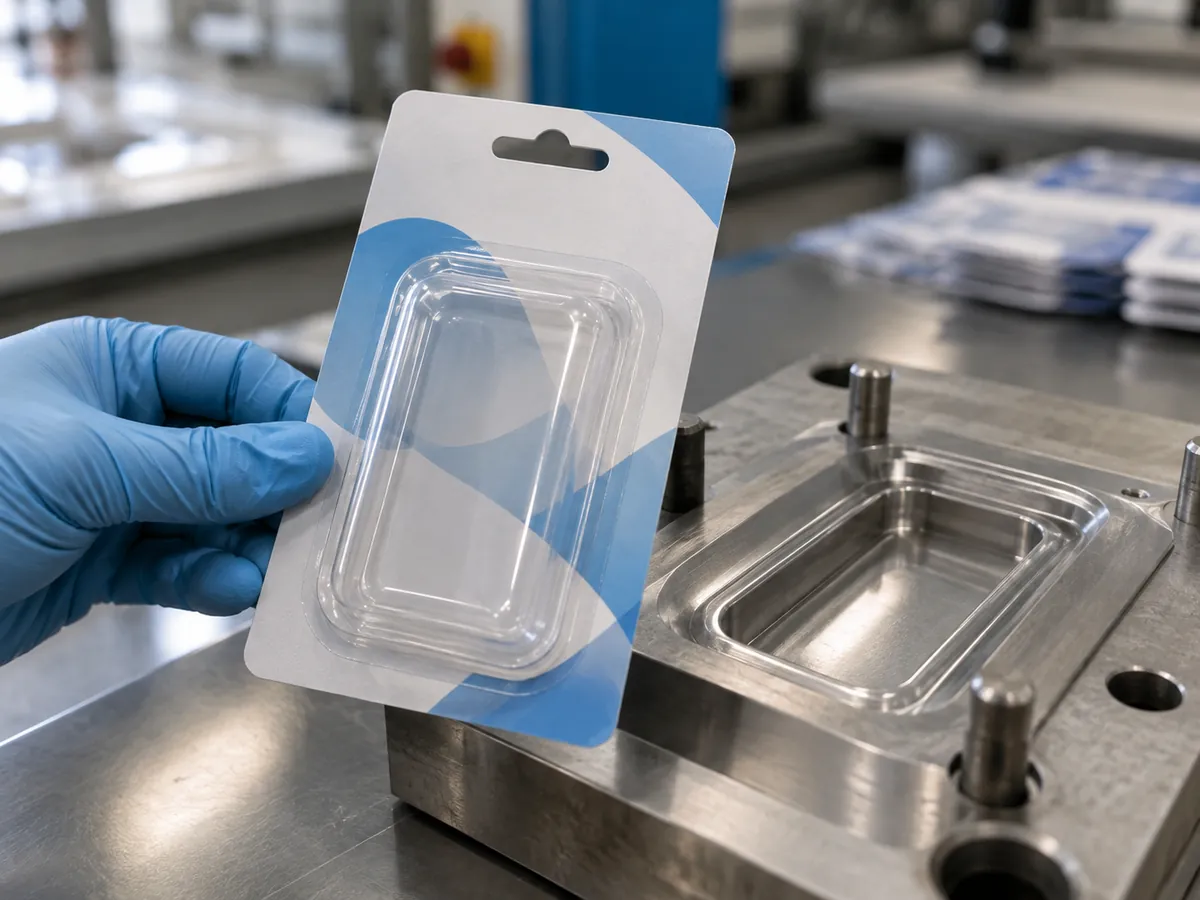
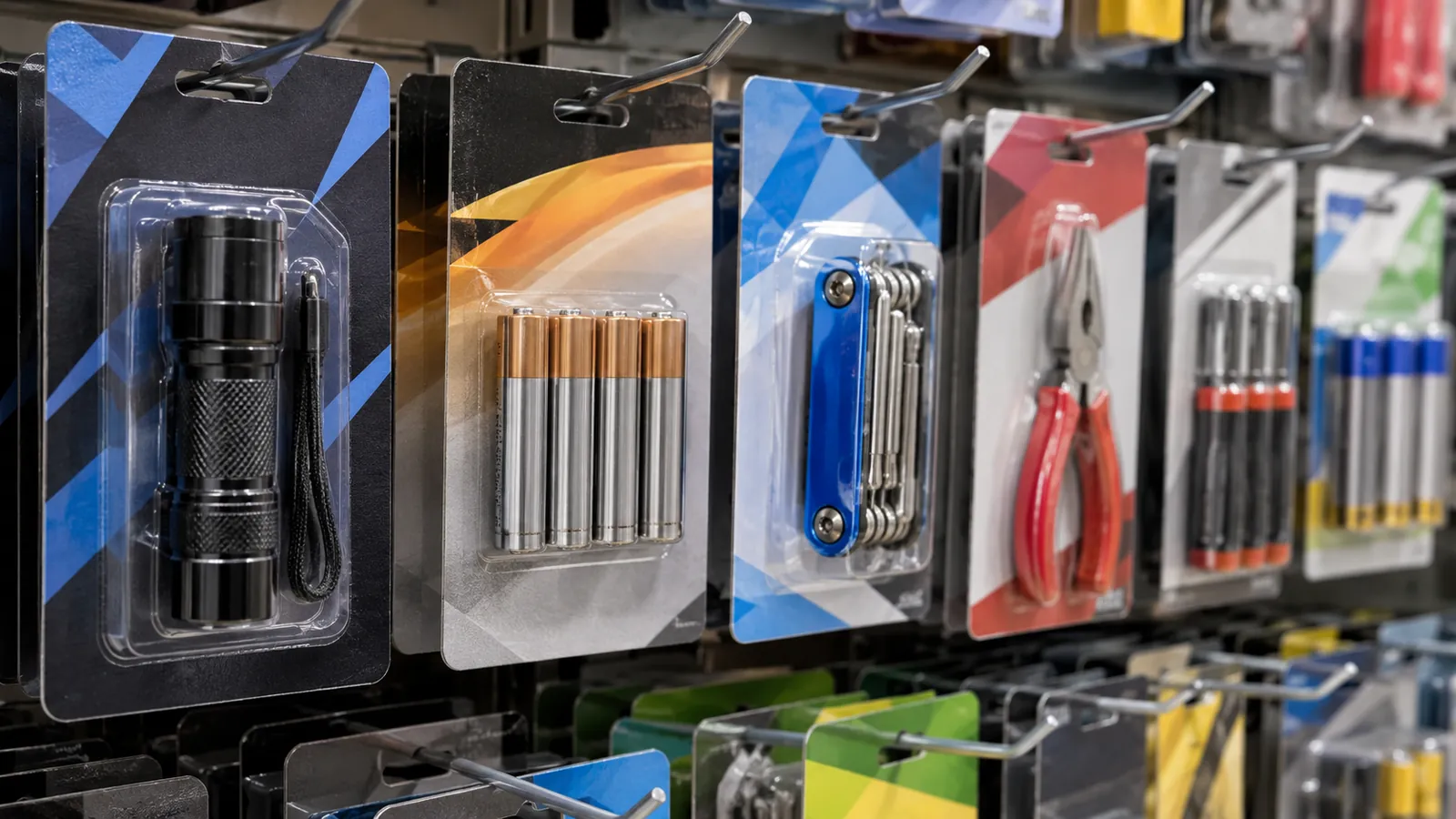
- Consumer-goods blisters: a clear plastic cavity holds an item such as a battery, a tool or a toy, and a printed card forms the backing. The pack hangs from a peg or sits on a shelf. The aim is visibility, display and some tamper resistance.
- Pharmaceutical unit-dose blisters: each tablet or capsule sits in its own cavity, sealed with lidding foil. The aim is protection from moisture, oxygen and light, and a clear record of dose. This topic is covered in pharmaceutical blister packaging.
Consumer-goods blister types
Face-seal blister cards
A thermoformed cavity has a flat flange around its rim. The flange is heat sealed to the face of a printed paperboard card that has a heat-seal coating. This is the most common format. Card and blister are bonded over a wide area, so the pack must be cut or torn to open, which makes it tamper evident. It suits lightweight items such as batteries, small tools and cosmetics.
Trapped blisters
The blister is held between two layers of card, or between a front card and a back card, with no seal to the blister itself. The blister is trapped by the card’s folding. This avoids heat sealing and can improve recyclability of the paperboard fraction if the plastic is separable.
Slide blisters
A blister sits in a cardboard or plastic sleeve and the product slides out. It is easier to open than a heat-sealed pack and can be reclosed. It is used for items where the user may want to return the product to the pack, such as small collectibles or electronic accessories.
Clamshells
A clamshell is a hinged, one-piece or two-piece plastic shell that snaps or seals closed. It is stronger than a card blister and holds heavier or more valuable items, but it is usually harder to open and uses more plastic.
Takeaway: It is common for electronics, tools and fresh produce.
Materials for the forming film
Thermoformed plastic films
The cavity is formed by heating a plastic sheet and drawing it into a mold by vacuum or pressure. Common materials include:
- PVC: clear, easy to form and low in cost. Recycling and regulatory concerns vary by market, so check requirements for your destination.
- PET and PETG: clear and stiff, and often preferred where PVC is restricted. See PET film.
- PP: used where heat resistance or a mono-material approach matters.
- Multilayer plastic structures with a barrier layer, used in pharma and food where moisture or oxygen protection matters. See barrier film.
The forming depth, wall thickness distribution and material choice must be matched. A deep draw thins the wall at the corners, so films are usually specified with a minimum wall thickness at the thinnest point as well as the sheet gauge.
Cold-form laminates
Cold forming presses an aluminum-based laminate into a cavity without heat. The laminate is commonly oriented polyamide (OPA) over aluminum foil over PVC or another sealant layer. An intact aluminum layer provides a strong barrier, but it does not certify the finished blister. In plastic forming, local thinning changes barrier performance; in cold-form foil, inspect for cracks or pinholes, and evaluate the sealed flange and lidding pair. A leak at the seal edge is separate from transmission through the cavity wall. They are opaque and have larger cavities than thermoformed ones, because the foil stretches less.
Takeaway: Read cold form foil and alu-alu blister packaging for detail.
Lidding and backing
The backing closes the blister and has to bond to the forming film.
- Heat-seal-coated paperboard: the standard backing for consumer blister cards. The coating is chosen to match the blister material; PVC and PET need different coatings. The board also carries the printing and graphics.
- Aluminum lidding foil: used for pharmaceutical blisters. Opening designs include push-through and peelable lidding. Easy peeling is not evidence of child resistance. Where US special-packaging rules apply, CPSC points to complete-package testing under 16 CFR 1700.20, including child and adult-use protocols; assess the assembled blister and its instructions, not the foil alone. See blister foil and pharmaceutical packaging foil.
- Plastic and paper/foil/plastic laminates: used where a peelable lid and some barrier are needed, such as for medical device trays.
The sealant on the lid and the sealing surface on the forming film must be compatible. A mismatch gives weak seals, delamination or board that tears the print when opened. ASTM F88/F88M-23 measures force to separate a seal strip and its failure mode. That result alone does not establish complete package integrity, child resistance or shelf life.
Takeaway: Select a finished-pack integrity method and acceptance criteria for the actual product and construction; keep the material-pair trial separate from the opening test.
Blister types and their uses
Scroll horizontally to view all columns if needed. ↔
| Blister type | Forming material | Backing | Typical uses | Notes |
|---|---|---|---|---|
| Face-seal card | PVC, PET/PETG, PP | Heat-seal-coated paperboard | Batteries, tools, personal care, toys | Tamper-evident, low cost |
| Trapped blister | PET, PETG, PVC | Folded card layers | Lightweight retail items | No heat seal needed |
| Slide blister | PET, PVC | Card sleeve | Collectibles, accessories | Easier to open, reusable |
| Clamshell | PET, PETG, PVC | Self-closing or sealed shell | Electronics, tools, produce | Strong, harder to open |
| Pharma thermoformed blister | PVC, PVDC-coated PVC, PCTFE laminates, PP | Aluminum lidding foil | Tablets and capsules | Barrier depends on structure |
| Pharma cold-form (alu-alu) | Aluminum laminate; confirm full layer sequence | Matched lidding foil | Moisture-sensitive drugs | Opaque; formed cavity and seal integrity need validation |
Choosing a blister format for your product
- Define the product weight and shape. Heavy items need a clamshell or strong card, light items a face-seal card.
- Decide if the pack must be tamper evident. A face seal or clamshell seal does this; a trapped blister relies on card construction.
- Match the barrier to the product. Retail items rarely need barrier; pharma and some food do. See moisture barrier packaging.
- Check forming depth and cavity layout. Deep cavities need thicker film and good mold design.
- Match the sealing pair. Ask the board or foil supplier to confirm heat-seal compatibility with your forming film.
- Consider end of life. PET blisters on paperboard can be separated and recycled in some systems; PVC creates sorting issues in others. Check local guidance.
- Test the finished pack. Seal strength, drop performance and, for pharma, moisture and leak testing.
Material-pair and finished-pack record
Scroll horizontally to view all columns if needed. ↔
| Field | Evidence / verification | Result to retain |
|---|---|---|
| Forming and lid layer sequence / grades | Supplier drawings and technical data | Document revision and lot |
| Flange and sealant pair | Trial at defined temperature, dwell and pressure | Settings and failure location |
| Formed cavity wall / foil condition | Agreed thickness or defect inspection | Local thinning, crack or pinhole record |
| Seal strength | Suitable F88 strip test with technique stated | Force and failure mode |
| Whole-pack integrity / protection | Product-specific leak and stability plan | Method, conditions and disposition |
| Child resistance, where required | Complete pack tested under applicable protocol | Design, instructions and test report |
Takeaway: Use the pharmaceutical blister guide to define the drug-protection branch, and the first-order checklist to retain drawings, lot samples and agreed acceptance records.
Sources and method
- CPSC Special Packaging FAQs: regulator guidance on special packaging and 16 CFR 1700.20 testing, not a material certification.
- ASTM F88/F88M-23: standard publisher’s scope for seal-strip force and failure mode.
- Kloeckner Pentaplast, High-Barrier Rigid Films: manufacturer coated/laminated forming-film examples.
- ACG, Packaging Materials brochure: manufacturer OPA/aluminum/PVC cold-form example. DESU, Blister sheet selection: manufacturer guidance on local thinning. ASTM F3039-23 defines a dye-penetration leak method for nonporous packaging; confirm applicability to the assembled design.
Accessed 8 October 2026. No package was tested by this site; the record above does not supply pass values.
Continue reading
Related articles
Shrink Wrap Packaging: Overwraps, Bundles and Sleeves
Shrink wrap packaging uses heat-shrinkable film to wrap a product or group of products tightly; here are the main formats and what each suits.
Flat Bottom Pouch: Box-Style Pouches Explained
A flat bottom pouch has a rectangular base and two side gussets that make a boxlike, self-standing pack. See construction, features and how it compares.
Flow Wrap Packaging: How It Works and What It Suits
Flow wrap packaging forms a film tube around the product with a fin or lap seal and two end seals. See variants, suitable products and trade-offs.