
Pharmaceutical Packaging Foil: Types and How to Select Them
Pharmaceutical packaging foil covers lidding, cold-form, strip pack and sachet laminates. See the types, key properties and how to choose between them.
Pharmaceutical packaging foil is aluminum foil, coated or laminated, used to protect drug products from moisture, oxygen and light in blisters, strip packs, sachets and closures. There is no single “pharma foil”. The foils for a push-through lid, a cold-form blister cavity and a powder sachet differ in temper, thickness, coatings and layers. This page lists those types and explains how to choose among them.
For the basics of the metal itself, see aluminum foil packaging. For the pack formats these foils serve, see the pharmaceutical packaging overview.
Foil types at a glance
These are construction directions, not interchangeable specifications.
Scroll horizontally to view all columns if needed. ↔
| Foil type | Function | Paired surface | Main failure to check |
|---|---|---|---|
| Blister lid | Push-through or peel opening | Specified forming web and matched seal coating | Weak seal or unsuitable opening force |
| Cold-form bottom web | Drawn barrier cavity; OPA / Al / PVC is one published option | Compatible lid and inner sealing layer | Cracks/pinholes at deepest corners |
| Strip-pack foil | Dose sealed between flat webs | Opposing sealable foil face | Seal channels or cracks at folds |
| Sachet / stick laminate | Barrier, print and sealing | Opposing sealant face | Powder contamination or damaged barrier layer |
| Induction liner | Closure at the bottle mouth | Actual bottle resin and rim geometry | Incomplete rim bond or opening failure |
Types of pharmaceutical aluminum foil
Blister lidding foil
Hard-temper aluminum is a push-through lidding option. Manufacturer public documentation also lists soft-temper lids, so temper depends on the opening design. It is covered in detail on the blister foil page, including push-through, peelable and child-resistant variants, so it is not repeated here. For selection, the main point is that the heat-seal lacquer must suit the forming web.
Cold form foil (bottom web)
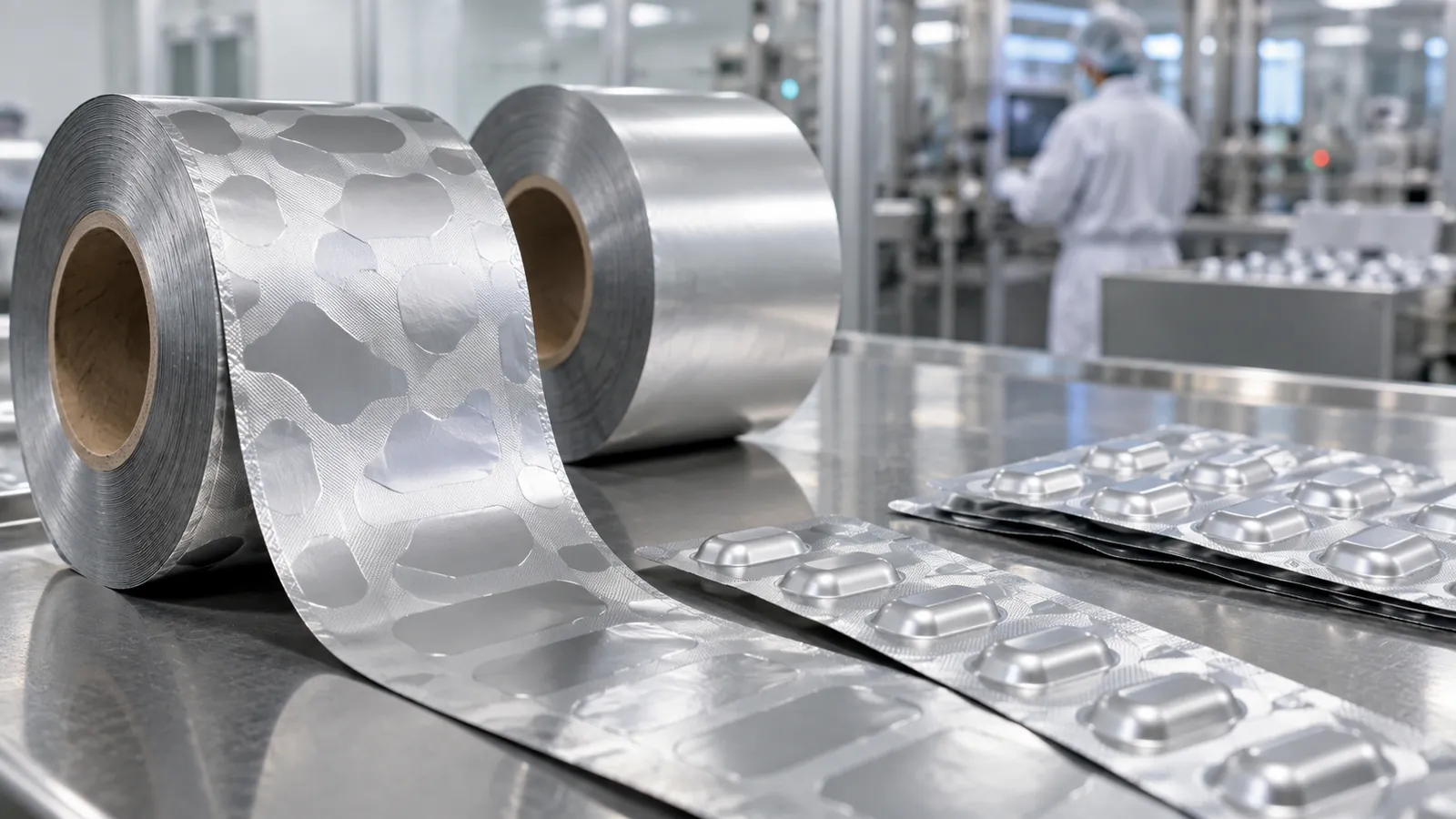
Cold-form foil is a thick, soft laminate that is pressed into cavities without heat, forming the blister itself. Manufacturer public documentation includes oriented polyamide / aluminum / PVC constructions, as well as alternative inner sealing layers. Confirm the actual specification. The polyamide outer layer adds stretch and puncture strength so the foil can be drawn into the cavity without cracking. The aluminum gives barrier, and the PVC inner layer seals to the lidding foil. Forming depth is limited by how far the laminate can stretch before pinholes or cracks appear, so deeper or larger tablets need more careful material selection.
Strip pack foil
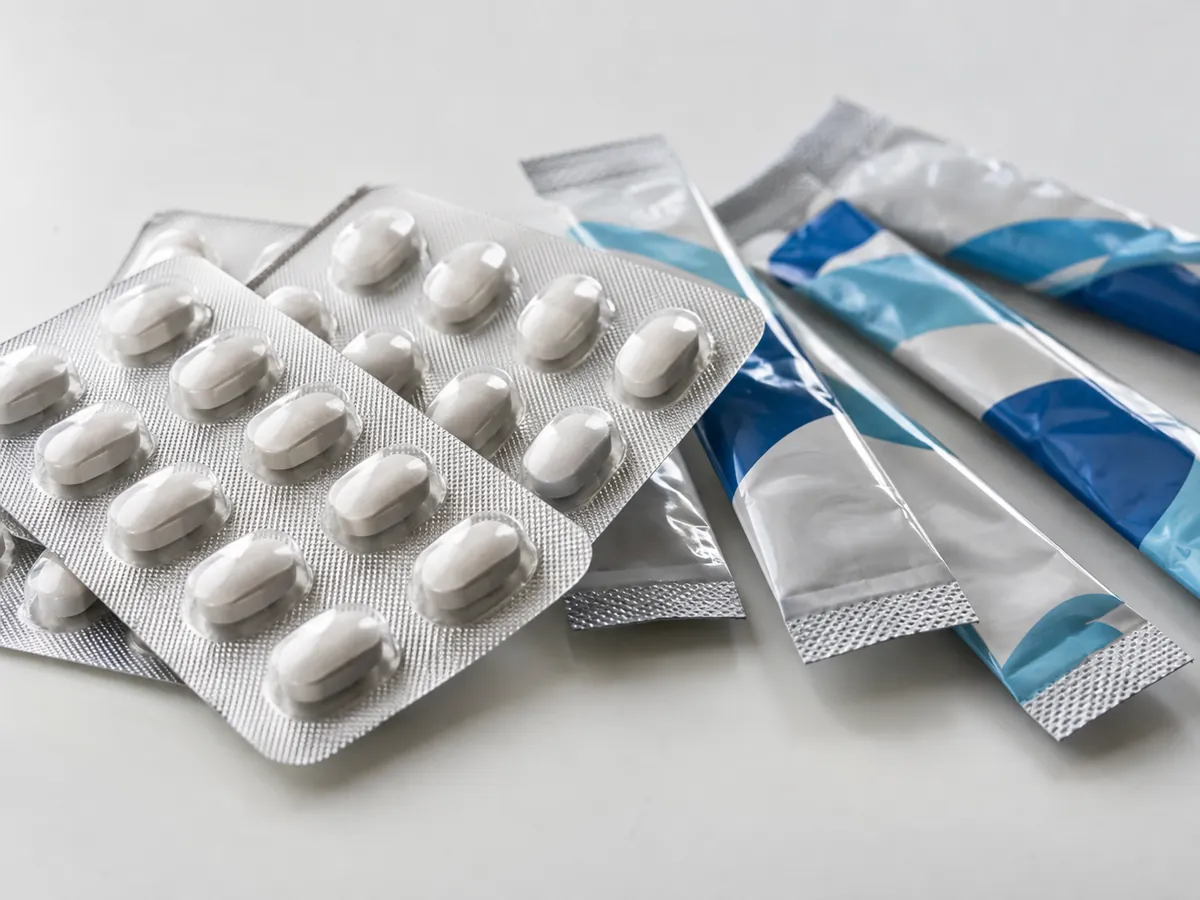
Strip packs seal doses between two foil layers. The material is typically a heat-sealable coated foil or a foil laminate, with the lacquer or sealing layer on the inside. Because there is no formed cavity, soft, thinner foil is often used. Sealing is done with embossed heated rollers or plates that form the individual compartments.
Sachet and stick pack laminates
Powders and granules commonly use paper/AL/PE or PET/AL/PE laminates. Paper gives a printable, tear-friendly outer face, PET adds stiffness and print quality, and PE provides the seal. Thickness and seal layer design are tuned to the vertical or horizontal form-fill-seal machine. When barrier needs are modest, a metallized or other high-barrier film may replace foil; see high barrier film.
Induction seal liners
Bottles for tablets, capsules and some liquids can be closed with a foil-based liner that is heat-sealed to the container rim by induction. The liner structure includes a foil layer for barrier and induction heating, and a seal layer matched to the container material (for example HDPE or PET). Liner selection is largely about matching the container resin.
Selection criteria
Barrier
Start with how sensitive the product is. A highly moisture-sensitive tablet may need a cold-form alu-alu pack, while a less sensitive one may be fine with a barrier-coated PVC web and foil lid. Barrier numbers should be compared with their test conditions stated; see WVTR and OTR.
Formability
For cold-form webs, test the deepest cavity in your design. Pinholes in drawn corners are the typical failure. For other foils, check that the foil can be creased or embossed without cracking.
Sealing compatibility
The sealing layer must match the other web and the machine. A lacquer designed for PVC may not seal to PP. Confirm the sealing window against your actual temperature, pressure and dwell settings. ASTM F88/F88M-23 measures test-strip seal separation force and failure mode; pair it with whole-pack integrity checks.
Printability
Check the print side coating, ink adhesion, registration and whether codes or serialization marks remain readable after sealing and handling.
Documentation
Pharma buyers typically ask for:
- Certificate of analysis per lot
- Specifications with alloy, gauge, coating weights and tolerances
- Food-contact declarations where relevant to the use; these do not establish drug-packaging suitability
- Drug-container suitability evidence and registration-support information for the destination market
Change control
Ask suppliers how they notify you before changes to alloy source, lacquer, adhesive, plant or process. A change that is trivial for the supplier can trigger re-qualification for you.
Common foil selection mistakes
- Qualifying a foil on one forming web, then switching webs without rechecking the lacquer.
- Choosing the thinnest foil on price and finding pinhole rejects or flex cracks later.
- Comparing barrier values measured at different temperatures and humidity levels.
- Treating a supplier’s alloy or coating change as minor and skipping notification terms.
- Ordering foil before the machine has been confirmed to handle its stiffness, reel size and core.
Many of these show up only after launch, when a change is expensive. Record machine, seal and integrity results before committing to final-pack stability work.
Foil qualification record
Scroll horizontally to view all columns if needed. ↔
| Item | Record for the project |
|---|---|
| Deepest cavity | Drawing, tool, layer specification, forming conditions, corner inspection results |
| Cracks and pinholes | Location, method, sample/lot, result after forming and handling |
| Lacquer pairing | Lid coating and mating web/bottle resin, sealing settings, strength/integrity results |
| Product evidence | Tested final pack, stability report, suitability documents and applicable filing support |
| Change notice | Supplier document revision, proposed alloy/coating/adhesive/process change, assessment and release decision |
Interchangeability: A cold-form bottom web is designed to form a cavity; a lid is designed to close it and permit the intended opening. Shared aluminum content does not make the two interchangeable.
Use the film specification comparison guide to record supplier documents alongside the trial results.
Sources
Reviewed 8 October 2026: ASTM F88/F88M-23 above defines the seal-strip test. FDA container-closure guidance addresses drug-packaging suitability and supporting documentation. A manufacturer’s public lidding foil page and cold-form brochure show temper options and OPA / Al / PVC examples; they are source documents, not product recommendations. These descriptions are not approved formulations or our test results.
Continue reading
Related articles

Pharmaceutical Blister Packaging: Forming Films, Lidding and Barrier
Pharmaceutical blister packaging pairs a forming film with a foil lid. Compare PVC, PVDC, PCTFE, PP and alu-alu for moisture barrier, machines and child resistance.

Pharmaceutical Flow Wrap: Wrapping Blisters, Devices and Kits
Pharmaceutical flow wrap seals blisters, devices and kits in a film pillow pack. Review barrier overwraps, peelable films, clean-room machines, coding and film choices.

Cold Form Foil: Laminates for Alu-Alu Blisters
Cold form foil is a soft aluminum laminate pressed into blister cavities without heat. Learn the OPA/Al/PVC build, forming limits, defects and checks.