
Pharmaceutical Flow Wrap: Wrapping Blisters, Devices and Kits
Pharmaceutical flow wrap seals blisters, devices and kits in a film pillow pack. Review barrier overwraps, peelable films, clean-room machines, coding and film choices.
Pharmaceutical flow wrap is a horizontal form-fill-seal process that wraps a single item or a group in a film pillow pack, with a fin seal along the back and a crimp seal at each end. In pharma and healthcare it is used for blister strips, small devices, kits and bundles. Define the intended protection role before specifying the film. The flow wrap format guide and flow wrapper film guide cover general operation.
Decide the wrap’s job first
Scroll horizontally to view all columns if needed. ↔
| Role | Required decision | Evidence to record |
|---|---|---|
| Secondary bundling | Holds already protected packs together | Handling, fit, print/code and line-trial results |
| Barrier overwrap | Adds specified moisture, oxygen or light protection | Exact film grade, test conditions, sealed-wrap integrity and product stability |
| Sterile barrier | Maintains sterility to point of use | Validated packaging and sealing system for the actual sterilization/distribution route |
Ordinary sealing or equipment described as clean-room compatible does not establish a validated sterile barrier. For terminally sterilized medical devices, ISO 11607 distinguishes packaging-system requirements from forming/sealing process validation; the medical packaging guide explains this scope.
What gets flow wrapped in pharma
Blister strips and cards
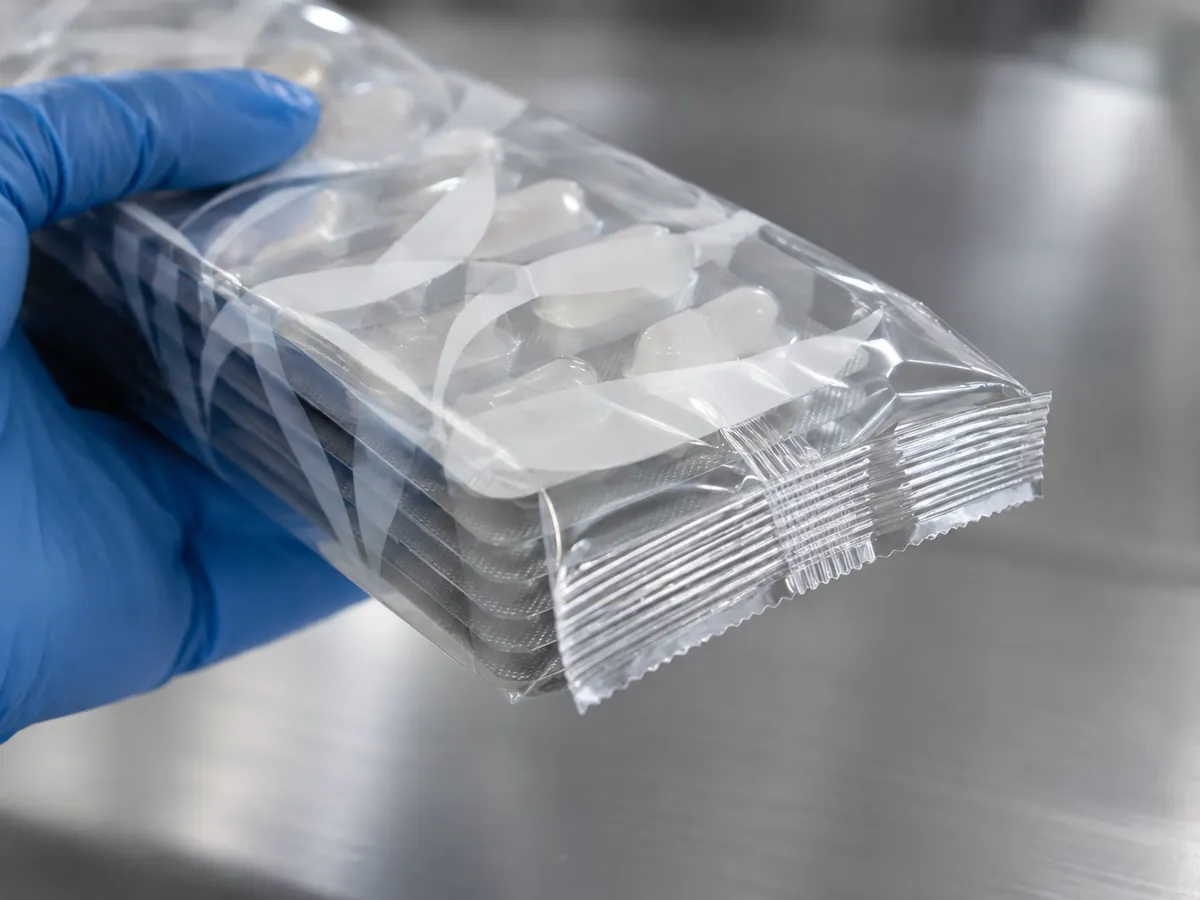
Blisters are often already protected by their forming web and lid. A flow wrap adds another layer. It can hold several blisters together, carry extra print, protect the foil from abrasion and, with the right film, add moisture barrier. For the blister itself see pharmaceutical blister packaging.
Secondary bundling
Blisters or small cartons are bundled in groups for hospital or institutional supply. A flow wrap holds the stack together and keeps it clean, without a carton.
Medical devices and kits
Syringes, swabs, dressings, tubing sets and procedure kits are commonly flow wrapped. If the item must stay sterile through use, the wrap is part of a sterile barrier and must meet medical packaging rules; see medical device packaging materials. Flow wrap used only for hygiene or dust protection has lighter requirements.
Barrier and protective overwraps
For barrier overwraps, evaluate barrier film or metallized film against the declared protection role.
Barrier values depend on test temperature and humidity, so compare supplier numbers only under matching conditions. A film with excellent flat barrier is only as good as its fin and crimp seals, because those are the weak points.
Peelable flow packs for medical items
Medical items in flow wraps often need to open by peeling rather than by tearing the film. Peelable constructions use a seal layer designed to separate cleanly at the seal, so the user can pull the faces apart without cutting. Seal strength has to sit in a window: strong enough to survive distribution, weak enough to open easily. Check the construction against the sterilization method if sterile claims apply, since not every film suits every process.
Film choices
Scroll horizontally to view all columns if needed. ↔
| Need | Film direction (typical) | Notes |
|---|---|---|
| Light protection and print | Specified opaque white, pigmented or metallized grade | Confirm light transmission of the actual web; BOPP film alone is not an opacity guarantee |
| Strong moisture barrier | Metallized or foil laminate | Barrier at seams still matters |
| Clear visibility | Clear laminates with PE or PP sealant | Check seal on your machine |
| Peelable opening | Film with peelable sealant layer | Validate peel force |
| Secondary bundling | Simple PE or PP film, if qualified | Compare handling and barrier requirements for the project |
Manufacturer public data distinguish clear, white and metallized BOPP grades. Appearance alone does not prove the light protection needed by a drug; obtain the exact grade’s optical evidence. Film must also run on the machine: stiffness, coefficient of friction, seal temperature range and gauge consistency all affect tracking and sealing.
Running pharma products on a flow wrapper
Confirm infeed and film behavior with the actual product.
- Product infeed: blister strips must be spaced and oriented consistently. Flighted conveyors and servo infeeds reduce jams and avoid seals landing on product.
- No product, no bag: sensors that stop film advance when an item is missing prevent empty packs and wasted film.
- Seal area contamination: powder or dust from tablets can end up in the fin or end seals and cause leaks. Good extraction and clean infeed help.
- Registered print: pre-printed film needs a registration mark sensor and tension control so the print falls in the same place on every pack.
- Pack looseness: a tightly wrapped item can stress blister cavities, so keep film fit snug but not compressive.
Clean-room and hygienic machine considerations
Pharma and medical lines usually work under tighter conditions than food lines.
- Cleanability: smooth surfaces, few crevices, materials that tolerate cleaning agents.
- Particle control: minimize lubricants, dust and abrasion on film paths; low-particle film trims and waste handling.
- Clean-room operation: equipment and film may need to run in a controlled environment, and film reels need appropriate handling and unpacking.
- Changeover and segregation: thorough line clearance between products, with controls against mix-ups.
- Documentation: equipment qualification, material traceability and batch records.
These requirements vary by company, product and market, so settle them with your quality team and machine supplier.
Printing and coding
Flow wraps carry product name, batch and expiry, and sometimes serialization or tracking codes. Options include pre-printed film with registration marks, and inline thermal transfer, inkjet or laser coding. Points to check:
- Registration mark reading so print stays aligned with the product and seals.
- Code contrast and adhesion on the chosen film, including metallized surfaces.
- Vision verification of code content and presence after sealing.
- Cleanliness of coding technologies in the environment.
Line acceptance record
Define pack role, product dimensions/edges, film grade, speed and acceptance criteria before the trial.
Scroll horizontally to view all columns if needed. ↔
| Check | Record challenge and settings | Record outcome |
|---|---|---|
| Fin/longitudinal and end seals | Seal location; temperature, pressure, dwell; clean and contaminated samples | Strength, failure mode, leak/integrity result and rejected packs |
| Registration marks | Print repeat, sensor settings, speed and splice/restart conditions | Alignment of print and seals; reject response |
| Missing product | Deliberately missing item under the agreed test protocol | Film-feed inhibition or machine response; empty-pack disposition |
| Coding | Expected batch/expiry, coding method, contrast and vision settings | Correct/readable code; missing or wrong-code rejection |
| Whole pack | Actual product fit and distribution/sterilization route, where applicable | Damage, integrity, opening and applicable validation report |
ASTM F88/F88M-23 measures force to separate a seal test strip and records failure mode. It does not establish whole-wrap leak tightness, drug stability or sterility. Add the integrity and product/system validation appropriate to the declared wrap role.
The supplier evaluation guide helps organize material traceability, change control and trial evidence.
Sources
Reviewed 8 October 2026: ASTM F88/F88M-23 above covers seal-strength testing. ISO 11607-1:2019 covers materials and sterile barrier/packaging systems for terminally sterilized medical devices; ISO 11607-2:2019 covers validation of forming, sealing and assembly processes. Manufacturer public documentation distinguishes opaque/metallized BOPP grades; the exact grade reference is recorded in the editorial evidence log, without a product endorsement.

Continue reading
Related articles

Pharmaceutical Blister Packaging: Forming Films, Lidding and Barrier
Pharmaceutical blister packaging pairs a forming film with a foil lid. Compare PVC, PVDC, PCTFE, PP and alu-alu for moisture barrier, machines and child resistance.
Pharmaceutical Packaging Foil: Types and How to Select Them
Pharmaceutical packaging foil covers lidding, cold-form, strip pack and sachet laminates. See the types, key properties and how to choose between them.
Bakery Packaging Film: Keeping Bread and Cakes Fresh
Bakery packaging film explained: how staling, moisture loss and mold shape film choice for bread, cakes, cookies and tortillas, plus formats and machines.