
Flow Wrap Film: Choosing Film for Horizontal Flow Wrappers
Flow wrap film guide: common structures, cold seal vs heat seal, COF, sealing, registration, tracking and troubleshooting for horizontal flow wrappers.
Leaks waste product; registration drift can misplace the cut and reject printed packs. Choose heat seal or cold seal against product heat tolerance and the wrapper configuration, then verify film surfaces, sealing and tracking at the intended speed. This page covers the specification and fault records. The pack style itself is covered in flow wrap packaging.
Scroll horizontally to view all columns if needed. ↔
| Product condition | Seal route to evaluate | Necessary film / machine data |
|---|---|---|
| Heat-sensitive product | Cold seal where the wrapper supports it | Cohesive pattern, pressure, storage limits and product trial |
| Product tolerates seal-zone heat | Heat seal on configured jaws/wheels | Actual structure, seal curve, dwell and pressure |
| Crumbs, dust or fat near seals | Validate the selected route with actual contamination | Seal/leak results and cleaning/stoppage records |
| Printed packs | Either supported route | Repeat, mark contrast/position, tension and cut-position results |
What is flow wrap film?
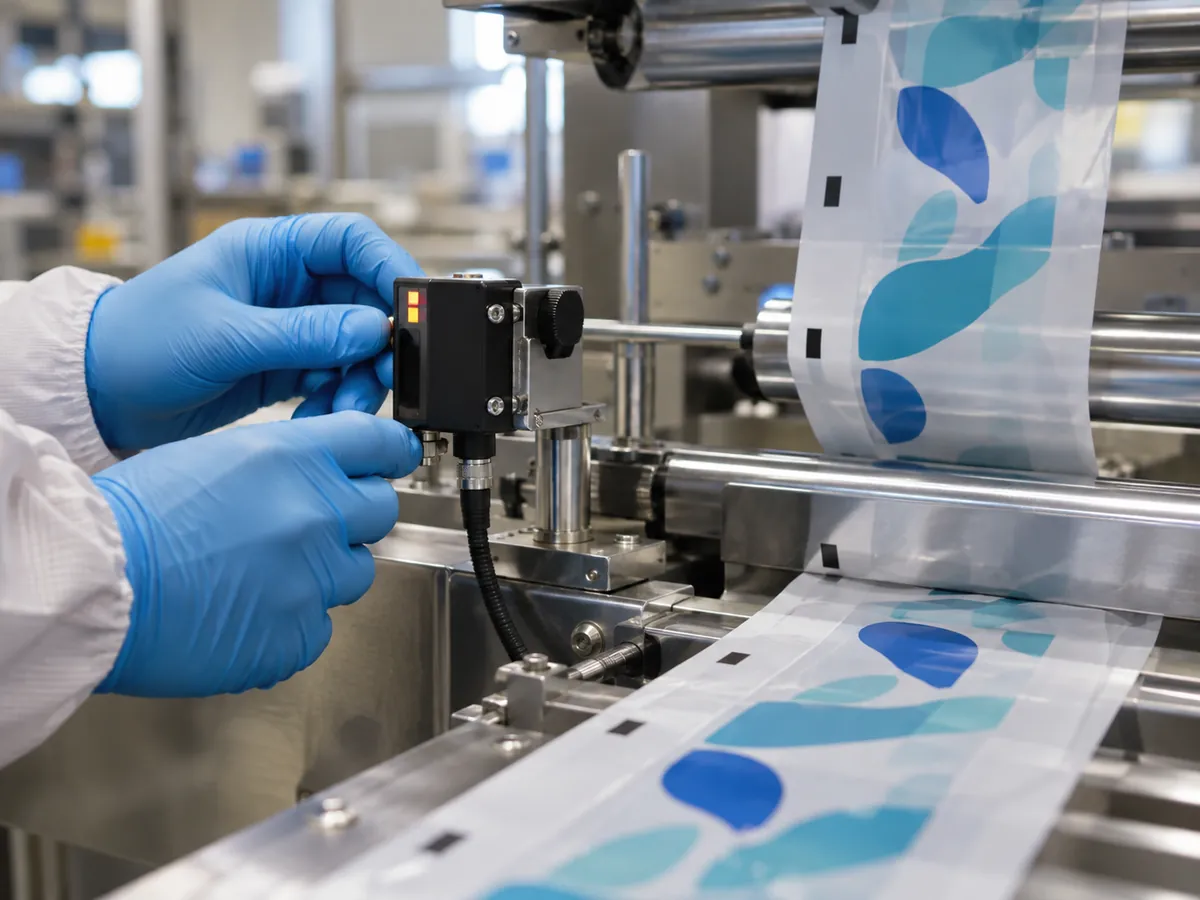
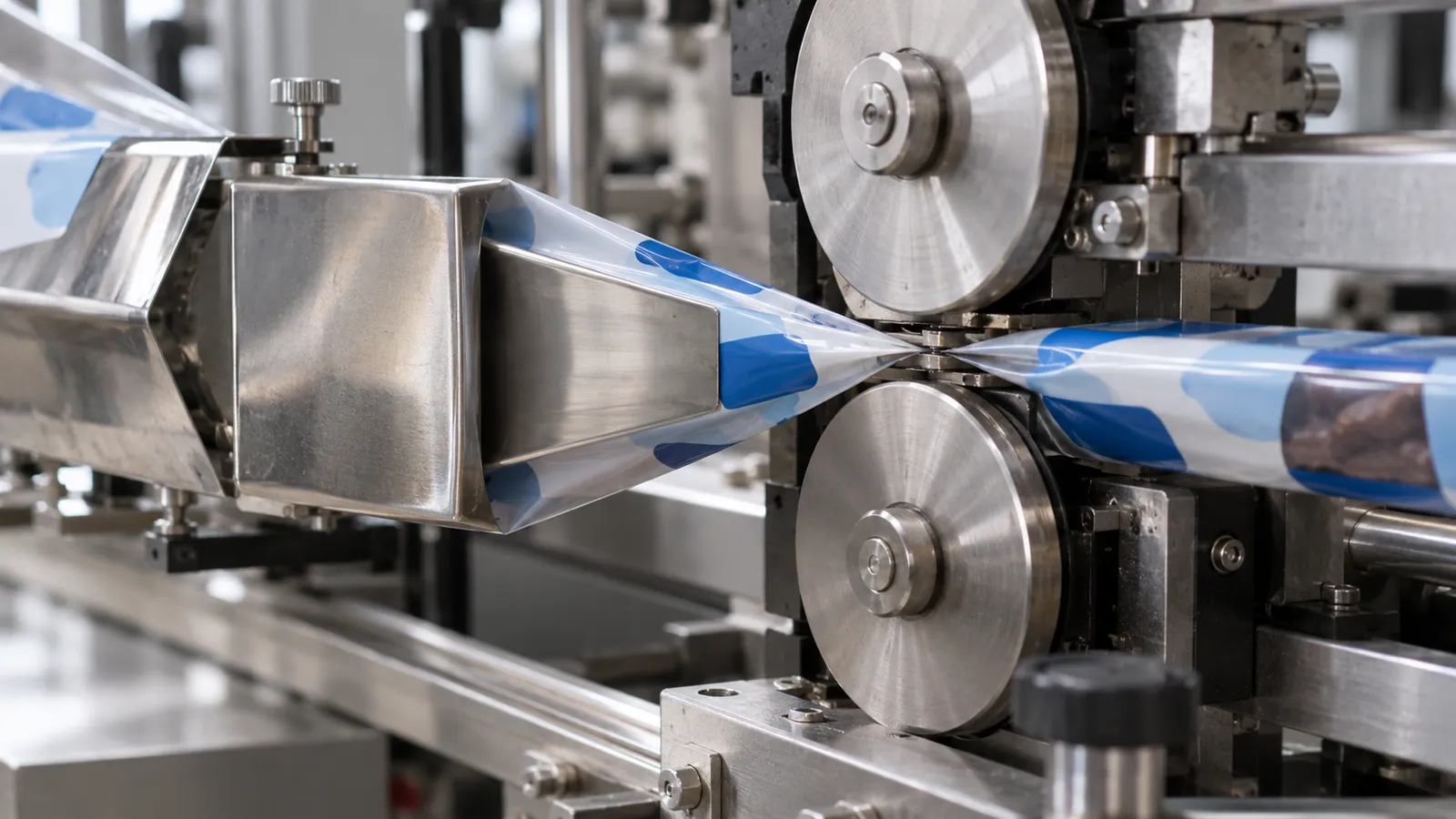
Flow wrapping (horizontal form-fill-seal, often called HFFS) feeds products on a conveyor into a forming box where the film wraps around them. Rotating fin wheels pull the film and press the longitudinal seal, then crimp jaws make the end seals and cut. Films for flow wrapping machines are supplied as reels and are typically printed with a registration mark so the cut lands in the right place relative to the artwork.
The film has to slide over the forming box without scuffing, grip the fin wheels without slipping, seal in a short dwell time, and hold up through handling. That is why flow wrapper film is often a laminate or a coextruded film with a sealant layer chosen for the machine.
Common flow wrap film structures
Structures vary by product, barrier need and machine. These are the most common, though exact constructions differ by supplier.
Scroll horizontally to view all columns if needed. ↔
| Structure | Typical use | Notes |
|---|---|---|
| BOPP / BOPP (laminated or coextruded heat-seal layers) | Biscuits, bakery, confectionery, non-food | Good clarity and stiffness, widely available, moderate moisture barrier |
| BOPP / metallized BOPP | Snacks, bars, products sensitive to light and moisture | Improved light and moisture barrier. Metallized layer adds opacity |
| PET / PE | Products needing heat resistance or a stiffer pack | PET adds stiffness and print quality, PE provides the sealant |
| Cold-seal BOPP | Chocolate, ice cream coatings, heat-sensitive products | Sealed by pressure on cold-seal adhesive instead of heat |
| Paper-based options | Dry products where a paper look or recyclability goal drives the design | Often paper with a heat-seal coating or laminate. Machine settings usually need extra trials |
Material background is in BOPP film and PET film. For product examples, see bakery packaging and pharmaceutical flow wrap.
Which layer of a flow wrap film does which job?
The table separates five jobs: outer surface and print, barrier, sealing, interlayer bonding, and slip/static control. Several layers or coatings can share a job. When a spec is written or a fault appears, start with the layer that owns that job.
Scroll horizontally to view all columns if needed. ↔
| Job | Layer that usually does it | Common materials | What it controls on the wrapper | Ask the film supplier for |
|---|---|---|---|---|
| Print and outer surface | Outer web, often reverse printed and laminated to the rest | BOPP, PET, paper | Graphics, stiffness through the forming box, resistance to jaw heat on the outside, friction against metal parts | Which face is printed, surface treatment for ink adhesion, outside COF against metal |
| Barrier | A middle layer or coating | Metallization, aluminum foil, EVOH in a coextrusion, barrier coatings | Shelf life against oxygen, moisture and light. Little effect on running, except that metal layers can crack where the film is creased | OTR and WVTR with test temperature and humidity, optical density for metallized layers |
| Sealing | Inner sealant layer, or a cold-seal coating | CPP, PE sealants, coextruded heat-seal skins on BOPP, cold-seal cohesive | Fin and end seal strength, how wide the seal window is, hot tack, sealing through crumbs or powder | Seal initiation temperature and seal window for this sealant, hot tack, seal strength with the test method |
| Holding the layers together | Lamination adhesive or extrusion tie layer | Adhesive laminations, extrusion lamination | Whether the layers stay bonded through crimping, creasing and handling | Bond strength between layers |
| Slip and static | Additives in the surface layers, sometimes a coating | Slip, antiblock and antistatic additives | Film-to-metal and film-to-film friction, tracking, how the roll unwinds, dust pickup | COF for each face with the method, at delivery and after storage |
Two things follow from this table.
First, some properties belong to more than one layer. Friction depends on the surface layers and on slip additives that migrate over time and can transfer from the inside face to the outside face on the roll, as explained in coefficient of friction. A new sealant grade can therefore change how the film runs over the forming box even when the print web is unchanged. On a lap seal the sealant has to bond to the outer surface, so the outer web shares the sealing job too.
Second, swapping a layer for one job can disturb another. Replacing a metallized web with clear film to show the product removes light barrier and also changes the background the photo eye reads the mark against. Moving barrier from foil to a coating or to EVOH changes how the structure behaves at creases and seals. Metallized film and EVOH film cover those trade-offs, and CPP film compares the common sealant choices. The way the layers are joined is described in laminated packaging.
Cold seal vs heat seal
Heat seal films use a sealant that softens under jaw heat. Cold seal films use a cohesive coating designed to seal to itself under pressure; confirm the coating pattern and jaw configuration for the product.
Scroll horizontally to view all columns if needed. ↔
| Factor | Heat seal | Cold seal |
|---|---|---|
| Product temperature | Product and seal area see jaw heat | No heat at the seal, suited to heat-sensitive products such as chocolate |
| Seal speed | Verify dwell and cooling at target speed | Verify pressure/contact time at target speed |
| Seal strength and hermeticity | Test the actual structure and jaw conditions | Test the actual coating pattern and pressure |
| Contamination tolerance | Trial the actual sealant with the product | Trial the actual cohesive with the product |
| Storage | Stable under normal conditions | Adhesive can block or degrade. Storage temperature and shelf life matter |
| Machine | Heated crimp jaws and fin wheels | Unheated or lightly heated jaws, correct pressure |
Check that your machine is configured for the system you intend to use. A cold-seal film will not run on a heated setup without changes, and the reverse is also true.
Film thickness
Specify total and layer thickness from the candidate structure’s data sheet, then confirm handling and sealing on the actual wrapper. Compare changes in gauge with tracking, wrinkles and seal results rather than assuming a thicker web runs better.
Coefficient of friction
Coefficient of friction (COF), measured in the lab per ASTM D1894, describes how easily the film slides over a surface. A flow wrapper cares about two kinds: film to metal, because the film slides over the forming box and guide rollers, and film to film, because it affects how the lap or fin lies and how the roll behaves on unwind.
- Too high a COF on metal drags the film, causing wrinkles, tension spikes, tracking drift and jams at the forming box.
- Too low a COF on the fin wheels or product contact points can cause slipping, so the film does not advance cleanly.
- Static can raise apparent friction and cause film to cling to the box or attract dust.
Slip additives bloom to the surface over time, so COF measured fresh from the converter may differ from COF after weeks in storage or after the film warms on the machine. Ask for a COF range at the end of shelf life as well as at manufacture.
Sealing performance
Fin seal vs lap seal
A fin seal joins the two inner surfaces face-to-face and folds the seam flat or out. It needs sealant on the inside only and is common on sealed packs. A lap seal overlaps the outer film over the inner and needs sealant to bond to the print or outer layer, so structure and surface chemistry must allow that. Lap seals use less film and give a flat back, but they limit structure choice.
Crimp jaws: temperature, dwell and pressure
The end seals are made by crimp jaws, typically with a serrated pattern. The three variables are temperature, dwell time (set indirectly by speed) and pressure. Seal window width, discussed in seal initiation temperature, tells you how far you can move these before the seal fails or the film distorts. A wide window is more forgiving at speed.
Hot tack and contamination
At end seals the product is often still moving and the pack is pulled while the seal is warm, so hot tack (see ASTM F1921) affects whether the seal holds immediately after the jaws open. Products that shed crumbs, oil or powder into the seal area need sealants rated for seal-through-contamination, otherwise leak rates rise even if jaw settings look correct.
Print registration and eye marks
A photo eye reads a printed registration mark and tells the machine where to cut. The mark should have strong contrast against its background, be positioned in the clear area the sensor can see, and be consistent in spacing. Registration drift commonly comes from film stretch, mark placement that varies across the roll, or low contrast on metallized or dark backgrounds. Specify mark size, position and color in the purchase spec, and check them on every new artwork.
Film tracking and tension
A wrapper needs the film to track straight. Roll quality (even winding, no telescoping), correct unwind tension and clean guide rollers all contribute. Tension that is too high stretches the film and shifts print registration. Tension that is too low causes wander and wrinkles. Check unwind brake or dancer settings when changing film, since a different stiffness or thickness shifts the best setting.
Machine speed
Speed raises the demands on every item above. At higher speed, dwell time falls, friction heat rises, static builds and the seal has less time to form and cool. A film that runs well at moderate speed may fail near the machine’s limit. Trial at the speed you plan to run, which may differ from the speed that is convenient for the first sample.
Common problems and likely causes
Scroll horizontally to view all columns if needed. ↔
| Problem | Likely causes |
|---|---|
| Wrinkles in the fin seal | COF too high on forming box, uneven tension, film too thin or too limp, misaligned forming box or fin wheels |
| Leaking end seals | Seal temperature or dwell outside window, contamination in seal area, crimp jaw misalignment or wear, sealant not suited to the product |
| Registration drift | Film stretch from high tension, mark contrast or position variable, sensor dirty or misset, splice or roll variation |
| Static | Low humidity, high speed, film type, missing static elimination, high COF causing friction charging |
| Blocking | Cold-seal or sealant layers pressing together on the roll, warm storage, high roll pressure, slip additives depleted |
| Film breaks | Weak splices, nicks on slit edge, excessive tension, sharp edges on forming box, brittle film in cold conditions |
Leaking seals, wrinkles or drifting print: check the film or the machine first?
Start with what changed last. If the fault began with a new roll, lot or structure while machine settings stayed the same, suspect the film first. If it began after a changeover, cleaning, jaw or belt work, or it shows up on every film you run, suspect the machine first. The table gives first checks for leaking seals, wrinkles and registration drift.
Scroll horizontally to view all columns if needed. ↔
| Symptom | Points to the film when | Points to the machine when | First checks, in order |
|---|---|---|---|
| Leaking end or fin seals | Leaks started with a new lot or sealant; the leaks follow one roll when rolls are swapped; clean seal areas fail at settings that worked before | Every film leaks; leaks line up with one jaw position or one side of the crimp; there is residue on the jaws; actual jaw temperature differs from the setpoint | 1. Clean the jaws and confirm actual temperature against the setpoint. 2. Look for product in the seal area. 3. Run the new roll and a retained good roll at the same settings. 4. Compare the new lot’s sealant data with the spec |
| Wrinkles in the fin seal or pack body | Wrinkles started with a new roll or supplier; the film is thinner or limper than before; outside COF is higher than specified; the roll is unevenly wound | Wrinkles appeared after a forming box change or belt adjustment; they sit on one side only; they persist across rolls and lots | 1. Run a roll that ran well before. 2. Check forming box size and alignment, fin wheels, and belt tension and tracking. 3. Measure COF of the new film against the spec |
| Print drifting out of register | The mark has weak contrast (metallized, dark or very glossy background); mark spacing varies along the roll; drift starts at a splice; thin film stretches at the current tension | The sensor lens is dirty or the sensor has moved; the sensor was taught on the previous film; every roll drifts; tension or brake settings were changed | 1. Clean the photo eye lens and check its position over the mark. 2. Re-teach the sensor on this film. 3. Measure the mark-to-mark repeat on the roll against the artwork. 4. Check unwind tension |
Use this diagnostic sequence under the machine’s operating instructions: retained good roll at the same settings → actual jaw temperature against setpoint → product or residue at the seal → the symptom-specific alignment/sensor checks above. A fault following the roll suggests a film investigation; a persistent fault keeps the machine/setup investigation open. This is an editorial comparison sequence, not a conclusive test of cause. Enter each step in the fault record.
Fault record
Scroll horizontally to view all columns if needed. ↔
| Field | Record for each step |
|---|---|
| Sample / change | New and retained lot/roll IDs: ___; what changed: ___ |
| Conditions | Speed, jaw actual/set temperatures, pressure, tension: ___ |
| Check | Swap / temperature / contamination / alignment / sensor: ___ |
| Outcome | Leak or cut-position result and method: ___; photo/sample ID: ___ |
| Closure | Correction: ___; repeat result: ___; owner and accept/hold: ___ |
This order does not hold in every case:
- If the film and the machine setup changed at the same time, for example a new structure launched on a newly adjusted line, neither can be cleared alone. Trial the film at target speed with both suppliers’ data in hand.
- With cold-seal film, check the age and storage temperature of the roll before the jaws, since the cohesive coating can block or degrade in storage.
- If the room’s temperature or humidity is outside what the machine was specified for, fix that before blaming either side. Static and friction both shift with conditions.
- Hot tack problems show up only while the pack is still warm and moving. A seal that tests fine on the bench can still open on the line, so check end seals as packs leave the jaws.
What to put in a flow wrap film specification
- Define the product: weight, shape, sharp edges, fat or dust, temperature sensitivity.
- Choose heat seal or cold seal based on product heat tolerance and machine setup.
- Set barrier needs for shelf life and confirm the structure supplies them.
- Specify COF film-to-metal and film-to-film with test method and conditions.
- Ask for seal window data and hot tack for the actual sealant, not a generic one.
- Define registration mark size, position and contrast.
- Specify core, roll diameter, weight, unwind direction and splice limits.
- Trial a full roll at target speed.
Questions for the wrapper supplier
Before the first order, confirm with the wrapper supplier:
- the minimum and maximum film width and roll size, and the core size
- the forming box size range for your product
- the jaw type and temperature range
- whether the machine is configured for heat seal, cold seal or both
- the photo eye type and mark requirements
- any film structures or thickness ranges they have tested
Wider coverage is in packaging film and machine compatibility, and the first-order risk checklist shows how supplier trials fit into a purchase.
Sources and method
Compiled from public manufacturer guidance, not our trials. The five-job table is an editorial specification framework; confirm its material choices with the candidate data sheet. Sources checked 8 October 2026:
Scroll horizontally to view all columns if needed. ↔
| Public source | Claim used / limit |
|---|---|
| Soontrue: horizontal flow-wrapper maintenance, 28 May 2026 | Sensor cleanliness, jaw residue and belt alignment as checks |
| Viking Masek: photo-eye setup, 8 December 2020 | VFFS source: mark contrast, lens/position and splice checks only |
| Viking Masek: VFFS troubleshooting, 6 August 2019 | VFFS source: recent changes and actual/set temperature comparison only |
| Viking Masek: film COF, 2 June 2020 | Face-specific friction; its VFFS COF ranges are not wrapper limits |
| ASTM D1894-24 and F1921/F1921M-12(2023) | Friction and instrumented hot-tack test scopes, not machine acceptance values |
The VFFS checks are editorial extrapolations to comparable sensors, surfaces and temperature controls. Forming-collar settings, jaw timings and numerical ranges are not transferred to a flow wrapper.
Continue reading
Related articles
Premade Pouch Packaging Materials: What Pouch Machines Need
Premade pouch packaging materials explained: tolerances, stiffness, sealants, zippers and the specs pouch machines need to open, fill and seal reliably.
Sachet Film: Choosing Packaging Film for Sachet Machines
Sachet packaging film runs on 3-side and 4-side seal machines. Compare structures, sealing, tear notches and fixes for leaks and seal-through-contamination.
Shrink Wrapping Film: Matching Film to Shrink Wrapping Machines
Shrink wrapping film must suit the sealer and tunnel. See which films fit L-sealers, side sealers and bundlers, seal methods and how to fix common defects.