
Hot Tack in Packaging Films: What It Is and Why It Matters
Hot tack packaging performance is the strength of a heat seal while it is still molten. Learn the ASTM F1921 test, the hot tack curve and how it affects VFFS lines.
Hot tack is the strength of a heat seal in the moment right after sealing, while the polymer is still molten or only partly cooled. It matters because many machines load the seal before it has cooled: on a vertical form-fill-seal line, product drops onto a bottom seal that was made a fraction of a second earlier. A sealant with good hot tack holds through that moment. One with poor hot tack leaves leaking or burst packs even if its final seal is strong.
Three sealing measurements
Scroll horizontally to view all columns if needed. ↔
| Property | When it is measured | What it tells you | Typical standard |
|---|---|---|---|
| Seal initiation temperature | After the seal has cooled | Lowest temperature giving a defined minimum strength | ASTM F88 on seals made per ASTM F2029 |
| Hot tack strength | Immediately after sealing, while still hot | Whether a seal survives load before cooling | ASTM F1921 |
| Final seal strength | After the seal has fully cooled | Strength of the finished seal in transport and use | ASTM F88 |
What hot tack means
When two sealant layers are fused under heat and pressure, the interface is a layer of molten polymer. Over the next fraction of a second to several seconds, it cools and crystallizes, and the seal gains its final strength. During that interval the seal has some strength, but usually a small fraction of the final value. That early strength is hot tack, and it is measured in force per width of seal, just like seal strength.
Hot tack differs from the final seal strength: a seal can reach a high strength after cooling but be weak at the instant it is stressed. It also differs from seal initiation temperature, which is a cold measurement. The comparison above separates these measurements.

The ASTM F1921 test in principle
ASTM F1921/F1921M-12(2023) is the standard test method for hot seal strength (hot tack) of thermoplastic polymers and blends comprising the sealing surfaces of flexible webs. In principle:
- Two strips of film are clamped and sealed together at a set temperature, dwell time and pressure.
- After a set delay time, the seal is pulled apart by the instrument while it is still hot, at a set speed.
- The peak force the seal withstands, per width of the strip, is recorded.
- The process is repeated across a range of sealing temperatures, with the delay time and other parameters held constant.
The result depends on every variable, so the report should state the sealing temperature range, dwell, pressure, delay time, strip width, pull speed and the selected F1921 method. Results are comparable only when these match. Hot tack data from different suppliers on different instruments with different delay times should not be compared directly.
The hot tack curve and window
Plotting hot tack strength against sealing temperature gives a hot tack curve. Described in words, and as a generic shape rather than measured data:
- At low temperatures the sealant barely fuses, so hot tack is close to zero.
- As temperature rises, strength increases and reaches a peak. This is where the sealant is molten enough to bond, but still has enough melt strength to resist the pull.
- At higher temperatures the curve falls. The polymer becomes too fluid, thins out in the seal and has too little melt strength to hold.
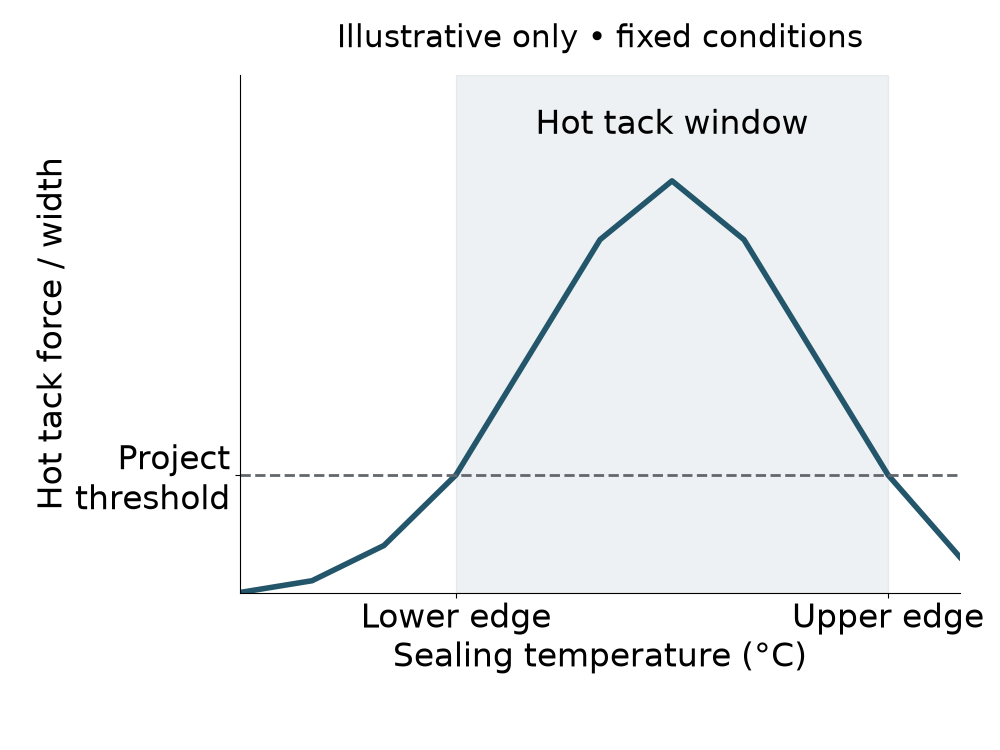
The hot tack window is the range of temperatures where hot tack exceeds a minimum you need. A wide window makes a line forgiving, because small changes in jaw temperature, ambient conditions or line speed do not push seals out of range. A narrow window means tight temperature control and frequent adjustments. What counts as a “minimum” depends on the pack, the product weight and the drop height, and has to be set from trials on your machine.
Why hot tack matters on VFFS and fast lines
On a VFFS machine, the film is formed into a tube around the fill tube, the vertical seal is made, and the horizontal jaws then seal and cut. A transverse sealing station commonly forms the top closure of the filled bag below and the bottom closure of the next bag above. Cutting between those bands leaves two distinct seal edges; they share a sealing operation, not one physical seal after separation. Product falls into the bag while the bottom seal is still warm, and the weight and impact of the product pull on it. Heavy, sharp or free-flowing products such as snacks, frozen goods, rice and powders put the most load on the seal. If the hot tack is too low, the seal opens partially, the pack leaks or product falls through.
Other settings with the same issue:
- High-speed lines reduce the time between sealing and loading, so the seal has less time to cool.
- Multi-lane stick pack and sachet machines run short dwells and need quick-bonding sealants. The pages on stick pack film and sachet film cover these formats.
- Flow wrap has a fin seal and end seals that are pulled and cut at speed, as described under flow wrapper film.
- Hot fill and heavy products where the contents stress the seal almost at once.
- Products with trapped air that expands or squeezes against the seal.
Machine design also helps, because cooling bars, adjustable drop timing, a slower fill and a shorter drop all reduce the load. Even so, a sealant that cannot hold at the moment of impact is a material problem that settings only partly solve.
Compare the actual sealant structure
Metallocene LLDPE, plastomer blends and ionomer-containing sealants are candidates, not a family-wide performance ranking. Ask for a curve on the intended layer structure, including thickness and additives; LLDPE film and PE film explain the material roles. Confirm blocking, sealing and recycling trade-offs on that structure.
A manufacturer’s public patent test data report hot tack using 0.5 s dwell, 0.4 s delay, 200 mm/s peel speed, 25.4 mm strips and 0.5 N/mm² sealing pressure; Table 8 gives temperature-dependent results for its particular films. This is published supplier work, not a recommendation or a trial by this site. It cannot set a target for another formulation.
Relationship to SIT and final seal strength
Three properties describe a sealant, and they answer different questions.
Hot tack and SIT are related, since a sealant that bonds at low temperature usually also builds hot tack at lower temperatures, but the correlation is not guaranteed. A low-SIT sealant can have a narrow hot tack window or a low peak, and a sealant with good hot tack may have a higher SIT. Vertical and high-speed applications should therefore look at all three. Cooled heat-seal strength and its initiation criterion are covered under seal initiation temperature, and packaging seal strength explains how finished seals are tested and specified.
Hot tack trial record
Scroll horizontally to view all columns if needed. ↔
| Field | Entry |
|---|---|
| Film lot, structure, sealant grade / thickness | _____ |
| F1921 method, strip width, pull speed | _____ |
| Temperature sweep, dwell, pressure and delay | _____ |
| Machine speed (packs/min), cycle and jaw-opening time | _____ |
| Product mass, drop height, first impact time after opening | _____ |
| Hot tack curve at the corresponding delay / delays | _____ |
| Cooled strength / SIT, leak result and failure location | _____ |
| Agreed load criterion, usable window and trial result | _____ |
Measure the time from jaw opening to first product impact; use it to select laboratory delays, rather than assuming machine speed alone gives cooling time. Confirm the full cycle on the real VFFS line and repeat if moving to a mono-material structure.
Sources and method
Reviewed October 8, 2026 using the public scopes of ASTM F1921/F1921M-12(2023) (instrumented warm-seal testing), ASTM F2029-16(2021) (laboratory seal preparation) and ASTM F88/F88M-23 (seal-strip strength). Patent data above apply to its disclosed films and conditions. The window graphic is a conceptual explanation, not a measured curve or machine setting.

Continue reading
Related articles
Packaging Film Coefficient of Friction (COF): Testing and Targets
Packaging film coefficient of friction explained: static vs kinetic COF, ASTM D1894 testing, slip additive migration and how to set COF targets for your machine.

Packaging Seal Strength: Testing and Specifying Seals
Packaging seal strength is how much force a heat seal resists before it opens. Learn ASTM F88 peel, burst and leak tests, failure modes and how to write a spec.
Seal Initiation Temperature (SIT): What It Is and How It's Measured
Seal initiation temperature is the lowest sealing temperature at which a heat seal reaches a defined minimum strength. Learn how SIT is measured and used.