
VFFS Packaging Film: Materials, Sealing and Machine Compatibility Guide
VFFS film guide: common structures, thickness, barrier, sealing, COF, tracking and troubleshooting for vertical form fill seal machines and rollstock.
Film that forms but cannot hold its fresh seals can waste product and stop the line. VFFS film is flexible packaging film supplied on a roll that a vertical form fill seal machine pulls over a forming collar, shapes into a tube, seals, fills with product and seals again to make a bag. The film has to slide, seal and track reliably at speed and protect the product. This guide covers structures, sealing, friction, tracking and the machine details to confirm before ordering VFFS rollstock.
Bag, product and sealing quick check
Scroll horizontally to view all columns if needed. ↔
| Bag and product | Seal configuration to confirm | Trial focus |
|---|---|---|
| Pillow bag; snacks | Fin or lap back seal; cross seals | Crumbs/oil, barrier and hot tack |
| Pillow bag; coffee | Back seal, cross seals and any valve | Oxygen/aroma target and valve position |
| Gusseted bag; granules | Back seam and folded cross-seal zones | Layer buildup, impact and channels |
| Bag for dusty powders | Approved jaw/sealant combination | Actual contamination and immediate load |
These are trial inputs, not material approvals. The machine drawing and actual product determine the configuration.
What VFFS packaging film is
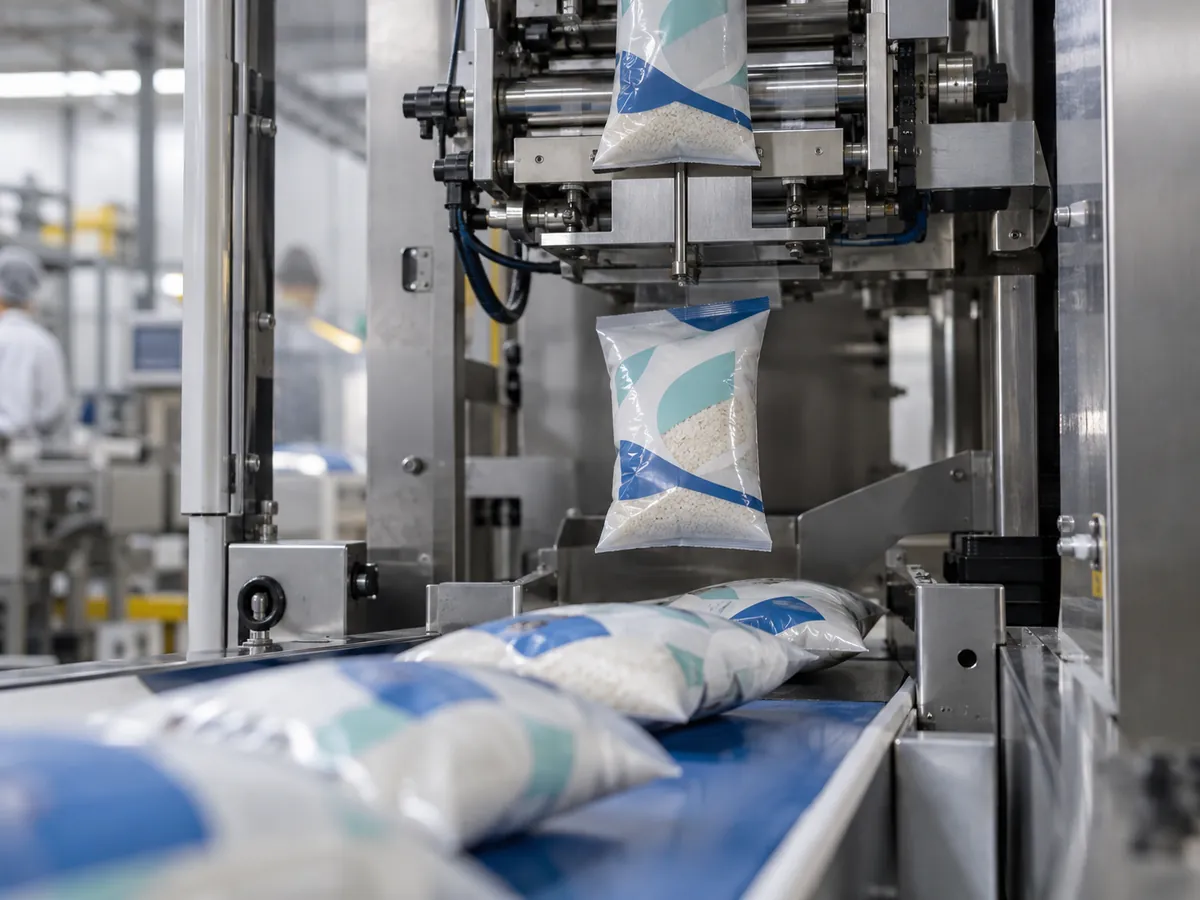
In a vertical form fill seal machine, film unwinds from a roll, passes over a forming collar (the shoulder) and wraps around a vertical filling tube. A vertical seal bar joins the film edges into a tube. Cross-sealing jaws then make the bottom seal of one bag, the product is dosed through the tube, and the jaws close again to seal the top of that bag and the bottom of the next, cutting between them.
Film for a vertical packaging machine has to do more than block oxygen and moisture. It is pulled over metal, has to seal quickly while carrying product weight, and has to run for hours without drifting off track. Most VFFS rollstock is a laminate or coextruded film printed on the outside, with a heat-seal layer on the inside.
Common VFFS film structures
Scroll horizontally to view all columns if needed. ↔
| Structure | Typical use | Notes |
|---|---|---|
| PET/PE | Snacks, dry foods, general purpose | PET outer gives print quality and stiffness. PE inner is the sealant |
| BOPP/CPP | Snacks, confectionery, bakery | Good clarity, stiffness and moisture barrier. CPP seals at moderate temperatures |
| PET/metPET/PE | Coffee, chips, products sensitive to light and oxygen | Metallized layer improves barrier and light blocking |
| Mono PE | Designs aimed at PE recycling streams | Can be more sensitive on the machine because sealing and stiffness gaps are narrower |
| Mono PP | Designs aimed at PP recycling streams | Higher seal temperatures, stiffness may suit some machines |
For background see PE film, BOPP film and mono-material packaging. Mono-material films often run well only after the jaw settings are adjusted, because the same polymer on both sides can leave less margin between sealing and film distortion than a laminate.
Film thickness
Specify total thickness from the approved film build, bag dimensions, fill mass and machine limits. There is no universal thickness range that qualifies VFFS rollstock. Compare candidates on the actual line, recording measured gauge, tracking, hot tack and finished-bag integrity.
A manufacturer’s public machine sheet lists an impulse-sealing option for poly film structures. That is an equipment-specific option, not proof that all PE grades or thicknesses work on every machine. The structures above are candidates for testing, not fixed product/material matches.
Barrier requirements
Barrier needs follow the product, not the machine.
- Oxygen (OTR): needed for fats, oils, coffee and nuts that oxidize. See oxygen transmission rate.
- Water vapor (WVTR): needed to keep crisp products crisp and powders free-flowing, or to hold moisture in. See water vapor transmission rate.
- Light: metallized or opaque layers protect light-sensitive products.
- Aroma: retention or exclusion of aroma often needs a barrier layer or a sealant with low scalping.
OTR and WVTR values depend on test temperature and relative humidity, so compare supplier figures only when conditions match. Standards such as ASTM D3985 and ASTM F1249 define the usual methods. Higher barrier layers can change sealing and stiffness, so check machine behavior whenever the structure changes.
Sealing performance
VFFS sealing has two jobs: a continuous vertical seal along the back of the tube and cross seals at top and bottom. The cross seals are the harder ones.
Seal initiation temperature and seal window
Seal initiation temperature is the lowest jaw temperature that produces a usable seal. Lower initiation helps at high speed because the seal forms in a shorter dwell. The seal window is the temperature range between a good seal and over-sealing, where the film shrinks, distorts or sticks to the jaw. A wide window tolerates temperature drift and speed changes. More in seal initiation temperature.
Hot tack
Hot tack is the strength of a seal while it is still warm, before it has cooled and crystallized. On a VFFS machine it matters twice. The product drops onto a bottom seal that is still warm, and the bag is pulled down while the top seal is fresh. Low hot tack can let bottom seals open under product impact. Record rejected bags, lost product, cleanup and restart time when assessing cost per good pack; cooled seal strength alone can miss this loss. Hot tack is measured using ASTM F1921/F1921M-12(2023), whose scope is hot seal strength of thermoplastic sealing surfaces, and hot tack curves for the sealant tell you the temperature range where it holds.
Seal strength
Seal strength, measured per ASTM F88/F88M-23 on a strip of flexible barrier material, shows how well the finished seal resists opening. It should be high enough for the load and handling, but a very high strength can make a bag hard to open if that matters for the design. Seal strength alone does not predict machine behavior, because a seal can pass in the lab and still fail from product contamination or high-speed hot tack loss.
Coefficient of friction
Coefficient of friction (COF) controls how film pulls over the forming collar and tube. The film is dragged by pull-down belts or pull-down rollers, and has to slide over stainless steel at the collar while the belts still grip it. ASTM D1894-24 covers static and kinetic friction of plastic film and sheeting; state the two contacting surfaces and test conditions.
- If COF against metal is too high, film drags, tension rises, the tube wrinkles and tracking wanders. Belts may slip, and film may stretch and shift print registration.
- If COF is too low, the film may slip on the pull-down belts, so bag length varies.
- Film-to-film COF affects how the sealed layers behave on unwind and in the formed tube.
Slip agents migrate over time, so COF can change during storage. Ask for COF specified on the inside and outside surfaces at the end of shelf life as well as at delivery.
Film tracking and registration
Film must feed straight to the forming collar. Poor winding, telescoped rolls, worn guide rollers, uneven tension or a misaligned collar all cause tracking problems, which show up as skewed backs, wrinkles at the seam or print that wanders from the cut.
A photo eye reads a registration mark printed on the film and controls where the machine seals and cuts. Mark size, position and contrast against the background must suit the sensor. Metallized or dark backgrounds can reduce contrast, and a mark that sits where the vertical seal overlaps can be misread. Film tension should be consistent from roll start to finish, because stretch changes the distance between marks and causes drift in print position.
Product compatibility
Scroll horizontally to view all columns if needed. ↔
| Product | Main film concerns |
|---|---|
| Snacks | Moisture and oxygen barrier, light block, good hot tack for crumbs and oil, often nitrogen flush. |
| Coffee | Oxygen barrier, aroma retention, valve compatibility if used. |
| Powders | Seal-through-contamination sealant, dust control, stiffness to resist pinholes |
| Granules (sugar, rice, pet treats) | Puncture and abrasion resistance, strong bottom seal for drop weight |
| Frozen food | Sealant that stays flexible at low temperature, strong seals when cold, moisture handling |
Common VFFS problems
Scroll horizontally to view all columns if needed. ↔
| Problem | Likely causes |
|---|---|
| Film slipping on pull-down belts | COF too low, worn or dirty belts, belt pressure too low, film surface contaminated with slip or dust |
| Poor sealing | Temperature or dwell outside window, contamination in seal area, jaw misalignment or worn PTFE cover, sealant unsuited to the product |
| Wrinkles | COF too high, film too thin, uneven tension, collar misaligned or worn, poor jaw parallelism |
| Tracking issues | Roll telescoping, guide roller misalignment, tension variation, collar not centered on the roll |
| Broken film | Weak splice, nicks on slit edge, excessive tension, burrs on collar or tube |
| Leaking bags | Weak hot tack, channel leaks at the fin seam gusset, contamination, over- or under-sealing, pinholes from sharp product |
What to put in a VFFS film specification
- Define the product, bag size, fill weight and whether it is sharp, oily, dusty or cold.
- Set barrier targets (OTR, WVTR, light) with test conditions and shelf life.
- Choose a structure to match, and a sealant tuned to the jaw type and speed.
- Request seal window and hot tack curves for the sealant on the actual structure.
- Specify COF inside and outside, with test method and when it applies.
- Define registration mark size, position and contrast.
- Specify roll width, core size, outer diameter, weight, unwind direction and splice rules.
- Plan a full-roll trial at target speed with real product.
When suppliers send their specifications, you can compare the film specifications side by side before choosing.
Forming tube and seal allowance
The film wraps around the forming tube; the remaining edge material makes the longitudinal seam. Use the drawing for that tube and bag format to set roll width, including gussets and tolerances.
- Fin seal: the two inside sealant faces meet and project as a fin. Allow material for both edges.
- Lap seal: one edge overlaps the other, so the specified inside face must seal to the specified outside face. An inside-only sealant does not establish lap-seal suitability.
The cover shows the collar/tube location; this text describes seam geometry, not a dimensioned tooling drawing.
Takeaway: Confirm the fin or lap drawing before ordering slit width.
What to confirm with the machine builder
Confirm the following with the machine builder and the film supplier. If you are still deciding between forming bags from film and buying finished pouches, read VFFS vs premade pouch packaging.
- Forming collar size: the collar is matched to bag width and film width. Film width follows the approved tube/bag drawing and the fin or lap allowance, not a shared overlap value for both seams.
- Sealing jaw type: most machines use constant-heat jaws, where jaws stay at temperature and the film dwell sets the energy, or impulse jaws, which heat and cool for each seal and suit heat-sensitive or thicker films at lower speeds. Ultrasonic sealing uses high-frequency vibration to generate heat locally at the sealing interface, so no externally heated jaw is needed; it is used for some contaminated or heat-sensitive applications, and whether it suits a given film and machine has to be confirmed in trials. Film sealants should be chosen to suit the jaw type.
- Film width and roll specifications: core inside diameter, maximum outer diameter, maximum roll weight, unwind direction and splice count must match the unwind stand. The full list is in machine compatibility.
- Pull-down method: belts or rollers change how COF and film surface behave.
Related resources
Use machine compatibility to record the tooling and roll inputs, then compare film specifications with matching test conditions.
Sources and method
- A machine manufacturer’s public forming and sealing guide, bag-forming section: tube, fin and lap sequences; not approval of a particular film.
- A manufacturer’s public machine sheet: equipment-specific impulse-sealing option for poly films.
- ASTM F88/F88M-23, F1921/F1921M-12(2023) and D1894-24, linked in their test sections: cooled strip strength, hot tack and friction respectively.
Public references checked 9 October 2026. Trial inputs and cost records are editorial checklists; no generic thickness, line speed or passing force is supplied.

Continue reading
Related articles

Premade Pouch Packaging Materials: What Pouch Machines Need
Premade pouch packaging materials explained: tolerances, stiffness, sealants, zippers and the specs pouch machines need to open, fill and seal reliably.
Sachet Film: Choosing Packaging Film for Sachet Machines
Sachet packaging film runs on 3-side and 4-side seal machines. Compare structures, sealing, tear notches and fixes for leaks and seal-through-contamination.

Stick Pack Film: Materials and Machine Requirements for Stick Packs
Stick pack film is narrow laminate rollstock formed into slim tubes. See structures, sealing, lane slitting, tear notches, COF and machine checks.