
When Cheaper Packaging Film Costs More on the Line
Compare cost per good finished pack, not price per kg, because a cheaper film can cost more through slow speeds, leakers and downtime.
The lowest price per kilogram or per square meter is not always the lowest cost. What you pay in the end is the cost of each good finished pack that leaves the line. A cheaper packaging film can cost more once slower speeds, leakers, downtime and scrap are counted, so compare cost per good pack, not price per kg.
Scroll horizontally to view all columns if needed. ↔
| Input | Unit / source | Cost boundary |
|---|---|---|
| Film price P | Currency/kg, supplier quote and validity date | State freight, tooling and tax inclusions |
| Structure grammage G | g/m², measured or supplier data | Include inks, adhesives and coatings |
| Web width W / repeat L | m, delivered roll and cut-off drawing | Include paid edge trim |
| Packs per repeat N | Count, actual lane and repeat layout | Divide cycle area by N |
| Good share q | Fraction, defined trial records | Include only losses not already in area |
| Total used area A / good packs Q | m² / count, same trial | Includes measured film waste; no second yield deduction |
| Other cost C | Currency, same run and scope | Exclude film scrap already counted above |
Build a cost-per-good-pack view
Start with the quoted film cost, then add the costs that differ between options:
- A narrower sealing window that forces slower machine speeds
- Leakers and rework
- Downtime from web breaks, poor splices or curl
- Startup scrap and changeover waste
- Product loss when packs fail
- Extra inspection to catch weak seals
- Complaints and returns
Some of these show up on the production report. Others, like slower speed, are easy to miss because the line is still running.
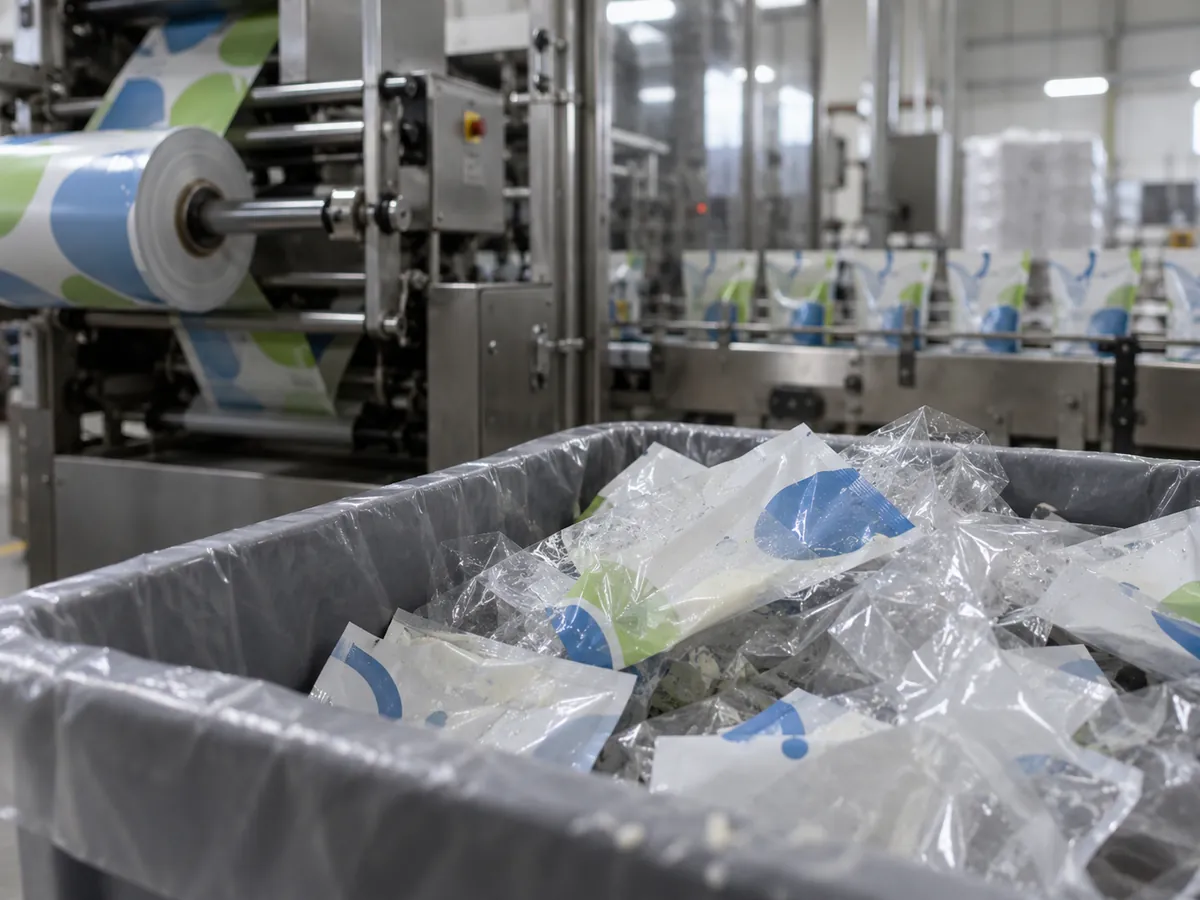
The unit for comparison is the good pack. Divide consumed film cost plus other recorded costs over a defined run by the number of packs that passed inspection. Add scrap film only if it is excluded from the consumed-film figure. Film that is thinner or lower in price per kg can still look more expensive on this basis if the price is not matched to the yield. Compare yield per kg at the real thickness, as explained in the film thickness guide, not the price alone.
What a flexible packaging film quote is made of
Before you can tell whether a cheaper film is really cheaper, you need to know what the quoted number covers. Flexible packaging film costs are built from a few groups of items, and two quotes can include different groups under one price.
- Materials. Each layer of the structure, plus inks, adhesives, coatings and any metallization. A barrier layer such as foil, EVOH or a metallized web adds material, and usually adds a process step as well.
- Conversion. Printing, lamination passes, adhesive curing time, slitting and, for pouches, pouch making, zippers and spouts. Each extra lamination pass adds machine time and setup waste.
- One-off tooling and setup. Printing cylinders or plates, color matching and proofs. Some suppliers quote these separately, others spread them across the first order.
- Order-size effects. Setup waste and changeover time are spread over the order, so a small order carries more of them per pack than a large one.
- Packing, freight and terms. Cores, pallets, delivery terms, payment terms and the period the price is valid for.
Ask each supplier to quote the same items, and to list what is excluded. A lower film price that excludes cylinders, or assumes a larger order than you will place, is not comparable with one that includes them.
Film prices also move. Resin and other inputs change in price over time, which is why a quote should carry a date and a validity period. In the US, the Bureau of Labor Statistics publishes a producer price index for plastics packaging film and sheet manufacturing that shows the direction of industry prices over time. It does not tell you what your film should cost, so ask suppliers for a current quote rather than adjusting an old one yourself.
Convert quotes to the same unit
Film is quoted per kilogram, per pound, per square meter, per thousand square inches (MSI), per linear meter or per thousand packs. Converting them all to the same basis is the first step in any comparison. The conversion runs through yield, which is film area per unit of weight. ASTM D4321-24 covers yield as film area per unit mass, including nominal yield calculations.
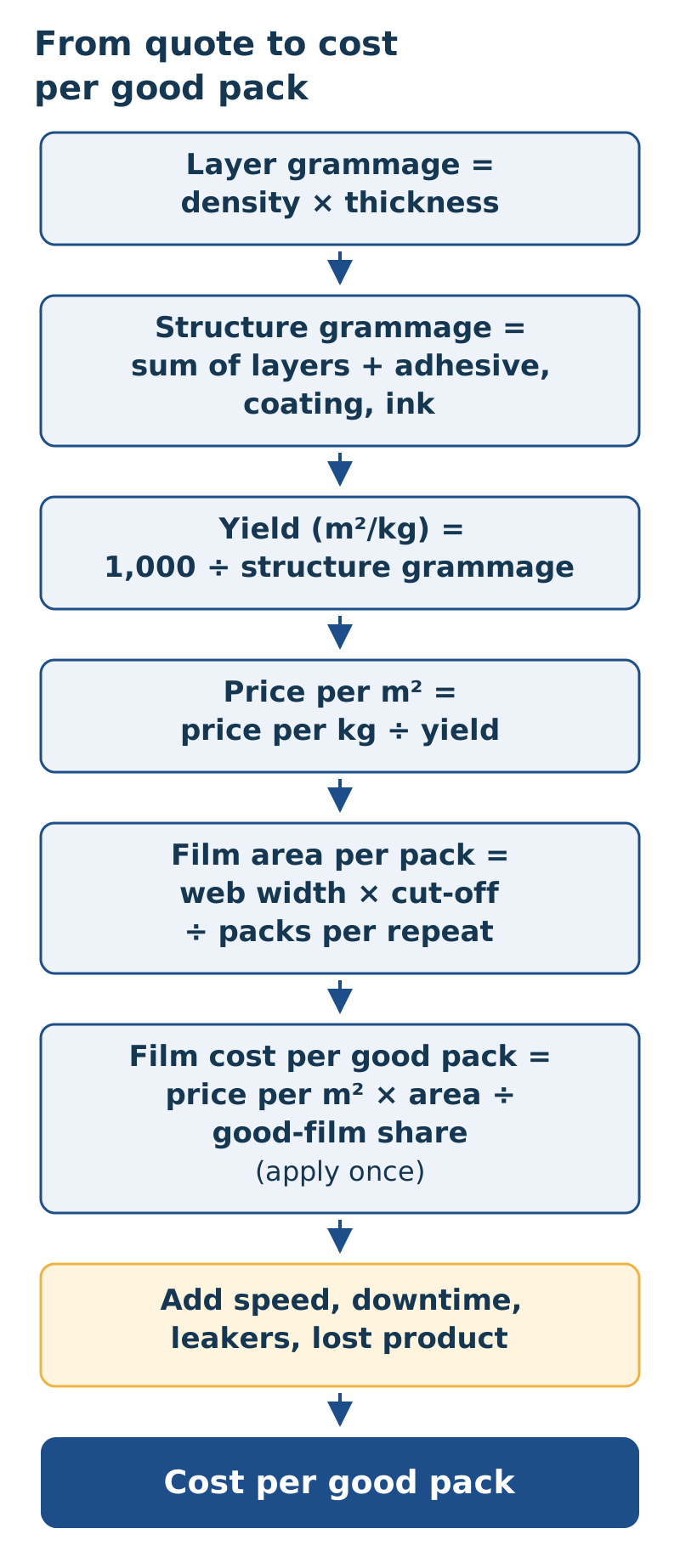
Work it out in this order:
- Grammage of each layer (g/m²) = density (g/cm³) × thickness (µm).
- Grammage of the structure (g/m²) = the sum of the layers, plus adhesive, coating and ink weights. Ask the supplier for these weights rather than guessing them.
- Yield (m²/kg) = 1,000 ÷ structure grammage.
- Price per m² = price per kg ÷ yield.
- Price per linear meter of roll = price per m² × web width in meters.
- Film area per pack for rollstock = web width × cut-off length (the print repeat) ÷ the number of finished packs made from one repeat. Web width × cut-off is the film used per machine cycle, which is one pack only on a single-lane machine with one pack per repeat. On a multi-lane machine, or where one repeat holds several packs, divide by the packs per repeat. Use the width of the roll as delivered to your machine, so that edge trim and any gaps between lanes stay in the area; trim the machine cuts away is film you paid for. For premade pouches the price is already per pouch.
- Film cost per good pack = price per m² × film area per pack ÷ the share of film that ends up in good packs. The share covers startup waste, splices, trim not already counted in step 6 and rejected packs. Apply it once. If you instead take the total film used in a trial run and divide it by the good packs from that run, scrap is already included, so do not divide by the share again.
For US quotes in mils and pounds, yield in square inches per pound = approximately 27,680 ÷ (density × thickness in mils). The constant follows from the exact definitions of the inch and the pound in the NIST guide to SI conversion factors. Price per MSI is then price per pound × 1,000 ÷ yield in square inches per pound.
Three cautions apply:
- Use measured values where you can. Nominal thickness and density give nominal yield. The actual yield of a delivered roll can differ, which is why specifications often state yield limits as a deviation from nominal.
- A lower film cost per pack is not the same as a lower cost per good pack. A thinner or cheaper film lowers the film line of the calculation, but it may also change speed, downtime, leakers and scrap. Compare the full cost per good pack, using the speed and scrap you measure for each film on your own line. A thinner film can still win if its saving outweighs any losses, and it can lose even when its film cost per pack is lower. Use the film cost from step 7 as the film line in the cost-per-good-pack view above, not the price per kg. Film lost to scrap is already inside that figure, so add only the other costs of scrap, such as lost product and labor.
- Keep the units visible. Write the unit next to every number in your comparison. Mixing mils and microns, or pounds and kilograms, is a common source of error; the film thickness page covers the thickness units in detail.
Single-lane and multi-lane example: assumed inputs
These are arithmetic assumptions in currency units (CU), not market prices or measured results. Both layouts have one pack per lane per repeat and the same grammage and good share; neither predicts machine output.
Scroll horizontally to view all columns if needed. ↔
| Worksheet v2026-10-08 | Single lane | Four lanes |
|---|---|---|
| P (CU/kg); G (g/m²) | 2; 50 | 2; 50 |
| W (m); L (m); N | 0.20; 0.15; 1 | 0.80; 0.15; 4 |
| Yield = 1000/G (m²/kg) | 20 | 20 |
| Price/area = P×G/1000 (CU/m²) | 0.10 | 0.10 |
| Area/attempted pack = W×L/N (m²) | 0.030 | 0.030 |
| q, excluding losses already in W×L/N | 0.90 | 0.90 |
| Yield method = P×G/1000×W×L/N/q (CU/good pack) | 0.00333 | 0.00333 |
| Measured-total method: A (m²); Q (good packs) | 90; 2700 | 90; 2700 |
| Measured-total film cost = P×G/1000×A/Q (CU/good pack) | 0.00333 | 0.00333 |
In the measured-total example, 90 m² includes 9 m² of startup/reject loss. Dividing its cost by 2700 good packs already accounts for that loss. Applying q again would give 0.00370 CU/good pack and count the same waste twice.
Copy the same-version table and replace its inputs. Use either the yield method or measured-total method, then add C/Q for other costs recorded over that run. For purchased film measured in kg, use P×total kg/Q instead of reconstructing area. Missing grammage, good count or a defined loss boundary leaves the comparison incomplete.
Sealing window and line speed
Sealing behavior can be an important hidden cost; rank it against downtime, product loss and other items using your trial records. A sealant with a narrow window between the temperature where a seal forms and the temperature where the film distorts or burns leaves the operator little room for error. Operators then slow the line or accept more rejects. Check the seal initiation temperature of each sealant and ask for a seal curve, not a single value.
On vertical form fill seal lines, product often falls into the seal area before the seal has cooled, so hot tack decides how fast the machine can run without seal failures. A film with poor hot tack may still pass a cold peel test on the bench. The VFFS film page covers the sealing and handling requirements in more detail.
Count scrap, downtime and leakers
Scrap is more than the film in the bin. It includes the packs made while the line is being adjusted, the product that must be recovered, and the labor to sort. Downtime events to track include web breaks, mistracking, jaw buildup, jams caused by friction that is too high or too low, and film that curls or blocks on the roll. Check friction early, because a mismatch in coefficient of friction is a common cause of drag on forming tubes and unstable feed.
Leakers have a delayed cost. A weak seal may only show up in transit or on the shelf, and then the cost is product loss, a customer complaint or a return. Record how seals are checked in production and how often. Seal strength data helps set the threshold, but it must be tied to a test method and a sample frequency, or it cannot be compared between films.
Scroll horizontally to view all columns if needed. ↔
| Cost driver | What to measure in a trial | Why a cheaper film can lose |
|---|---|---|
| Line speed | Packs per minute at acceptable seal quality | Narrow window forces a slower setting |
| Startup scrap | Packs or meters discarded before stable running | Poor tracking or curl extends adjustment time |
| Stoppages | Count and duration per shift | Web breaks, splices and jaw buildup |
| Leakers | Rejects found in line checks and later | Weak seals or contamination in the seal area |
| Inspection | Extra checks needed to protect the customer | Lower confidence in seal consistency |
| Product loss | Product wasted with each failed pack | High-value product magnifies each leaker |
Check whether the cheaper film is equivalent
Cheaper offers often come with a structural change: a thinner layer, a different sealant, a lower-grade barrier layer or a different laminate. These changes may be fine, but test them instead of assuming. A lower barrier may reduce shelf life, which is a cost even if the line runs well. Review the OTR and WVTR test conditions, and the shelf life page, before accepting a substitute. To compare the two structures systematically, follow how to compare film specifications.
Use ranges when exact figures are unavailable
You often will not have exact numbers before a trial. A rough low, expected and high scenario is more useful than a precise-looking figure built on weak assumptions, because it shows which variables deserve more investigation.
For example, you might estimate line speed, reject rate and downtime for each film under all three scenarios, then compare the cost per good pack in each case. If the cheaper film only wins in the low-problem scenario, the saving is fragile. Do not invent figures to fill the table; use your own production records, and mark the cells you cannot fill as unknown.
Trial the film on your own machine
Data sheets and sample rolls cannot tell you how a film will run on your line. Before you switch, run a trial on your own machine. Record speed, seal results, stoppages and scrap, and compare them with your current film under the same conditions. A simple protocol works:
- Run the current film and the candidate on the same machine, same product and same operators where possible
- Set a defined run length for each, so scrap and stoppages can be compared per pack
- Find the sealing temperature range on each film instead of reusing the old settings
- Test seals during and after the run, including a hold period for leak checks
- Log every stoppage and its cause
- Keep retained samples from the trial
If your line uses premade pouches, the trial should also cover opening, filling and sealing, as described in premade pouch materials. When the candidate comes from a new supplier, combine the trial with the checks in how to evaluate a flexible packaging supplier.
Methods and sources
The worksheet is editorial arithmetic; its assumed inputs are not a quote or an ASTM test result. ASTM D4321-24 defines plastic-film yield. NIST SP 811, Appendix B supplies conversion factors; the imperial yield constant is rounded. FRED’s BLS series PCU326112326112 is an industry price index, not a film quotation. Accessed 8 October 2026.

Continue reading
Related articles
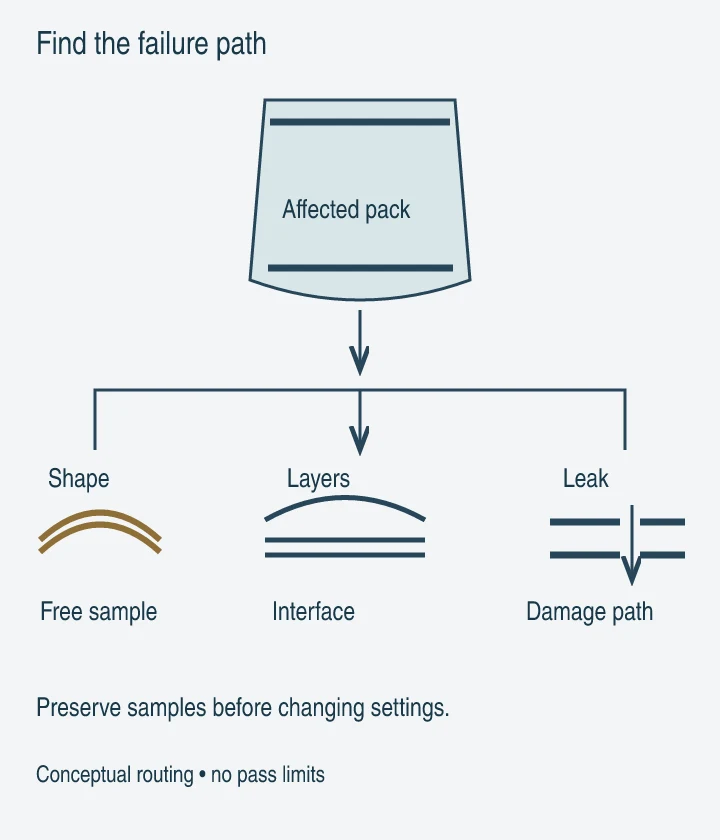
Flexible Packaging Film Problems: A Troubleshooting Guide
Film defects can cause scrap, leaks and repeat downtime. Locate the failure and preserve comparison samples before choosing a test or changing materials.

How to Choose Flexible Packaging Film: A Step-by-Step Selection Guide
An end-to-end engineering guide to selecting flexible packaging films: product barrier risks, machine kinematics, substrate structures, and trial verification protocols.

First-Order Risk Checklist for Printed Pouches and Rollstock
A compact checklist for controlling specification, payment, quality and shipment risk on a first order of printed pouches or rollstock.