
Packaging Film Thickness: Microns, Gauge and Mils Explained
Packaging film thickness explained: microns, gauge and mils, how to convert between them, how thickness is measured and what downgauging does to a pack.
Writing mil as mm can order a film 39.37 times thicker than intended. Packaging film thickness is the distance through a film from one surface to the other, quoted in microns (µm), mils or gauge depending on the region and the material. The units describe the same property: 100 gauge equals 1 mil equals 25.4 µm. Thickness affects stiffness, machine behavior, barrier, strength and cost, so a specification must state the unit and how the thickness is measured.
Film gauge conversion: mil to micron
Use 1 mil = 25.4 µm, and 1 µm = about 3.94 gauge (0.0394 mil).
Scroll horizontally to view all columns if needed. ↔
| Gauge | Mil | Micron (µm) |
|---|---|---|
| 48 | 0.48 | about 12 |
| 75 | 0.75 | about 19 |
| 92 | 0.92 | about 23 |
| 100 | 1.0 | 25.4 |
| 150 | 1.5 | 38.1 |
| 200 | 2.0 | 50.8 |
| 300 | 3.0 | 76.2 |
| 400 | 4.0 | 101.6 |
Assumed example: 23 µm ÷ 25.4 = 0.9055 mil = 90.55 gauge, or about 91 gauge when rounded to a whole gauge. Conversely, 92 gauge = 0.92 mil = 23.368 µm, about 23.4 µm to one decimal place. State the rounding and tolerance; nominal labels are not exact equivalences.
Common mistake: writing an intended 1 mil (0.0254 mm) as 1 mm specifies 1,000 µm instead of 25.4 µm. Convert units before applying the tolerance.
Packaging film gauge, mils and microns
Three units are in daily use:
- Micron (µm). One thousandth of a millimeter. The metric standard in most of the world.
- Mil. One thousandth of an inch. Common in North American specifications. A mil is 25.4 µm and is not a millimeter.
- Gauge. Historically used for film, with 100 gauge equal to 1 mil. Packaging film gauge shows up on BOPP, BOPET and nylon data sheets. A “92 gauge” film is 0.92 mil, or about 23 µm.
Be careful with the word “mil” in speech. Some people say “mil” when they mean a millimeter, and some say “micron” loosely. Always write the unit.

Plastic packaging film and sheet: where film ends
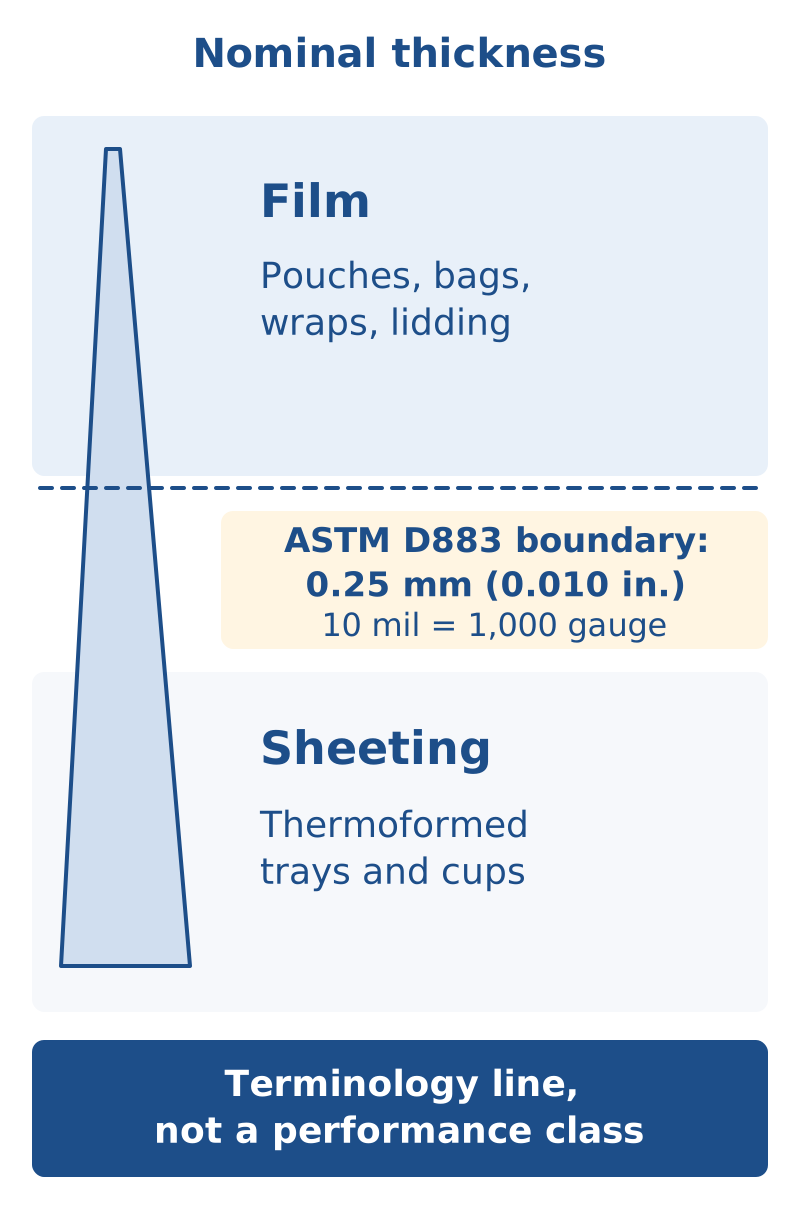
Plastic packaging film and sheet are the same kind of material at different thicknesses. ASTM D883, the ASTM terminology standard for plastics, treats “film” as an optional term for sheeting with a nominal thickness no greater than 0.25 mm (0.010 in.). That definition is quoted in the ASTM D6988-21 public scope. In the units above, 0.010 in. is 10 mil or 1,000 gauge. It converts exactly to 254 µm, while 0.25 mm is 250 µm; the standard pairs the two as rounded equivalents.
Scroll horizontally to view all columns if needed. ↔
| Nominal thickness | ASTM D883 term | Typical packaging use |
|---|---|---|
| Up to 0.25 mm (0.010 in.) | Film, an optional term for thin sheeting | Pouches, bags, wraps, lidding, laminate layers |
| Above 0.25 mm (0.010 in.) | Sheeting | Material that must hold its own shape, such as thermoformed trays and cups |
Three cautions apply when you use this line:
- It is a terminology boundary, not a performance class. Crossing it does not make a material stiffer or a better barrier by itself; resin, orientation and layer structure still decide that.
- The line is about nominal thickness. A material sold at 0.25 mm can measure slightly above or below it within tolerance.
- Other definitions exist. Other standards, customer specifications and trade names may draw the line differently, and some suppliers name products by use rather than by thickness. Write the thickness and unit in the specification instead of relying on the word “film” or “sheet”.
Flexible packaging structures normally sit well inside the film range. In an assumed laminate PET 12 / AL 7 / PA 15 / PE 70 µm, the layer sum is 104 µm before adhesive, not a measured total; flexible packaging film explains the structure roles. For the polymers themselves, see packaging film types.
Nominal, average and profile variation
A film thickness number can mean different things.
- Nominal thickness is the target figure the film is designed and sold at. It is a label.
- Average thickness is what you measure across a sample or across a roll. It should sit close to nominal, within the agreed tolerance.
- Profile (gauge) variation is the difference in thickness across the web width and along its length. A film can have the right average and still be thick at one edge and thin at the other.
Profile variation matters because thick spots build up on the roll as ridges or hard bands, which can cause telescoping, wrinkles and tracking problems. Thin spots weaken seals and puncture resistance. Specify a tolerance and how it is measured as well as the nominal figure.
For a laminate or coextruded film, total thickness differs from the thickness of the barrier or sealant layer. Flexible packaging film shows how structures are built up.
How film thickness is measured
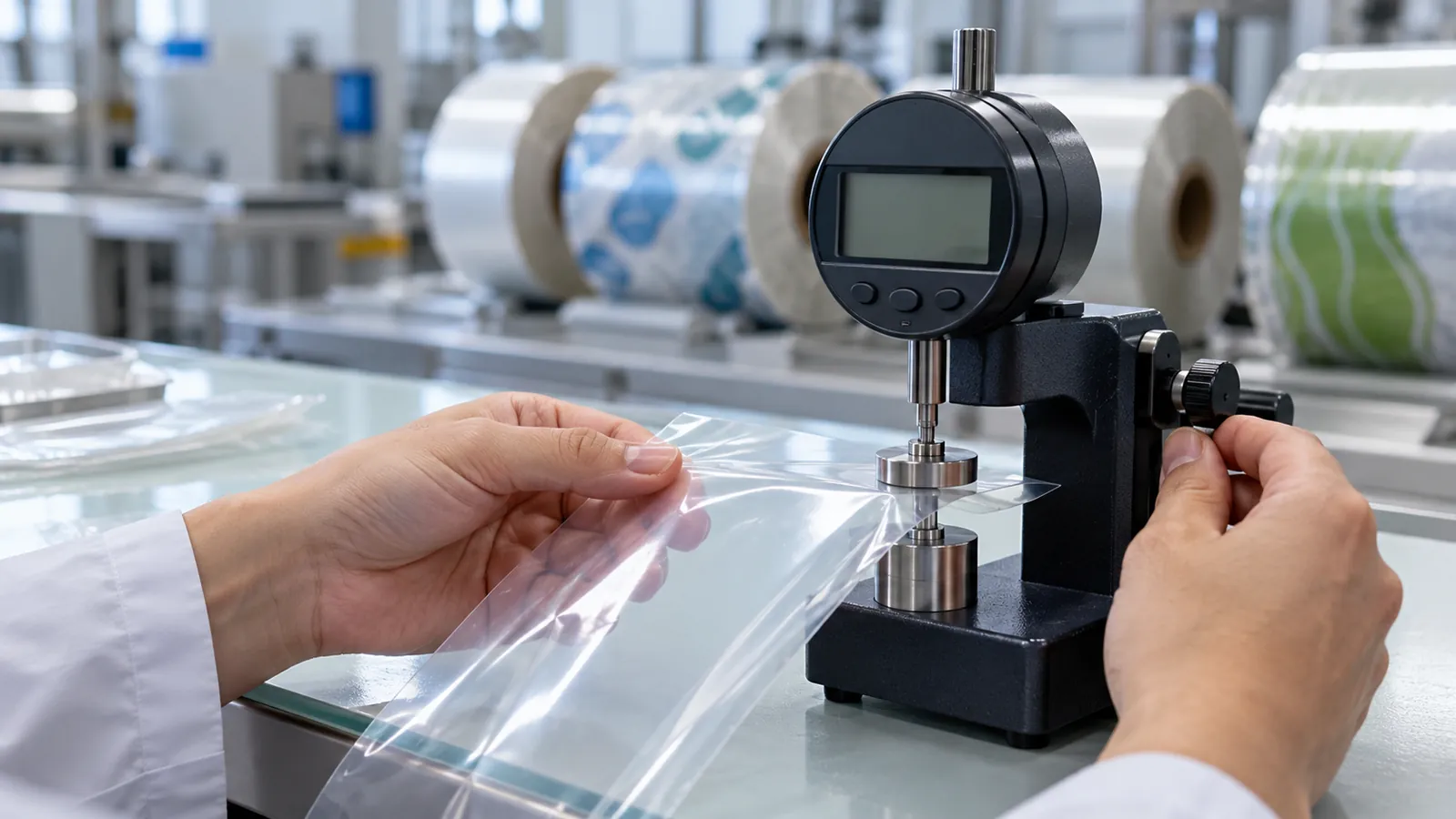
ASTM D6988 is a guide for determining the thickness of plastic film test specimens when that thickness is used to calculate other test results. It states that it is not intended for measuring thickness for the commercial classification of products or for quality control, and ISO 4593 covers the same subject with technical differences. In principle, the film is placed between a flat anvil and a measuring contact, with a defined contact force, and the gap is read. Methods and tools include:
- Contact micrometers and dial or digital gauges. Common in labs and at the line. The contact pressure and the surface finish of the contact faces affect the reading, especially on soft film.
- Stack measurement. Several layers measured together and divided, which reduces the error on very thin film.
- Non-contact methods. Capacitance, optical or beta and x-ray sensors measure on-line during production.
- Weight and area. Cut a known area, weigh it and calculate thickness from density. This gives an average and helps check multilayer or coated structures where direct measurement is hard.
Sample enough points across the web width and along the length. A single reading cannot show profile variation. For a laminate with a thick outer layer, direct measurement may not separate layers, so a cross-section under a microscope may be needed.
Yield and grammage
Yield is how much film area you get from a given weight, commonly expressed as area per unit weight. Grammage is the opposite view: weight per unit area (grams per square meter).
Two films with the same thickness can have different yield, because yield depends on density. A lower-density polymer gives more area per kilogram than a denser one at the same gauge. A metallized or filled structure changes the density again. This matters when you compare quotes. Priced per kilogram, a lighter-density film can be better value than it looks, while a price per square meter hides the weight difference. Ask the supplier for yield, density and the unit the price is based on.
What thickness changes
Scroll horizontally to view all columns if needed. ↔
| Property | Effect of thicker film | Effect of thinner film |
|---|---|---|
| Stiffness | Higher, so film holds shape and runs flat on collars | Lower, more wrinkles and floppiness |
| Machinability | Better tracking and handling up to a point, but needs more seal energy | May stretch under tension, cause registration drift |
| Barrier | Often improves moisture barrier of polyolefin layers, and little change to a thin coated barrier layer | Potentially reduced barrier for thickness-dependent layers; confirm the changed structure |
| Puncture and strength | Higher | Lower, as covered in puncture resistant film |
| Sealing | Needs longer dwell or higher temperature | Seals faster, but easier to overheat |
| Cost and weight | More material per pack | Less material, lower cost per pack |
Barrier changes depend on which layer is thickened. Do not infer oxygen or moisture protection from a change in total thickness: identify the layer changed and test the revised structure. The pages on oxygen transmission rate and water vapor transmission rate cover the two measurements.
Downgauging trade-offs
Downgauging means reducing film thickness to save material, weight and cost, and it is a common sustainability measure. It works when the original film was thicker than the application needed, or when a better resin lets you keep performance with less material. It fails when stiffness, seal integrity or puncture resistance drops below what the line and distribution need.
Before downgauging, check:
- Machine behavior: tracking, wrinkles, seal window, and feeding at line speed.
- Seal strength and hot tack after the change.
- Puncture, flex and drop performance with real product.
- Barrier at the new total and layer thickness, tested at the right conditions.
- Registration and print behavior, since thin film stretches more.
- Total pack cost, including scrap and downtime, because a cheaper film can cost more.
Run a full-roll trial instead of relying on lab data alone. The VFFS film page shows how thickness fits with other machine factors.
Thickness and profile record
Scroll horizontally to view all columns if needed. ↔
| Field | Nominal / agreed value | Measurement / record |
|---|---|---|
| Lot, structure, units and rounding | _____ | _____ |
| Total thickness and tolerance | _____ | _____ |
| Each barrier / sealant layer, including adhesive basis | _____ | _____ |
| Cross-web positions (edge, center, opposite edge) | _____ | _____ |
| Along-roll sample positions and sample count | _____ | _____ |
| Average, minimum and maximum; profile limits | _____ | _____ |
| Instrument, contact force, calibration and method | _____ | _____ |
| Yield / density basis and incoming-QC agreement | _____ | _____ |
Total thickness does not establish individual layer thickness. Record the layer-verification method separately, then recheck machine settings, seals and barrier after a change.
Sources and method
Scope reviewed October 8, 2026: ASTM D6988-21, the edition used for the film/sheet definition and non-QC limitation above. It is historical; the publisher also lists D6988-26. Unit arithmetic uses the NIST exact inch definition: 1 in = 25.4 mm; this page uses the packaging convention 100 gauge = 1 mil. Examples are assumed, not measured films. Agree commercial tolerances and sampling separately.
Continue reading
Related articles

Hot Tack in Packaging Films: What It Is and Why It Matters
Hot tack packaging performance is the strength of a heat seal while it is still molten. Learn the ASTM F1921 test, the hot tack curve and how it affects VFFS lines.

Oxygen Transmission Rate (OTR): Units, Test Methods and How to Read It
Oxygen transmission rate (OTR) measures how much oxygen passes through a film. Learn the units, test methods, conditions and how OTR relates to shelf life.

Packaging and Shelf Life: How Film Choice Affects It
Packaging film shelf life depends on oxygen, moisture, light and seal integrity. Learn the failure modes, real-time vs accelerated tests and a study checklist.