
Water Vapor Transmission Rate (WVTR): Units, Test Methods and Interpretation
Water vapor transmission rate (WVTR) measures how much moisture passes through a film. Learn units, test conditions, ASTM F1249, E96 and how to read the number.
Comparing WVTR values at different conditions can select the wrong moisture barrier. Water vapor transmission rate measures mass crossing a unit area per day; a lower value indicates less transmission only for a matched test basis.
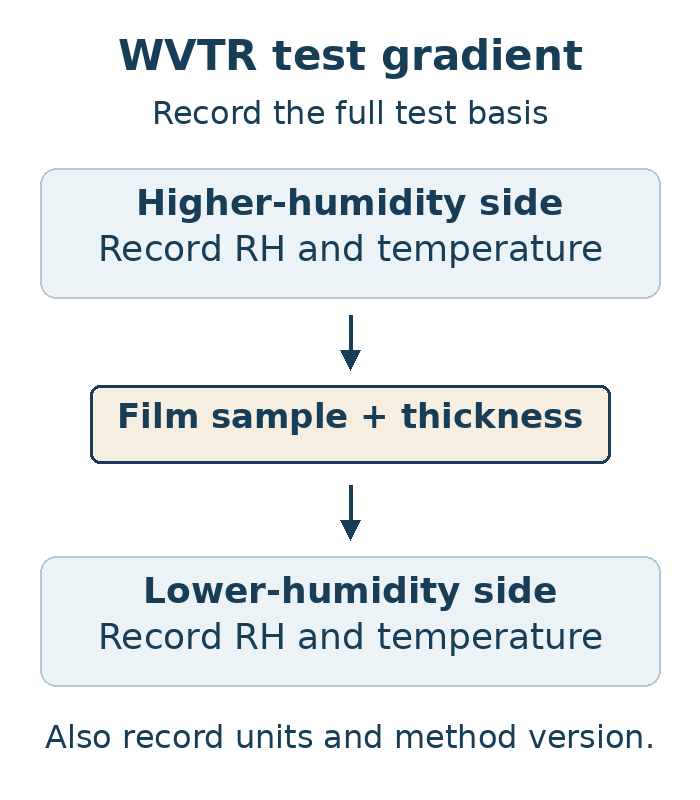
Test basis at a glance
Scroll horizontally to view all columns if needed. ↔
| Input | Record before comparing |
|---|---|
| Result and unit | g/(m²·day) or g/(100 in²·day) |
| Temperature | Actual test temperature, °C |
| High-humidity side | RH, % |
| Low-humidity side | RH, %; do not assume zero |
| Method and version | ASTM/ISO designation and test variant |
| Sample | Full structure, thickness and conditioning |
A single “90% RH” does not describe both sides of the moisture gradient.
Takeaway: Reject a comparison that omits temperature or either side’s humidity.
What water vapor transmission rate means
WVTR measures moisture moving from a high-humidity side of a film to a low-humidity side. The driving force is the difference in water vapor pressure across the film. For a dry product like crackers, powders, or tablets, moisture ingress softens, clumps, or degrades the contents. For a moist product like cheese or baked goods, moisture loss can dry the product out. In both cases, WVTR tells you how quickly conditions inside the package equilibrate with the outside.
WVTR is different from oxygen barrier. A material can be excellent for one and poor for the other, which is why many structures combine layers. The oxygen side is covered on the OTR page.
Units and naming
Use the same area basis before comparing results. Since 1 inch = 0.0254 m, 100 in² = 0.064516 m²: multiply g/(100 in²·day) by 15.500031 to obtain g/(m²·day); divide for the reverse direction. The inch definition is given in NIST SP 811.
Example, assumed input: 0.50 g/(100 in²·day) at a stated, unchanged test condition becomes 0.50 × 15.500031 = 7.75 g/(m²·day). Converting back gives 7.75 ÷ 15.500031 ≈ 0.50. This is an area conversion, not a change in humidity or temperature.
WVTR and MVTR are both used for water-vapor transmission in a manufacturer’s public glossary, cited for terminology, not as a recommendation. Match the unit and method as well as the abbreviation.
Takeaway: Convert area units only after confirming that the test conditions match.
Test conditions
Record temperature and the RH on both sides. Do not compare a high-side humidity alone with a fully specified gradient. Request matching measurements if a report omits the low-side RH or conditioning history.
ASTM F1249-25 warns that WVTR may not vary inversely with thickness or directly with water-vapor partial-pressure difference. Unit conversion is exact; conversion between test climates needs material-specific evidence.
Takeaway: Keep temperature, both RH values and thickness beside every result.
WVTR test methods
Scroll horizontally to view all columns if needed. ↔
| Official method | Public scope |
|---|---|
| ASTM F1249-25 | Flexible barrier sheets and films; modulated infrared sensor |
| ASTM E96/E96M-24a | Gravimetric WVTR; desiccant and water methods have different conditions |
| ISO 15106-1:2003, confirmed 2023 | Humidity-detection sensor for films, sheets and multilayer plastics |
ISO 15106 is a series: specify the part actually used. These public catalog scopes do not provide complete test procedures or establish equivalence between methods.
Comparing material grades
A resin name is not a comparison basis. Obtain a result for each candidate’s actual grade, total thickness, layer build and post-conversion condition, using the same temperature, humidity gradient and method. Without matching data, leave the comparison open rather than ranking foil, PCTFE, PVDC or polymer films together.
The barrier film, high barrier film and aluminum foil pages describe structure choices; they do not replace a matched WVTR report.
Takeaway: Request equal-condition results for the exact grades and thicknesses.
Where WVTR matters most
Pharmaceutical blisters. Tablets and capsules can be sensitive to moisture, and shelf life claims depend on it. Blister packs rely on foil and barrier films such as PVDC or PCTFE, covered under blister foil and pharmaceutical packaging. Confirm the requirements for your destination market.
Dry foods. Crackers, cereal, powders, instant drinks, and snacks lose crispness or clump when moisture gets in. Snack packaging is a typical example, which often needs both a moisture and a light barrier.
Moist products. Where the goal is to keep moisture in, WVTR controls weight loss and drying.
Film versus package
Flat-film WVTR describes the material only. In the package, moisture can enter through seals, creases, pinholes, closures, and cracks from flexing or handling. Thin metallized layers and coatings can crack when the film is formed, creased, or bent, which raises the real transmission. The package surface area and any headspace also matter, and absorption by the product changes how quickly it responds. Package-level testing and storage trials at expected conditions are the true check.
Converting effects
Printing, laminating, metallizing, coating, and forming all affect the finished barrier. Lamination can add a layer and its adhesive, which may help or hinder. Cold-forming and thermoforming thin the film and can stretch or crack barrier layers. Heavy creasing in a stand-up pouch or gusset may damage a metallized layer. Request barrier data after conversion where it matters.
Takeaway: Check the converted and filled pack as well as the original film.
OTR versus WVTR
Scroll horizontally to view all columns if needed. ↔
| Aspect | OTR | WVTR |
|---|---|---|
| What it measures | Oxygen passing through film | Water vapor passing through film |
| Typical unit | cm³/(m²·day) | g/(m²·day) |
| Common US unit | cc/100 in²/day | g/100 in²/day |
| Method details | See the OTR guide | Record the method and version above |
| Main condition sensitivity | Temperature, humidity (especially EVOH) | Temperature, humidity gradient |
| Typical protection goal | Prevent oxidation and spoilage | Prevent moisture gain or loss |
What to put in a WVTR specification
Copy the record below and keep the original report with it.
Scroll horizontally to view all columns if needed. ↔
| Field | Entry |
|---|---|
| Film grade / lot / structure / thickness | ____ |
| Flat film or package / conversion state | ____ |
| WVTR / original unit | ____ |
| Temperature / high-side RH / low-side RH | ____ / ____ / ____ |
| Method / version / conditioning | ____ |
| Area conversion factor / converted result | ____ / ____ |
| Report reference / date / responsible person | ____ |
Retain the same test conditions after conversion. Confirm the selected material with finished packs and storage trials; shelf-life planning explains the boundary. Other tests are listed in the performance overview.
Takeaway: Use this record to compare matching reports, then validate the package.
Questions and answers
What is the difference between MVTR and WVTR?
In packaging permeation terminology they describe the same moisture-vapor transmission measurement. The name does not make reports interchangeable: compare the method, units, thickness, temperature and humidity on both sides. Changing RH is not an area-unit conversion; use a measured result or a validated material model at the new conditions.
Use the specification record to retain that comparison basis.
Methods and sources
The official method catalogs linked above support the scopes and comparison limits; full standards are needed for laboratory work. The numerical example uses assumed data and the NIST inch definition, and says nothing about a particular film. Reviewed: 8 October 2026.

Continue reading
Related articles
Moisture Barrier Packaging: Protecting Dry and Moist Products
Moisture barrier packaging keeps dry products crisp and moist products fresh. See how to match film structures, desiccants and seals to the product and climate.
Oxygen Transmission Rate (OTR): Units, Test Methods and How to Read It
Oxygen transmission rate (OTR) measures how much oxygen passes through a film. Learn the units, test methods, conditions and how OTR relates to shelf life.
Packaging and Shelf Life: How Film Choice Affects It
Packaging film shelf life depends on oxygen, moisture, light and seal integrity. Learn the failure modes, real-time vs accelerated tests and a study checklist.