
Moisture Barrier Packaging: Protecting Dry and Moist Products
Moisture barrier packaging keeps dry products crisp and moist products fresh. See how to match film structures, desiccants and seals to the product and climate.
Moisture barrier packaging controls how fast water vapor moves between the product and the surrounding air. For a dry product the problem is moisture coming in, which causes softness, caking or degradation. For a moist product the problem is moisture going out, which dries and hardens it. The metric is explained on the water vapor transmission rate (WVTR) page.
Choose the moisture task
Scroll horizontally to view all columns if needed. ↔
| Task | Product limit to establish | Validation route |
|---|---|---|
| Prevent gain | Acceptable water uptake (g) before quality fails | Ingress at stated temperature / humidity, complete-pack storage |
| Prevent loss | Acceptable water loss (g) or drying limit | Loss under the intended climate, including closure use |
Select the direction and quality limit before choosing a film or desiccant.
Two different problems
The words “moisture proof packaging” hide two opposite jobs.
Moisture gain. The product is drier than the air around it and takes up water through the pack. Examples:
- Crisp products such as crackers, chips, cereal and wafers lose crunch once they pick up a little water.
- Hygroscopic powders such as instant drink mixes, sugar-based and salt-based products clump, cake or become sticky. Ground spices cake the same way; spice packaging materials adds the check for spice oil on the inner layer.
- Pharmaceutical tablets and capsules can degrade or change dissolution with moisture, and some are very sensitive.
Moisture loss. The product is wetter than the surrounding air and dries out. Examples:
- Bakery products can lose softness through drying; staling also has causes beyond moisture loss.
- Cheese loses weight and develops a dry rind.
- Fresh produce, meat and some prepared foods lose weight and look dull.
Set the acceptable product water uptake or drying limit. Package performance depends on the product, structure, closure and environment; barrier alone does not establish storage life.
Some products do the opposite of what you would expect from the label. Fresh baked goods can have mold problems if moisture is trapped inside, and some fresh products are packed in films with deliberate permeability or microperforations. A high moisture barrier is not automatically right.
Matching structures to moisture needs
Do not rank moisture protection from the polymer family alone. Dry milled rice makes the same split in a sack: the woven polypropylene can be the outer bag that carries the weight, while the moisture job is a separate inner layer. Rice packaging materials records that split, the mouth closure and the shipping humidity. Compare the complete laminate’s WVTR at the same thickness, temperature and humidity gradient. Candidate structures include PE film, BOPP film, coated or metallized films and foil laminates; the barrier film guide explains layer roles.
For pharmaceutical blisters or sachets, barrier screening is only part of container-closure suitability and product stability. See blister foil and pharma foil; neither a material name nor a desiccant approves a package.
A result at 38 °C / 90% RH and one at 23 °C / 50% RH have different conditions. These are example comparison conditions, not mandatory settings; do not convert between them by a fixed factor. ASTM E96/E96M-21 explicitly warns that results under one condition need not represent another. ASTM F1249-25 covers instrumental WVTR through flexible barrier materials.
Product type, risk and typical approach
Use this table as a starting point for discussion with your film supplier. It does not replace testing.
Scroll horizontally to view all columns if needed. ↔
| Product type | Main moisture risk | Typical approach |
|---|---|---|
| Crisp snacks, crackers, cereal | Gain; loss of crispness | Metallized or high-barrier polyolefin laminates, adequate seal quality; see snack packaging |
| Hygroscopic powders | Gain; caking and clumping | Polyolefin or foil laminates, zipper or closure checked for leaks, sometimes desiccant |
| Pharmaceutical tablets and capsules | Gain; potency or dissolution change | Evaluate a product-specific blister, sachet or bottle system with moisture protection and stability evidence |
| Bakery goods | Loss; staling (and mold if too tight) | Polyolefin films, matched to the product’s moisture and shelf life |
| Cheese | Loss; weight loss and drying | Films with controlled moisture and oxygen barrier, vacuum or MAP formats |
| Fresh produce | Loss and condensation; gas requirements vary by crop | Consider controlled permeability or microperforation only for a produce/pack design validated for respiration, water loss and storage conditions |
| Meat | Drying, purge and package atmosphere | Validate the specific chilled tray, vacuum or MAP pack; do not transfer a produce microperforation design to meat |
| Coffee | Gain, plus oxygen and aroma concerns | Foil or metallized laminates, usually with a one-way valve for roasted beans |
Desiccants
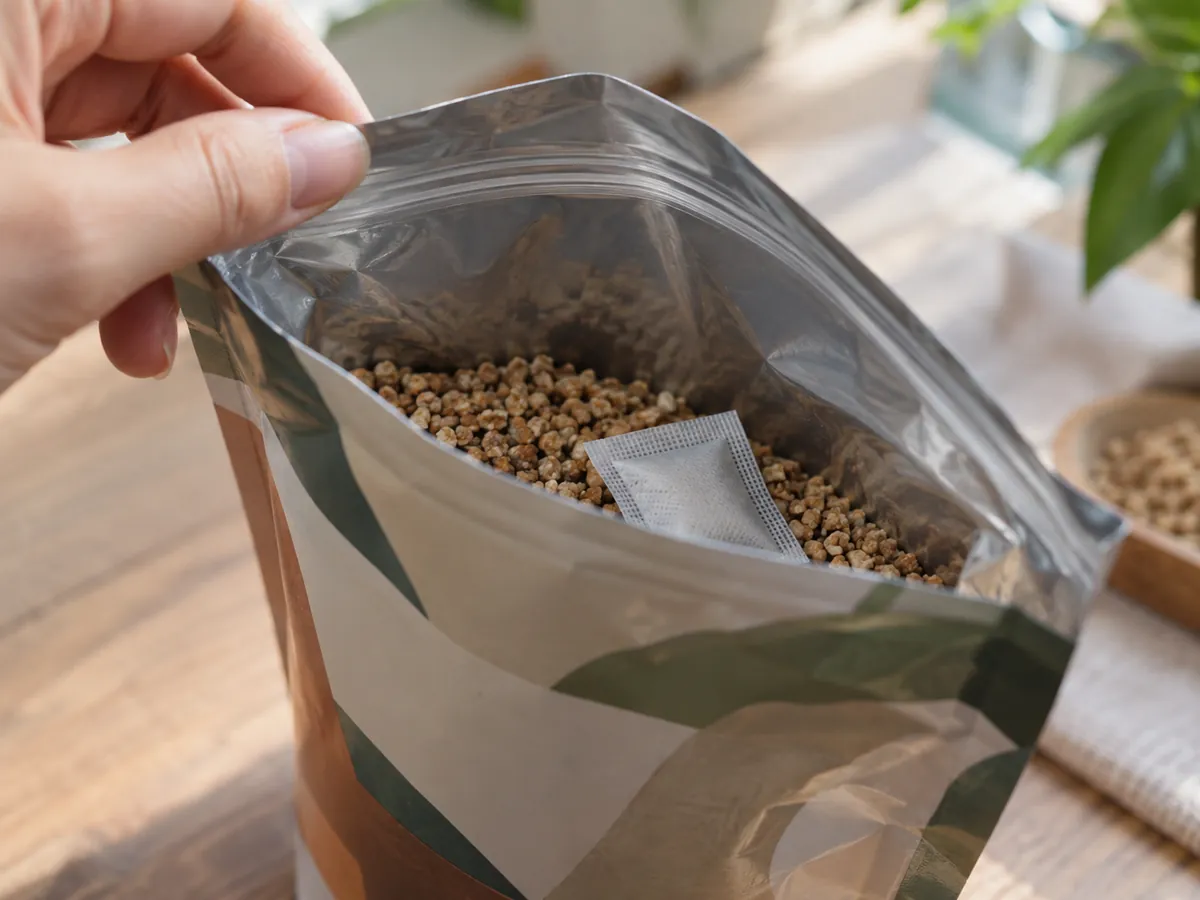
Desiccants, such as silica gel or clay packets, absorb moisture inside the pack. They are used in rigid containers and some pouches to cope with the moisture that is present at filling and the small amount that gets in later. They supplement a barrier and do not replace one: a desiccant has a fixed capacity and will saturate in a leaky pack. Points to consider:
- Capacity must cover the headspace moisture, the product’s own release and the permeation over the shelf life.
- The packet should be clearly non-edible and suitable for contact with your product. Food-contact and drug-contact rules differ by market, so confirm requirements for your destination.
- Hot or humid distribution can use up capacity faster than the lab test suggests.
Seals, zippers and other weak points
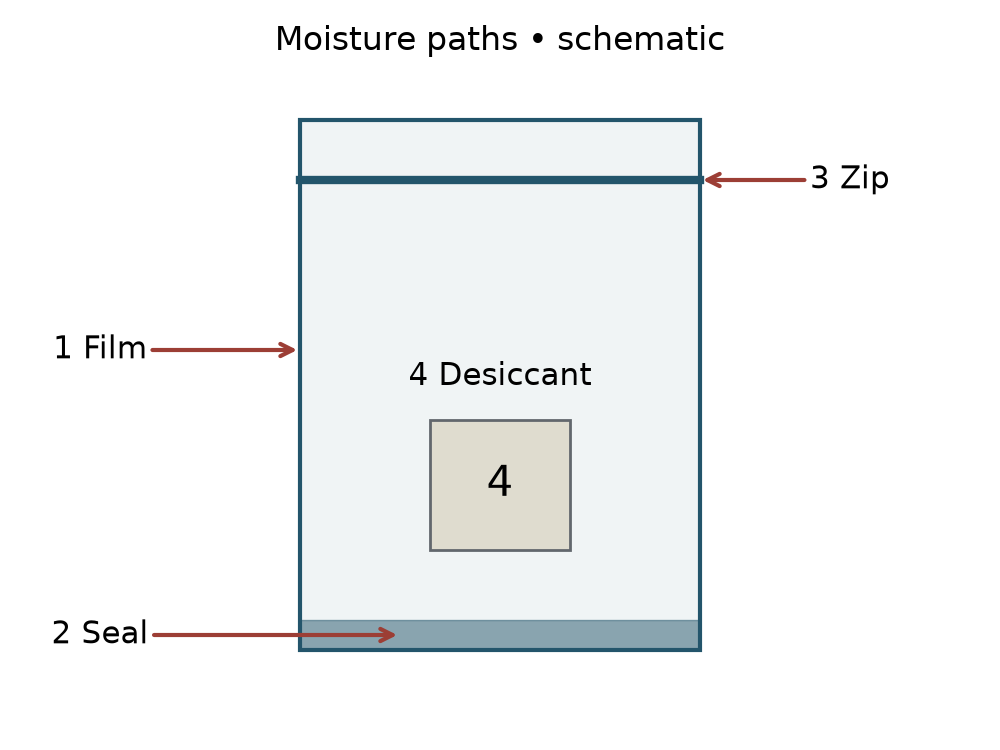
Flat-film WVTR describes the best case. The finished pack adds other routes for water vapor:
- Seals. The seal edge exposes the sealant cross-section, and a seal with product trapped in it can leave a channel. The seal strength page covers seal quality.
- Zippers. A resealable zipper is usually not a hermetic closure. On a moisture-sensitive product, test the whole zipper pouch rather than the film.
- Creases and gussets. Metallized and coated layers can crack, which raises the real transmission.
- Pinholes. Thin foil or coatings may have defects.
- Microperforations. Open holes create additional transfer paths; verify their size, count and complete-pack performance.
- One-way valves. A valve is a functional component with opening/closing behavior and a fitted seal. Test it in the package; it is not equivalent to a permanently open perforation, and neither automatically dominates film transmission.
Package-level testing, as opposed to film-only testing, is what shows whether any of these paths dominate.
Moisture budget example
Assumed screening inputs only: allowed gain 1.0 g water, film area 0.05 m², storage 100 days at 23 °C, outside 50% RH and an assumed maintained dry interior. Ignoring closures and initial moisture, allowable flat-film WVTR = 1.0 ÷ (0.05 × 100) = 0.20 g/(m²·day). The same arithmetic can screen a loss budget under a specified outward gradient.
Record product gain/loss limit (g): _____; area (m²): _____; days: _____; inside/outside temperature and RH: _____; measured package transfer (g/day): _____; initial moisture/desiccant working capacity (g): _____. This calculation assumes constant conditions; it does not predict a product date or justify RH conversion.
Climate and distribution conditions
A pack that works in a temperate warehouse may fail in a hot, humid market. Moisture transfer depends on the water vapor pressure difference across the film and the material response; temperature and RH must be considered together. Think about:
- Where the product will be stored: tropical ports, un-air-conditioned warehouses and shipping containers can be harsher than a lab.
- Temperature cycling, which can cause condensation inside clear packs.
- Pack size and format: the ratio of surface area to product weight matters. Small sachets and single-dose packs have a large surface area for the amount of product, so they need a better barrier than a large bag of the same product.
- How the pack is stored on the shelf: open stacking or direct sunlight can alter conditions inside.
If your product ships to more than one climate zone, design for the harshest realistic one or define separate structures.
Steps for choosing a moisture barrier
- Decide whether you are blocking gain or loss, and define the acceptable change in the product.
- Set the storage temperature and humidity and the shelf life.
- Shortlist a complete structure, then ask for WVTR at your conditions, with the method (such as ASTM F1249 or ASTM E96).
- Decide whether oxygen and light also matter, and combine barriers in one structure.
- Check seals, closures and creases, and ask for post-conversion or package data.
- Add a desiccant only when the budget calls for it.
- Confirm with stored packs in realistic conditions. Packaging and shelf life explains how that ties to dating.
Sources and method
Reviewed October 8, 2026. F1249-25 and E96/E96M-21 public scopes support method and condition boundaries. The FDA container-closure guidance, July 1999, section III.G, discusses water-vapor protection for solid oral dosage forms and the package seal. It does not approve the candidate materials in this guide. The budget uses stated assumed inputs; complete-pack storage and product-specific assessment remain necessary.
Continue reading
Related articles
Oxygen Barrier Packaging: Choosing the Right Level of Protection
Oxygen barrier packaging should match what the product can tolerate. Learn how to size protection, use nitrogen flushing and scavengers, and validate shelf life.
Packaging and Shelf Life: How Film Choice Affects It
Packaging film shelf life depends on oxygen, moisture, light and seal integrity. Learn the failure modes, real-time vs accelerated tests and a study checklist.

Water Vapor Transmission Rate (WVTR): Units, Test Methods and Interpretation
Water vapor transmission rate (WVTR) measures how much moisture passes through a film. Learn units, test conditions, ASTM F1249, E96 and how to read the number.