
Rice Packaging Materials: Woven Sacks, Liners and Sealed Retail Packs
Humidity that crosses an unlined weave can damage dry rice in transit. The moisture wall is a polyethylene layer or a sealed film bag.
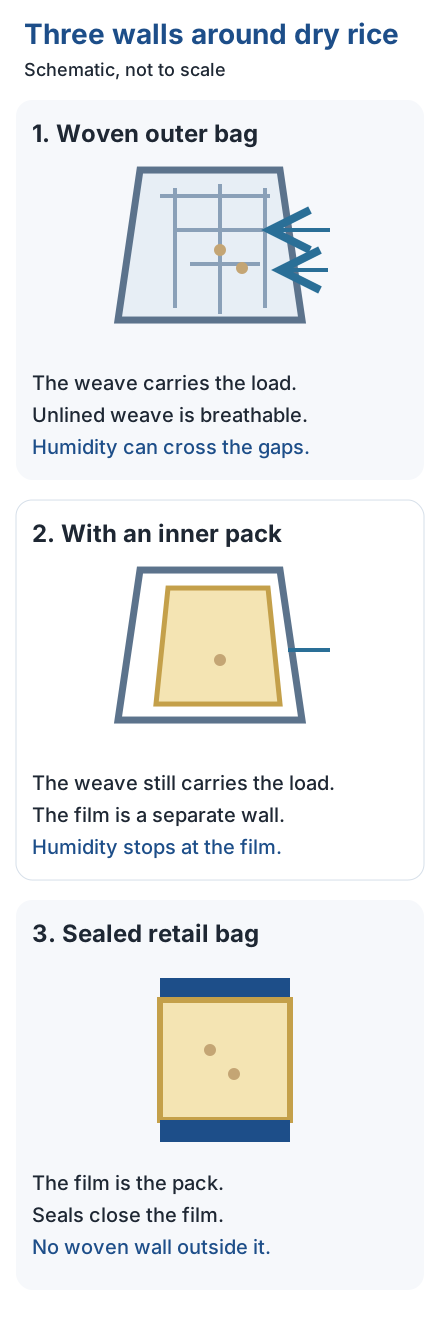
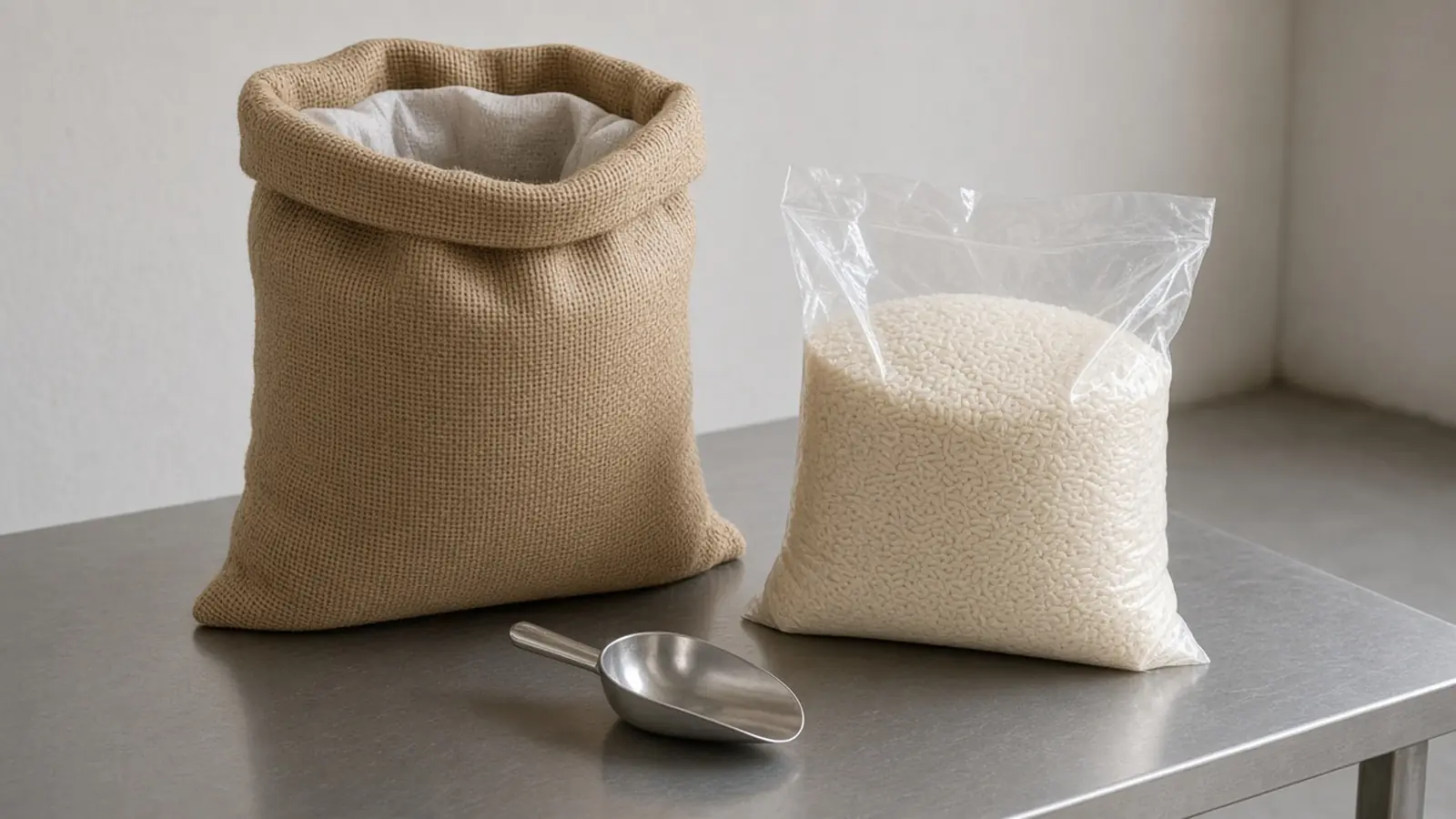
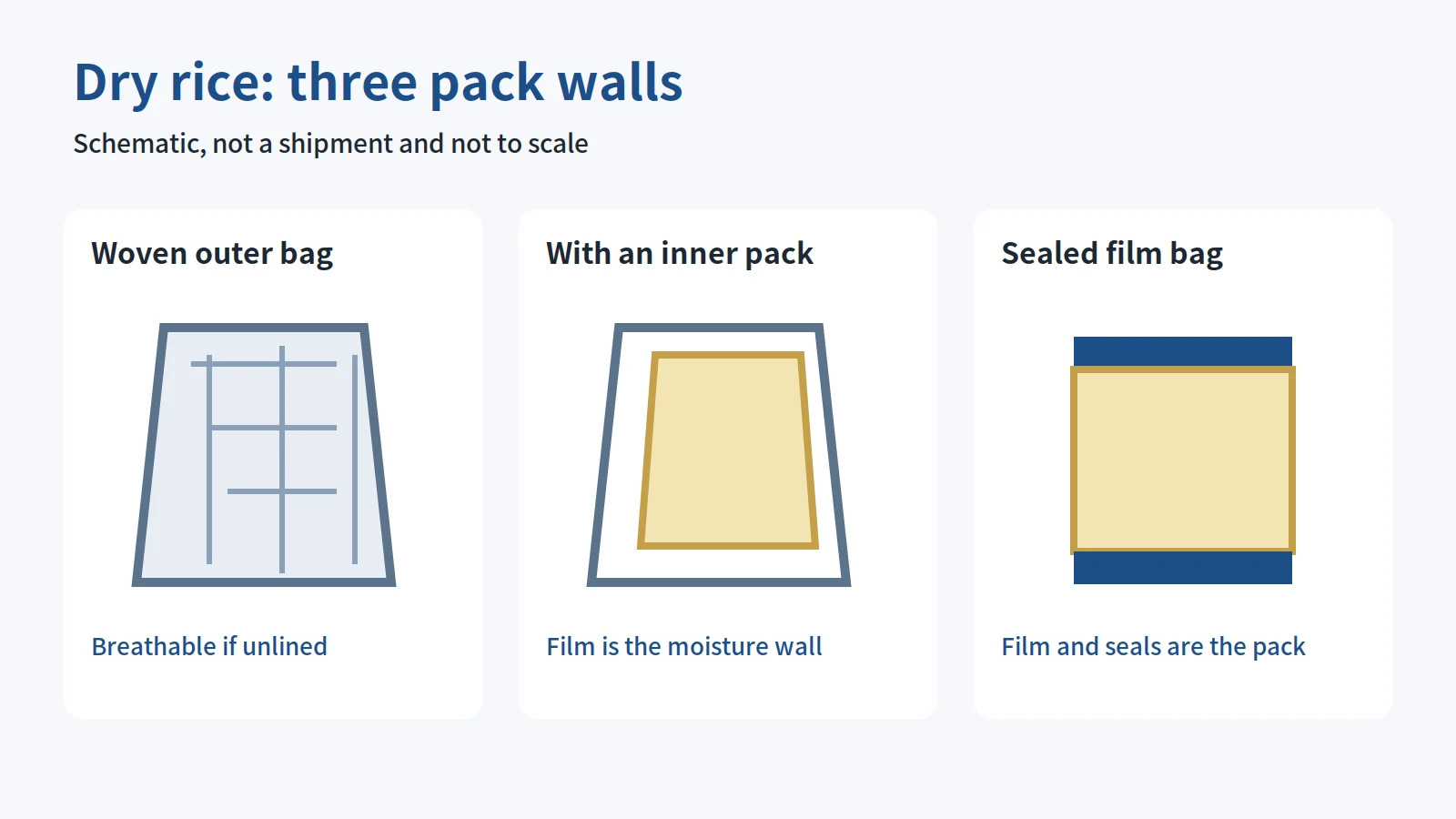
Dry edible rice is packed in a woven outer bag, in that bag with an inner pack, or in a sealed film bag. Polypropylene names the woven fabric. In the CFTRI cereals chapter, the moisture wall is a polyethylene layer or the sealed film, and only where that wall is continuous and its mouth is closed.
The comparison sits with the other product pages under flexible packaging applications. It covers dry retail white rice and brown rice. The ranges below come from one chapter on wheat, rice, milled products and sugar. Write your own rice type, fill weight and humidity on the record sheet, next to whichever range you are looking at.
Scroll horizontally to view all columns if needed. ↔
| Input | What to write down | Why the pack changes |
|---|---|---|
| White or brown rice | Milled white rice, or brown rice with the bran left on | Brown rice and basmati are the flavour-barrier case. Ordinary milled rice in the unit-pack section is the woven-sack and LDPE/LLDPE case |
| Fill weight | Kilograms in this bag | Unit packs are split around 10 kg. Up to 100 kg is stated only for a woven sack that also has a PE layer |
| Shipping and storage humidity | Warehouse, container and any measured humidity | Lined woven sacks are the moisture-protection row. Unlined woven sacks are the breathable row |
| Structure in hand | Woven only, woven plus inner pack, or sealed film | Each row has a different mouth to close |
What packaging rice comes in
Three structures cover the dry rice on this page.
Woven outer bag. A. R. Indiramma’s chapter for the Central Food Technological Research Institute, in the ICPE book Plastics in Food Packaging, names flat or circular woven sacks of polypropylene or HDPE for cereals, flours and sugar. Jute, hessian and burlap are the textile sacks in the same discussion. The weave holds the rice and takes the handling. Table 5.2 calls unlined HDPE or PP woven sacks breathable. The jute column is good breathability and poor moisture protection. The prose says jute sacks cannot, as such, protect the product from moisture coming in. A tarpaulin over a stack of jute bags covers the stack. The cloth under it is still jute.
Woven sack with an inner pack. The same section says a suitable polyethylene layer on a PP or HDPE woven sack gives protection at high humidities. Table 5.2 assigns moisture protection to lined woven sacks, and breathability to unlined ones. Jute sacks can gain a water-vapour barrier from webs of paper, plastic or foil, which also reduce sifting. The weave still carries the load. The added layer is the moisture wall where that layer is continuous.
Sealed retail bag. For unit packs up to 10 kg, the chapter names LDPE and LLDPE, including blends, with LLDPE used where more strength is wanted. A figure caption shows rice packs in units of 1 to 25 kg. For basmati, brown rice and flours, the chapter names a flavour-barrier film: reverse-printed polyester laminated to LDPE, coextruded LDPE/LLDPE, and PET/LDPE. A machinery supplier’s rice page lists preformed pouches and rollstock among its own rice formats (Unified Flex, fetched 8 October 2026). The speeds and freshness wording on that page stay with that supplier.
PE film is the family the chapter uses for the inner layer and for the smaller unit packs. PET film is the outer film in the PET/LDPE laminate the chapter shows for basmati retail packs.
White rice and brown rice
In the unit-pack section, ordinary milled rice sits with other grains that need a measured fill, impact strength and puncture resistance. The chapter points to high bulk density, tensile strength for form-fill-seal work, and puncture resistance because some grains have sharp edges. Puncture resistance is the film check to ask for when the pack is a film. On a woven sack, the matching check is whether the weave and the closure still hold the rice after handling.
Brown rice is grouped with basmati and with flours. The chapter says those products need a flavour-barrier material because of flavour loss and oxidative rancidity. The structures it names are polyester laminated to LDPE, coextruded LDPE/LLDPE, and PET/LDPE. It describes PET/LDPE as protection against flavour loss and rancidity, as a check on insect entry and foreign odours, and as a print surface. Vacuum packing and a carbon dioxide flush are described as a further step for brown rice. Shelf-life periods printed in that chapter stay in the chapter. A date for your rice comes from a filled-pack test at your humidity.
The chapter also says perforated bags are used so rancid odour can leave. A perforation is an opening. That bag is a different structure from a lined sack.
Fill weight
Write the kilograms on the sample first.
In the unit-pack section, textile, jute and burlap are described for packs above 10 kg, and plastic woven sacks are described for that range because the textile bags are open to vermin. Up to 10 kg, the chapter names LDPE and LLDPE. A rice figure on those pages is captioned for units of 1 to 25 kg, so a rice bag can sit on either side of the 10 kg line. Up to 100 kg is stated for PP or HDPE woven sacks that include a suitable PE layer, for cereals, flours and sugar together. A basmati retail figure is captioned for PET/LDPE packs of 1 kg and 5 kg.
A 25 kg woven sack and a 1 kg film bag hold dry rice with different walls. Record the fill weight beside the structure. The 100 kg line belongs to the sack that has the PE layer.
Where moisture protection sits
Moisture barrier packaging is a result for a complete pack under a stated humidity difference. WVTR is the film number, with a temperature and a humidity written beside it. The cereals chapter gives no WVTR for a woven rice sack, so the table below stays qualitative.
Table 5.2 draws the line the sample has to follow:
Scroll horizontally to view all columns if needed. ↔
| Sack in the table | What the chapter says about air and moisture |
|---|---|
| Jute | Good breathability, poor moisture protection. The prose says jute sacks, as such, let moisture in |
| HDPE or PP woven, unlined | Good breathability |
| HDPE or PP woven, lined | Good moisture protection |
“Good protection at high humidities” is attached to woven PP or HDPE sacks with a suitable PE layer. Record the humidity of the warehouse and the container on the sheet below. Grain-storage moisture tables stay off this page. The chapter mixes rice with other cereals and with flours, and white rice and brown rice do not share one borrowed limit here.
Common mistake: reading polypropylene on the sack ticket as a moisture-proof result for the rice inside.
Materials and closure matrix
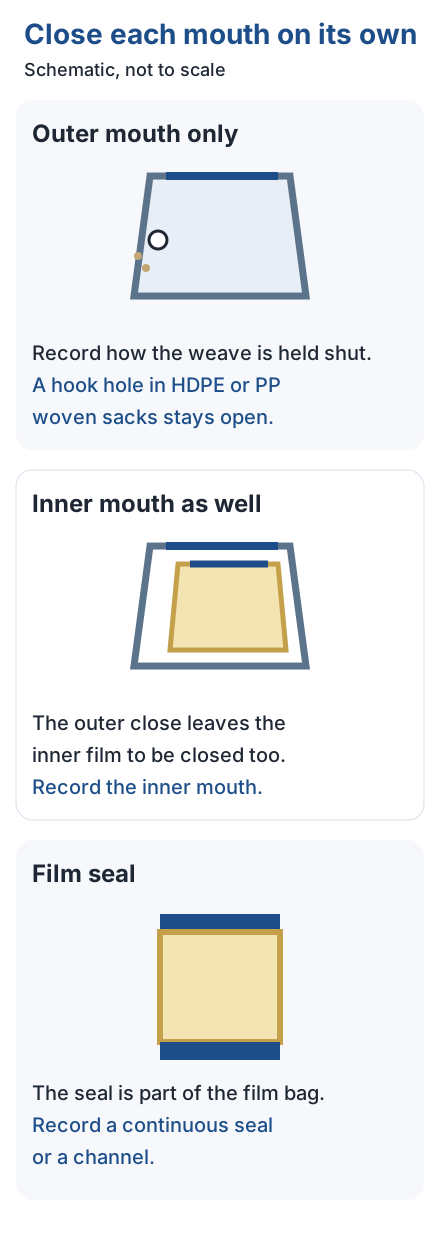
Use one row for the bag you are holding. The closure column is what you record on the sample, not a seal method the chapter measured.
Scroll horizontally to view all columns if needed. ↔
| Structure | What carries the rice | Moisture job in the chapter | Closure to record |
|---|---|---|---|
| Woven outer bag | PP or HDPE weave, or jute, hessian or burlap | Unlined woven sack: breathable. Jute fabric: poor moisture protection | The outer mouth. On HDPE or PP woven sacks, a hook hole does not close back up, and grain seeps |
| Woven outer bag with an inner pack | The weave | A PE layer on PP or HDPE woven sacks. Paper, plastic or foil webs on jute | The outer mouth and the inner mouth on two lines. A shut weave with an open inner film leaves a moisture path |
| Sealed retail bag | The film | LDPE or LLDPE for the unit packs the chapter describes up to 10 kg. Polyester/LDPE or PET/LDPE where the chapter is discussing flavour barrier for brown rice or basmati | The film seal. Look for a continuous seal or a channel. There is no weave outside it |
Takeaway: put the polypropylene name in the material column, then judge the bag by the inner wall, the mouth you can see, the rice type and the fill weight.
Copy the sample record
Copy one sheet per bag. Leave a line blank until you have looked.
Rice sample record
Bag ID:
Date and person:

Initial product condition
  White milled rice or brown rice:
  Broken kernels, off-odour, or insects, as seen:
  Moisture result, only if your team measured it (method and value):

Storage humidity
  Warehouse and shipping route:
  Temperature and relative humidity, if measured:
  Wet spots or condensation on the bag (yes or no):

Inner-pack continuity
  None, or a PE, film, paper or foil layer:
  Continuous, or a tear, gap or open seam:
  Where you looked:

Mouth closure
  Outer mouth (what is holding it shut):
  Inner mouth, if there is an inner pack (closed or open):
  Film seal, if this is a retail film bag (continuous or channeled):
  Hook holes or other punctures (count, and whether grain is coming out):

Transport damage
  Splits, abraded corners, crushed seams:
  Rice outside the bag:
  Fill weight on this bag (kg):
  Decision: hold, use, or retest: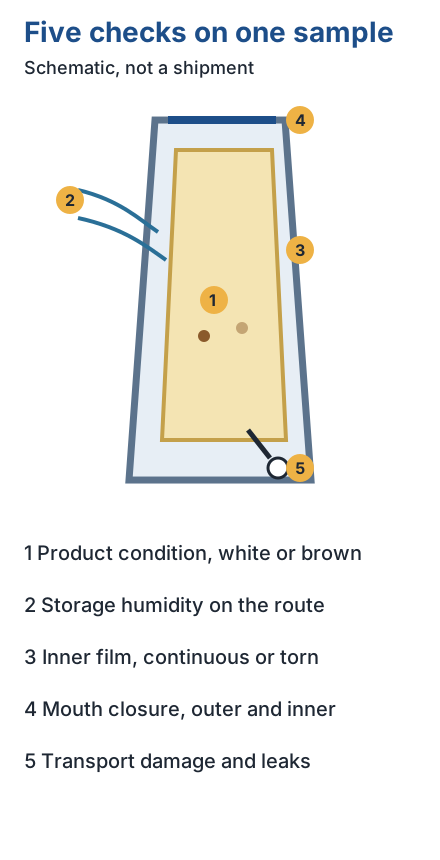
When this page stops
The structures above are for dry milled white rice and brown rice. Cooked-rice pouches, microwave or steam packs, and paddy or seed storage sit outside this page. A storage-life date is a filled-pack result, not a line in this guide. A woven sack stays a breathable fabric until a continuous inner layer is closed. The chapter does not describe that weave as airtight.
Food-contact status is a document from the supplier of the finished sack or film. The food contact packaging regulations page lists what to request. The chapter says a functional pack should meet the food laws. It does not clear a particular sack.
The chapter also says HDPE and PP woven sacks should be checked for safety and should conform to IS 14887. The clauses of that standard are not copied here.
Sources and method
Written 12 October 2026 from two sources read before drafting. No bag was filled or tested for this page. The matrix and the record sheet are a way to compare a sample. They are not a test method and they set no pass limit.
- A. R. Indiramma, Food Packaging Technology Department, CFTRI, “Packaging Aspects of Wheat, Rice, Milled Products and Sugar,” Chapter 5 of Plastics in Food Packaging (ICPE), PDF. Read 11 October 2026 from the local text of that PDF. The chapter pages print no publication date. The bibliography includes references through 2003. Used here: deterioration driven by humidity, jute versus lined and unlined HDPE/PP woven sacks (including Table 5.2 and the hook-hole note), the PE layer on woven sacks, unit-pack materials and the 10 kg split, the 100 kg line for woven sacks with a PE layer, the rice figure caption of 1 to 25 kg, the basmati PET/LDPE figure of 1 and 5 kg, and the flavour-barrier structures named for brown rice and basmati. Grain moisture tables, film-thickness insect trials, fumigant permeability tables, seed-storage results and the chapter’s shelf-life periods were left out.
- Unified Flex, pasta, beans and rice packaging, library document 49d739f6e2e783bd70f52a9b8a832e938dbe41e71eb81f894b803b2f46a3edde, fetched 8 October 2026, published date on the record 22 December 2023. Used only to note that this supplier lists preformed pouches and rollstock for rice. Machine names, speeds and seal claims on that page are not used.
Continue reading
Related articles
Nut Packaging Materials: Whole, Shelled, Raw and Roasted Products
Nut packaging materials follow shell, piece size and roast. Record moisture loss and gain, and leave barrier cells blank until a supplier sheet arrives.
Spice Packaging Materials: Aroma, Moisture and Contact-Layer Checks
The best spice packaging depends on whole or ground form, climate and how spice oils meet the inner layer. Compare the risks, then copy a sample record.
Fresh Produce Packaging Film: Respiration, Moisture and Trial Inputs
Match fresh produce film to crop, cut state, pack geometry and cold-chain conditions. Use a blank trial record for gas exchange, moisture and supplier data.