
Nut Packaging Materials: Whole, Shelled, Raw and Roasted Products
A raw-nut storage estimate copied onto pieces or a roast fails the pack. Shell, intact kernels, pieces and some roasted nuts do not share one storage life.
A raw-nut storage estimate copied onto pieces or a roast fails the pack. Shell, intact kernels, pieces and some roasted nuts do not share one storage life, so the film has to be named from the lot in front of you.
Nut packaging materials start from the nut in hand. Marita Cantwell’s storage answer at the UC Davis Postharvest Research and Extension Center, last updated 16 May 2023 and read 11 October 2026, ties nut quality to drying and to moisture-proof bags. Nuts in the shell have about 25-50% longer shelf-life than the nutmeats alone. That percentage varies with the nut and with whether the packaging provides a moisture barrier, a low oxygen concentration, or both. Pieces of nutmeats have about half the shelf-life of the intact nutmeats. Some roasted nuts have a shelf-life about one fourth that of the raw nutmeats. The month table in that answer is not copied here. It assumes raw nuts, in the shell or intact, dried before storage, and, if packaged, humidity controlled with oxygen near air. Use the table to write the state, the moisture direction, the climate, the atmosphere, the seal and the web name. Leave thickness, OTR and WVTR empty until a supplier sheet for this lot is attached.
This page sits with the other product notes under flexible packaging applications. It covers dry tree nuts and the peanuts Cantwell lists with them: in the shell or shelled, intact or in pieces, raw or roasted. Coconuts and chestnuts stay off the sheet. That answer treats them as fresh fruit because their moisture is high, and it gives coconut a refrigerated figure near 20%, with no chestnut percentage in the same sentence. Dried fruit is out of scope. Oxidation and nitrogen flushing for snacks, including nut snacks as a group, stay on snack packaging film.
Scroll horizontally to view all columns if needed. ↔
| Input | What to write down | Why the pack changes |
|---|---|---|
| Nut state | In shell, intact kernel, or pieces; raw or roasted | Cantwell’s comparisons differ for shell, pieces and some roasts |
| Moisture direction | Loss (brittle) or gain (mold), or both | Both are named quality failures. A moisture-proof bag is the recommendation, and it is not a WVTR |
| Storage climate | Temperature and relative humidity you will actually hold | Generally 0-10°C and 55-70% RH in that answer, tied to the nut’s own moisture |
| Atmosphere | Air, vacuum, or a flush, and whether oxygen will be measured | The month table assumes packaged nutmeats sit near air |
| Seal and reclose | Continuous, channeled, or still open; opened again or not | An open mouth drops the wall the estimate assumed |
| Candidate web | Name on the roll or the spec, or empty | This page has no thickness, OTR or WVTR |
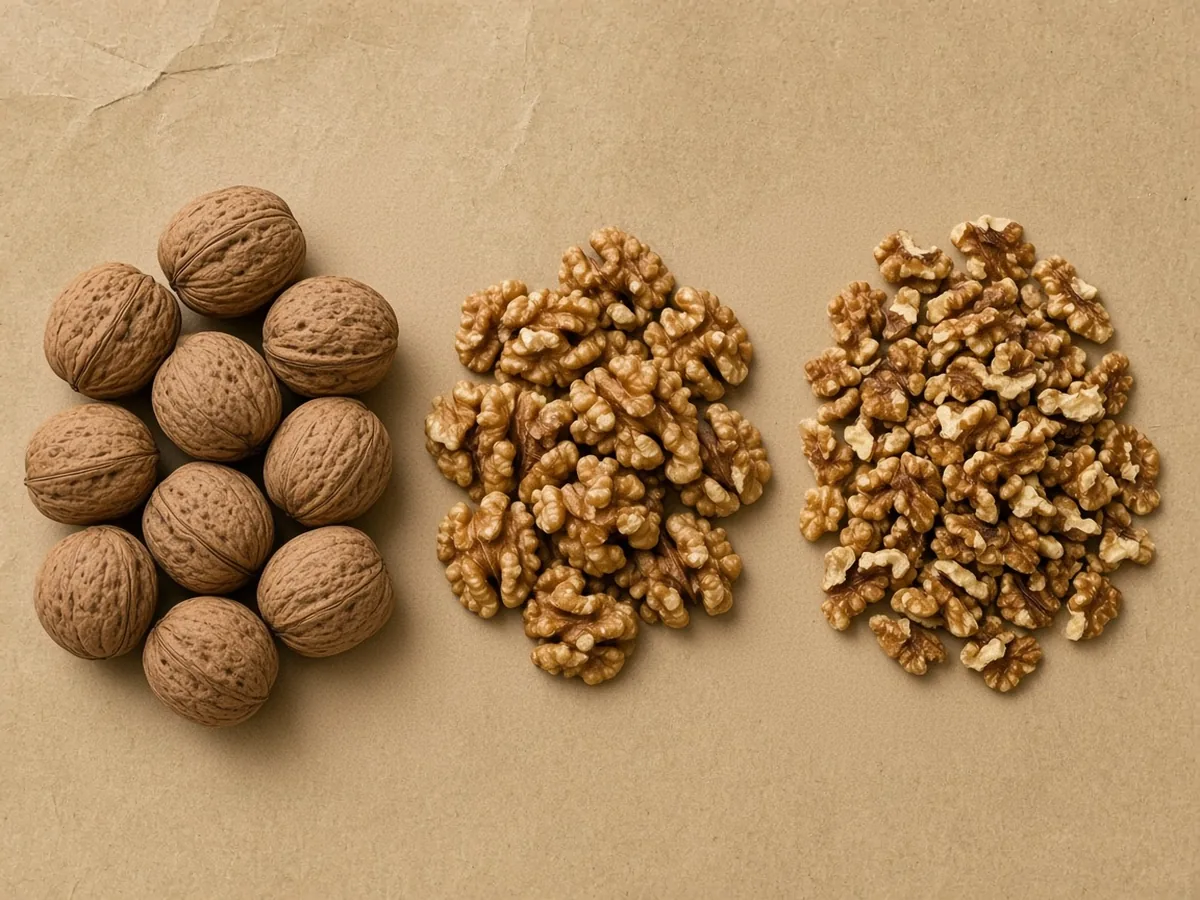
What shell, pieces and roasting change
Write the state before you name a web.
Cantwell’s quality list for nuts is rancidity from lipid oxidation, darkening tied to the initial drying temperature and later storage, mold where moisture and temperature allow it, brittleness when moisture is too low, insect infestation, and stale flavor when the nuts are held too long under the storage conditions in view. The same answer names aflatoxins and human pathogenic bacteria as food-safety concerns that moisture and temperature affect, and it notes allergic reactions to some nuts, especially peanuts, in some people. This page records the moisture and the temperature. It does not set a kill step, a water activity, or a pathogen test.
The shell comparison is the first split. In-shell nuts last about 25-50% longer than the nutmeats alone in that account, and the spread is wide because the nut and the pack both move it. A moisture barrier and a low oxygen level are the two pack conditions she names. A bag that only looks like a nut bag does not tell you which of those two it has.
Pieces are the second split. Pieces of nutmeats have about half the shelf-life of the intact nutmeats. More cut surface is the practical reading of that line. The answer does not give a piece size, so “pieces” means the broken nut you can see, and the cell stays empty until you describe it.
Roast is the third split. Some roasted nuts have a shelf-life about one fourth that of the raw nutmeats. “Some” is her word. A roasted almond and a raw walnut do not inherit one number from that sentence. Write raw or roasted as the lot is, and leave the life comparison empty when the lot is a mix or the roast is unknown.
Takeaway: Put in-shell, intact kernel, pieces, raw and roasted on separate lines. One comparison does not fill the other lines.
Where moisture fails in both directions
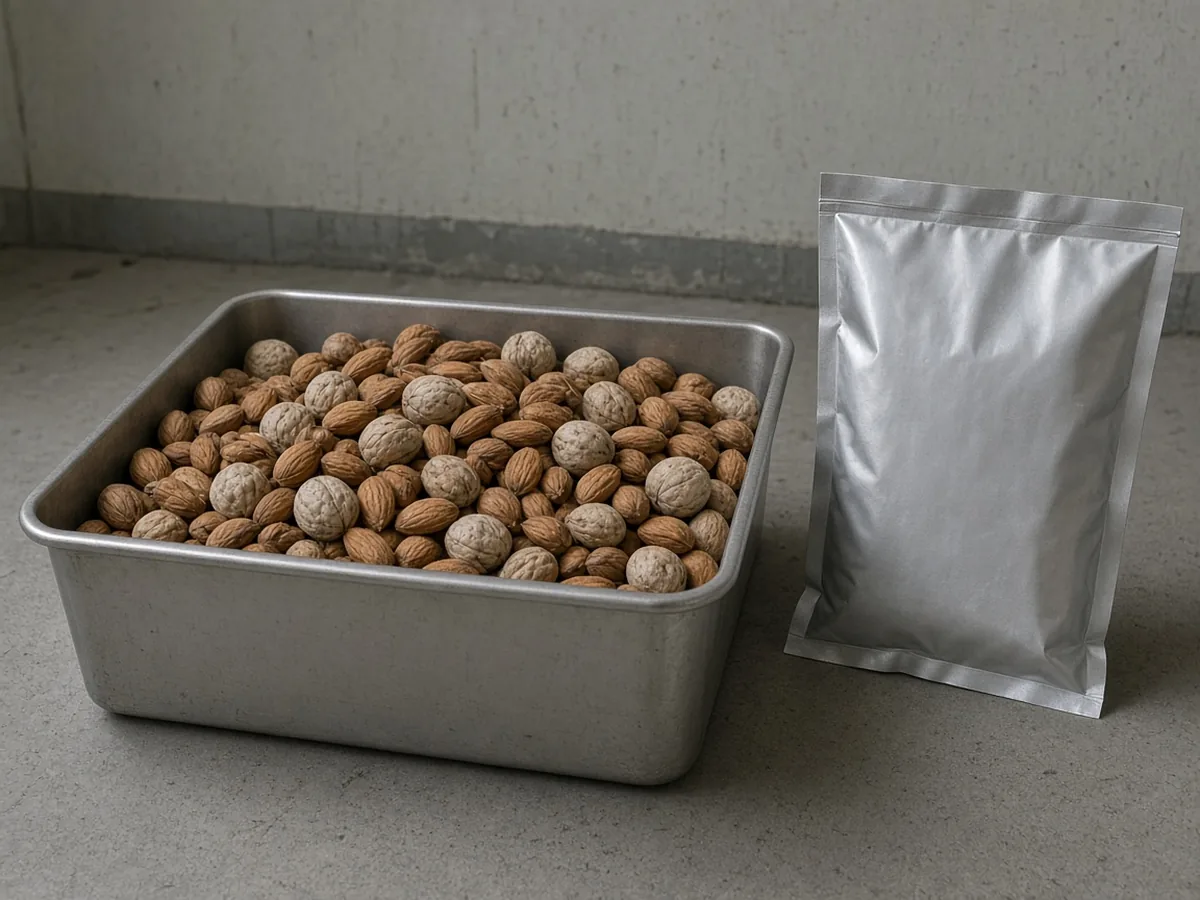
Cantwell says nuts in the shell are often handled loose, so temperature matters when there is no bag, and she recommends moisture-proof packaging to hold quality. Loose nuts in a bin and nuts in a closed pouch are different moisture jobs. The photograph shows the two arrangements. It is not a humidity reading.
Moisture fails in two directions. Too low, and the nutmeat goes brittle. Too high, and mold becomes the concern, along with the food-safety issues she ties to moisture and temperature. A film chosen only to “keep moisture out” misses the lot that is already drying out. Moisture barrier packaging is the measurement page for water vapor. Copy a WVTR onto the record only when the supplier sheet prints the number, the unit, and the test temperature and humidity. If it does not, leave the cell empty.
For refrigerated storage she says moisture should be near these percentages. The OTR and thickness cells stay empty on purpose.
Scroll horizontally to view all columns if needed. ↔
| Nut, as she names it | Moisture near this percent | OTR | Thickness |
|---|---|---|---|
| Almond | 6 | ||
| Brazil nut | 7 | ||
| Cashew | 8 | ||
| Hazelnut | 15 | ||
| Macadamia | 15 | ||
| Pecan | 5 | ||
| Peanut | 7 | ||
| Pistachio | 7 | ||
| Walnut | 5 | ||
| Any nut absent from that list |
Optimum relative humidity in the same answer is 55-70%, depending on the moisture of the nuts, and the higher the temperature, the more critical humidity and moisture become. The general storage temperature she gives is 0-10°C, with that same 55-70% band, again depending on the original moisture. Those are storage conditions for the nut, not a film specification.
Takeaway: Write moisture loss and moisture gain as two lines. The refrigerated percentage fills neither the OTR cell nor the thickness cell.
What the pistachio sheet adds
The UC Davis pistachio fact sheet, read 11 October 2026 from the same saved excerpt, is one nut. Its figures stay on pistachio.
It sets an optimum of 0-10°C. To limit lipid oxidation, it recommends that storage not exceed 20°C. It says the lower the temperature, the longer the storage life, and that pistachios can be stored frozen for a year or longer and remain in good condition. That frozen sentence is the sheet’s statement about frozen storage. It is not a date for a flexible pouch held in a warm warehouse.
Humidity on that sheet splits by temperature. Below 10°C it calls for 65-70% relative humidity. Above 10°C it calls for relative humidity below 32%. Moisture loss can make pistachios brittle. Excess humidity promotes pathogen growth and lipid degradation. Use this split on a pistachio line. Do not paste it onto the almond or walnut line, where Cantwell’s general 55-70% band is the sentence you have, still tied to that nut’s own moisture.
The sheet also states a gas condition for pistachios: oxygen below 0.5%, with nitrogen as the balance, or carbon dioxide above 80%, as a way to limit insects, pathogens, rancidity, staleness and other deterioration. It recommends vacuum packaging or a nitrogen flush to remove oxygen. Those are headspace statements on that sheet. They are not an OTR, and they are not a gas target for other nuts here. Oxygen barrier packaging is where a supplier OTR is read with its test temperature and humidity. This page has no OTR for any nut.
Two handling notes on the same sheet belong next to the climate line. Nuts pick up odors from other goods because of their high lipid content, so the sheet says to keep them away from strong-smelling commodities. Ammonia blackens external tissues. Respiration is very low, under 5 mg CO2/kg-hr at 5°C, which the sheet ties to drying. A film sized for a respiring fresh leaf is the wrong comparison for that pistachio.
Barrier film is the layer that slows oxygen, water vapor, light or aroma. Which of those this pouch actually slows is a blank until the structure is named.
What to write down before a seal trial
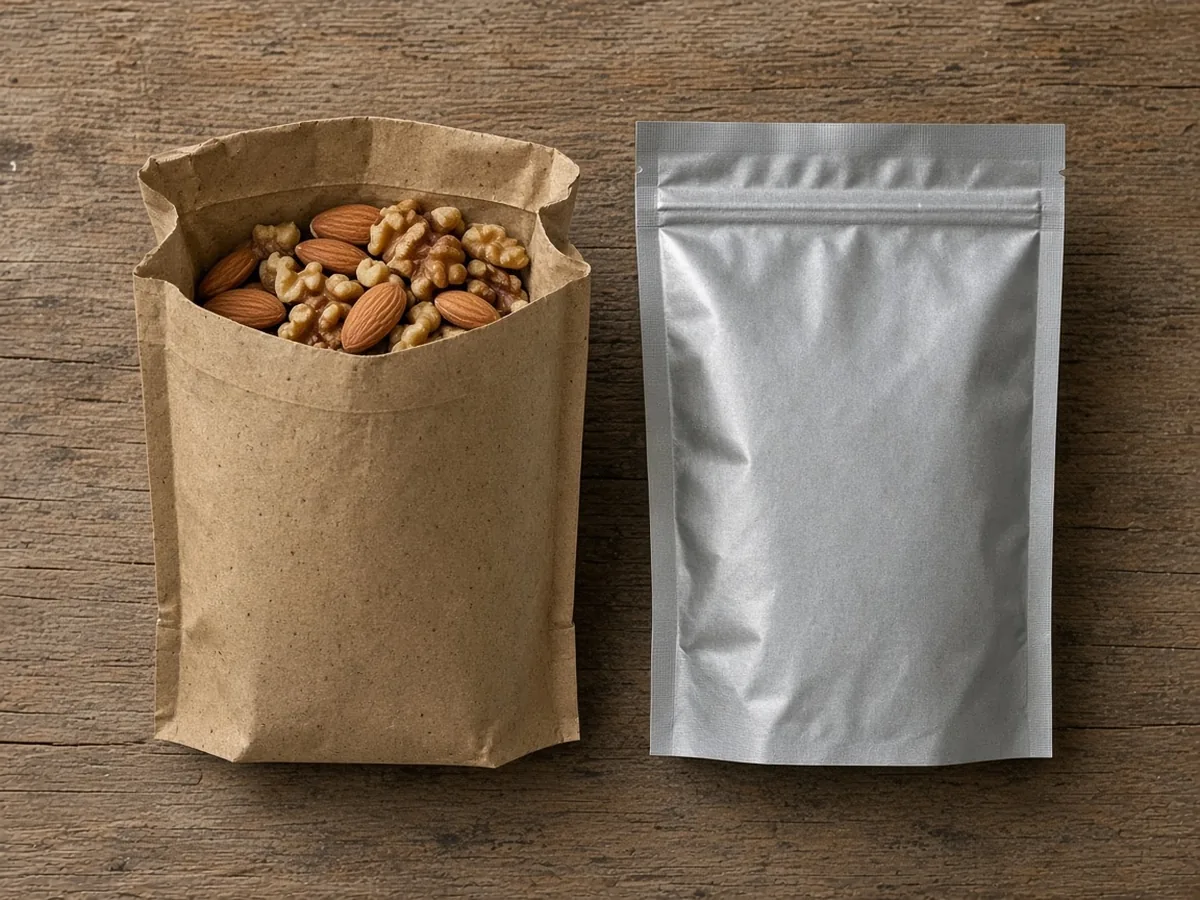
The seal is part of the wall. A barrier film with an open mouth is a tray of nuts.
Packaging seal strength is the force measurement on a finished seal. This guide does not set a pass value. Write whether the sample seal is continuous, channeled, or not yet made, and whether anyone will open the pack and close it again. Cantwell’s packaged-nutmeat assumption is a closed pack with humidity controlled. A zipper left open after the first handful is a different pack, and the record needs its own line for that.
Light is a separate column from the oxygen number. The snack page already treats light as a driver of fat oxidation for nut snacks. This page does not add a light-transmission figure. If the pouch in hand is clear, opaque, or metallic, write what you see. The silver pouch in the photograph is a picture of a closed unprinted pouch, not a measured barrier.
Food-contact status is a document for the finished web. The food contact packaging regulations page lists what to ask for. Nothing here clears a pouch for a market.
Copy this record
Copy one sheet per sample. An empty line means you have not looked yet.
Nut packaging record
Sample ID:
Date and person:

State
  Nut, as named on the lot:
  In shell, intact kernel, or pieces, as seen:
  Raw or roasted:
  Coconut, chestnut, or dried fruit (yes stops this sheet):

Moisture and climate
  Measured moisture, percent:
  Cantwell refrigerated figure if this nut is listed, percent:
  Loss (brittle), gain (mold), or both:
  Storage temperature:
  Relative humidity:
  Pistachio humidity split used (yes or no):

Atmosphere
  Air, vacuum, or a flush, and the gas if you know it:
  Headspace oxygen, with unit, or empty:
  Pistachio gas note used (yes or no):

Web and seal
  Web name on the roll or spec, or empty:
  Thickness, or empty:
  OTR, with unit, temperature and humidity, or empty:
  WVTR, with unit, temperature and humidity, or empty:
  Seal continuous, channeled, or not yet sealed:
  Opened and closed again (yes, no, or not opened):

Decision
  Hold, retest the wall, or out of scope:
When this page stops
The notes above are for dry nuts whose state you can see and whose storage climate you can write down. Dried fruit, coconut and chestnut need their own product record. A pathogen-control process is not on this page. A storage-life date for a filled pouch is a result for that product, that package and that route, which is the subject of packaging and shelf life. Cantwell’s comparisons and the pistachio frozen sentence do not supply that date.
Sources and method
Written 14 October 2026 from sources read before drafting. No nuts were packed or measured for this page. The record compares a sample with the published conditions below. It is not a test method and it sets no pass limit.
- Marita Cantwell, answer to “Do you have information about the best temperatures at which I should store nuts for our retail chain?”, UC Davis Postharvest Research and Extension Center, postharvest.ucdavis.edu. The saved page text says last update 16 May 2023. Read 11 October 2026 from the research excerpt. Used here: drying and moisture-proof bags; rancidity, darkening, mold, brittleness, insects and stale flavor; aflatoxin and pathogenic bacteria named only as moisture- and temperature-sensitive concerns; allergic reactions, especially peanuts; refrigerated moisture figures for almond, Brazil nut, cashew, hazelnut, macadamia, pecan, peanut, pistachio and walnut; coconut near 20% and the fresh-fruit grouping of coconut and chestnut, which this page then excludes; relative humidity 55-70% tied to nut moisture; higher temperature making humidity more critical; in-shell shelf-life about 25-50% longer than nutmeats, with the pack conditions that move that percentage; pieces about half the life of intact nutmeats; some roasted nuts about one fourth the life of raw nutmeats; general storage at 0-10°C and 55-70% RH. Table 1’s month grid was not copied. Its assumptions are stated in the text: raw nuts, dried before storage, and packaged nutmeats held with humidity controlled and oxygen near air.
- Pistachio fact sheet, UC Davis Postharvest Research and Extension Center, postharvest.ucdavis.edu/produce-facts-sheets/pistachio. No publication date was printed in the saved excerpt. Read 11 October 2026. Used only for pistachio: optimum 0-10°C, the recommendation not to exceed 20°C to limit lipid oxidation, frozen storage for a year or longer remaining in good condition, relative humidity 65-70% below 10°C and below 32% above 10°C, brittleness from moisture loss, pathogen growth and lipid degradation from excess humidity, oxygen below 0.5% with nitrogen as the balance or carbon dioxide above 80%, vacuum or nitrogen flush, odor pickup, ammonia blackening, and respiration under 5 mg CO2/kg-hr at 5°C. USDA grade names and the aflatoxin limit on that sheet were left out.
Continue reading
Related articles
Rice Packaging Materials: Woven Sacks, Liners and Sealed Retail Packs
What dry rice packaging is made of: a woven outer sack, a sack with an inner pack, or a sealed film bag. Polypropylene is not a moisture-proof guarantee.
Spice Packaging Materials: Aroma, Moisture and Contact-Layer Checks
The best spice packaging depends on whole or ground form, climate and how spice oils meet the inner layer. Compare the risks, then copy a sample record.
Fresh Produce Packaging Film: Respiration, Moisture and Trial Inputs
Match fresh produce film to crop, cut state, pack geometry and cold-chain conditions. Use a blank trial record for gas exchange, moisture and supplier data.