
Spice Packaging Materials: Aroma, Moisture and Contact-Layer Checks
The best spice packaging depends on whole or ground form, climate and how spice oils meet the inner layer. Compare the risks, then copy a sample record.
No single film is the best spice packaging for every product. Ground spices cake when they take up moisture and lose aroma faster than whole ones, some spice oils attack the inner layer of a pouch, and the climate the pack travels through decides how much barrier is enough. Choose the structure from those three facts, then confirm it with your own spice sealed in sample pouches.
This page covers dried whole spices, ground spices and blends in retail packs and foodservice refill pouches. Other product briefs in this section are on flexible packaging applications. These inputs set the structure, so record them before asking for one:
Scroll horizontally to view all columns if needed. ↔
| Input | Why it changes the answer | Record |
|---|---|---|
| Product form | Ground spices take up water and lose aroma faster than whole ones | Whole, ground or blend; every blend ingredient |
| Climate | A cool, dry market may need simple packaging; a hot, humid one needs real moisture protection | Worst storage and transport conditions |
| Contact layer | Oils in turmeric, chilli, ginger and pepper powders can react with the inner layer | Proposed sealant, to be stored with the actual spice |
| Light | Pigments in turmeric, red chilli, saffron and green cardamom fade | Whether the pack has to block light |
| Seal and closure | The heat seal protects the spice until opening; a zipper, if fitted, only recloses | Pouch format; zipper or none |
| Use pattern | A refill emptied into a kitchen container is handled differently from a pack used from the shelf | Sealed retail, refill emptied, or used from the pouch |
What a spice pack has to keep in and out
A packaging reference chapter on spices from the Indian Centre for Plastic in the Environment (ICPE, listed under sources below) sets out the spoilage factors that shape the brief:
- Moisture. Spice powders are hygroscopic. They pick up water from the air, turn soggy, form lumps and stop flowing freely.
- Aroma. The flavour sits in volatile oils. When those oils escape or some aromatic compounds oxidize, the spice tastes flat.
- Light. Green cardamom, red chilli, turmeric and saffron carry natural pigments that fade under light.
- Outside odour. The barrier that holds aroma in also has to keep foreign smells out.
- Oil contact. Volatile oil can react with the inner layer of the pack, leaving a greasy package and smudged print.
Heat, humidity and oxygen also speed up insect infestation, so whole spices still go into closed packs. Moisture barrier packaging explains how water uptake is budgeted and oxygen barrier covers oxidation.
Takeaway: mark which of these five factors apply to your spice before comparing films, because each one points to a different layer.
Whole and ground spices carry different risks
Grinding changes the problem. FAO guidance for small processors says finely ground spices absorb water much faster than whole spices and should go into airtight containers soon after milling. The ICPE chapter names moisture and insects as the main threats to whole spices in storage, because their volatile oils stay inside the plant cells, while powders deteriorate quickly and need more careful pack selection. Treat the aroma risk for whole spices as lower, not absent.
Scroll horizontally to view all columns if needed. ↔
| Product form | Moisture | Aroma | Light | Oil on the contact layer | Record first |
|---|---|---|---|---|---|
| Whole spices (peppercorns, cardamom, clove, cinnamon) | Main risk, with insects | Lower relative risk | Check pigmented ones such as green cardamom | Not flagged by the source | Moisture at packing and the storage climate |
| Ground single spices | Main risk: caking and loss of flow | Higher; deterioration is faster after grinding | Check turmeric, red chilli and saffron | Flagged for turmeric, chilli, ginger and pepper | Caking, aroma and inner-layer condition over time |
| Blends and curry powders | Main risk | Higher | Depends on ingredients | Flagged when the blend contains any of those four | As for ground spices, with every ingredient listed |
The ratings are drawn from the sources, not measured. For moisture, ask the converter for WVTR at the temperature and humidity your packs will see.
Takeaway: settle whole, ground or blend first, because the form decides how much moisture and aroma protection the pack needs.
Spice packaging materials by layer job
A spice pouch is usually a laminate in which each layer has a job: the outer layer carries print and takes handling, a middle layer provides the barrier, and the sealant touches the spice and forms the seals. The ICPE chapter lists the laminates then in common use for printed spice pouches: polyester or BOPP outside, metallized polyester or aluminium foil as the barrier, and polyethylene as the sealant. It also says PVDC and EVOH based materials needed study. Use that list to see the pattern; it is not a ranking of today’s options.
Scroll horizontally to view all columns if needed. ↔
| Layer job | What it has to do for spices | Materials named in the source | Check on your structure |
|---|---|---|---|
| Outer and print | Carry print; resist tear and puncture; add no odour or taint | Polyester, BOPP | Print condition after filling and handling; odour |
| Barrier | Slow moisture, oxygen and aroma loss; block light where pigments fade | Metallized polyester, aluminium foil; PVDC and EVOH named for further study | OTR and WVTR of the full laminate at stated conditions; opacity of the printed pack |
| Sealant and contact | Seal reliably; resist spice oil; stay compatible with the product | LDPE, LLDPE, cast PP, LD-HDPE coextrusion, ionomer, EAA | Condition after storage with the actual spice (next section) |
Compare complete structures. A metallized layer in one laminate and a foil layer in another can’t be ranked until both full laminates are tested under the same conditions. Packaging film describes the base films, and laminated packaging explains how the layers are bonded into one web.
Climate can move the answer more than the spice. FAO notes that a spice sold in a cool, dry market may need only simple packaging such as paper, while the same spice in a hot, humid market needs considerable moisture protection. Write down the worst storage and transport conditions before you ask for a structure.
Takeaway: ask for complete laminates with barrier data at your worst conditions, rather than for a material name.
The contact layer needs a test with the real spice
Spice packs can fail at the inner layer in ways a barrier number won’t predict. The ICPE chapter singles out powders of turmeric, chilli, ginger and pepper, and mixes containing them. Their volatile oils can react with the contact layer. The chapter reports sticky inner surfaces, damaged print and, in some cases, delamination.
For those powders the chapter advised against LDPE as the sealant and suggested a coextruded LD-HDPE film with the HDPE facing the product, cast polypropylene, an ionomer or EAA. That advice comes from an older reference and predates many current sealant grades. Use it to decide what to test. It neither bans a polymer nor proves that an alternative works with your blend.
Common mistake: choosing the sealant from barrier data alone. A laminate with low OTR and WVTR can still turn sticky inside when it holds turmeric or chilli powder.
A workable screen: seal the actual spice in sample pouches of each candidate structure, store them under conditions your team sets, and open them at agreed intervals. Look for tackiness, oil staining or odour on the inner surface, layer separation at the seal or panel, and print damage. Keep a reference from the same lot in an airtight container, as FAO recommends for retained samples. This is a proposed screen; the intervals and pass criteria belong to your quality team.
Material type says nothing about food-contact compliance. Ask the supplier for documents covering the finished structure, and use the food contact packaging regulations overview to know what to request.
Takeaway: shortlist sealants from the source list, then keep only those your quality team accepts after storage with your own spice.
The original seal and any zipper are separate checks
The ICPE chapter calls seal integrity the vital link: a well-designed, well-bonded laminate still lets the product down if the pouch seal fails. It lists centre-seal, three-side-seal, four-side-seal and strip formats, and none of them needs a zipper. The original heat seal protects the spice until first opening. If the pouch has a zipper, assess the heat seal and the reclosure separately, because a good result on one tells you nothing about the other. A pouch without a zipper has only the original seal to check.
Grinding produces fine dust, as the FAO guidance notes, so ground spice can reach the seal area during filling. Record whether powder was visible in the seal of each sample and keep those packs apart for checking. Use seal strength for the force measurement and the zipper pouch page for what a reclosure can and cannot hold.
Common mistake: counting on a zipper that closes well to protect the spice in storage. Until first opening, that job belongs to the original heat seal.
Takeaway: judge the original heat seal for storage and delivery, and the zipper only for reclosing after opening.
A refill pouch and a kitchen container do different jobs
In one chef forum thread, a spice producer asked chefs whether they would rather get bags to empty into their own containers or a large, sturdy container with a wide mouth. Those are two jobs. The sealed refill protects the spice through storage and delivery until someone opens it. The kitchen container takes the repeated opening and scooping that follow.
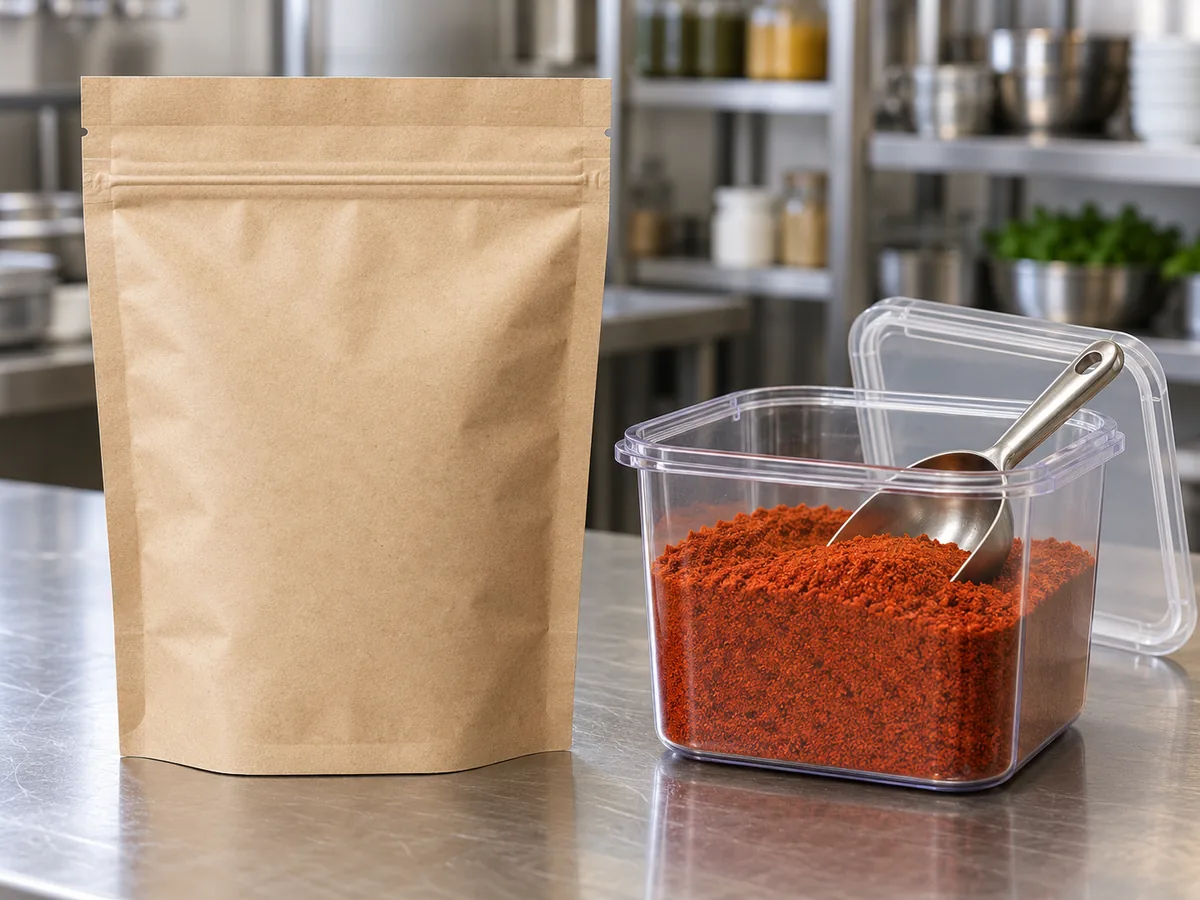
Assess them separately. For the refill, record the structure, the seal and the distribution climate. For the kitchen side, record how often the container is opened, how the lid closes and how fast a refill is used up. A stand-up pouch with a zipper can do both, but then the zipper and the opened-pack behaviour need checking too. Any storage-life statement still needs shelf-life testing on filled packs.
Takeaway: specify the refill for storage and delivery, and choose the kitchen container for daily handling.
When this does not apply
The sources used here deal with dried products. Spice pastes, flavoured oils, fresh herbs and anything sterilized or heat-treated in the pack need a different brief. Food-safety release and label rules are outside this page. Neither source gives a numeric barrier target, film thickness or shelf-life figure that fits current spice packs, so the page supplies none; those numbers have to come from your own filled-pack tests and the supplier of the finished structure.
Copy the sample record
Copy one record per spice and per candidate structure, and leave a field blank until you have the data. The record is a proposed checklist with no target values; it is not a standard method.
Scroll horizontally to view all columns if needed. ↔
| Field | Record |
|---|---|
| Spice and form | Name; whole, ground or blend; every blend ingredient: ____ |
| Lot and moisture at packing | Lot ID; moisture method and result: ____ |
| Market and climate | Where packs are stored, shipped and sold; worst conditions: ____ |
| Use pattern | Sealed retail, foodservice refill emptied into a container, or used from the pouch: ____ |
| Candidate structure | Outer, barrier and sealant layers; supplier specification reference: ____ |
| Barrier data | OTR and WVTR with test temperature and humidity: ____ |
| Contact layer after storage | Interval and conditions; tackiness, oil staining, odour, delamination, print: ____ |
| Factory seal | Powder seen in the seal area (yes or no); seal check method and result: ____ |
| Reclosure | Zipper, other closure or none; check method and result: ____ |
| Retained reference | Airtight reference sample ID and storage place: ____ |
| Food-contact documents | Documents received for the finished structure: ____ |
| Decision and owner | Approved, rejected or more testing; name and date: ____ |
| Unresolved | Open questions: ____ |
Once the record is filled in, compare the barrier fields with the moisture barrier guide and the seal fields with seal strength. For the wider film decision, how to choose flexible packaging film walks through product risk, structure and machine fit.
Common questions about spice packaging
What packaging material is best for dried spices?
No single material wins. Ground spices and blends usually need a laminate with real moisture and aroma barrier and a sealant that tolerates spice oil; whole spices are more forgiving on aroma. Choose from the spice form and the worst climate, then test with the spice.
Why does the inside of a spice pouch turn greasy or sticky?
Volatile oils in some spices can react with the inner layer. The reference used here flags turmeric, chilli, ginger and pepper powders and their mixes. Test the proposed sealant with the actual spice.
Can a paper-look pouch be assumed to protect spices?
No. The outside finish says nothing about the barrier layer inside. Ask for the full layer structure and its barrier data at stated conditions.
Should a refill pouch also be the daily-use container?
It can, though the jobs differ. The sealed refill protects the spice until opening; daily use adds repeated opening, so the closure and the time to use up the pack matter.
What should a restaurant record before choosing a refill bag?
Note which spices and forms you buy, how they are stored, whether refills are emptied into containers and how long an opened pack stays in use, then fill in the sample record for each candidate bag.
Do red chilli, turmeric or saffron need light protection?
The reference used here lists them, with green cardamom, as spices whose pigments fade under light. Ask for light-transmission data on the finished printed pack rather than assuming that heavy printing gives enough protection.
Sources and method
This guide was written on 2026-10-11 from two primary sources read that day. Both are older documents. They support the mechanisms described here; they do not supply current specifications, compliance status or shelf-life figures. No samples were made or tested for this page, and the record above is a proposed checklist.
- ICPE, “Packaging of Spices” (PDF), printed pages 195 to 199: spoilage factors, packaging requirements, whole and ground forms, laminates in use, contact-layer compatibility and seal integrity. The file metadata dates the PDF to 2005; the chapter prints no publication date. Its film thicknesses, shelf-life tables and market figures were not used.
- FAO, Quality assurance for small-scale rural food industries: herb and spice products: packaging by product, market and climate; ground spices taking up water faster; retained samples. The page shows no publication date.
Reader questions came from US search suggestions, a search results page and a chef forum thread retrieved on 2026-10-11. The FAQ wording is editorial.
Continue reading
Related articles
Nut Packaging Materials: Whole, Shelled, Raw and Roasted Products
Nut packaging materials follow shell, piece size and roast. Record moisture loss and gain, and leave barrier cells blank until a supplier sheet arrives.
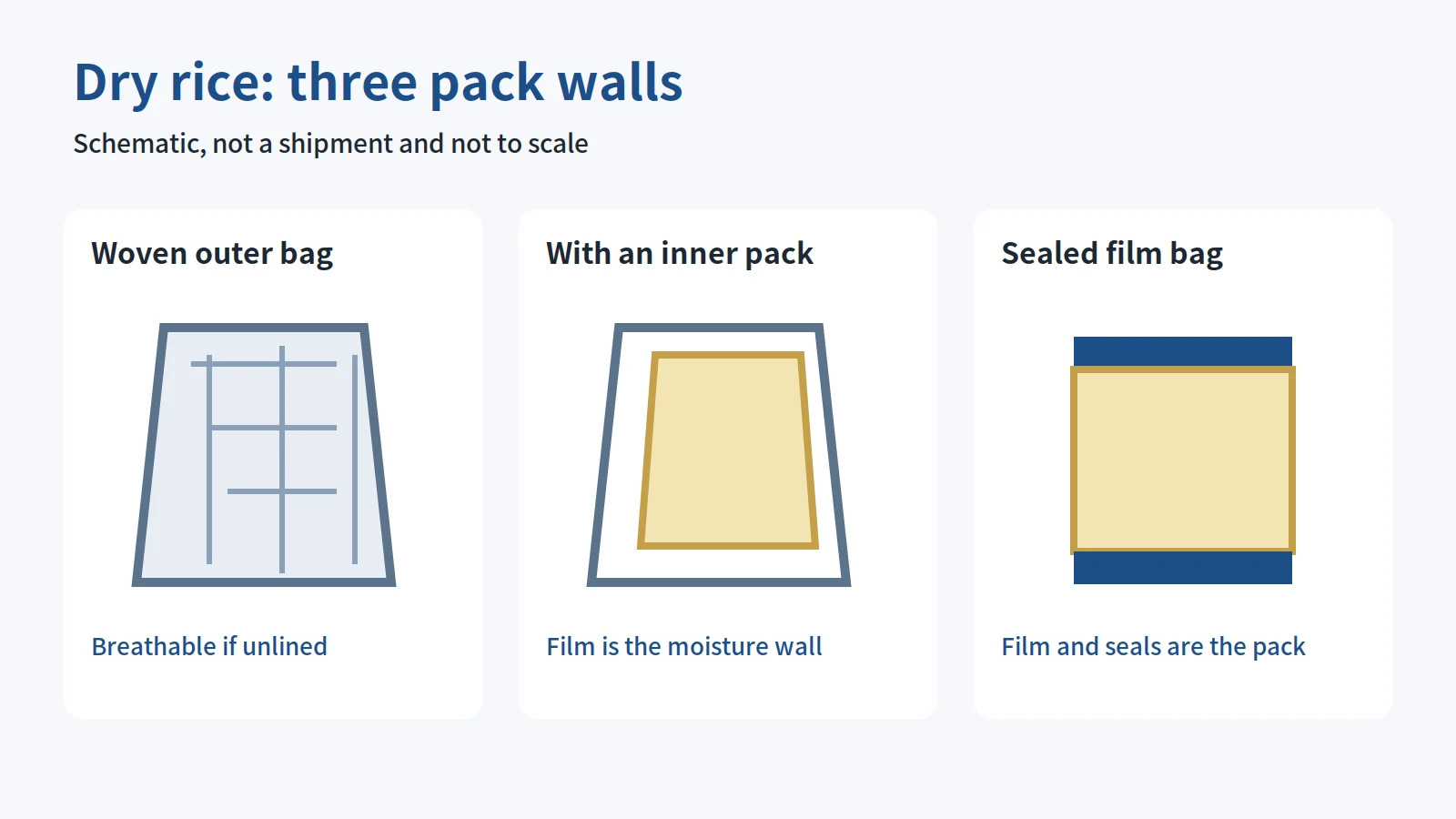
Rice Packaging Materials: Woven Sacks, Liners and Sealed Retail Packs
What dry rice packaging is made of: a woven outer sack, a sack with an inner pack, or a sealed film bag. Polypropylene is not a moisture-proof guarantee.
Bakery Packaging Film: Keeping Bread and Cakes Fresh
Bakery packaging film explained: how staling, moisture loss and mold shape film choice for bread, cakes, cookies and tortillas, plus formats and machines.