
Fresh Produce Packaging Film: Respiration, Moisture and Trial Inputs
A fresh produce film trial starts with the crop, cut state, fill weight and temperature history. Record gas exchange and moisture together to avoid comparing the wrong pack conditions.
A fresh produce film trial starts with the crop, cut state, fill weight and temperature history. Record gas exchange and moisture together to avoid comparing the wrong pack conditions. A supplier’s description of a film as breathable is a starting question; the trial needs a named product, a defined pack and documented conditions.
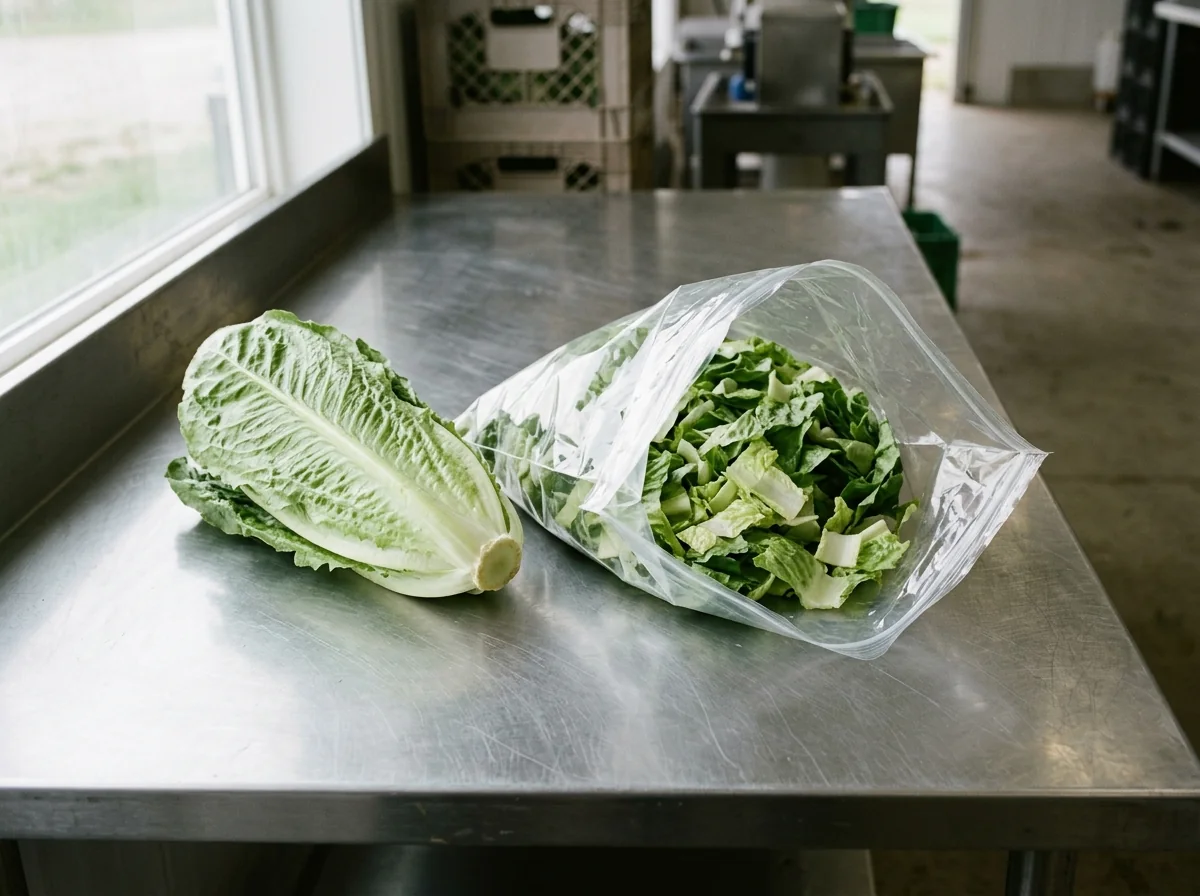
FAO’s packing and packaging guidance explains why: produce respiration consumes oxygen and releases carbon dioxide inside a film pack. Selecting a film depends on permeability, the commodity, package size and the handling time and temperature. MAP, or modified atmosphere packaging, supplements temperature and humidity management. It cannot replace them.
This guide helps material evaluators prepare a sample trial. It provides a whole-versus-cut lettuce comparison, an input record and a supplier-data checklist. It does not specify a universal hole size, gas mixture, film thickness or shelf life. Start with the applications overview for other product families.
Whole and cut lettuce need separate records
The UC Davis romaine and loose-leaf lettuce fact sheet, updated September 2025, distinguishes intact heads from cut romaine. It describes potential carbon-dioxide injury in intact heads, while cut romaine is commonly packaged in a different atmosphere to control cut-surface browning. Its respiration data also distinguish heads, intact leaves and salad-cut pieces.
Scroll horizontally to view all columns if needed. ↔
| Product state | What the UC Davis distinction means | What to put on the trial sheet |
|---|---|---|
| Intact romaine head | A cut-lettuce atmosphere is not a head specification | Type, cultivar if known, maturity, trimming and existing damage |
| Intact separated leaves | A head and a bag of leaves are different sample descriptions | Whether leaves are intact, washed and drained |
| Cut romaine | Cut-surface browning is part of the packaging task | Cut dimensions, preparation time and initial cut-edge condition |
These are lettuce-specific boundaries, not gas targets for every fruit or vegetable. For a mixed salad, list every component and its proportion. Treat a change of crop or cut state as a reason to review the trial design rather than carry over the previous approval.
Match gas exchange to the filled package
Film selection needs more than a resin name. A public manufacturer technical overview, listed under sources below, describes matching gas transmission to respiration, including package size and produce type or mix as design inputs. It also describes microperforation as an option for produce with higher respiration demands. This is manufacturer guidance about design variables, not proof that an unspecified film suits your crop.
For each candidate, ask whether the supplier’s gas data describe the unperforated film, a perforated web or the finished package. Record that distinction beside the result. Keep an OTR measurement in its stated units and conditions; do not put it in the same column as a measured oxygen percentage inside a pack.
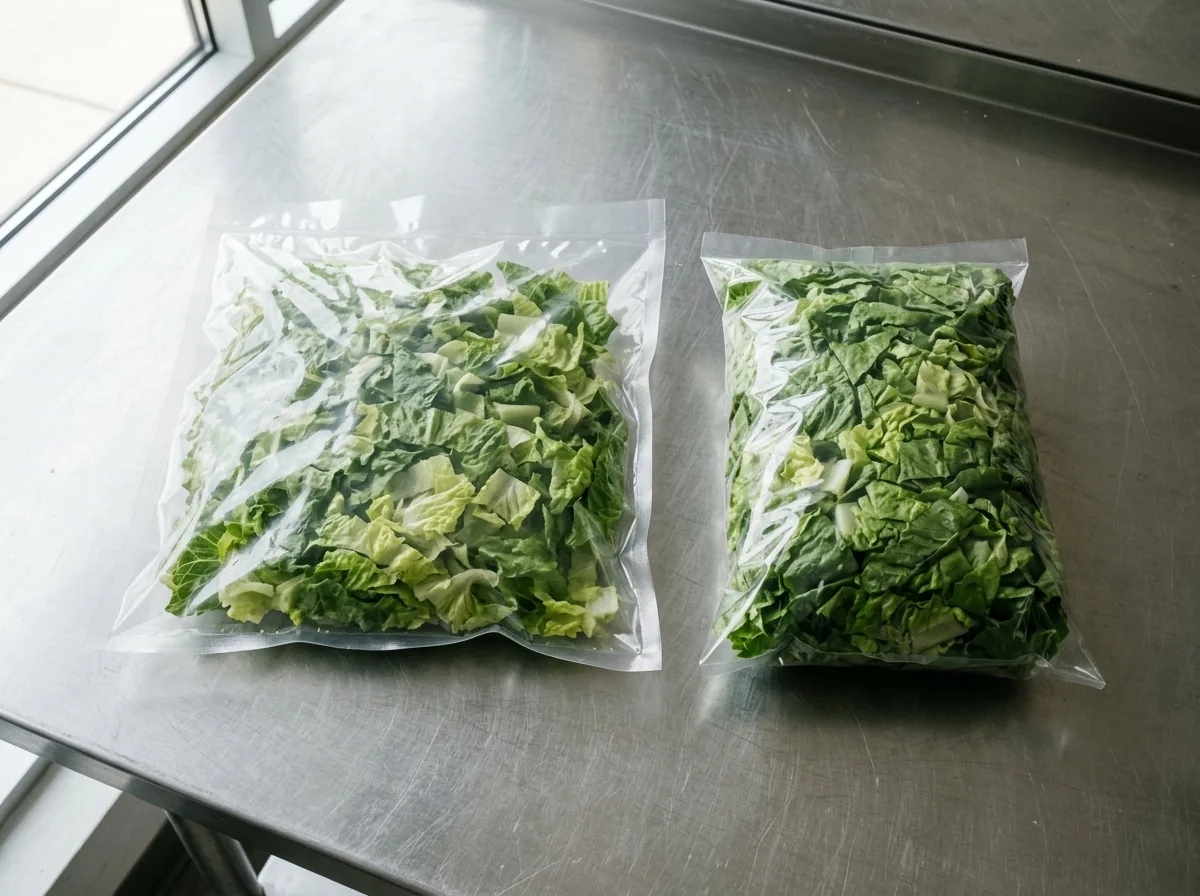
Use a separate row for each combination of fill mass and pack geometry. Record the dimensions, film area available for exchange, seal layout and headspace description. Ask the supplier how it defines effective exchange area, particularly where film faces overlap or contact other surfaces. Do not infer an area from the roll width alone.
If perforations are specified, attach the supplier’s drawing or specification, including their location and how the pattern is identified. If those details are unavailable, write “Unknown” and keep the candidate under review. A photograph cannot establish microperforation size or count.
Record drying and condensation as different observations
UC Davis notes that lettuce loses water and wilts, especially under warm, dry conditions, and that a plastic bag can reduce that loss. Retaining moisture is therefore part of the task. But FAO’s postharvest quality guidance also separates ambient humidity from prolonged condensation on produce, which can favor decay.
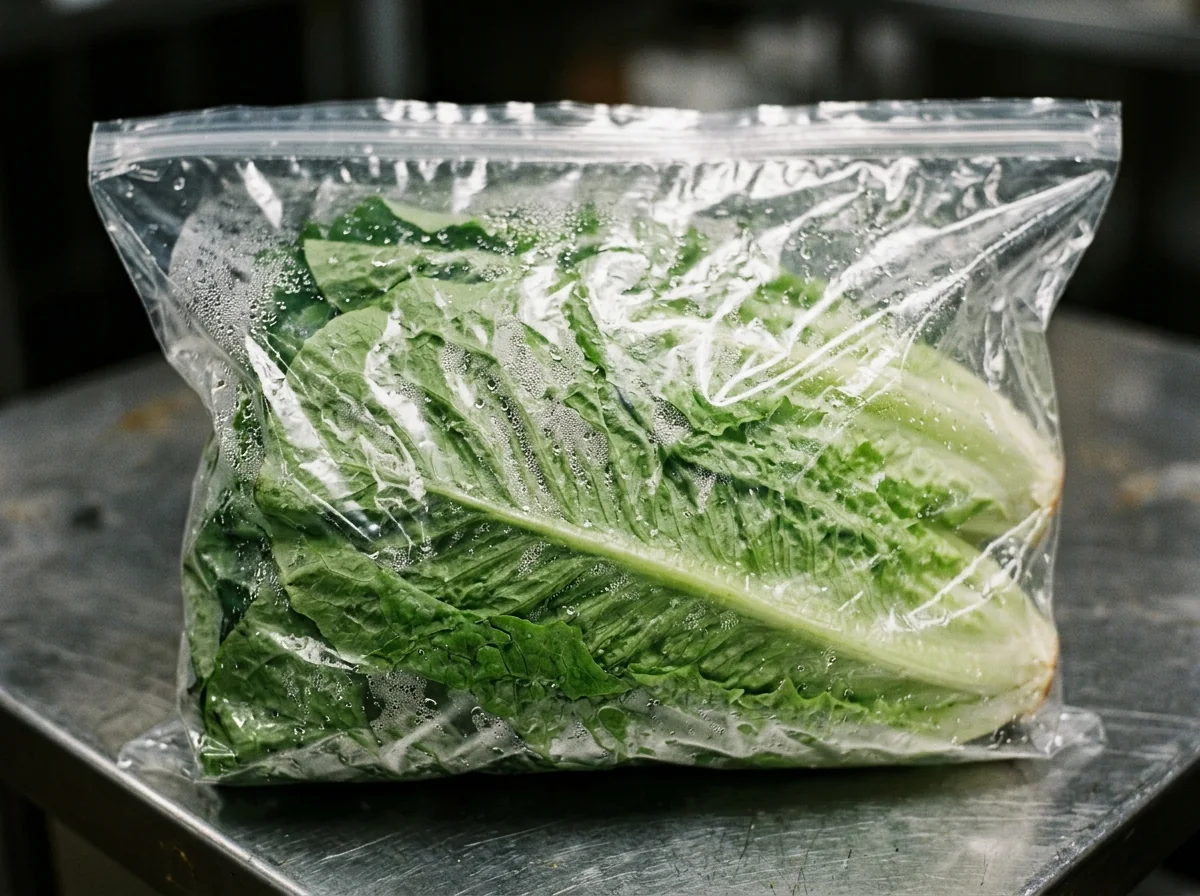
Give the trial sheet separate fields for leaf wilting, visible water on the product, droplets on the film and liquid collecting at the bottom. Record surface wetness at packing, too, so the record does not silently treat all later water as newly formed condensation.
Temperature changes can also cause water vapor to condense, as explained in the Postharvest Management of Vegetables condensation guide. Photograph the same areas at the planned observation times. Write down where moisture appears and when, alongside the temperature record. The photographs document visible condition; they do not measure humidity, gas composition or microbial safety. A clearer-looking film is not a substitute for those measurements.
Use the WVTR guide when checking a water-vapor transmission specification. Keep that laboratory value separate from the observed drying or wetness of a filled bag.
Copy this fresh-produce film trial record
Use one record for each candidate film, product state and pack configuration. Download the blank CSV trial record, or copy the fields below into your own worksheet. The file contains blank entry cells; it supplies no recommended settings or acceptance limits.
Scroll horizontally to view all columns if needed. ↔
| Input group | Record before or during the trial | Attach or identify |
|---|---|---|
| Product | Crop, cultivar if known, lot, maturity and initial condition | Lot record and starting photographs |
| Preparation | Whole/head/leaves/cut, cut dimensions, washing, draining and preparation times | Actual preparation record |
| Pack | Fill mass, dimensions, available film area, headspace description and seal layout | Pack drawing; define how area was measured |
| Film | Candidate code, structure, thickness and specification revision | Supplier sheet; leave unknown values blank |
| Exchange | Oxygen and carbon-dioxide transmission data, units, test conditions, perforation details | Identify film-level or package-level data |
| Moisture | WVTR with conditions; initial wetness; later wilting, droplets and pooled liquid | Test method and dated observations |
| Cold chain | Product temperature at packing and actual time-temperature history through storage and handling | Logger file and sensor location |
| Atmosphere | Initial and subsequent headspace oxygen/carbon-dioxide readings, when measured | Method, sampling time and sample identification |
| Line behavior | Seal settings used, visible seal contamination, channels, leaks or pack damage | Machine-trial record and inspection method |
| Outcome | Cut-edge color, wilting, visible decay, pack integrity and other agreed quality criteria | Observation schedule, acceptance criteria and reviewer |
Before starting, agree which conditions the trial represents, the number of samples, the observation schedule and the decision criteria with the people responsible for the product and its safety. Record any departure from the plan. Do not invent a pass limit after seeing which candidate looks best.
For a useful comparison, keep the product lot, preparation, fill and handling as consistent as the plan allows. Identify the factor being changed. If several factors change together, record them and avoid attributing the outcome to the film alone.
Seal and running behavior need their own checks. The film and machine compatibility guide helps organize that part of the record. A material evaluation should retain both the filled-pack observations and the line settings used to make those packs.
Leave these supplier specifications unknown until documented
An empty cell shows what still needs evidence. Replacing it with a typical value can make two unrelated specifications look comparable.
Scroll horizontally to view all columns if needed. ↔
| Specification question | Entry until the relevant document arrives |
|---|---|
| Which structure and thickness apply to this sample code? | Unknown |
| What are the oxygen and carbon-dioxide transmission values, units, methods and test conditions? | Unknown |
| Do those values include perforations and refer to film area or a finished pack? | Unknown |
| What perforation pattern and tolerances identify this candidate? | Unknown |
| What are the WVTR method, units, temperature and humidity conditions? | Unknown |
| Which sealing conditions and contact-use documents cover the supplied structure? | Unknown |
| Which product, pack and handling conditions support any shelf-life claim? | Unknown |
Hold the comparison where the missing information matters. Ask for the original sheet or a documented test, then update the record with its revision and date. The film specification comparison guide provides the next check once those documents are available.
The trial’s conclusion should identify the exact product, film, pack and handling conditions evaluated, with unresolved items carried forward. Quality observations alone do not establish food safety or authorize a shelf-life claim. Keep that decision with the responsible product and food-safety team and its validation process.
Method and sources
Updated October 2026. This is an editorial trial-planning worksheet based on public technical guidance, not a report of a trial conducted by this site. No candidate-film performance data were supplied, so specification and acceptance cells remain blank. Sources were read on 15 October 2026:
- FAO: Packing and packaging materials — respiration, permeability, package size and handling conditions; qualitative principles, not a current film specification.
- UC Davis: Lettuce, romaine and loose-leaf, updated September 2025 — whole and cut lettuce boundaries and water loss.
- Postharvest Management of Vegetables: Relative humidity and condensation — temperature changes and visible condensation.
- FAO: The role of post-harvest management in assuring quality and safety — relative humidity and condensation on produce.
- “Fresh Produce Packaging” technical overview, sections on MAP, controlled OTR and microperforation — manufacturer descriptions used to identify questions for the trial record; no supplier-specific numerical values adopted.
Continue reading
Related articles
Nut Packaging Materials: Whole, Shelled, Raw and Roasted Products
Nut packaging materials follow shell, piece size and roast. Record moisture loss and gain, and leave barrier cells blank until a supplier sheet arrives.
Tea Packaging Materials: Brew Bags and Storage Pouches
Tea packaging materials for dry leaf: a brew bag lets water through, and a storage pouch has to slow aroma loss. Record leaf, atmosphere and the seal.
Rice Packaging Materials: Woven Sacks, Liners and Sealed Retail Packs
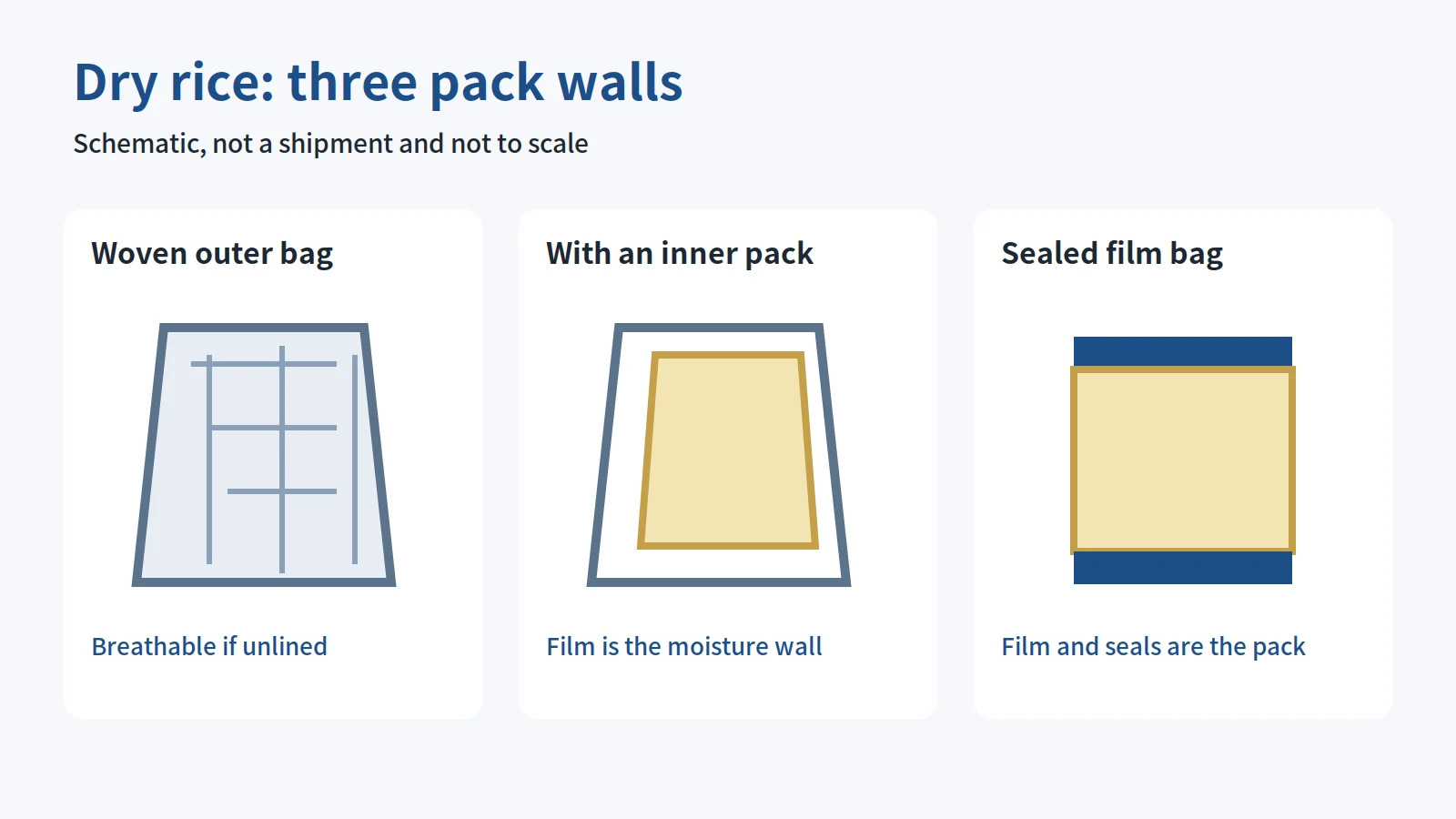
What dry rice packaging is made of: a woven outer sack, a sack with an inner pack, or a sealed film bag. Polypropylene is not a moisture-proof guarantee.