
How to Compare Flexible Packaging Film Specifications
Separate hard requirements from preferences, normalize units and test conditions, and compare the full package before choosing a film.
Comparing films at different test conditions can select a pack that leaks or fails its shelf-life requirement. To compare them fairly, convert every value to the same unit, record the test conditions beside it, and judge the whole structure, not one headline property.
Scroll horizontally to view all columns if needed. ↔
| Input | Record for both films | Miscomparison risk |
|---|---|---|
| Structure | Layer order, grades, total/layer thickness ___ | Treating different structures as equivalents |
| Units | Same units and specimen thickness ___ | Confusing yield, grammage and thickness |
| Test conditions | Method/edition, temperature, RH, specimen ___ | Ranking incomparable barrier or strength data |
| Sealing | Sealant, dwell, pressure and curve ___ | Selecting a film outside the line’s seal window |
| Machine | Width/core/unwind, tooling and trial record ___ | Buying film that cannot run on the line |
Why there is no single “best” flexible packaging film
Searches for the best flexible packaging film usually turn up rankings, awards and supplier promotions. None of them can answer the question for your pack, because the best film is the one that meets your product’s barrier and shelf-life needs, seals and runs on your machine, and suits the market where the pack is sold, at a cost per good pack you accept. A film that wins on one property can still fail on another that matters more to you.
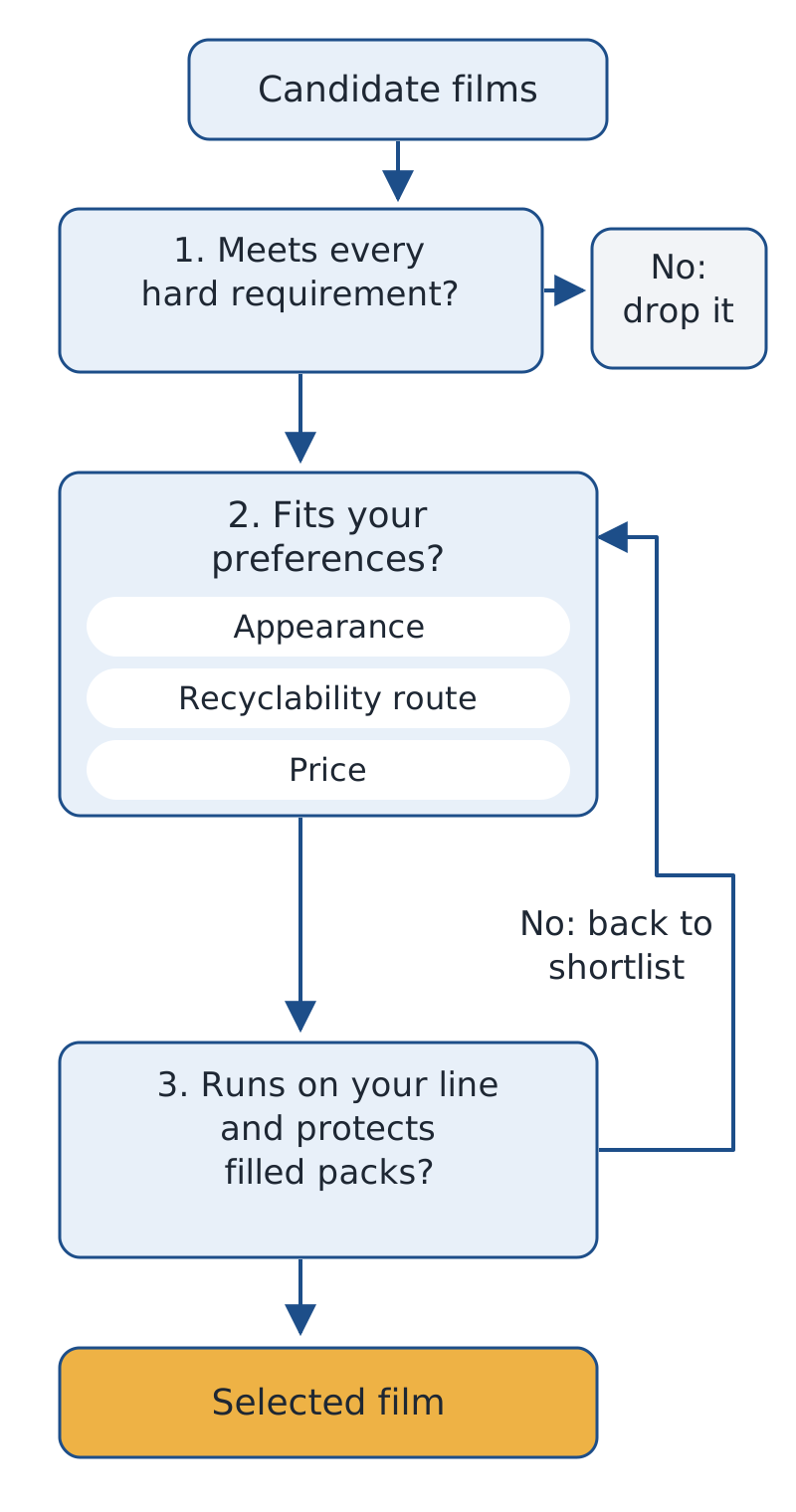
So treat “best” as three tests, in this order:
- Does it meet every hard requirement? A film that misses one is out, however good its other numbers.
- Among the films that pass, which fits your preferences, such as appearance, recyclability route and price?
- Does the shortlisted film actually run on your line and protect the product in filled packs?
Separate requirements from preferences
Start with the conditions that would make a film unacceptable. These are hard requirements:
- Barrier needs for oxygen, moisture or aroma
- Seal method and sealant compatibility with your packing machine
- Compatibility with the product, such as oils, acids or powders
- Processes the pack must survive, such as retort, microwave or freezer use
- Food-contact requirements for the destination market
Preferences come second. Gloss versus matte, or a soft-touch finish, can matter for the brand, but they should not outweigh a requirement that decides whether the pack works at all. Write the two lists down before you open any data sheet, so a supplier presentation cannot quietly reorder them.

Normalize units and test conditions
Suppliers quote the same property in different ways. Thickness may be given in microns, gauge or mils. The NIST SI conversion table gives 1 mil = 25.4 µm; ask the supplier to define any “gauge” convention instead of assuming it. Convert everything to one unit before comparing, and check whether the figure is for one layer or the total structure. The film thickness page explains the units and how thickness is measured.
Grammage (grams per square meter) and thickness are different measures. Two films of the same thickness but different densities will yield differently per kilogram, which matters when you compare prices per kg. If a quote is per kg, ask for the yield in square meters per kg at the quoted thickness.
Read barrier values with their test conditions
OTR and WVTR figures are only comparable when they were measured at the same temperature and relative humidity. Reporting conditions differ between suppliers and between standards, and for moisture-sensitive barrier layers the oxygen barrier can change a great deal as humidity rises. Record the test conditions next to each value. If a sheet does not state them, treat the number as unconfirmed and ask.
Also check what was tested: a flat film, a laminate, or a finished pouch. Seals, folds and creases can add leak paths that a flat-film test will not show. Background is in oxygen transmission rate and water vapor transmission rate, and high barrier film covers structures that need a metallized, foil or EVOH layer.
Compare sealant and seal window
The sealant layer decides how the film behaves on the machine. Compare the sealant polymer and thickness, the temperature at which a useful seal forms, and how wide the usable temperature range is. Seal initiation temperature tells you where sealing starts, but it says nothing about how forgiving the film is above that point. For vertical machines, hot tack matters because the seal is stressed while still warm as product drops. Seal strength is a separate check; the seal strength page covers how it is tested and specified.
Ask for the seal curve, not one number: strength against sealing temperature, at a stated dwell time and pressure. Two films with the same peak strength can have very different usable windows.
Check friction and handling properties
The coefficient of friction (COF) controls how film slides over forming tubes, jaws and rollers. A film with high COF can drag and wander, while one with very low COF can slip on pull belts or stack poorly in rolls. Specifications usually give static and kinetic values for specific surface pairings, such as sealant to sealant or sealant to metal, so confirm which pairing the number refers to. The coefficient of friction page lists typical test methods and explains why targets depend on the machine.
Key performance properties: quick reference and checklist
Use this table when a data sheet lists a property and you need to know what it tells you and what to ask for. It does not give target values on purpose: a good result depends on your product, pack format and machine, and figures from different methods or conditions cannot be compared. For each property, ask the supplier for the value, the test method and the conditions, and record all three.
Scroll horizontally to view all columns if needed. ↔
| Property | What it tells you | Typical reporting | Example method | Ask the supplier for | Risk if unchecked |
|---|---|---|---|---|---|
| Thickness | Gauge of each layer and the total | µm, mil or gauge | D6988-26 | Nominal value, tolerance, number of points measured | Price and yield compared on unequal films |
| Oxygen transmission rate | How much oxygen passes through the film | cm³/(m²·day) | D3985-24; F1927-20 at controlled humidity | Temperature, relative humidity, flat film or finished pack | Oxidation and shorter shelf life |
| Water vapor transmission rate | How much moisture passes through the film | g/(m²·day) | F1249-25 | Temperature, relative humidity, flat film or finished pack | Soft, clumped or dried-out product |
| Coefficient of friction | How the film slides over machine parts and itself | Static and kinetic, no unit | D1894-24 | Which surfaces were tested, and when after production | Web wander, drag or slipping on the line |
| Seal initiation temperature | Where a useful seal starts to form | °C or °F at a stated strength | Lab seals per F2029-16(2021); separation per F88/F88M-23 | Dwell, pressure, strength threshold used | Weak seals at your jaw settings |
| Hot tack | Strength of the seal while still hot | Force per seal width | F1921/F1921M-12(2023) | Hot tack curve with temperature range, dwell and delay time | Seals pulled open as product drops on vertical machines |
| Seal strength | Force to peel a cooled seal | Force per seal width, such as N/15 mm | F88/F88M-23 | Specimen width, peel mode, test speed, lab or production seals | Seal failures in transport and use |
| Puncture resistance | Slow probe penetration of flexible films/laminates | Force, energy and penetration | F1306-21(2025) for slow probe penetration; dart impact is separate | Probe, test speed, sample temperature | Pinholes and leaks with sharp contents |
ASTM D1709-24 measures free-falling dart impact, reported as the mass associated with the specified failure criterion. It is not the F1306 slow-rate puncture measurement. D6988 is a guide to test-specimen thickness determination; F2029 prepares lab heat seals, F88 measures their separation strength, and F1921 measures hot tack. Those tests do not validate a production line or prove absence of leaks. Editions and public scopes reviewed October 8, 2026.
Read the table as a checklist: if a row matters for your pack and the data sheet does not cover it, that row becomes a question in the comparison grid below. The film performance overview explains how these properties relate to one another.
Compare the complete package
Put these side by side for each option:
- Layer structure, listed layer by layer
- Roll specifications: core size, outer diameter and unwind direction
- Recyclability claims and what they rest on: a named standard, a regional scheme or only the supplier’s statement
- How the film runs on your actual machine, including sealing window and handling
A comparison grid keeps the numbers beside their conditions:
Scroll horizontally to view all columns if needed. ↔
| Item | Film A | Film B | Check |
|---|---|---|---|
| Total thickness (µm) | Convert from gauge or mils; confirm tolerance | ||
| Layer structure | Layer by layer, with thickness of each | ||
| OTR and conditions | Temperature, humidity, film or pack | ||
| WVTR and conditions | Temperature, humidity, film or pack | ||
| Sealant and seal window | Seal curve, dwell and pressure | ||
| COF (static / kinetic) | Which surfaces were tested | ||
| Roll specification | Core, outer diameter, width, unwind | ||
| Recyclability claim | Basis for the claim and region | ||
| Food-contact declaration | Market covered and date |
Copy the table into your trial notes or print this page; there is no separate download. Fill it from documents and enter “unknown” for missing information.
Hypothetical filled example, assumed inputs: both candidates are declared PET/PE with 80 µm total thickness. Film A has a documented seal curve at the proposed dwell/pressure; Film B lists peak seal strength only and its OTR humidity is unknown. A remains a trial candidate, not an approved pack. B’s barrier comparison is on hold until matching-condition data arrives. If B later fails a hard barrier limit under those conditions, reject it; do not use a line trial to waive that requirement. No values here are supplier or test results.
Check recyclability and format claims
Terms such as recyclable or mono-material mean different things in different markets. Ask whether a claim rests on a named guideline, a test or a design-for-recycling assessment, and whether it applies where the pack will be collected. What such claims should cover is described in recyclable flexible packaging and the design for recycling checklist. A mono-material swap can also change sealing window and barrier, so test it rather than assuming equivalence.
Format also changes what a specification means. A film for rollstock is judged on how it runs through a forming machine, while a laminate for premade pouches is judged on seal strength, stiffness and appearance after conversion.
Mark unknowns instead of guessing
An empty field shows what still needs confirmation and keeps an assumption from becoming a commitment. Mark each unknown as “ask supplier” and decide whether you need the answer before you move to a trial.
Once the grid is complete, shortlist two options and test them under the same conditions on your machine. If the shortlist differs in price, compare cost per good pack, because a cheaper film can cost more once waste and downtime are counted.
Method and sources
This guide normalizes public test scopes and provides an editorial comparison worksheet. Official ASTM scope/edition links are in the property table and dart-impact paragraph; NIST supports the mil conversion. The A/B example is explicitly hypothetical. Review date: October 8, 2026. Different methods, specimens or conditions remain non-comparable unless a validated correlation is available; these summaries do not replace the full standards or production validation.

Continue reading
Related articles

How to Choose Flexible Packaging Film: A Step-by-Step Selection Guide
An end-to-end engineering guide to selecting flexible packaging films: product barrier risks, machine kinematics, substrate structures, and trial verification protocols.
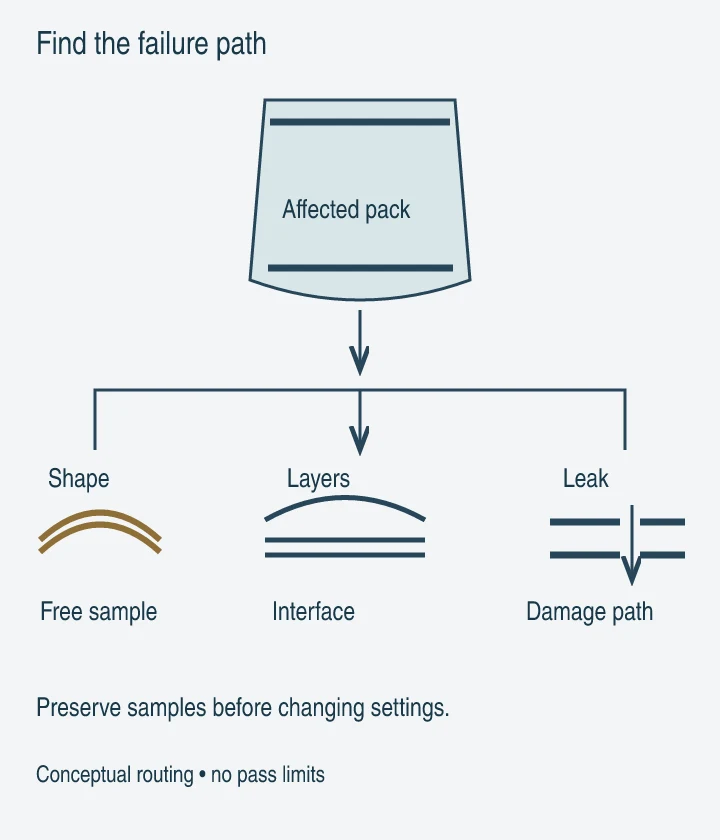
Flexible Packaging Film Problems: A Troubleshooting Guide
Film defects can cause scrap, leaks and repeat downtime. Locate the failure and preserve comparison samples before choosing a test or changing materials.

First-Order Risk Checklist for Printed Pouches and Rollstock
A compact checklist for controlling specification, payment, quality and shipment risk on a first order of printed pouches or rollstock.