
Snack Packaging Film: Structures, Formats and Machines
Snack packaging film explained: typical BOPP and PET structures, barrier needs, nitrogen flushing, bag formats and the machines that run them.
Snack packaging film is usually a laminate or coextruded film, most often built on BOPP or PET, that protects fried, baked or dried snacks from oxygen, moisture, light and grease for the length of the shelf life. The structure you need depends on how perishable the snack is, how it is filled and whether the pack also has to be recyclable. This page covers what the film has to protect against, the common structures, the bag formats and the machines that run them.
Risk and film quick check
These are candidates to evaluate, not approved recipes or certified recycling designs. Compare grade-specific OTR/WVTR at stated temperature and humidity.
Scroll horizontally to view all columns if needed. ↔
| Main risk | Candidate direction | Mechanism / role to check | Trial evidence |
|---|---|---|---|
| Oxidation, nuts or fried snacks | Specified metallized or coated barrier web / matched sealant | Oxygen ingress and initial headspace oxygen | Residual oxygen, intact seals and product shelf life |
| Moisture pickup, crackers or puffs | Sealable BOPP or moisture-barrier laminate | Water-vapor ingress and clean closure | WVTR conditions and texture through storage |
| Breakage, fragile pieces | Film and bag geometry qualified together | Retained gas cushion plus transport protection | Filled-pack crush/drop damage and leakage |
| High fat or light sensitivity | Qualified opaque/metallized barrier and sealant | Light transmission, grease contact and oxygen barrier | Grade data, contaminated seals, bond and storage results |
What goes wrong with snacks
The way a snack fails sets the film specification.
- Oxidative rancidity: fried and nut-based snacks contain unsaturated fats that react with oxygen over time and develop off-flavors. Oxygen barrier and low residual oxygen in the pack both matter.
- Moisture pickup and loss of crunch: chips, crackers and puffed snacks absorb water vapor from the air and turn soft. The film needs a water vapor barrier suited to the humidity of the market where the product is sold.
- Light: light speeds up fat oxidation and can fade colors. Metallized or opaque layers block it.
- Breakage: fragile snacks need a pack that holds a gas cushion and resists crushing in distribution. That depends partly on film stiffness and seal strength, and partly on the format.
- Grease: oily snacks can migrate oil toward the seal area and weaken it, so the sealant layer and seal-area cleanliness on the machine matter.
Material roles
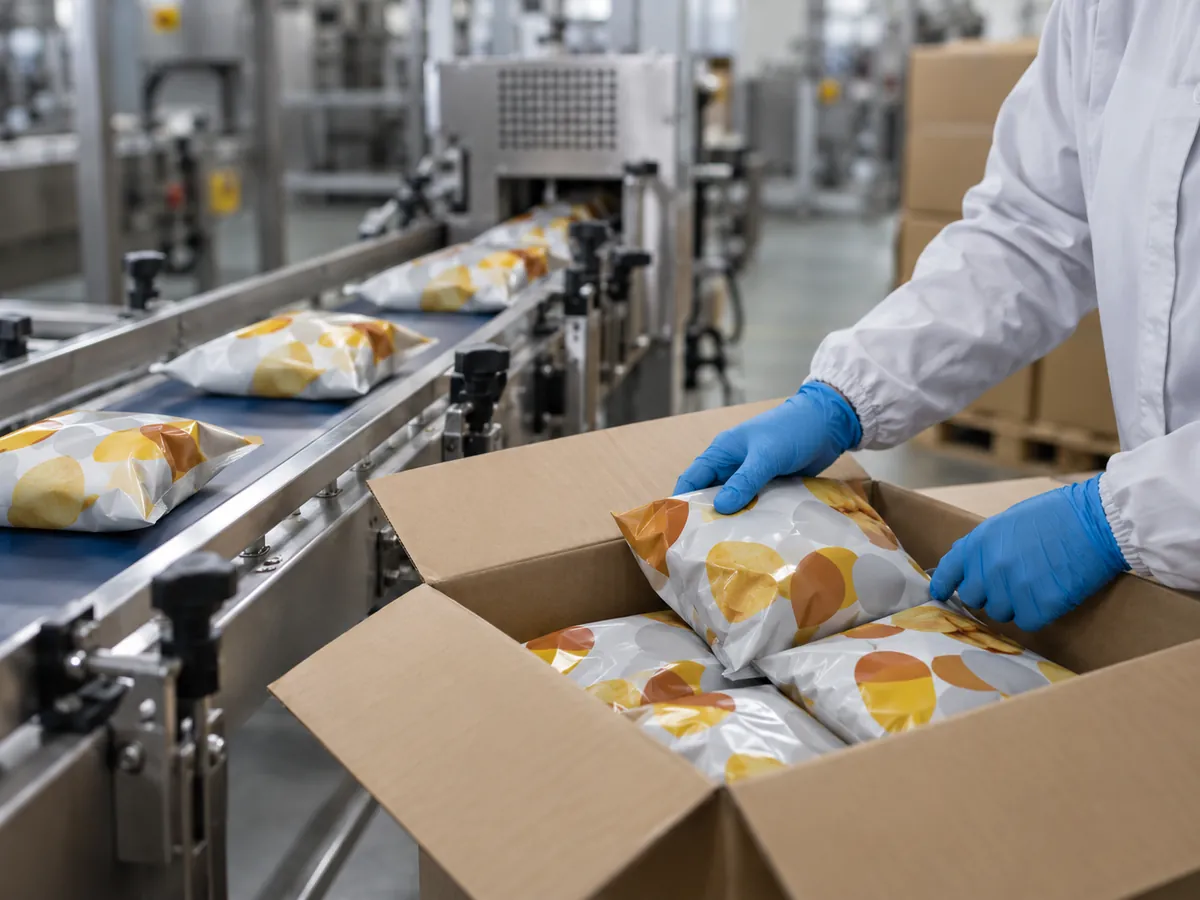
An outer web carries print and handling properties; a sealable surface closes the pack, and any barrier layer must protect the product under its storage conditions. BOPP film, PET film and PE film explain the base materials. Metallized and coated candidates are covered in the barrier film guide.
Manufacturer public data describe metallized, sealable BOPP for gas-flushed snack applications. This supports a candidate direction, not every laminate recipe, a whole-pack shelf-life claim or a recycling certification.
Nitrogen flushing
Nitrogen flushing is used on snack lines to reduce headspace oxygen before sealing. This lowers the oxygen left in the headspace, slows rancidity and gives the bag a cushion that reduces breakage. The flush only sets the starting point, so the film’s oxygen barrier has to hold for the whole shelf life. A well-flushed bag made from a low-barrier film will slowly equilibrate with the air outside. Target residual oxygen levels are set by the snack producer and verified with in-line or sampling analyzers.
Snack packaging formats
- Pillow bags: the classic format for chips and puffs, formed with a fin seal or lap seal and crimped ends.
- Gusseted bags: side or bottom gussets give a larger, more stable bag for family-size packs.
- Stand-up pouches: common for nuts, trail mix and premium snacks where shelf presence and a zipper for reclosing matter. See stand-up pouch.
- Flow wraps for bars: horizontal wrapping of single bars, with fin seals and end seals. See flow wrap packaging.
Machines for snack packaging
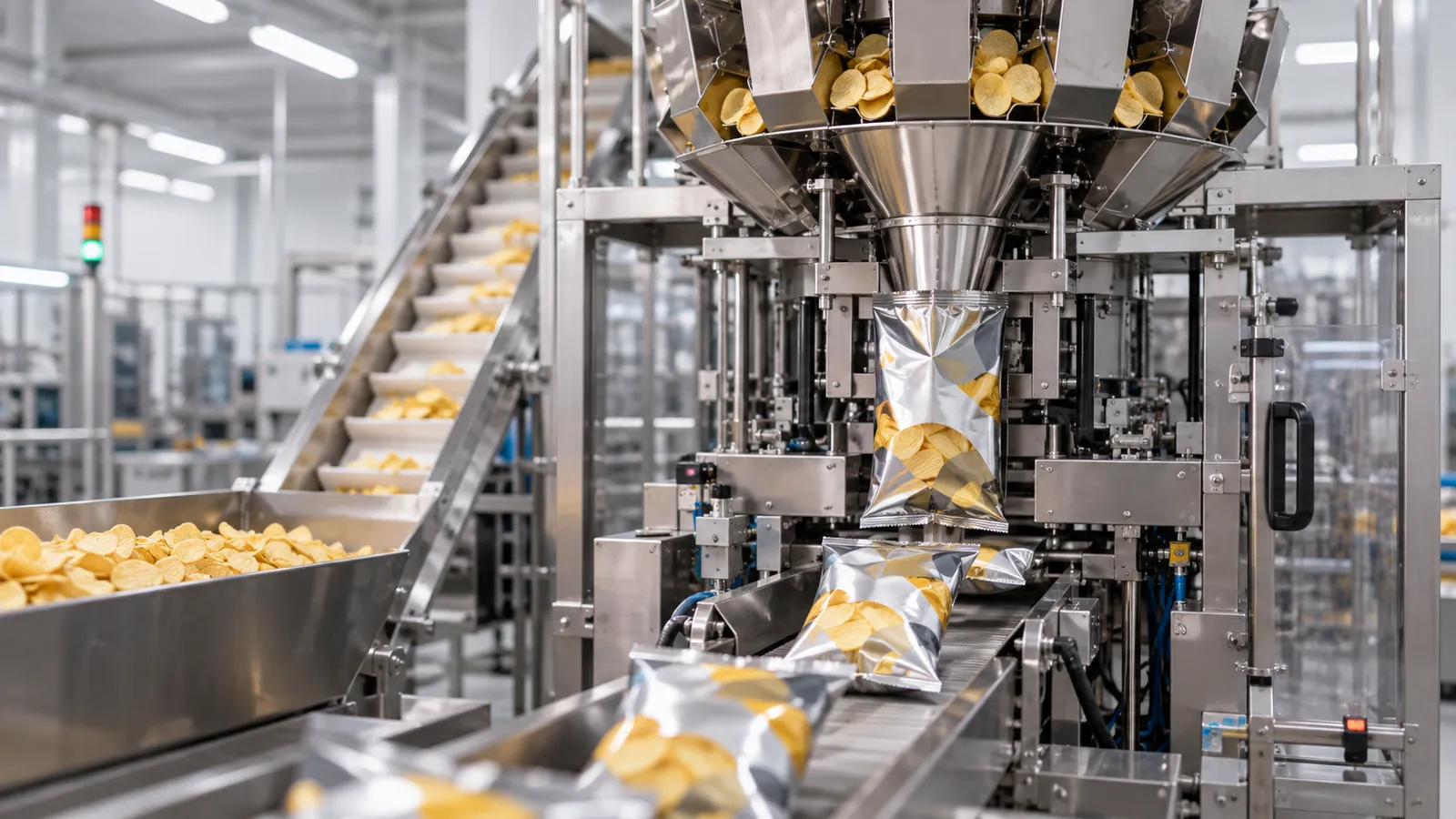
High-speed snack lines usually pair a multihead weigher with a vertical form-fill-seal machine. The film is pulled over a forming collar, sealed vertically and then crimped across the top and bottom. The film’s coefficient of friction, seal range and stiffness decide whether it runs smoothly at speed, and grease on the seal area makes this harder. The VFFS film guide covers these requirements in detail.
Bars and other discrete items typically go through horizontal flow wrappers, where the film has to feed cleanly around the product and seal with a consistent crimp. See flow wrapper film for what to check.
Stand-up pouches for premium snacks are filled on premade pouch machines or on dedicated form-fill-seal pouch lines. Details are on the premade pouch materials page.
Recyclable snack packaging
BOPP and the base film of metallized BOPP are both PP. Combining them does not automatically create a mixed-polymer laminate. The metal deposit, adhesives, inks, coatings and other components still need assessment against the target PP recycling protocol and the actual collection/sorting stream. A PP-based structure is not automatically recyclable.
Keep ordinary film candidates separate from a design assessed or certified under a named recycling protocol: record the full construction, assessment scope and destination-market acceptance. The mono-material guide explains the material-family boundary; design for recycling covers the component checks. Recheck barrier and product shelf life when changing the structure.
Snack trial record
Nitrogen does not replace barrier: Flushing controls the starting headspace; film and seal integrity govern later ingress. Set residual-oxygen acceptance for the product, then verify both initial oxygen and shelf-life performance.
Scroll horizontally to view all columns if needed. ↔
| Input / check | Project record |
|---|---|
| Product and storage | Fat/moisture risks, actual fill, target shelf life and climate |
| Film and barrier | Full layer/grade list; OTR/WVTR method, temperature/RH, document revision |
| Gas and seals | Flush settings, residual-oxygen result, contaminated-seal and leak results |
| Distribution | Pack geometry, line speed, breakage and gas retention after handling |
| Recycling claim | Named protocol, assessment/certificate scope, inks/adhesives/metal-layer details, local acceptance evidence |
The film specification comparison guide helps record these inputs without treating a supplier’s flat-film figure as finished-pack performance.
Sources
Reviewed 8 October 2026: a manufacturer’s public OPP film range and metallized-white BOPP data sheet support the material identity and candidate barrier/sealing roles; they are cited as source documents, not product recommendations. RecyClass design guidelines provide component-specific checks. Neither a polymer name nor a gas-flushing claim establishes recycling acceptance or product shelf life.
Continue reading
Related articles
Bakery Packaging Film: Keeping Bread and Cakes Fresh
Bakery packaging film explained: how staling, moisture loss and mold shape film choice for bread, cakes, cookies and tortillas, plus formats and machines.
Cheese Packaging Film: Ripening, Vacuum and MAP
Cheese packaging film explained: gas-permeable ripening films, vacuum bags for blocks, MAP for sliced and shredded cheese, reclosable packs and structures.
Coffee Packaging Materials: Barrier, Valves and Pouch Formats
Coffee packaging materials explained: oxygen and aroma barrier, one-way degassing valves, nitrogen flushing, pouch formats and machine fit.