
Coffee Packaging Materials: Barrier, Valves and Pouch Formats
Coffee packaging materials explained: oxygen and aroma barrier, one-way degassing valves, nitrogen flushing, pouch formats and machine fit.
Sealing freshly roasted coffee without a gas-handling plan can leave a swollen pack. Choose barrier and valve or pre-degassing together; the product form changes which checks matter.
What different coffee products need
Scroll horizontally to view all columns if needed. ↔
| Product | Main concern | Typical packaging approach |
|---|---|---|
| Whole bean | CO2 release and oxidation | Valve bag with high-barrier laminate, nitrogen flush |
| Ground coffee | Degassing and aroma retention | Valve or pre-degassed fill, very high barrier, nitrogen flush |
| Instant coffee | Moisture pickup, caking, aroma loss | High moisture barrier, no valve needed, often stick packs or jars with pouch refills |
| Capsules and pods | Oxygen ingress during long shelf life | Barrier lidding and body, nitrogen flushing |
Why roasted coffee is hard to package
Freshly roasted coffee can continue releasing CO2 after roasting; record its behavior for the actual roast and grind rather than using a universal wait time. If the pack is sealed tight too early with no valve, it can swell or burst. If air gets in, oxidation dulls the aroma. Volatile aroma compounds can also escape through a film with poor aroma barrier, and moisture pickup affects both flavor and mold risk. The package has to block oxygen, moisture and aroma loss while handling gas that comes from inside.
Coffee bag material and barrier layers
A common coffee bag structure is a printed outer layer, a barrier layer and a sealant layer. Typical choices for the barrier are:
- Aluminum foil laminates give near-complete oxygen, moisture and light barrier and are widely used for premium or long shelf life packs. See aluminum foil packaging.
- Metallized PET film is another barrier-layer candidate. Compare OTR after flexing on matched structures, thicknesses and test conditions; no pinhole or flex-crack ranking against foil is established here.
- Films with barrier coatings or EVOH layers can reach strong oxygen barrier without a foil layer. See high barrier film.
- Paper-based laminates appear in some premium bags but still need a barrier layer to protect aroma.
Read barrier numbers together with their test conditions. OTR and WVTR results change with temperature and humidity, so compare suppliers’ data at the same conditions. The barrier film page covers the general concepts.
One-way degassing valve
A one-way degassing valve is a small valve, usually bonded to the inside or outside of the bag, that opens when internal pressure exceeds the outside and closes again afterward. This lets CO2 escape without letting air back in. In practice:
- The valve is often applied to the film or bag before filling, either by the converter or by a valve applicator on the packaging line.
- A valve adds a small leakage path and a location that has to seal correctly, so it needs its own leak and function tests.
- Valve seat quality, adhesive and the film surface it is bonded to all influence reliability.
- Pre-degassing without a valve places a waiting step before sealing. It does not shorten roast-to-pack time; define that wait from the actual coffee and package trial.
When reviewing a new valve pouch, the SunDance announcement evidence matrix shows which material and package documents remain to be requested.
Valve and pre-degassing timelines
Scroll horizontally to view all columns if needed. ↔
| Route | Order of operations | Record |
|---|---|---|
| With valve | Roast → selected cooling / handling → fill and seal → gas exits through valve | Roast / seal times; valve and seat tests |
| Pre-degassed, no valve | Roast → cool and wait for chosen degassing endpoint → fill and seal | Wait duration / conditions; post-seal swelling and shelf-life result |
Neither route has a universal roast-to-pack interval. The valve manufacturer’s public documentation supports outward gas release, not a fixed waiting time.
Nitrogen flushing
Flushing with nitrogen reduces the oxygen in the headspace before sealing. For ground coffee it lowers the starting oxygen level a lot, and for whole bean it reduces early oxidation. It only helps if the film’s barrier keeps oxygen out afterward, so flushing and barrier go together. Residual oxygen targets are set by the roaster and checked with a headspace analyzer.
Coffee pouch formats
Scroll horizontally to view all columns if needed. ↔
| Format | Typical use | Notes |
|---|---|---|
| Flat-bottom (box) pouch | Retail whole bean and ground, premium shelf appearance | Stable, large print area, often with zipper and valve |
| Side-gusset bag | Traditional roasters’ bags, quad-seal style retail | Compact for shipping, usually valve and tin-tie or tape |
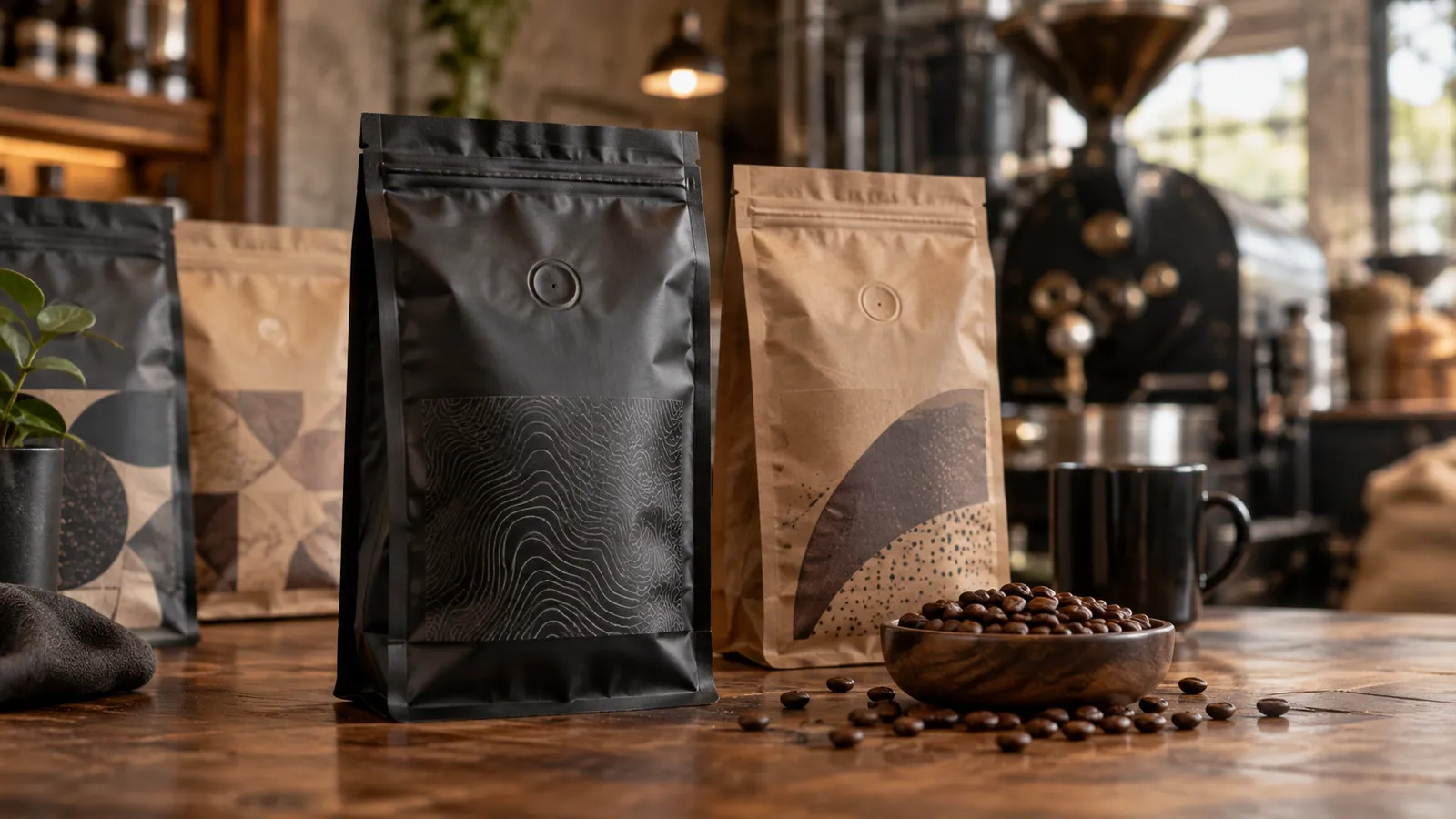
| Stand-up pouch | Retail packs, single-origin offerings | Zipper for reclosing, valve for degassing |
| Stick pack | Instant coffee, single-serve | No degassing needed, high moisture barrier |
| Capsule lidding | Single-serve capsules | Barrier lidding foil, sealed to a molded cup |
Stick packs, side gusset bags and flat-bottom bags each have their own page (stick pack, side gusset pouch, flat bottom pouch), so this page covers them only as they apply to coffee.
Machines for coffee packaging
Premade pouches, including flat-bottom and stand-up pouches with zippers and valves, are filled and sealed on premade pouch machines. The pouch must open and seal reliably with the valve and zipper in place. Premade pouch materials lists what to check.
Roasters who run rollstock use vertical form-fill-seal lines for pillow and gusseted bags, sometimes with a valve applicator placed before the forming collar. The film has to seal over the valve area without leaks. The VFFS film page covers seal range, friction and forming behavior.
Recyclable coffee packaging and the barrier trade-off
Many coffee bags combine PET, foil and PE, a mixed laminate that most recycling systems cannot process. Recyclable designs usually move to a mono-PE or mono-PP structure with an EVOH or coating-based barrier. These can protect coffee well, but the oxygen barrier and light block may be lower than a foil laminate, so validate shelf life instead of assuming it. The valve and zipper need to be made of a compatible polymer family. Mono-material packaging covers structure options, and recyclable flexible packaging covers what makes a pack recyclable in practice.
What to decide when specifying a coffee bag
Scroll horizontally to view all columns if needed. ↔
| Check | Record for each sample / time point | Result / action |
|---|---|---|
| Trial identity | Roast / grind, batch, fill weight; pouch / valve grade; roast and seal times | Set storage and sensory criteria |
| Valve attachment | Leak method, seat location and result before / after handling | Investigate leaks separately from valve function |
| Valve function | Opening / closing checks under supplier-defined conditions | Record method and result |
| Barrier / flush | OTR conditions; residual headspace oxygen at sealing and later | Compare against project target |
| Finished-pack shelf life | Actual storage time / conditions; swelling, aroma and quality | Validate product claims before approval |
Use packaging seal strength to distinguish seal-force measurements from package leak checks.
Method and sources
The timelines locate the waiting step; they do not prescribe a degassing duration. The foil/metallized-film ranking was removed because matching comparison data were unavailable. Valve documentation reviewed 2026-10-08; timelines give sequence only, without measured degassing endpoints.
Continue reading
Related articles
Bakery Packaging Film: Keeping Bread and Cakes Fresh
Bakery packaging film explained: how staling, moisture loss and mold shape film choice for bread, cakes, cookies and tortillas, plus formats and machines.
Cheese Packaging Film: Ripening, Vacuum and MAP
Cheese packaging film explained: gas-permeable ripening films, vacuum bags for blocks, MAP for sliced and shredded cheese, reclosable packs and structures.
Flexible Cosmetic Packaging: Sachets, Refill Pouches and Wipes
Flexible cosmetic packaging explained: sample sachets, refill pouches, wet-wipe packs, chemical compatibility, premium print and typical structures.