
Stick Pack Packaging: Format, Materials and Uses
Stick pack packaging is a narrow single-dose tube with a fin or lap seal and two end seals. See uses, why brands pick it, opening features and how it compares.
A stick that is too narrow to dispense or too small for the dose can waste product. Stick pack packaging is a long, narrow single-dose tube with a fin or lap longitudinal seal and a seal at each end. It holds a measured portion of powder, granules, gel or liquid and is torn open at a notch, so the contents pour out like a straw. It is widely used for sugar, instant drinks, supplements and pharmaceutical powders. This page covers the format. Film structures and machine requirements are in the stick pack film guide.
Stick pack vs sachet vs pillow bag
Scroll horizontally to view all columns if needed. ↔
| Feature | Stick pack | Sachet | Pillow bag |
|---|---|---|---|
| Shape | Long, narrow tube | Flat rectangle or square | Larger pillow-shaped pack |
| Seals | Fin or lap seal and two end seals | Three or four sides | Fin or lap seal and two end seals |
| Typical dose | Small, single serve | Small, single serve | Larger, multi-serve or retail |
| Pouring | Easy, narrow stream | From a torn corner | Usually opened and poured |
| Typical products | Sugar, instant drinks, powders, gels | Sauces, samples, creams, powders | Snacks, confectionery, bakery |
A stick pack uses a tube-forming process like a pillow bag, but much smaller and usually in many lanes. A sachet is a flat pack formed from sides; sachet packaging covers that style, and pillow bag packaging covers the larger tube format.
What is a stick pack?
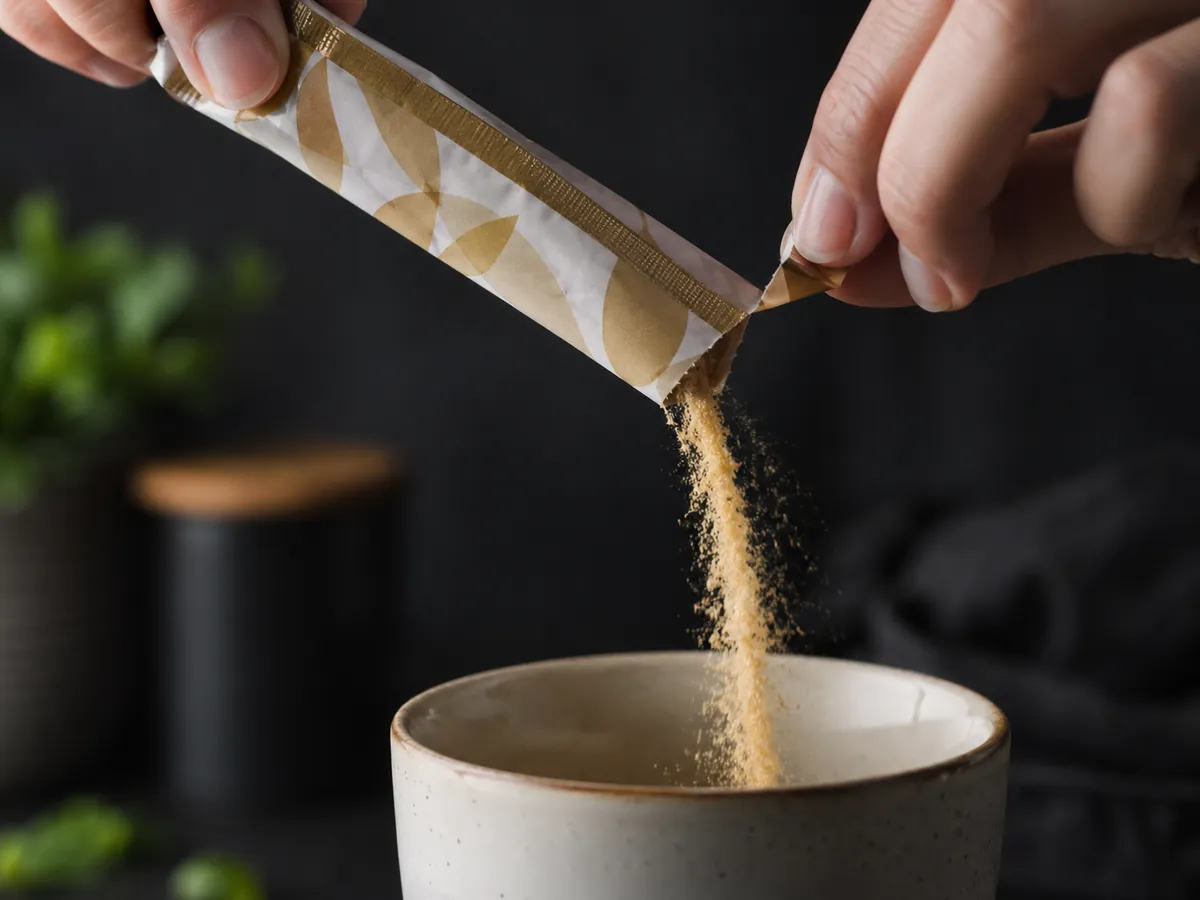
A stick pack is made by forming a flat web of film into a narrow tube, sealing the back with a fin or lap seal, dosing the product and sealing across the tube to close the bottom and the top. The pack is slim and light, about the size of a pen or a bit longer, with the product loaded inside. Most are made on multi-lane machines which run many tubes at once from a wide reel.
Because the pack is long and narrow, the contents flow from a small opening and the dose is easy to pour into a cup, a bottle or directly into the mouth.
Uses of stick pack packaging
- Sugar and sweeteners: table sugar, sweetener and creamer in cafes and hotels.
- Instant drinks: coffee, tea, hot chocolate and flavored drink mixes.
- Powders and supplements: protein, electrolytes, vitamins and probiotics, which often need moisture and oxygen barrier.
- Gels and liquids: energy gels, honey and some personal care products, using tubes sealed for liquids.
- Pharmaceutical: single-dose granules and powders that are dissolved in water. See pharmaceutical flexible packaging.
Why brands choose stick packs
- Each dose is pre-measured, so users do not scoop or spill.
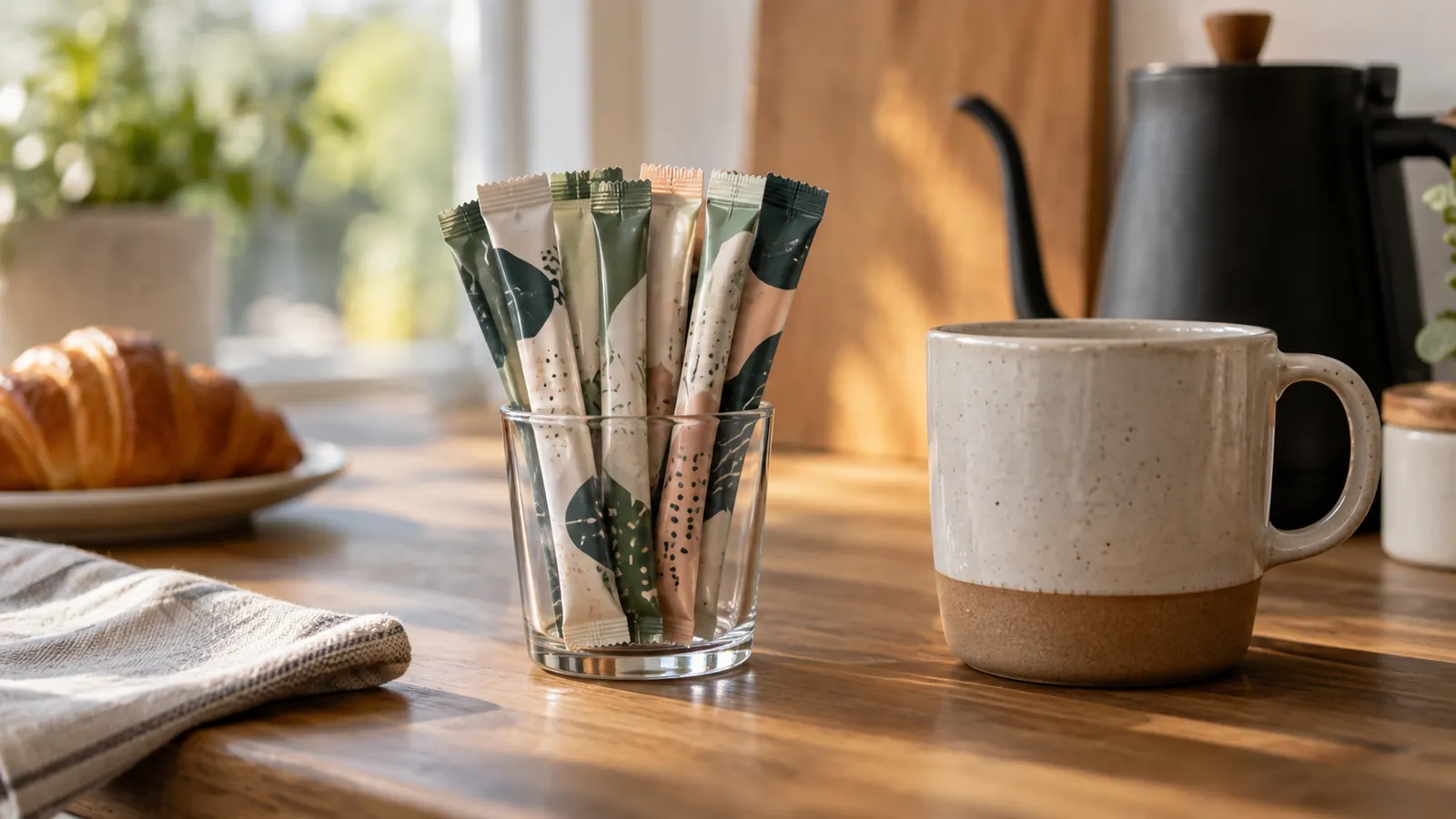
- Slim, light packs are easy to carry and sit well in a sachet box or a dispenser.
- The shape suits pouring into a bottle neck or a mug.
- Foil and metallized structures give a high barrier for moisture-sensitive products.
- Multi-lane machines produce high volumes at low film cost per dose.
- The surface is printable for sampling and travel packs.
Trade-offs include a single-use format, limited recyclability for laminated structures, and a setup that depends on dose accuracy and dust control at the seal. Confirm recyclability claims against collection systems in your destination market.
Dose sizes
There is no gram-based definition or universal dose range for a stick. Pack width, usable length, seal allowances and measured product bulk density set the capacity. At the same mass, a lower-density powder occupies more volume than dense granules; this says nothing about filling speed.
Example, assumed inputs: a 5 g dose at a bulk density of 0.5 g/mL occupies 10 mL (mass ÷ density). If a filled-pack trial establishes only 8 mL of usable cavity with the required headspace, this assumed format is too small. These are arithmetic inputs, not supplier ratings or our test data; replace them with measured density and a cavity trial.
Opening features
Most stick packs open by a tear notch in the end seal. A serrated edge or small V-notch starts the tear, which then runs across the pack. A laser score can guide tearing on foil or tough structures. Some sticks are designed to be torn at either end, and others have a printed arrow showing where to tear. Test opening with filled packs and across humidity ranges, since tearing depends on film structure and orientation.
Typical structures
Most sticks are laminates with a printable outer layer and a heat-seal layer inside. Compare PET/AL/PE, metallized and paper-based candidates using finished-structure barrier results at the required conditions rather than a universal barrier or cost ranking. Mono-material designs exist but usually need care to seal well. For more, read about aluminum foil packaging and mono-material packaging.
Packing and handling
Sticks are normally collected in a row and loaded into cartons, display boxes or dispenser packs. Their straight, even shape makes them easy to stack and count, and a box can hold many doses. Because the tube is thin, careless handling can crease the foil or crack end seals, so check how packs are dropped into cartons and how the carton is closed. Sticks that are curled or bowed from uneven fill are harder to pack. For powders, the pack should be checked for air content: too much trapped air makes the stick bulge and may stress the seals under transport pressure.
What to settle before ordering stick packs
- Define the product, its flow behavior and the dose weight.
- Set barrier needs and shelf life with test conditions, using OTR and WVTR data.
- Keep dust out of seals and validate any intended contamination tolerance on filled packs.
- Decide the tear feature and test it.
- Confirm lane count, tube size and reel width with the machine builder.
- Run trials with the real product before committing.
Method and sources
An equipment manufacturer’s public packaging glossary describes a stick with fin or lap back seams and two end seals. The geometry diagram is an editorial schematic; the capacity calculation uses explicitly assumed inputs. Manufacturer URLs are retained in the evidence record reviewed October 8, 2026. Use sachet format guidance, stick-pack film inputs and barrier testing inputs for the next checks.
Continue reading
Related articles

Flat Bottom Pouch: Box-Style Pouches Explained
A flat bottom pouch has a rectangular base and two side gussets that make a boxlike, self-standing pack. See construction, features and how it compares.
Quad Seal Bag: Four Corner Seals and When to Use Them
A quad seal bag has four vertical corner seals that give a squared, stable shape. Learn how it is made, where it is used and how it compares to side gusset.

Retort Pouch: Structures, Processing and Uses
A retort pouch is a filled, sealed flexible pack sterilized in a retort. Learn the structures, seal integrity needs, regulations and typical uses.