
Metallized Film: Metallized PET, BOPP and CPP for Packaging
Metallized film has a thin vacuum-deposited aluminum layer that improves barrier and adds a foil-like look. See process, optical density, uses and limits.
Creasing a metallized pack can reduce barrier protection and increase oxygen or water-vapor transmission. Metallized film uses vacuum-deposited aluminum on a plastic base; compare it with foil using post-conversion and post-flex results, not appearance alone.
This page explains deposition, optical density and flex risk. Metallized PET, BOPP and CPP need separate base-film and process specifications.
Metallized film vs foil
Scroll horizontally to view all columns if needed. ↔
| Feature | Metallized film | Aluminum foil |
|---|---|---|
| Metal thickness | Nanometer scale, vacuum-deposited | Micron scale, rolled sheet |
| Barrier | Strong improvement, not complete | Near complete when pinhole-free |
| Light barrier | Confirm on finished film | Confirm foil and defects |
| Weight and cost | Compare complete structure and conversion cost | Compare complete structure and conversion cost |
| Flex durability | Can crack with flexing | Can crack when folded or creased |
| Appearance | Bright, mirror-like to satin | Metallic, often dull or bright |
| Recycling | May suit recycling in some designs, depending on base film | Hard to recycle in laminates |
Use aluminum foil packaging for the foil route. Test both candidates after representative flexing; a shelf-life target alone cannot select one.
How vacuum metallization works
Metallizing is done on a roll-to-roll machine inside a vacuum chamber. A film web travels over a cooled drum while aluminum wire is fed onto heated boats, where it melts and evaporates. The vapor condenses on the cold film surface and forms a thin metal coating; obtain its thickness or coating-mass evidence for the selected process.
Key steps and variables:
- The film surface is treated, often by corona or plasma, so the metal bonds well. Some films are made with a special metallizable skin.
- Moisture, slip additives and contamination on the film surface can degrade the deposit.
- Web speed and evaporation rate set how much aluminum arrives per unit area.
- Drum temperature controls heat load on the film and how the metal grows.
The metal layer is on one side. After metallizing, the film is usually laminated or coated so the metal sits inside the structure and is not exposed to abrasion.
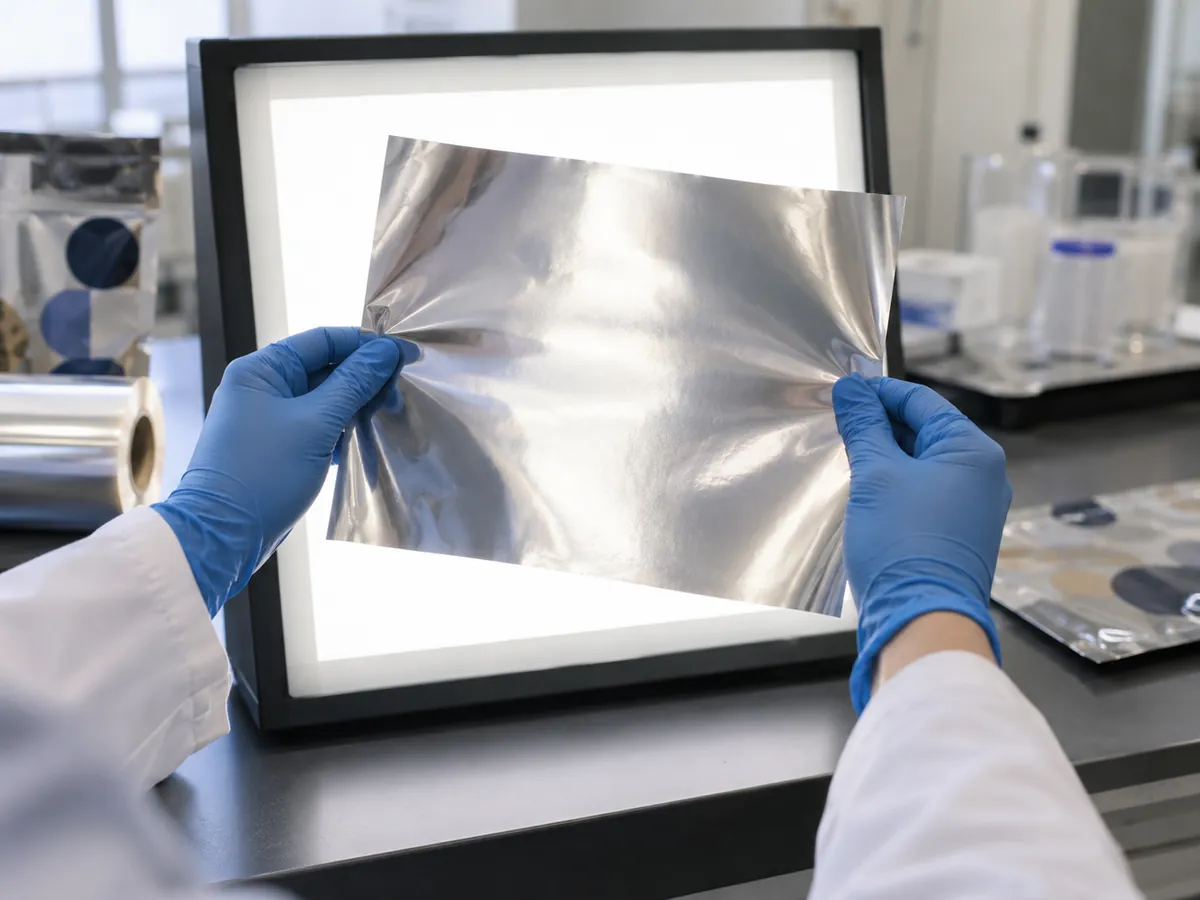
Optical density as a control
Optical density (OD) is an optical measurement, not a universal conversion to metal thickness or oxygen barrier. A manufacturer’s public film table lists OD and OTR/WVTR separately; films with different formulations cannot be ranked by OD alone.
Within the same base film, surface preparation and deposition process, ask for a validated relationship between OD, metal deposition and barrier. Changing the base, coating quality or process breaks that comparison. Do not assume a higher OD guarantees better barrier.
Measurement schematic: light source → film sample at the instrument aperture → detector → OD reading. Record instrument/calibration, sample ID, base film and the center/edge positions measured. A transmission densitometer provides a reading; holding film over a light box provides a visual inspection only. The schematic is not a sample measurement.
Set an OD range and tolerance for that construction, then verify OTR/WVTR independently.
Barrier improvement vs the base film
Metallizing can improve barrier by a large factor over the unmetallized film. Metallized PET, for example, often shows a strong drop in oxygen and water vapor transmission compared with plain PET. Metallized BOPP and CPP improve over their bases too, although the base film still matters, especially for moisture.
Keep these points in mind:
- Results depend on temperature and relative humidity of the test. Compare data under the same conditions; see OTR and WVTR.
- Standard methods include ASTM D3985 and ASTM F1927 for oxygen and ASTM F1249 for water vapor.
- Creases, folds and handling can reduce barrier performance, meaning OTR or WVTR may increase. Compare transmission before and after representative handling.
- Metallized film does not equal foil. Verify coating defects and transmission instead of assuming an impermeable metal layer.
For the overall barrier picture, see barrier film.
Metallized PET, BOPP and CPP compared
- Metallized PET is a candidate middle ply for snack and coffee laminates; compare its barrier and dimensional stability for the selected grade. See PET film properties.
- Metallized BOPP is used in snack bags and wrappers; compare its actual moisture barrier and converted-pack cost. See BOPP film.
- Metallized CPP is soft and heat-sealable, and is used as the inner web or sealant side. See CPP film.
Metal adhesion and lamination failures
The metal layer is only as good as its bond to the film. Typical problems:
- Metal pickup or transfer: when a laminate is peeled, the aluminum stays on the adhesive or the second web instead of the base film. This points to a weak metal-to-film bond.
- Delamination in the structure: the bond between metal and film or between layers fails under stress, heat, or product attack, such as oils, solvents or high humidity.
- Corona or treatment decay: treatment on the base film fades with time and storage, so old stock can bond poorly.
- Adhesive and ink interaction: some adhesives and coatings attack or wet the metal poorly.
- Moisture and heat during processing can change the metal bond or the film dimensions.
To reduce the risk, specify the base film and metallizable surface, test metal bond strength (peel and metal-pickup checks) on finished laminates, and age samples with the product or a simulant. Ask the supplier about treatment levels and shelf life of the metallized roll.
Flex cracking
Thin metal layers crack when flexed or creased, and each crack becomes a path for gas. Pouches that are shipped, dropped or handled can lose barrier at folds. ASTM F392/F392M-23 conditions film by flexing; separate OTR/WVTR measurements assess the resulting barrier change. Laminating the metal inside the structure and choosing a base film that flexes well help. Where flex is severe, a tougher layer such as nylon may be added; see nylon packaging film.
Where metallized film is used
- Snacks: metallized BOPP or PET laminates protect fat and crispness. See snack packaging.
- Coffee: metallized layers add aroma and light protection in bags; see coffee packaging.
- Confectionery: wrappers and twist wraps for candy; see candy packaging.
- Dry mixes and powders: pouches and sachets.
- Decorative uses: gift wrap, labels and shiny outer layers.
Recyclability notes
The metal layer is tiny, but it still affects recycling. A metallized BOPP laminate sealed with a polypropylene sealant can be close to mono-PP, while metallized PET laminated to PE is a mix of polymers. Some guidelines treat the vacuum-deposited aluminum as acceptable in small amounts and others do not, so confirm with current guidance from RecyClass, APR or CEFLEX and your market. See mono-material packaging and recyclable flexible packaging.
What to put in a metallized film specification
Keep flat and flex-conditioned samples comparable. Fill one record for each construction.
Scroll horizontally to view all columns if needed. ↔
| Record item | Conditions to fill | Result to fill |
|---|---|---|
| Base and deposit | Base polymer, grade, gauge, surface and deposition process: ___ | Sample/batch: ___ |
| Optical density | Range, instrument, calibration and web position: ___ | Measured OD: ___ |
| Flat barrier | OTR/WVTR methods, units, temperature and humidity: ___ | Before flex: ___ |
| Flex-conditioned barrier | F392/F392M level, conditioning and same permeation conditions: ___ | After flex; change: ___ |
| Laminate and seal | Adhesive, metal bond, aging and jaw settings: ___ | Delamination, leaks and trial outcome: ___ |
Use the film specification comparison guide to separate OD control, barrier measurements and finished-pack acceptance.
Sources and method
Reviewed October 8, 2026. A manufacturer’s public metallized-film table, May 2023, reports OD and barrier separately. A manufacturer’s transmission-densitometer manual illustrates instrument aperture, sample placement and calibration, not a recommended packaging instrument. ASTM D3985-24, F1927-20, F1249-25 and the linked F392/F392M scope distinguish permeation from flex conditioning. These references do not supply a universal OD-to-thickness or OD-to-barrier conversion.
Continue reading
Related articles
Barrier Film for Packaging: Oxygen, Moisture, Light and Aroma Barriers
Barrier film slows the passage of oxygen, water vapor, light and aroma through packaging. See which materials block what and how barrier is measured.

Alu-Alu Blister Packaging: When Full-Foil Blisters Make Sense
Alu alu blister packaging uses a cold-formed foil cavity and foil lid for near-total barrier. See when it is chosen and how it compares with PVC blisters.
Aluminum Foil Packaging: Foil Laminates, Gauges and Uses
Aluminum foil packaging explained: why foil gives near-complete barrier, layer thickness and temper, laminate structures, uses and recycling limits.