
Cold Form Foil: Laminates for Alu-Alu Blisters
Cold form foil is a soft aluminum laminate pressed into blister cavities without heat. Learn the OPA/Al/PVC build, forming limits, defects and checks.
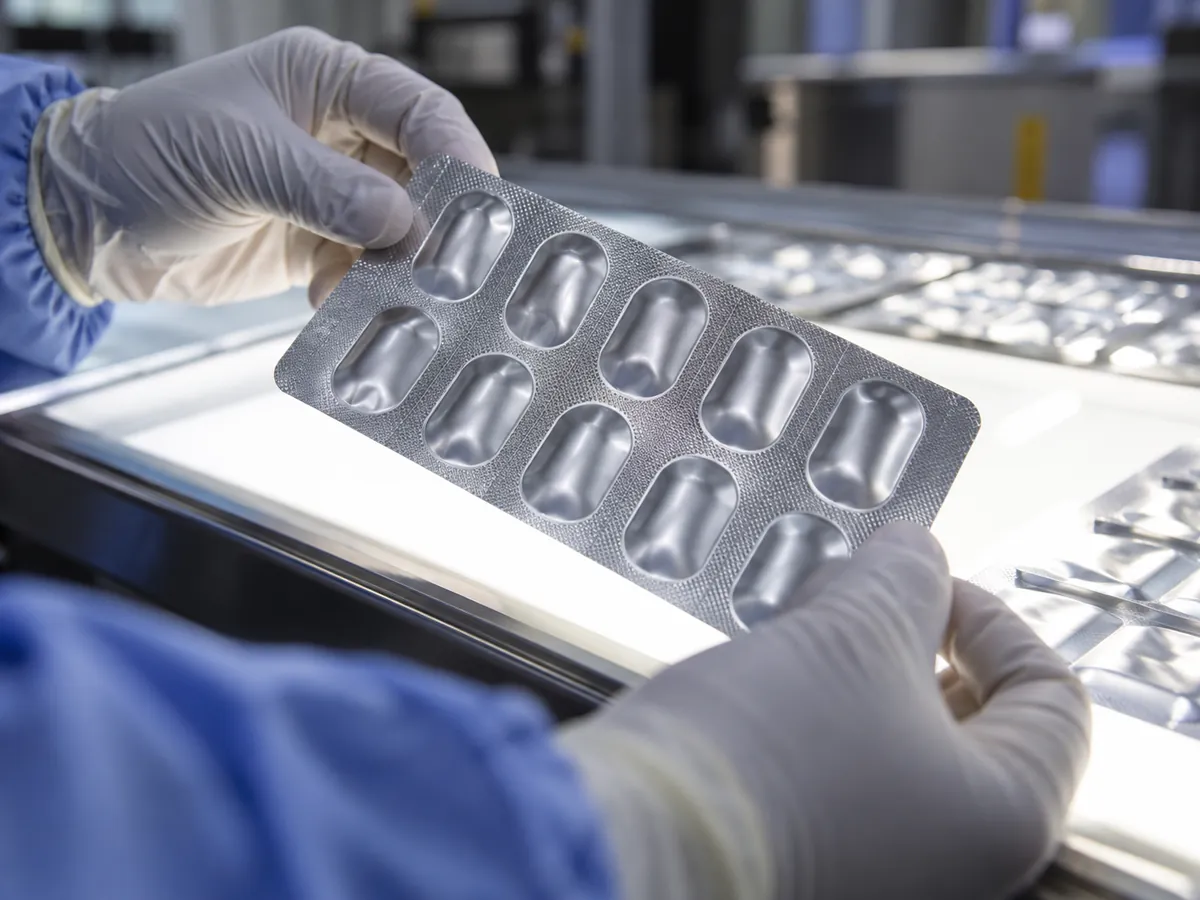
Cracks or pinholes introduced during drawing can defeat the cavity barrier. Cold form foil is a soft, formable laminate that is pressed into blister cavities at room temperature, so the foil itself becomes the blister. A common construction is oriented polyamide (OPA) on the outside, aluminum in the middle and PVC on the inside. The aluminum gives a near-complete barrier to moisture, oxygen and light, and the plastic layers let the laminate stretch and seal. Cavity depth needs validation together with corner radii, spacing and tooling; a depth figure alone is insufficient.
This page covers the material. The pack-level choice between full-foil and plastic blisters is on the alu-alu blister packaging page, and the lid is covered in blister foil. A direct comparison of the two foils is in blister foil vs cold form foil.
Cold form foil construction
The laminate has three working layers, bonded with adhesive:
Scroll horizontally to view all columns if needed. ↔
| Layer | Typical material | Job |
|---|---|---|
| Outer | Oriented polyamide (OPA, a nylon) | Gives stretch, puncture and flex resistance; protects the foil during forming and handling; takes print or a coating |
| Core | Soft aluminum foil | Barrier to moisture, oxygen and light; carries the shape after forming |
| Inner | PVC, sometimes PP or other sealable layers | Heat-seals to the lidding foil, often through a lacquer on the lid |
The aluminum is annealed (soft, “O” temper) to permit drawing; this does not prevent cracks when forming limits are exceeded. A manufacturer’s OPA/Al/PVC data sheet identifies OPA, aluminum and PVC separately. Record foil-layer thickness and total laminate thickness as separate specification fields; do not infer one from the other. For general foil properties, alloys and tempers, see aluminum foil packaging. The outer OPA relates to the family covered on the nylon film page.
Some constructions replace PVC with other inner layers where PVC-free packs are required. Variants change the sealing partner, so the lidding lacquer has to be matched.
Why it is formed cold, not heated
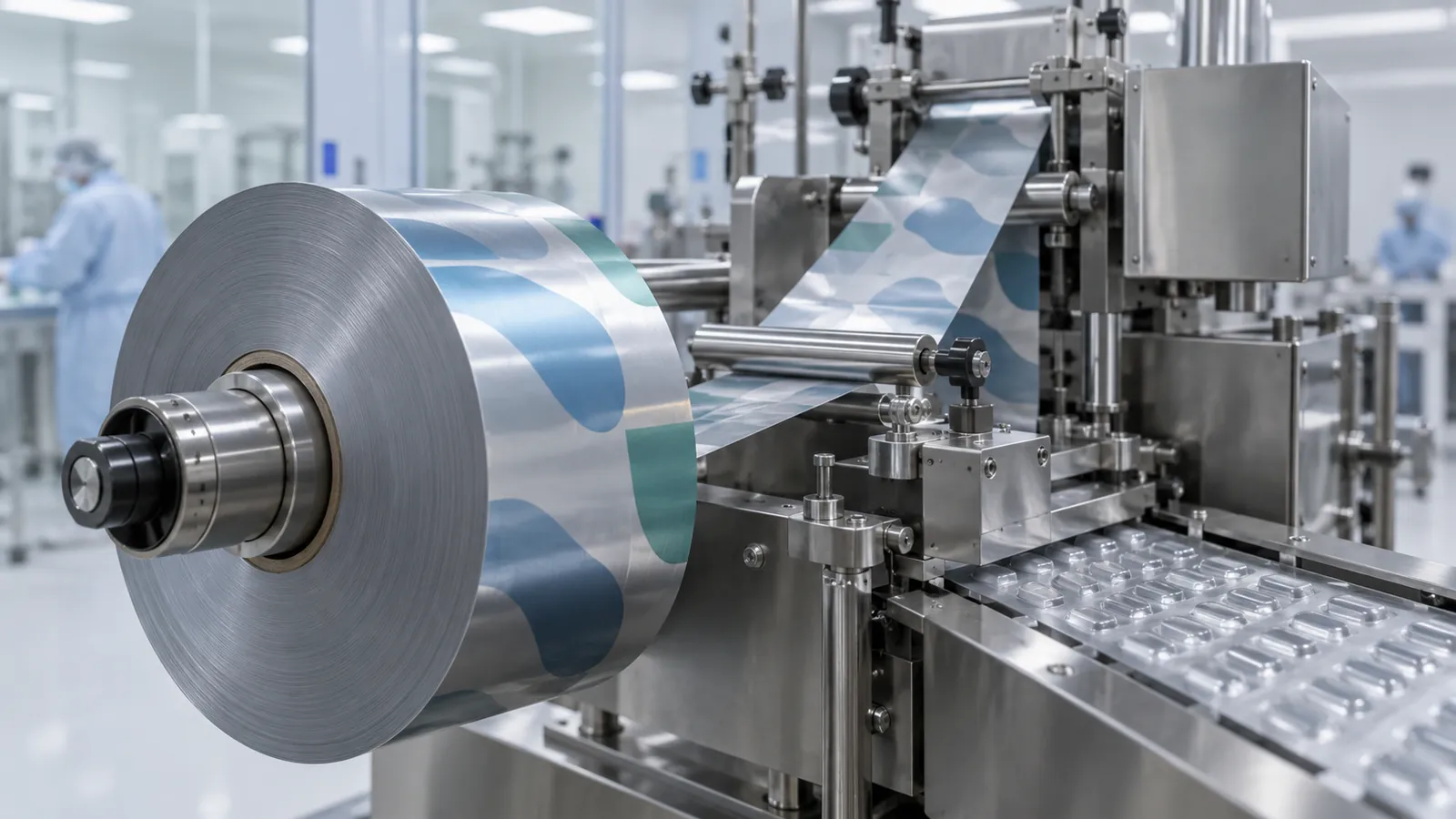
Plastic blister webs such as PVC or PP are softened with heat, then drawn into a mold by vacuum or air pressure. Aluminum does not soften that way. Heating foil laminates does not make the metal flow like a polymer, and it would risk delaminating or damaging the plastic layers. Instead, a plunger (plug) pushes the laminate into a female die at room temperature. The soft aluminum stretches and thins by plastic deformation, the OPA and PVC stretch with it, and the cavity holds its shape because the metal does not spring back much.
The practical consequences:
- Forming is a mechanical operation, so tooling clearance, plug shape and forming speed control the result.
- There is no heating zone, which can shorten the forming station.
- The wall that results is thinner than the starting web, particularly in the corners and base.
Barrier: moisture, oxygen and light
An intact aluminum layer is a complete barrier to moisture vapor, oxygen and light, which is why cold form foil is chosen for products that degrade with humidity or light. In practice, what gets through a pack comes mostly from the seal area, the lid and any defects in the formed foil, and almost none from the foil wall. Forming quality and sealing therefore matter as much as the laminate choice. Compare barrier figures only with their test conditions stated (temperature and relative humidity); see water vapor transmission rate and oxygen barrier packaging for background. Moisture uptake is also tested on finished packs through stability studies, because the web alone does not show it.
Forming depth limits and larger cavities
Aluminum can only stretch so far before it thins to the point of cracks or pinholes. That sets a practical limit on cavity depth for a given foil and cavity shape. Several things move that limit:
- Deep, narrow cavities draw the foil harder than shallow, wide ones. Sharp corners concentrate strain, and generous radii help.
- Large tablets, capsules or multi-unit cavities have a higher draw ratio and need more material pulled in.
- A thicker or better-annealed foil and a more stretchable OPA layer improve formability.
- Foil is drawn from the surrounding web, so tight cavity spacing limits the material available.
- Controlled plug speed and a suitable surface condition reduce friction.
Alu-alu cavities tend to be shallower and have a wider flange than thermoformed ones, so the pack is often larger for the same dose. For bigger or more demanding shapes, run forming trials on the intended tooling and request the supplier’s recommended limits; do not rely on a general depth figure.
Cracks and pinholes from forming
Forming is where cold form foil is most likely to be damaged. The typical defects are:
- Pinholes in drawn corners or the cavity base, where the aluminum thins past its limit or a pre-existing foil defect opens up. They break the barrier and are often not visible without backlighting.
- Cracks along the radius or flange edge, from overstretching, a sharp plug or die edge, or low-quality foil.
- Wrinkles or folds at the flange, when the web was not held evenly during forming.
- Delamination, when the layers separate under strain, often because the adhesive does not match the forming stress.
- OPA whitening or surface scuffing from friction and stress at the plug.
Specifications commonly include a maximum pinhole count for the foil before forming, and finished packs are checked after forming to find those introduced by the process.
Tooling and machine considerations
- Plug and die material, surface finish, edge radius and clearance are tuned per laminate and cavity. Rough or sharp tooling causes pinholes.
- Cold-form blister machines are built for this job and use higher forming force than thermoforming. Not every blister machine can run foil, so check with the machine builder.
- Foil is stiffer and heavier than plastic web, so reel size, core, unwind tension and web guidance matter. Wrinkles at the flange cause sealing problems later.
- The lid is sealed to the formed web with a heated tool. The inner layer and lid lacquer must be a validated pair.
- A wide flange takes more material, so layout and pack size are linked to the web width.
The format-level view of the machines is on the blister packaging page.
Quality checks
Scroll horizontally to view all columns if needed. ↔
| Check | Input conditions | Result to record | Acceptance basis |
|---|---|---|---|
| Incoming holes | Lot, sample area, optical method: ___ | Count/locations: ___ | Supplier defect limit: ___ |
| Forming defects | Depth, radii, spacing, tool and speed: ___ | Base/corner cracks or holes: ___ | Validated drawing: ___ |
| Wall thickness | Measurement method and base/corner locations: ___ | Measured thickness: ___ | Agreed minimum: ___ |
| Seal integrity | Completed pack and applicable leak protocol: ___ | Leak indication/detection limit: ___ | Pack criterion: ___ |
| Seal strength | Lid/inner-film pair and seal/test settings: ___ | Force and failure mode: ___ | Product-specific limit: ___ |
| Bonding | Forming and aging conditions: ___ | Separation/peel result: ___ | Agreed bond requirement: ___ |
| Stability | Product, pack and storage conditions: ___ | Moisture uptake/product results: ___ | Stability protocol: ___ |
ASTM D3078-02(2021)e1 detects gross leaks by bubble emission in flexible packages with headspace gas. Establish applicability and sensitivity for the blister; it is not a pinhole count or wall-thickness method. ASTM F88/F88M-23 measures seal strength; ASTM F2029-16(2021) prepares laboratory seals. None substitutes for the finished-pack stability study.
What to put in a cold form foil specification
- Laminate structure and layer thicknesses (OPA, aluminum, inner layer)
- Alloy, temper and foil gauge, with pinhole limits
- Maximum cavity depth and shape validated by the supplier, and how it was proven
- Inner layer and the lid lacquer it is validated against
- Forming and sealing conditions tested on your machine
- Reel width, core, roll weight and unwind direction
- Pharma compliance documentation and change-control terms for your market
For the wider pharma context see pharmaceutical packaging foil.
Sources and method
A manufacturer’s OPA/Al/PVC data sheet and a manufacturer’s November 2022 foil overview describe the laminate and soft forming foil. The data sheet shows inconsistent headline and table totals, so no universal total-thickness range is used. ASTM F88/F88M-23 and ASTM F2029-16(2021) provide method scopes, not acceptance limits. Sources checked October 8, 2026; manufacturer descriptions are not this site’s tests or recommendations.
Continue reading
Related articles

Alu-Alu Blister Packaging: When Full-Foil Blisters Make Sense
Alu alu blister packaging uses a cold-formed foil cavity and foil lid for near-total barrier. See when it is chosen and how it compares with PVC blisters.
Aluminum Foil Packaging: Foil Laminates, Gauges and Uses
Aluminum foil packaging explained: why foil gives near-complete barrier, layer thickness and temper, laminate structures, uses and recycling limits.
Blister Foil vs Cold Form Foil: Lidding vs Forming Foil Compared
Blister foil vs cold form foil: one is the thin lidding foil, the other the formable laminate that becomes the cavity. See how they differ and work together.