
Blister Foil vs Cold Form Foil: Lidding vs Forming Foil Compared
Blister foil vs cold form foil: one is the thin lidding foil, the other the formable laminate that becomes the cavity. See how they differ and work together.
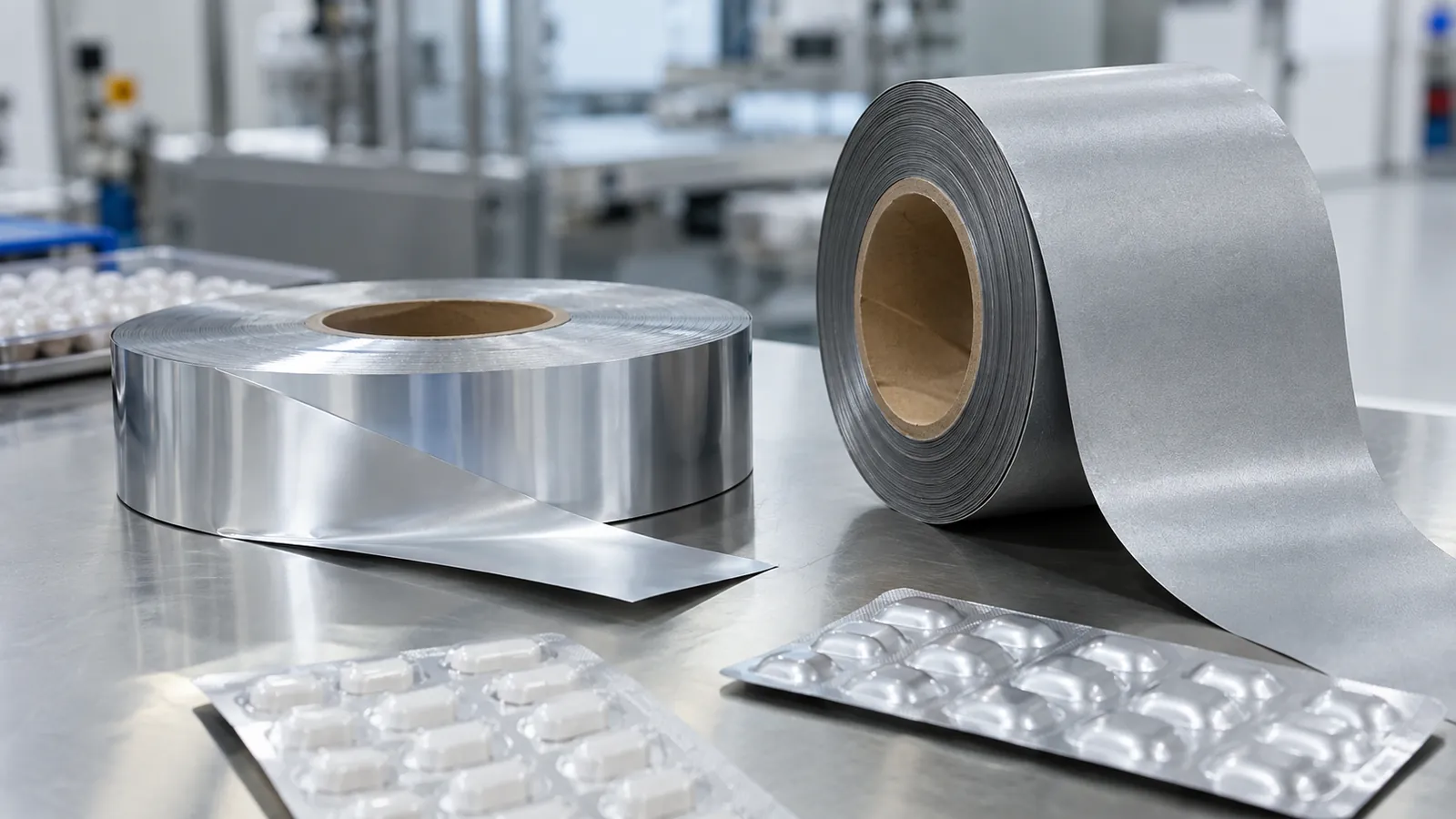
Confusing lidding with the forming web can leave a blister unformable or poorly sealed. For the pharmaceutical foil blisters discussed here, lidding closes the cavity and cold-form laminate makes an opaque foil cavity; they perform different jobs. Push-through lidding often uses hard foil, while peelable and composite lids have different structures and opening behavior.
Each material has its own page: blister foil and cold form foil. The pack-level decision is covered under alu-alu blister packaging.
Blister foil vs cold form foil at a glance
Scroll horizontally to view all columns if needed. ↔
| Feature | Blister (lidding) foil | Cold form foil |
|---|---|---|
| Role in the pack | Lid, sealed over the cavity | Bottom web, formed into the cavity |
| Typical build | Push-through: hard foil with outer print/protection and inner heat-seal lacquer; peelable/composite builds differ | Oriented polyamide (OPA), soft aluminum, PVC or similar sealable inner layer |
| Aluminum temper | Hard foil is a push-through option; verify opening design | Soft foil for drawing; forming can still introduce cracks |
| Thickness | Specify aluminum separately from coatings or laminate | Specify aluminum separately from OPA, inner film and adhesive |
| Forming | None; it stays flat | Pressed cold by a plug into a die |
| Main risk | Seal problems, lacquer mismatch, pinholes | Pinholes, cracks and thinning in drawn corners |
| Seals to | Forming web (PVC, PVDC-coated PVC, PP, PCTFE laminates, or cold form foil) | The lidding foil lacquer |
| Barrier contribution | Closes the pack; barrier through the lid is high if pinhole-free | Sets the barrier of the cavity walls |
A manufacturer’s November 2022 foil-lidding overview distinguishes push-through, peel-open and peel-push constructions. Gauge and temper must follow the selected design, not a generic “blister foil” specification.

Different jobs in the pack
A blister has three parts: a cavity, the product and a lid. The lid has to do two things that pull in opposite directions. It must protect the dose and survive distribution, yet let a patient press a tablet through it or peel it back. Hard-temper foil is frequently chosen for push-through opening. Soft-temper and composite alternatives exist; confirm release force and handling on the finished design.
The cavity has a different set of demands. Whatever material makes it must be drawn into a three-dimensional shape without failing. Plastic webs such as PVC or PP are softened by heat and formed by vacuum or air pressure. Aluminum does not soften in a useful way, so a cold form laminate is pressed into the die at room temperature, and the soft aluminum deforms plastically and holds the shape. That is why the two foils use different tempers and different layer builds, and why one cannot substitute for the other.
Where each foil is used
Foil-based lidding can be paired with these pharmaceutical forming webs:
- Over thermoformed plastic cavities, including PVC, PVDC-coated PVC and PCTFE-containing laminates
- Over cold-formed foil cavities in alu-alu packs
- In peelable and child-resistant variants, where paper and PET layers are added to the foil
Cold form foil is used only where the bottom web must be a full-foil barrier. Typical reasons are moisture-sensitive or light-sensitive drugs, hot and humid distribution and long labeled shelf life. The decision should rest on stability data for the product and market, not a rule of thumb. Barrier terms are explained in moisture barrier packaging.
When both are used together
An alu-alu blister uses both foils in one pack. The cold-form laminate is the cavity and foil-based lidding closes it. Select the lid’s temper and opening structure separately from the soft forming foil.
- The inner layer of the cold form web (commonly PVC, sometimes PP or another sealable layer) and the lid lacquer must be a validated pair.
- Changing either side means re-checking seal strength and integrity.
- With no clear plastic in the barrier path, pack performance depends on seal quality and pinhole-free forming. The seal is often the main path for transmission.
Scroll horizontally to view all columns if needed. ↔
| Position in an alu-alu assembly | Component / interface |
|---|---|
| Outside of lid | Print/protective coating |
| Lid barrier | Aluminum; hard foil is one push-through option |
| Underside of lid | Heat-seal lacquer |
| Bonding interface | Lacquer against the validated inner film of the forming web |
| Cavity, product side to outside | PVC or specified sealable film / adhesive / soft Al / adhesive / OPA |
After changing the lid, recheck lacquer/web compatibility, sealing settings, strength, leakage and the intended opening mode. Review stability and child-resistance evidence where the change affects them.
Forming, sealing and machine differences
Blister lidding does not involve forming. The lid is unwound, printed or already printed, and sealed to the bottom web between a heated tool and a counter plate. Temperature, pressure, dwell time and tool condition drive seal quality, whether the machine uses flat-plate or rotary sealing.
Cold form foil adds a forming station with higher forming force and tooling matched to the laminate. Not every blister machine can run it, so confirm with the machine builder. Foil is also stiffer and heavier than plastic web, so reel size, unwind tension and web guidance need attention. Wrinkles at the flange cause sealing problems later. The format itself is described in blister packaging.
Cost, pack size and trade-offs
Cold form foil laminates and their forming are generally more costly than a plain PVC web, and the pack tends to be larger because cavities are shallower and the flange wider. Compare the selected lid separately from the forming web in the bill of materials. The trade-offs of choosing a cold form cavity are covered on the alu-alu page: opaque pack, larger size, forming limits on deep cavities and poor recyclability. Compare on total cost, including scrap and line speed, instead of material price alone.
Quality checks that differ between the two foils
Scroll horizontally to view all columns if needed. ↔
| Check | Blister foil | Cold form foil |
|---|---|---|
| Pinholes | Incoming inspection against supplier limits | Incoming inspection and again after forming |
| Seal integrity | Channels around every cavity, dye or vacuum leak tests | Same, plus flange condition |
| Seal strength | Seal-strength test under ASTM F88/F88M-23 | Same, with laboratory seals under ASTM F2029-16(2021) |
| Legibility and abrasion on the outside | Not usually a focus | |
| Forming defects | Not applicable | Cracks, thinning, wrinkles, delamination |
| Push-through or peel force | Functional test on finished packs | Not applicable |
When to choose blister foil
- For a pharmaceutical foil-lidded blister, select the lid for the required push-through or peel opening; other blister formats may use non-foil lids.
- You need a push-through, peelable or peel-push child-resistant lid. Requirements vary by market, so confirm what yours requires and validate the finished pack.
- Your forming web is a thermoformed film, and you can name its type so the lacquer can be matched.
When to choose cold form foil
- Stability data show that a transparent plastic web, even a high-barrier one, will not protect the product through its labeled life.
- The product is sensitive to light, moisture or oxygen and the cavity cannot be see-through.
- Your machine has a cold form station, and the cavity depth and shape fit within the supplier’s validated forming limits.
Which foil does your pack need
- Is this a pharmaceutical foil-lidded blister? Identify its opening mode before choosing the lid.
- Do stability data and climate zone require a full-foil cavity? If yes, add cold form foil as the bottom web.
- If no, check whether a thermoformed high-barrier plastic web meets the target.
- Confirm the lid lacquer is validated against the exact inner layer of the forming web.
- Run forming trials on the deepest cavity if cold forming, with backlit inspection.
- Check that your machine can form and seal foil.
- Qualify seals on your own line and run stability on the final pack.
The wider foil family is covered in pharmaceutical packaging foil.
Sources and method
The linked manufacturer overview (November 30, 2022) and a manufacturer’s OPA/Al/PVC data sheet distinguish opening designs and forming structure; these are public descriptions, not this site’s tests or recommendations. ASTM F88/F88M-23 measures seal strength; ASTM F2029-16(2021) prepares laboratory heat seals, not production validation or leak testing. Sources checked October 8, 2026. Layer order is schematic; thicknesses require the selected data sheet.
Continue reading
Related articles

Alu-Alu Blister Packaging: When Full-Foil Blisters Make Sense
Alu alu blister packaging uses a cold-formed foil cavity and foil lid for near-total barrier. See when it is chosen and how it compares with PVC blisters.

Blister Foil: Lidding Foils for Pharmaceutical Blister Packs
Blister foil is aluminum-based lidding for pharmaceutical blister packs. Learn lidding types, lacquers, sealing variables and checks.
Cold Form Foil: Laminates for Alu-Alu Blisters
Cold form foil is a soft aluminum laminate pressed into blister cavities without heat. Learn the OPA/Al/PVC build, forming limits, defects and checks.