
HDPE Packaging Film: Stiffness, Moisture Barrier and Uses
HDPE packaging film explained: stiffness, moisture barrier, dead-fold and crinkle, uses in liners, bags and MDO-HDPE mono-PE structures, and its limits.
Selecting an HDPE liner by stiffness alone can leave tear, sealing or fold behavior unresolved. HDPE film is a candidate for stiff liners, cores and oriented outer webs; confirm the finished film rather than treating the resin name as a performance specification.
For the other PE grades, see the polyethylene film overview.
Scroll horizontally to view all columns if needed. ↔
| Role | Useful check | Limitation |
|---|---|---|
| Dry-food liner | WVTR at stated gauge and humidity | Does not establish oxygen protection |
| Folded closure | Retention after an agreed fold test | A photograph cannot prove dead-fold |
| MDO outer web | MD/TD properties and shrink under heat | Orientation does not guarantee a sealing window |
| Coextruded core | Stiffness, tear and seal-layer identity | Specify the product-contact sealant separately |
What high density means for film
HDPE has few side branches, so chains pack closely and crystallinity is high. Record resin density from the specific grade sheet, including the measurement method; a generic density cutoff does not establish film performance. That tighter packing changes the film in four ways.
- Stiffness: modulus is much higher than for LDPE or LLDPE. A thin HDPE film holds its shape where an LDPE film of the same thickness would be limp.
- Moisture barrier: crystalline regions are barely permeable to water vapor, so verify the moisture barrier of the actual film at its specified thickness. See moisture barrier packaging for the broader picture.
- Heat exposure: verify shrink, dimensional stability and integrity at the intended filling, storage and sealing conditions; melting point alone does not establish suitability.
- Gas permeability is low relative to other PE, though still poor for oxygen in absolute terms.
Moisture barrier and how to compare it
For dry products such as cereal, crackers and powders, compare candidate HDPE, LDPE and LLDPE films at the same gauge, temperature, humidity and vapor-pressure difference. Resin family alone is not a matched barrier result.
Three rules apply when you compare numbers.
- Test conditions matter. A WVTR value is only meaningful with temperature and relative humidity stated. ASTM F1249-25 covers WVTR by a modulated infrared sensor. Do not compare figures from different conditions.
- Thickness matters. WVTR, in g/(m²·day), generally decreases with increasing thickness for the same homogeneous material under fixed conditions. The permeability coefficient is thickness- and pressure-normalized: P = WVTR × thickness / vapor-pressure difference, for example in g·mm/(m²·day·kPa). It is not the same quantity as WVTR. F1249 warns that inverse thickness scaling may not hold; do not apply it automatically to multilayers or changed orientation.
- Oxygen is a different matter. HDPE is still a poor OTR barrier. For oxygen-sensitive products, add a layer from the barrier film family.
Dead-fold and crinkle
A fold remaining in one sample does not establish fold retention across grades, gauges or directions. Treat dead-fold and rustle as sample requirements, with an agreed observation method rather than a universal HDPE property.
Scroll horizontally to view all columns if needed. ↔
| Sample observation | Method to agree | Result to fill |
|---|---|---|
| Crease retention | Grade, gauge, MD/TD fold, load, fold time and time after release | ___ |
| Reopening or spring-back | Compare equally conditioned samples using the same fold procedure | ___ |
| Rustle and feeding | Handle and feed samples on the intended line | ___ |
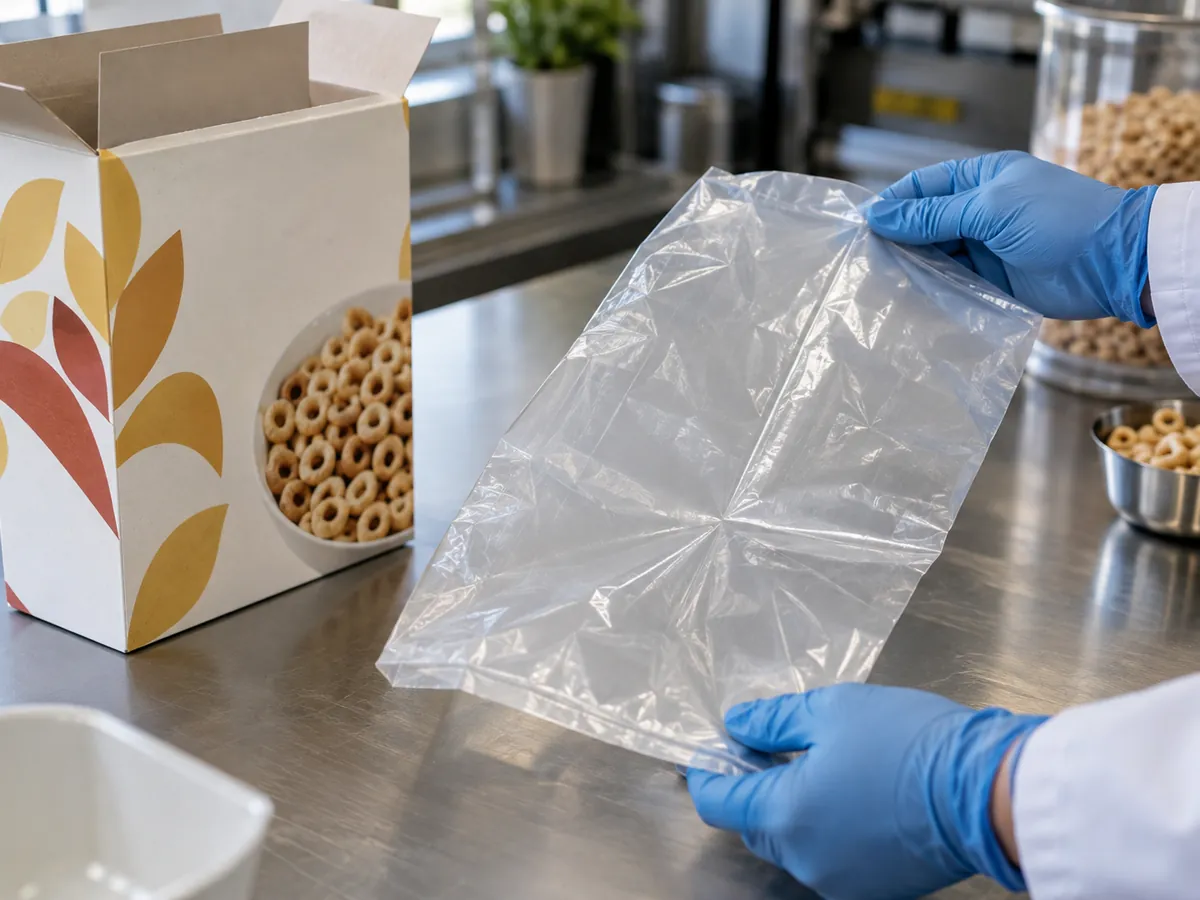
Keep the samples and conditions with the record; the cereal-liner image is illustrative, not a test result.
Typical uses
- Cereal and dry-food liners: film inside a carton protects cereal, crackers and dry mixes from humidity. The stiffness helps the liner stand and open smoothly during filling.
- Carrier and produce bags: very thin HDPE bags carry a surprising load because of the film’s stiffness and strength, so they are common as “T-shirt” carrier bags and roll-on produce bags.
- Coextruded cores: HDPE is used as a stiffening core between PE skins. Obtain the actual layer count and identify which surface handles sealing.
- Liners and sacks: trash liners and industrial liners that need strength at thin gauge. For very tough applications, see high molecular weight grades below.
- Mono-PE laminates: HDPE appears in the oriented outer web of a recyclable all-PE pouch.
MDO-HDPE for mono-PE structures
Traditional laminates pair a PET or BOPP outer web with a PE sealant. Because the layers are different polymers, they are hard to recycle together. Mono-PE structures replace the outer web with a PE film stiff and clear enough to print and run.
The step that makes this work is machine-direction orientation (MDO). A PE film, often rich in HDPE, is stretched in the machine direction after extrusion. A manufacturer’s MDO process brochure describes heating, MD stretching, annealing and cooling. Annealing reduces orientation stress; the outer web’s dimensional stability and sealing tolerance still depend on grade, draw ratio, gauge and heat-setting. Record MD and TD separately.
Layer-role schematic: MDO PE outer web → adhesive → PE sealant → product. The outer web supplies print support and stiffness; the sealant is selected for its sealing window. Confirm shrink, print distortion and seal integrity across actual jaw temperature, pressure and dwell settings instead of assuming orientation raises heat resistance.
Plan for three problems:
- Oxygen-sensitive products need a thin barrier layer that does not disqualify the pack from PE recycling streams.
- MDO films need good surface treatment and tension control for print and registration.
- Recycling acceptance depends on region and on guidelines from bodies such as APR or RecyClass. Confirm for your market.
See mono-material packaging for design principles and mono-PE packaging for the all-PE route.
HDPE film versus other PE films
Scroll horizontally to view all columns if needed. ↔
| Feature | HDPE | LDPE | LLDPE |
|---|---|---|---|
| Stiffness | High | Low | Moderate |
| Water vapor barrier | Measure at matched gauge | Measure at matched gauge | Measure at matched gauge |
| Clarity | Grade/process-dependent | Grade/process-dependent | Grade/process-dependent |
| Tear at thin gauge | Record MD/TD | Record MD/TD | Record MD/TD |
| Heat resistance | Confirm shrink/seal window | Confirm shrink/seal window | Confirm shrink/seal window |
| Feel | Crisp, crinkly | Soft | Soft to supple |
| Typical role | Core, liner, stiff outer web | Skin, coating, soft bags | Sealant, tough core |
These roles are starting points, not measured rankings; confirm optics, tear and thermal behavior on matched samples. For the sister grades, see LDPE film and LLDPE film.
HMW-HDPE in brief
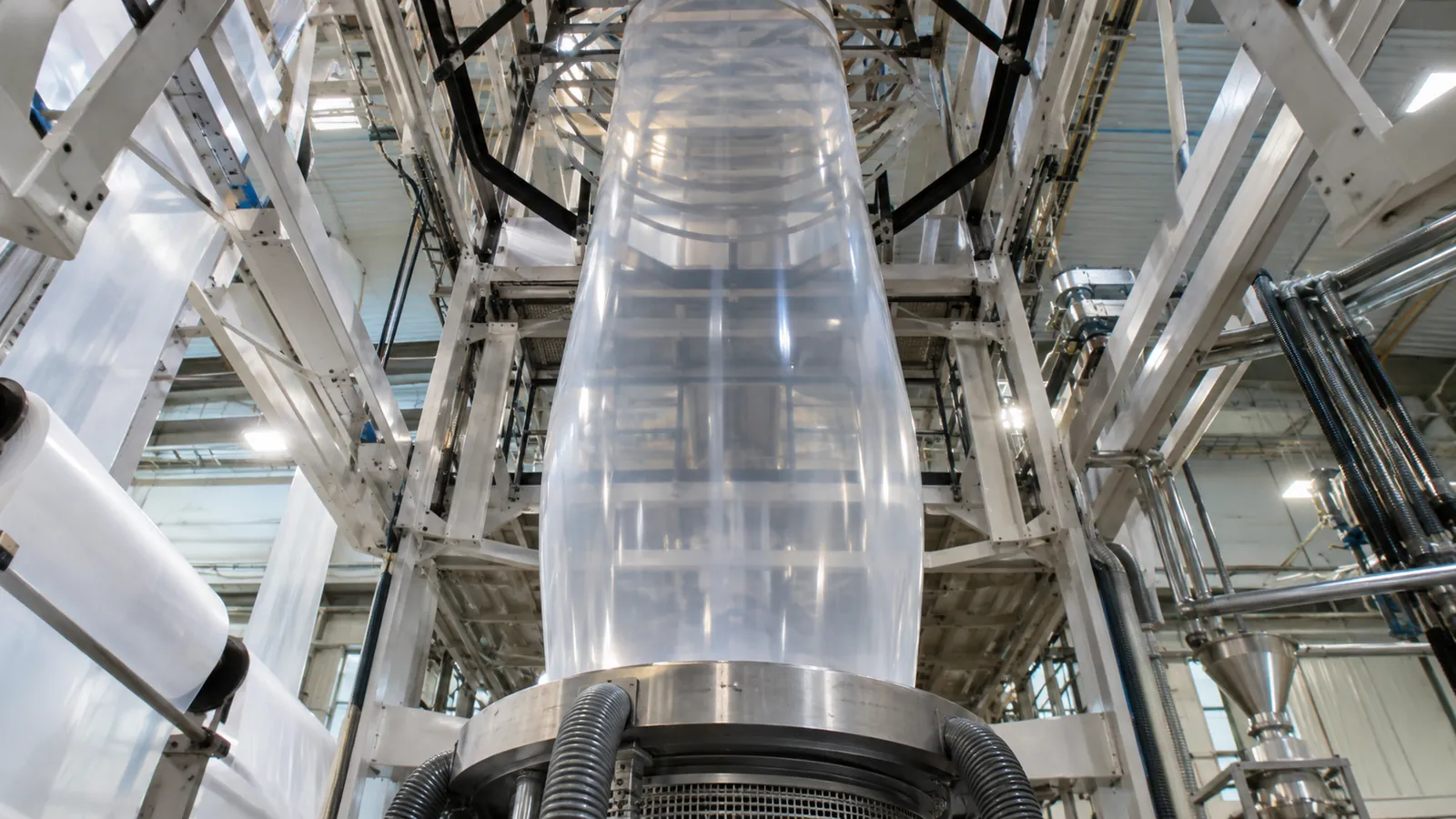
High molecular weight HDPE (HMW-HDPE) has very long chains. In film, that gives high tensile strength, good puncture resistance and toughness at very thin gauges, which is how ultra-thin carrier bags and produce rolls are made. The trade-off is harder extrusion: melt viscosity is high, and the film is typically made on dedicated blown film lines with a high-stalk bubble. Ask your supplier whether a grade is HMW or a standard HDPE film resin, because they do not behave alike.
Limits of HDPE film
- Haze: higher crystallinity scatters light. HDPE film is typically translucent rather than glossy and clear.
- Tear: thin HDPE film often tears easily, especially across one direction, because of orientation built into the blown film process. HMW grades and blends can improve this.
- Narrower seal window: the higher melting point means seals form at higher temperatures than LLDPE sealant layers. In multilayer film, use a lower-melting seal layer instead of sealing HDPE to itself where you can.
- Noise and feel: it is not suitable where a quiet, soft film is wanted.
- Oxygen barrier is poor, so add a barrier layer.
What to put in an HDPE film specification
- Role: liner, carrier bag, coextruded core or MDO outer web.
- Barrier: state the moisture target with temperature, humidity and thickness.
- Stiffness: state tensile or modulus targets, commonly tested to ASTM D882, and the machine’s tolerance for crinkle.
- Strength: dart impact (ASTM D1709), puncture and tear at the specified gauge. Name the gauge the numbers apply to.
- Seal layer: if HDPE is a core, specify the sealant and seal conditions separately.
- Appearance and noise: haze, gloss and rustle expectations.
- Compliance and recyclability: food-contact declarations for your destination market and any recycling claims.
Supplier numbers can then be compared using the approach in how to compare film specifications.
Sources and method
Reviewed October 8, 2026. ASTM F1249-25, public scope and thickness-scaling caution, supports the WVTR distinction. A manufacturer’s MDO process brochure, April 2023, explains annealing and the outer-web/sealant construction. These are method and process references, not our tests. Fold retention has no universal value here; use the sample record above.
Continue reading
Related articles
LDPE Packaging Film: Properties, Processing and Uses
LDPE packaging film explained: branching, processing roles, blend trials and the matched optics, mechanical and seal evidence needed to compare candidates.
LLDPE Packaging Film: Toughness, Sealing and Uses
LLDPE packaging film explained: grade choice, comonomers, hot tack, contaminated-seal testing and the evidence needed for sealants, stretch film and sacks.
Polyethylene (PE) Packaging Film: LDPE, LLDPE, HDPE and mLLDPE
Polyethylene packaging film explained: how LDPE, LLDPE, mLLDPE and HDPE differ, sealing and COF checks, and how to specify a grade.