
Mono-PE Packaging: Polyethylene-Based Pouches and Laminates
Mono PE packaging replaces PET/PE laminates with polyethylene-based films. See the outer webs, barrier options, seal window and machine changes involved.
Replacing PET/PE without qualifying sealing and barrier can turn a material change into rejected packs. Mono PE packaging is a flexible pack in which the outer web, the sealant and the bulk of the structure are polyethylene, so the finished pouch or laminate is designed for a PE recycling stream. Two kinds of structure go by the name. An all-PE structure has no non-PE layer at all. A PE-based structure is mostly PE but contains small amounts of non-PE components, such as an EVOH barrier layer, a barrier coating, adhesive and ink, kept within the thresholds of the recycling guideline the pack is designed to, for example the CEFLEX design guidelines. The name alone does not prove a pack will be accepted in a PE stream: check the structure against the guideline and the collection and sorting system where it is sold. The usual route is to replace the PET outer film of a PET/PE laminate with an oriented PE film. The structure is simple on paper. The work is in getting enough heat resistance, stiffness and barrier out of one polymer family. For the broader comparison with mono-PP, see mono-material packaging; this page covers PE in more detail.
PET/PE replacement decision
Scroll horizontally to view all columns if needed. ↔
| Requirement | Evidence to compare | Decision before switching |
|---|---|---|
| Product protection | Full structures, thicknesses and OTR/WVTR conditions | Keep current pack until candidate shelf life is qualified |
| Outer-web stability | Grade/gauge, MD/TD results and heat-shrink data | Check both directions under the actual process |
| Sealing | Seal curve, hot tack and integrity on the line | Establish a passing window including stops/restarts |
| Recycling claim | Bill of materials, protocol/version and destination | Confirm the complete pack and local route |
This is a decision checklist compiled from public guidance, not a measured PET/PE-versus-PE ranking.
Why the PET outer layer matters
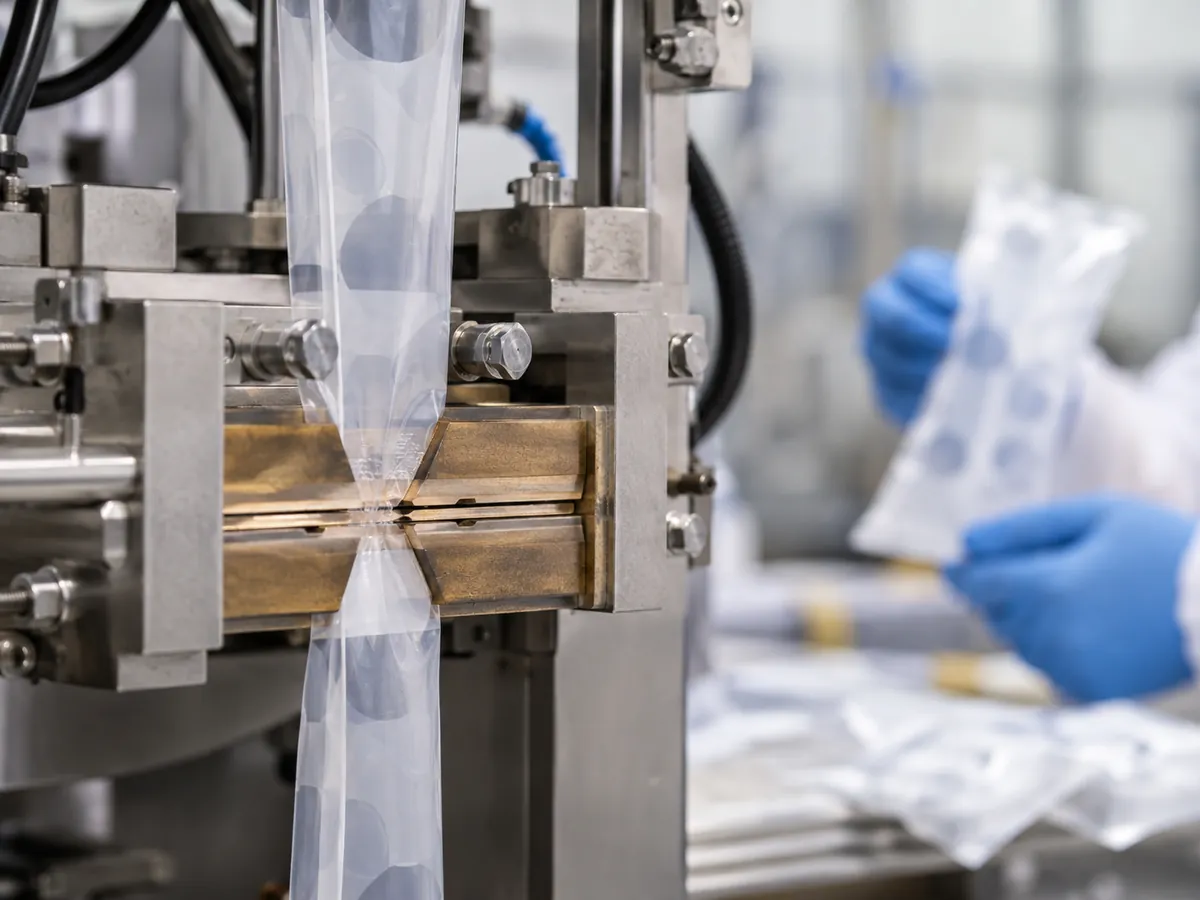
In a conventional laminate, PET stays solid at sealing temperature while the PE sealant on the inside melts and fuses. That gap in melting behavior is what gives a wide, forgiving seal window. Take PET out and put PE on both sides, and the outer layer starts to soften at temperatures not far above where the sealant seals. A mono-PE design therefore starts with one question: how do you make a PE outer web that holds up against the jaws?
Outer webs: MDO-PE and BOPE
Two oriented PE films are used to fill the PET role.
- MDO-PE (machine-direction oriented PE). A PE film stretched in the machine direction. A public equipment brochure separates stretching from annealing; the finished grade and process determine its properties.
- BOPE (biaxially oriented PE). PE oriented in both machine and transverse directions. The name does not establish higher stiffness, optics or heat resistance than MDO-PE. Compare grade, gauge, test direction/method and conditioning before selecting either web.
Both are laminated to a PE sealant web, or in some designs the structure is a single coextruded oriented film with a separate print film. Which route works depends on pack size, print requirements and whether the pack is a premade pouch or a rollstock for a form-fill-seal line. For the basic PE grades behind these films, see PE film, LLDPE film and HDPE film.
PE sealants
The inner layer is a conventional PE sealant, often a blend based on LLDPE or a metallocene-type grade, sometimes with LDPE for processing. Qualify seal strength, hot tack and behavior with the actual contaminant on the selected grade. The design rule is to keep a clear temperature gap between the sealant and the outer web. A sealant with a lower seal initiation temperature widens the usable window, which is why many mono-PE trials start by looking at the sealant. How that window is defined is covered under seal initiation temperature.
Barrier options and their limits
PE is a good moisture barrier but a poor oxygen barrier. A PET/foil/PE laminate gets its oxygen barrier from the foil or a metallized layer. A mono-PE pack has to find it elsewhere.
- Thin EVOH layer. A coextruded EVOH core gives strong oxygen barrier at low thickness. EVOH is moisture sensitive, so barrier drops in humid or wet conditions, and recycling guidelines allow it only within defined limits. Check the current limit in the guideline you design to. See EVOH barrier film.
- Barrier coatings. Thin coatings applied to the film can reduce oxygen or water vapor transmission without adding a separate polymer layer. Performance varies by coating, substrate and humidity, and some coatings are treated differently by different guidelines.
- Metallization. A vacuum-deposited metal layer on a PE film adds light block and some barrier. It does not match foil, and its treatment in recycling guidelines differs. See metallized film.
No barrier ranking follows from the material name alone. Dry products with modest shelf-life targets, such as many snacks, grains, powders and household goods, tend to be the easier fits. Coffee, nutritional powders and other oxygen-sensitive products are harder. Whatever barrier you choose, confirm it with OTR and WVTR data stated at the test temperature and relative humidity, then with a shelf-life study on the real product.
Heat resistance and the seal window
The central machine issue is the narrower seal window. With PE outside and PE inside, overheating can cause the outer layer to stick to the jaws, shrink, wrinkle or distort the print. Underheating gives weak or incomplete seals. Practical points:
- Set jaw temperatures with a seal curve for the actual structure, not a PET/PE starting point.
- Check temperature uniformity across the jaw length and between jaws, since small differences matter more with a narrow window.
- Look at dwell time and pressure together with temperature. Test each candidate temperature/dwell combination instead of assuming that raising temperature offsets a shorter dwell.
- Test hot tack on vertical form-fill-seal lines, since the seal is stressed while still warm. See hot tack.
- Use PTFE-coated or release-treated jaws or tapes if sticking appears.
Illustrative layer order, not to scale: oriented PE outer web → specified bond layer → PE sealant web. Put any barrier, coating, ink and fitment in the actual bill of materials. No layer thickness is assumed here.
The usable heat-seal window starts where the agreed strength and integrity criteria pass and ends before distortion, sticking or other failure. Hot tack is a separate check during cooling; use seal-strength testing for the cooled result.
Common mistake: Treating a successful center setting as qualification of both edges of the process window.
Printing and lamination
Oriented PE films can be reverse printed by flexo or gravure, though some require specific surface treatment and ink systems. Dimensional stability under web tension and drying temperature is lower than with PET, so registration and tension control need attention. Printing on the outside of the laminate (surface print) is possible but exposes the ink to abrasion.
Lamination uses solvent-based, solventless or water-based adhesives. The adhesive and the inks are part of the recycling assessment, so ask the converter for the adhesive type and coat weight. Heavy ink coverage and some ink families can reduce the quality of recycled PE. Keep coverage within what the design needs, and see design for recycling for how these choices are checked.
Machine adjustments to expect
Whether the pack runs on a VFFS machine, a premade pouch filler or a flow wrapper, a film swap alone is not enough, so plan a trial.
- Re-profile sealing temperature, pressure and dwell.
- Check film stiffness over the forming collar and tracking through the machine. A softer outer film can behave differently from PET. See VFFS film and premade pouch materials.
- Check coefficient of friction against the forming tube and jaws.
- Run long trials, including stops and restarts, since marginal seal windows show up in drift.
- Test seal strength and leaks at the edges of the running window as well as the center.
Where PE film is collected
Collection of PE film depends on region. In some markets, retail drop-off programs accept clean PE film such as bags and wraps, and flexible packaging may be accepted there. In others, flexible packaging may be collected curbside or sorted at facilities for mixed plastics. In many places it is not collected at all. A mono-PE structure that meets a design guideline is recyclable in principle, but whether it is recycled in practice depends on what exists where the pack is sold. The page on recyclable flexible packaging covers claims and verification.
What to put in a mono-PE pouch specification
Record the current PET/PE baseline and the proposed PE-based pack under matching conditions. Leave untested values blank.
Scroll horizontally to view all columns if needed. ↔
| Trial field | Baseline / candidate record |
|---|---|
| Full layer build and grades | ___ / ___; thickness and MD/TD data: ___ |
| Protocol, version and destination | ___; complete-pack assessment: ___ |
| Product / fill / shelf-life target | ___; OTR/WVTR method and temperature/RH: ___ |
| Machine / speed / dwell / pressure | ___ / ___ |
| Temperature points tested | ___; low-pass / center / upper-pass settings: ___ |
| Outer-web and registration behavior | ___; stops/restarts: ___ |
| Hot tack / cooled strength / integrity | Methods, conditions, results and failures: ___ |
| Adhesives, inks, barrier and fitments | Identities / quantities / assessment disposition: ___ |
| Trial decision | Pass / revise / reject; reason and approver: ___ |
Takeaway: Qualify the finished structure and keep the trial settings with the approved bill of materials. Use the film-specification comparison guide to record comparable inputs.
Common questions
MDO-PE vs BOPE: how should I choose?
Start with the missing property in your current trial: stiffness in each direction, shrink under process heat, optics or sealing behavior. Request comparable grade-specific data and test the complete laminate. Orientation direction alone does not select the winner.
Sources and method
- CEFLEX design choices: barrier, coating, adhesive and ink amounts affect recyclability. Check non-PE auxiliaries individually and as part of the full pack; a permitted polymer name does not approve every formulation.
- A manufacturer’s public technology-centre brochure, machine-direction orienter and pilot-line sections: stretching and annealing are separate operations.
- ASTM F88/F88M-23 and F1921/F1921M-12(2023): cooled strip strength and hot tack have different test scopes.
Public guidance checked 9 October 2026. It supplies process context, not a supplier’s declaration for your grades or an assessment of your finished pouch. No matched BOPE/MDO performance dataset is presented.
Continue reading
Related articles
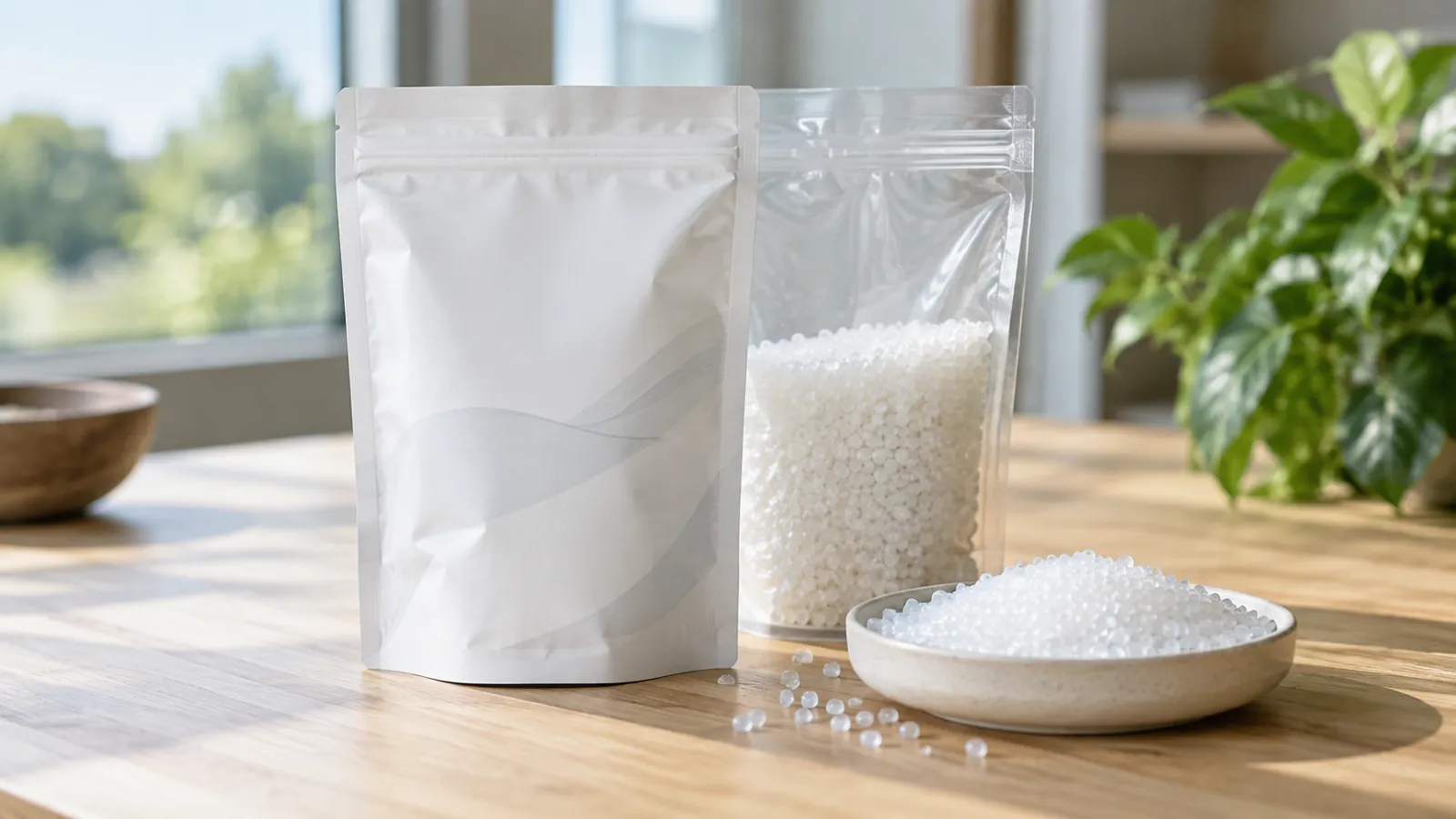
Mono-Material Packaging: Mono-PE and Mono-PP Flexible Structures
Mono material packaging explained: how mono-PE and mono-PP structures are built, their barrier limits, and what they change on the packaging line.
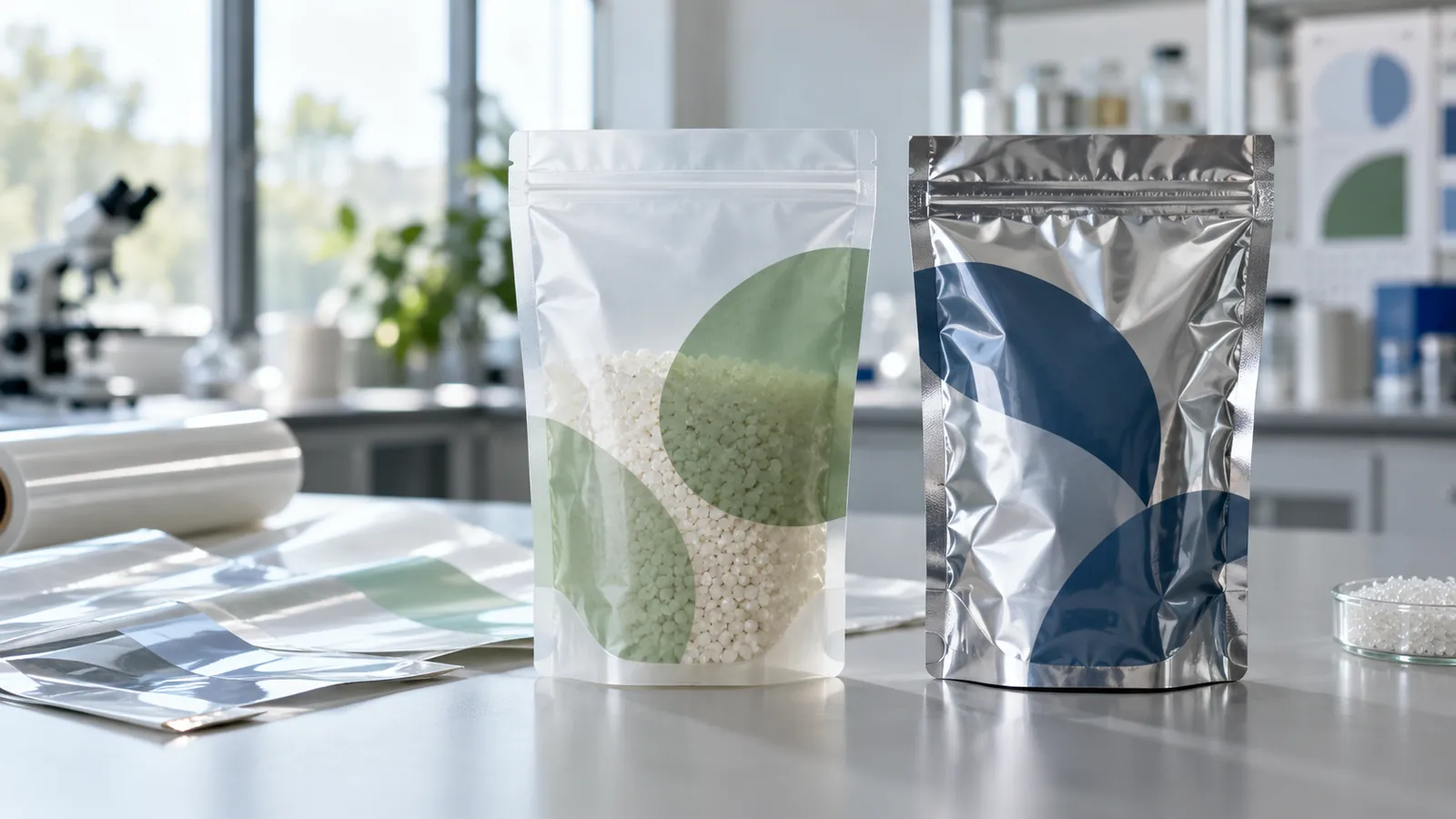
Mono PE vs Multilayer Film: Recyclability vs Performance
Mono PE vs mixed-material multilayer film compared on recyclability, barrier, seal window, print and cost, with guidance on which structure suits your product and line.
Mono-PP Packaging: Polypropylene-Based Structures
Mono-PP packaging uses a PP-dominant structure. Check outer and sealant grades, cold-use and retort evidence, barrier, and recycling-stream compatibility.