
LDPE Packaging Film: Properties, Processing and Uses
LDPE packaging film explained: branching, processing roles, blend trials and the matched optics, mechanical and seal evidence needed to compare candidates.
Easy extrusion does not prove that an LDPE film can survive puncture or a demanding seal cycle; assuming it does can lead to broken packs or unnecessary thickness. LDPE is a branched polyethylene used for bags, coatings and blend components, with finished-film performance determined by grade and processing.
This page covers LDPE’s roles and limits. Start with the polyethylene film overview for the other resin families.
Scroll horizontally to view all columns if needed. ↔
| Decision | Useful starting point | Limit to verify |
|---|---|---|
| Blown film processing | A grade intended for stable bubble operation | Actual output and gauge control |
| Clear, soft bags | Sample optics and feel | No automatic clarity advantage over LLDPE |
| Thin film or demanding sealing | Matched puncture and seal results | Processing ease is not a toughness guarantee |
| Oxygen-sensitive product | Additional barrier layer | PE resin name is not a shelf-life specification |
What branching does to LDPE film
LDPE is made by high-pressure free-radical polymerization. The process produces chains with both short branches and long branches, and the long branches are what set LDPE apart. They keep the chains from packing tightly, so crystallinity and density stay low. Specify the actual resin density in g/cm³ and its test method rather than a family-wide range. The public extrusion guide lists ASTM D1505 or D792 for density; the selected grade sheet determines which applies.
That structure has four practical effects.
- Clarity and gloss: lower crystallinity means smaller or fewer light-scattering crystals. Check haze and gloss on the same gauge and fabrication route; branch structure alone cannot rank the finished films.
- Softness: modulus is low, so the film feels supple and drapes easily. This suits bags that need to feel soft in the hand and wraps that conform to the product.
- Melt strength: long-chain branches entangle in the melt and resist stretching, so the molten bubble in blown film holds its shape.
- Low-temperature flexibility: the film stays flexible in cold storage, which matters for frozen food bags.
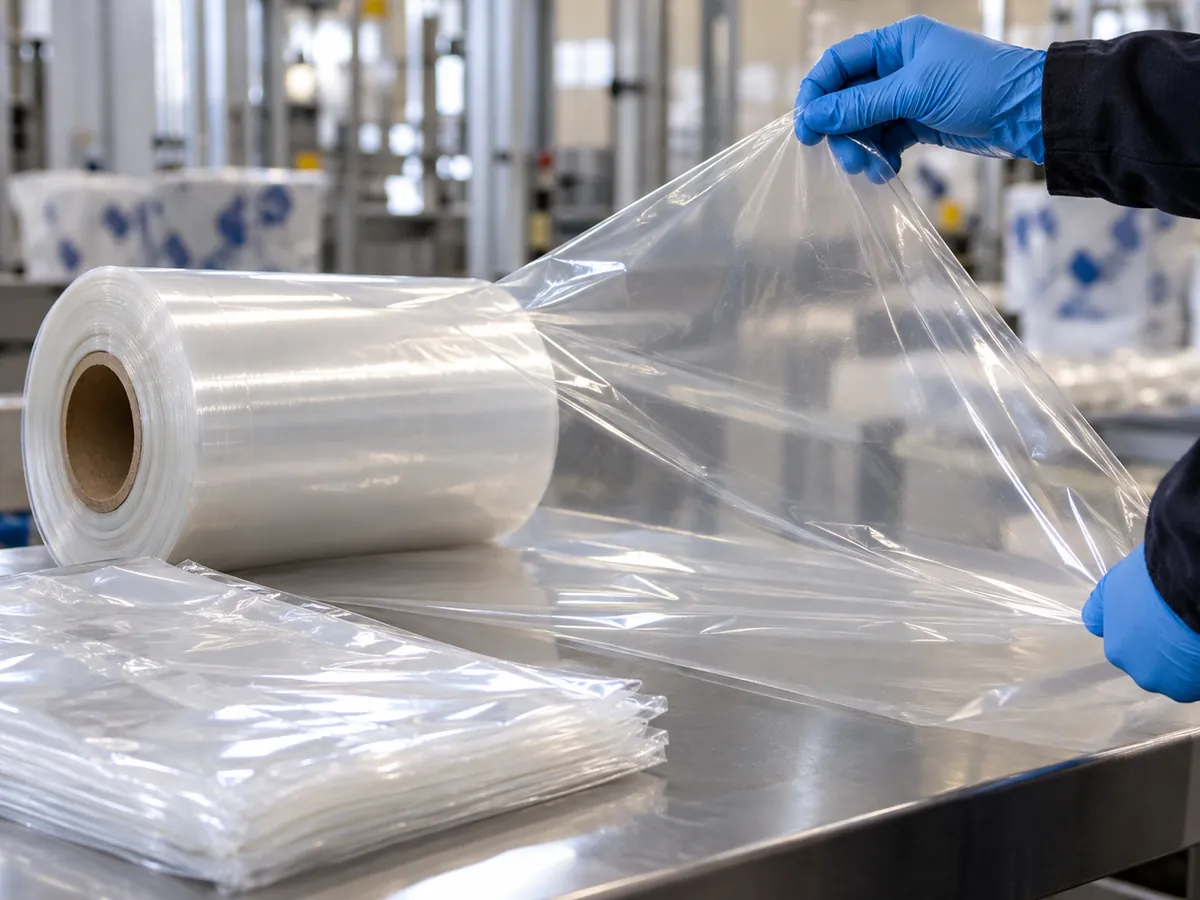
Processing LDPE and bubble stability
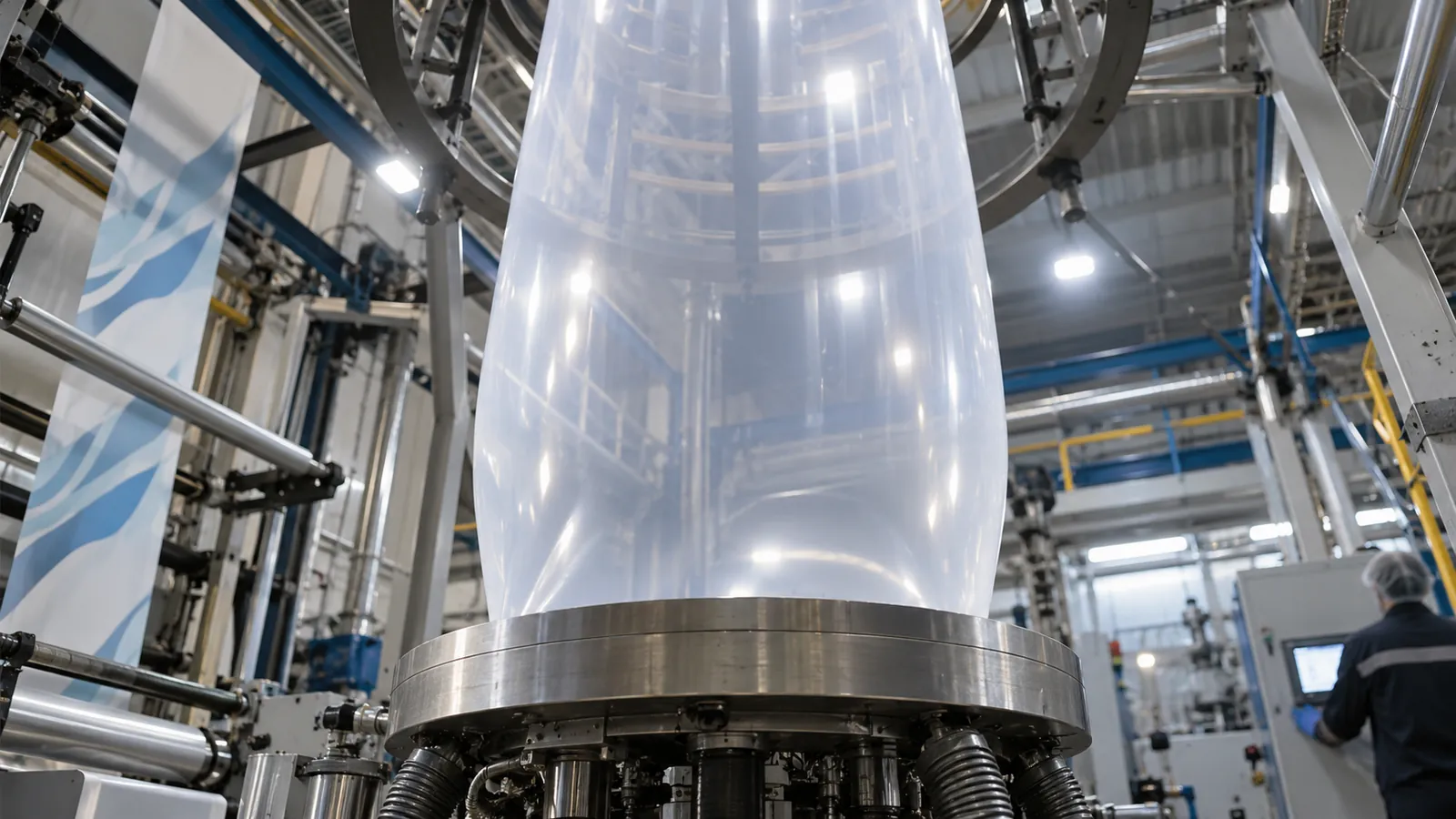
In blown film, molten resin is inflated into a bubble and cooled while being drawn up the tower. A manufacturer’s public blown-film grade page attributes bubble stability to that grade’s melt strength. It does not establish that every LDPE film gives higher output or lower motor load than every LLDPE film.
Record melt index, die configuration, blow-up ratio, cooling and output for the actual grade. For cast film or extrusion coating, use a resin intended for that process rather than transferring a blown-film claim.
The public extrusion guide explains how resin structure, cooling and orientation affect the film. Trial gauge control and roll quality on the intended equipment before accepting a processing advantage.
LDPE film properties at a glance
Compare finished samples, not broad rankings of resin families.
Scroll horizontally to view all columns if needed. ↔
| Property | Evidence to request | Conditions to match |
|---|---|---|
| Clarity and gloss | Haze/gloss result and method | Gauge, blown/cast route and cooling |
| Softness and stiffness | Modulus and handled sample | MD/TD, gauge and conditioning |
| Tensile and dart impact | ASTM D882 / D1709 results | Method edition, direction and gauge |
| Heat seal | Cooled seal strength and hot tack | Jaw settings, seal age and test delay |
| Water vapor and oxygen | WVTR and OTR | Temperature, humidity and complete stack |
ASTM D882-26a measures tensile properties and D1709-24 measures free-falling dart impact. Any WVTR or OTR comparison needs matching conditions.
Where LDPE film is used
- Bags: bread bags, produce bags, garment bags and general-purpose retail bags use monolayer or coextruded LDPE for clarity and a soft feel.
- Liners: carton liners, drum liners and pallet covers use LDPE for flexibility and easy handling.
- Shrink film: LDPE-rich blends are used for collation shrink and some bundling films, where the film must shrink on heating and then hold the load. See shrink film for how shrink structures work.
- Lamination webs: LDPE is used as a tie or sealant layer in laminates, and as a melt-extruded adhesive layer between substrates.
- Extrusion coating: LDPE is coated onto paper, board, foil and film to add heat-sealability and moisture resistance.
- Blends with LLDPE: an LDPE fraction may be trialled for processing; verify optics and toughness after changing the formulation.
LDPE in blends with LLDPE
LDPE and LLDPE can be blended or assigned to separate layers. The resin label does not set a blend ratio or guarantee clarity, toughness or sealing. Keep grade, gauge and fabrication conditions with each trial.
Scroll horizontally to view all columns if needed. ↔
| Intended use | Variable to adjust | Verification | Result to fill |
|---|---|---|---|
| Blown-film bag | LDPE/LLDPE grade and blend range | Bubble stability, gauge and puncture at equal thickness | ___ |
| Printed skin | Skin formulation and treatment | Haze, gloss, print adhesion and COF | ___ |
| Sealant | Seal-skin grade and additives | Seal strength, hot tack and contamination challenge | ___ |
| Coating | Coating grade and draw conditions | Curtain stability, adhesion and coating weight | ___ |
Branch schematic: LDPE backbone → short and long side branches; conventional LLDPE backbone → short side branches. This conceptual comparison is not a molecular test or a layer recipe. For the other blend component, see LLDPE film.
Limits of LDPE film
Reject an LDPE candidate if its tested properties do not meet the application; there is no resin-wide pass or fail.
- Thin-gauge abuse: check puncture, tear and drop performance before reducing thickness.
- Sealing: compare cooled seal strength and hot tack separately. Do not infer either from easy processing; see seal initiation temperature.
- Machinability: check stretch and tracking on equipment needing a stiff web.
- Oxygen protection: verify product shelf life and add a layer from the barrier film family where required.
LDPE versus LLDPE
LDPE’s branching is a processing consideration; LLDPE provides other formulation options. Neither name proves that one finished film is clearer, tougher or better-sealing. Compare same-gauge specimens made by the same route, with matching methods, and record unknown values as unknown.
The full LDPE vs LLDPE film comparison provides that evidence framework.
What to put in an LDPE film specification
Before requesting a quote, decide and write down:
- Role: monolayer bag, liner, skin layer, extrusion-coating resin or blend component.
- Thickness and gauge tolerance: see film thickness and gauge for how to state it.
- Optics: haze and gloss targets, and whether the film is printed (surface treatment level).
- Mechanical needs: tensile, dart impact and tear targets with the test method named.
- Sealing: seal temperature range, jaw type and any hot-tack need.
- Slip and antiblock: COF range and what surfaces it applies to (film-to-film or film-to-metal).
- Compliance: food-contact declarations for your destination market, and any recyclability claims.
The numbers suppliers send back can be compared using how to compare film specifications.
Sources and method
Reviewed October 8, 2026. A manufacturer’s polyolefin extrusion guide supports the branching explanation and processing variables. The public LDPE grade page describes one blown-film resin, not a family-wide superiority claim. ASTM method links above identify tensile and impact scopes; F88/F88M-23 covers seal-strip strength and F1921/F1921M-12(2023) hot tack. No matched LDPE/LLDPE optics or sealing dataset is supplied here; the tables are trial records, not our test results or supplier recommendations.
Continue reading
Related articles
Polyethylene (PE) Packaging Film: LDPE, LLDPE, HDPE and mLLDPE
Polyethylene packaging film explained: how LDPE, LLDPE, mLLDPE and HDPE differ, sealing and COF checks, and how to specify a grade.
BOPP Film for Packaging: Types, Properties and Uses
BOPP packaging film explained: what biaxial orientation does, the main grades from clear to metallized, sealing options and typical uses.
HDPE Packaging Film: Stiffness, Moisture Barrier and Uses
HDPE packaging film explained: stiffness, moisture barrier, dead-fold and crinkle, uses in liners, bags and MDO-HDPE mono-PE structures, and its limits.