
Shrink Film: Types, Properties and How to Choose
Shrink film is an oriented plastic film that tightens around a product when heated. Compare PVC, PETG, POF and PE types and learn how to choose.
Wrong shrink direction can wrinkle a pack or pull a seal apart. Choose the pack format, MD/TD shrink balance and compatible machine together. Shrink film is a plastic film that has been stretched during manufacture so that it tries to return to its original, smaller dimensions when heated. Wrapped around a product and passed through heat, it tightens into a close-fitting, clear or printed cover. The right type also depends on product shape and end-of-life requirements.
Main types of shrink film compared
Scroll horizontally to view all columns if needed. ↔
| Type | Orientation to confirm | Application branch | What to verify | Limits |
|---|---|---|---|---|
| PVC | Balanced or TD grade | Overwrap, band or sleeve | MD/TD curve and sealing or seaming method | Confirm food-contact and recycling requirements; no family-wide seal or cold-temperature rating |
| PETG | TD sleeve grade | Contoured sleeve | Shrink curve for the exact grade and container | Check compatibility with the PET bottle recycling route |
| POF (polyolefin) | Balanced grade | Retail overwrap | Seal range, shrink force and finished appearance | A material name does not establish a usable tunnel window |
| PE shrink | MD-weighted or application-specific balance | Multipack bundling | Load restraint, gauge and tunnel trial | Confirm clarity and energy demand for the actual grade and pack |
| OPS | TD sleeve grade | Container sleeve | Contour fit and print distortion | Do not assume reliable sink-float separation from PET; assess the complete printed sleeve design |
Detailed notes are on separate pages: PVC shrink film, PETG shrink film, OPS sleeve limitations and POF shrink film. PE shrink is a heavier-duty bundling film built on polyethylene film technology. If you are choosing between two sleeve films, PETG vs OPS shrink film compares them directly.
Choose the pack branch first
Scroll horizontally to view all columns if needed. ↔
| Pack task | Direction to check | Equipment branch |
|---|---|---|
| Sleeve label | TD around the circumference; verify MD height change | Sleeve applicator with a compatible steam or hot-air tunnel |
| Retail overwrap | Balanced MD/TD contraction | L-sealer or side sealer, then tunnel |
| Multipack bundle | MD-weighted or specified balance for the load | Sleeve wrapper and bundling tunnel |
Use this decision tree as a trial route: sleeve → TD → sleeve applicator; overwrap → balanced → L-/side-sealer; bundle → MD-weighted or load-specific balance → bundler. Specialized MD sleeves follow their own applicator design.
Choose the direction before comparing polymers; then confirm the grade curve and seal survival on the selected machine.
How shrink packaging film works
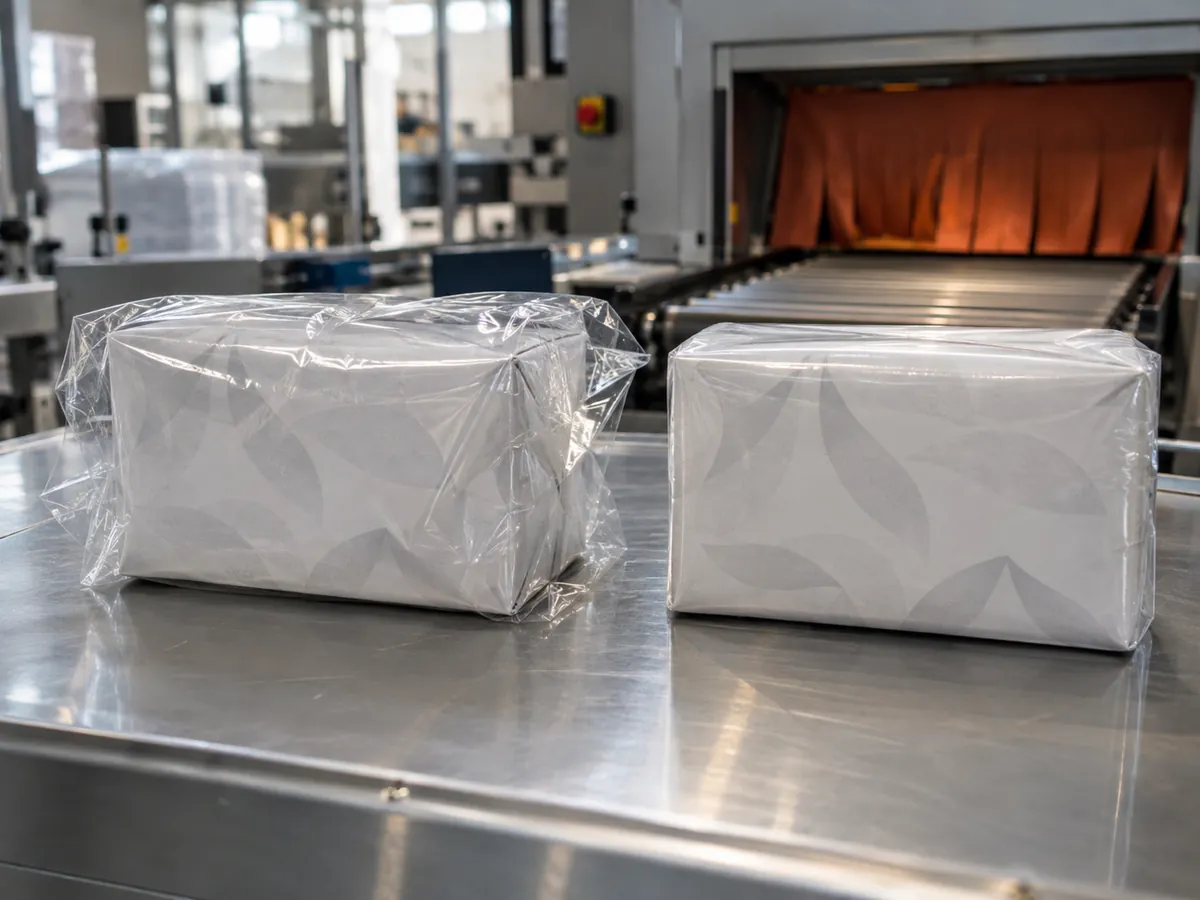
Shrink film is made by extruding a film, then stretching it while it is soft, either in one direction or in both. Cooling retains the orientation. Later, when the film is heated above its shrink onset temperature, the chains relax toward their original arrangement and the film contracts. If a product restrains the film, it pulls tight around it.
This is why shrink film behaves differently from ordinary packaging film. A packaging film such as a plain extruded layer is dimensionally stable on purpose. Shrink film is built to be unstable at a specific temperature.
Properties to read on a data sheet
- Free shrink: the percentage a film shrinks, unrestrained, at a stated temperature, usually reported separately for machine direction (MD) and transverse direction (TD). Compare values at the same test temperature.
- Shrink tension (shrink force): the force the film exerts while shrinking against a restraint. High tension gives a tight wrap but can crush light cartons or distort thin bottles.
- Shrink onset temperature: the point where meaningful shrinking begins. A low onset suits heat-sensitive products and short tunnels. A higher onset alone does not establish a wider process window or resistance to sagging; compare the full grade curve and pack trial.
- Seal strength and seal range: shrink film must seal before shrinking. Film that seals only in a narrow window is harder to run.
- Clarity, gloss and haze: these matter more for retail overwrap than for transit bundling.
- Tensile and puncture behavior: tensile properties are measured by methods such as ASTM D882, and sharp corners on boxes test the puncture side.
Treat any figures as supplier-specific. Shrink behavior changes with gauge, orientation ratio and the tunnel, so confirm values on the data sheet for the exact grade.
Machine direction, transverse and balanced shrink
The direction of orientation decides how the film behaves on the product.
- Predominantly transverse (TD) shrink is typical for sleeve labels. The sleeve wraps around a bottle, shrinks around its circumference and barely changes in height.
- Predominantly machine direction (MD) shrink suits some banding and overwrap uses where length matters.
- Balanced (biaxial) shrink is similar in both directions. This is the usual choice for overwrapping boxes and food items, where the film must pull tight on all sides without distorting the package.
A film whose shrink balance does not match the pack shows up as wrinkles, a bent carton, a sleeve that rides up or a seal line that pulls apart.
Equipment overview
The film and the machine need to be chosen together.
- L-sealer with shrink tunnel: the film is center-folded, the product enters the fold, and an L-shaped sealing bar closes the side and the end in one stroke. The wrapped product then goes through a hot-air tunnel. This is a common choice for varied product sizes and moderate output.
- Side sealer: a continuous sealing bar or wheel closes the film around products moving in a line, then a tunnel shrinks it. It is built for higher throughput on uniform products.
- Sleeve applicator with steam tunnel: a tubular sleeve (often seamed with solvent for PETG or PVC) is cut and dropped over a container, then shrunk with steam. Confirm heat distribution around the actual container contours.
- Sleeve wrapper for bundling: wraps a heavy-gauge film around multipacks and shrinks them in a tunnel, with open ends where applicable.
Tunnel temperature, air flow and dwell time matter as much as the film. Too little heat leaves a loose, wrinkled pack. Too much melts holes or burns through seals. For how film runs on automatic equipment more generally, see packaging film and machine compatibility.
Choosing shrink film
Work through these questions in order.
- Product shape and weight: simple boxes and cans work with most films. Contoured bottles favor a high-TD-shrink sleeve film. Heavy multipacks need a tough bundling grade.
- Tunnel type: hot air, steam and infrared deliver heat differently. Confirm that the film’s shrink curve matches the tunnel; confirm the permitted heat source for the grade.
- Clarity and print: retail overwraps need low haze, and sleeves need a surface that prints well, often reverse-printed.
- Seal method: impulse or hot-wire sealing, hot-knife sealing and solvent seaming each suit different films.
- Food contact: if the film touches food directly, ask the supplier for the declaration of compliance and confirm the rules for your destination market.
- Recycling: some shrink materials interfere with recycling streams, especially around PET bottles and chlorinated polymers. See recyclable flexible packaging for the wider picture.
- Pack storage: cold storage, freezer use and hot trucks change brittleness and shrink behavior.
Run a trial on your own line before committing. A sample that shrinks well on a supplier’s tunnel can behave differently on yours, and the tunnel settings you finalize become part of the specification. For sleeves on PET bottles, check sleeve design and recycling limitations.
What to put in a shrink film specification
- Film type, gauge and shrink direction (MD, TD or balanced)
- Free shrink values at the stated test temperature, MD and TD
- Shrink tension and onset temperature
- Seal method and seal window
- Optics requirement (clarity, haze, gloss) and print method
- Perforation requirement for air release, if any
- Food-contact documentation for the destination market
- Recyclability or design-guideline requirement
- Roll width, core size and unwind direction for the machine
- Trial conditions: tunnel temperature, air speed and dwell time
Frequently asked question
What is the difference between stretch film and shrink wrap?
A manufacturer’s explanation describes stretch film’s elastic recovery during wrapping; shrink film tightens after heating. Confirm which process the machine uses before ordering. For retail formats, compare flow wrapping with shrink wrapping.
Sources and method
Reviewed October 8, 2026. The table routes trials; it does not rank cost, shrink temperature or seal performance across polymer families. A manufacturer’s public grade-specific shrink curve illustrates why the complete temperature response matters; it is supplier information, not a recommendation or a test by this site. The RecyClass decoration handbook describes TD/MD sleeve routes and PET sorting constraints. Confirm current recycling acceptance for the complete bottle/sleeve design.
Continue reading
Related articles
OPS Shrink Film: Oriented Polystyrene Shrink Sleeves
OPS shrink film is oriented polystyrene used mainly for shrink sleeve labels. See its properties, trade-offs vs PETG and PVC, recycling and storage.
POF Shrink Film: Polyolefin Shrink Wrap Explained
Polyolefin shrink film (POF) is a coextruded, biaxially oriented chlorine-free wrap. Learn cross-linked vs non-cross-linked grades, machines and POF vs PVC.
PVC Shrink Film: Properties, Applications and Limitations
PVC shrink film for sleeves and overwraps: assess heated-process controls, grade-specific seals, cold handling and replacement trials against POF or PETG.