
PETG Shrink Film: Shrink Sleeves, Properties and Uses
PETG shrink film is a high-shrink, transverse-oriented film used for sleeve labels on bottles and contoured containers. See properties, uses and recycling.
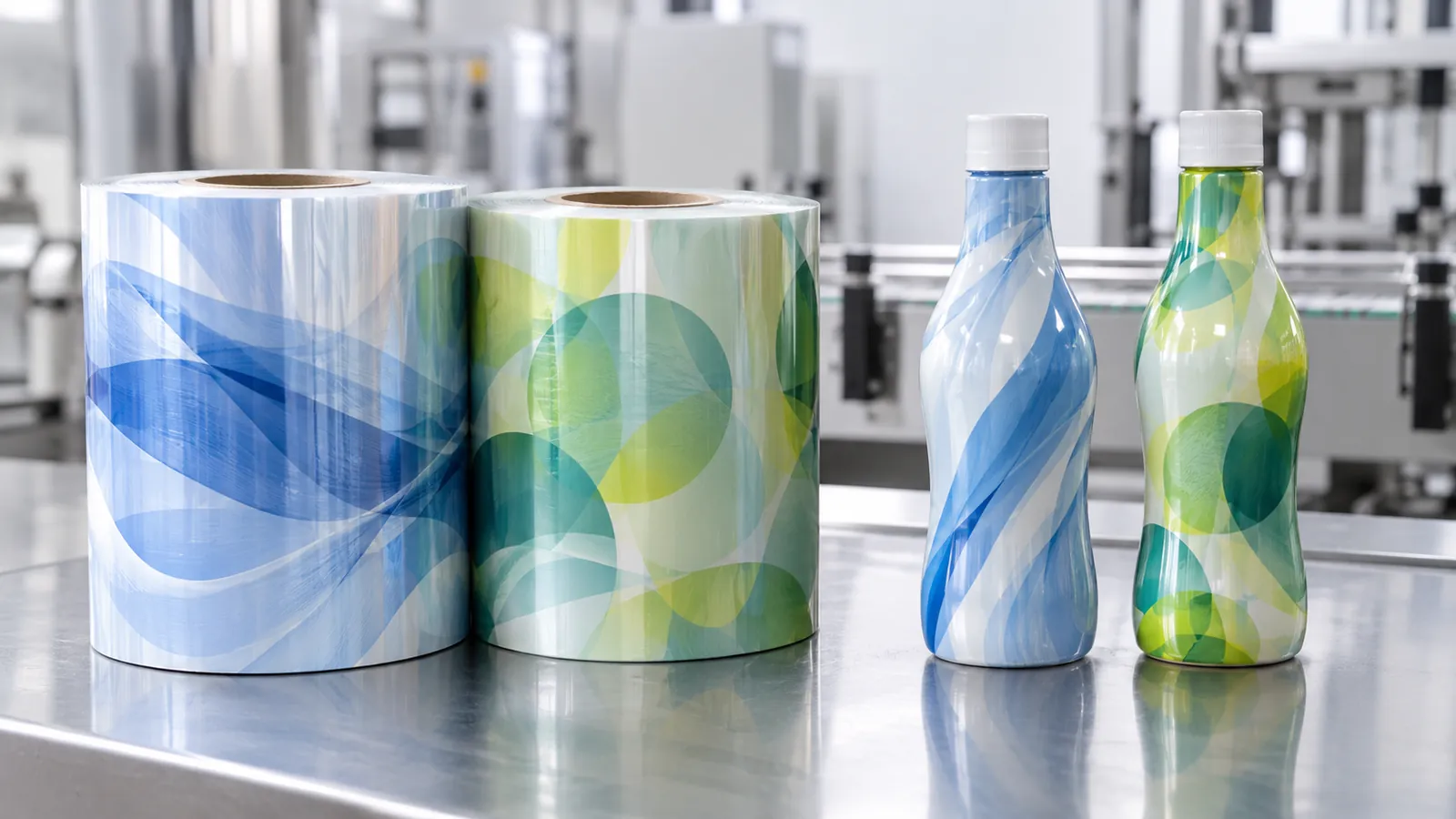
Insufficient shrink or excessive height change can distort a sleeve and its graphics. Match the PETG grade’s TD and MD curves to the container profile and tunnel before approving a sleeve. PETG shrink film is a glycol-modified polyester film oriented mainly in the transverse direction, made for sleeve labels on bottles, jars and other contoured containers. Its circumferential and height changes depend on the grade and heating conditions. Its recyclability on PET bottles is the main design question, and the industry has developed several responses to it.
What PETG shrink sleeve film is
PETG is a modified polyester. The glycol modification keeps the polymer from crystallizing the way standard polyester does, which is what makes it clear, amorphous and able to shrink at moderate temperatures. It is related to, but distinct from, the biaxially oriented film described on the PET film page, which is made to stay dimensionally stable.
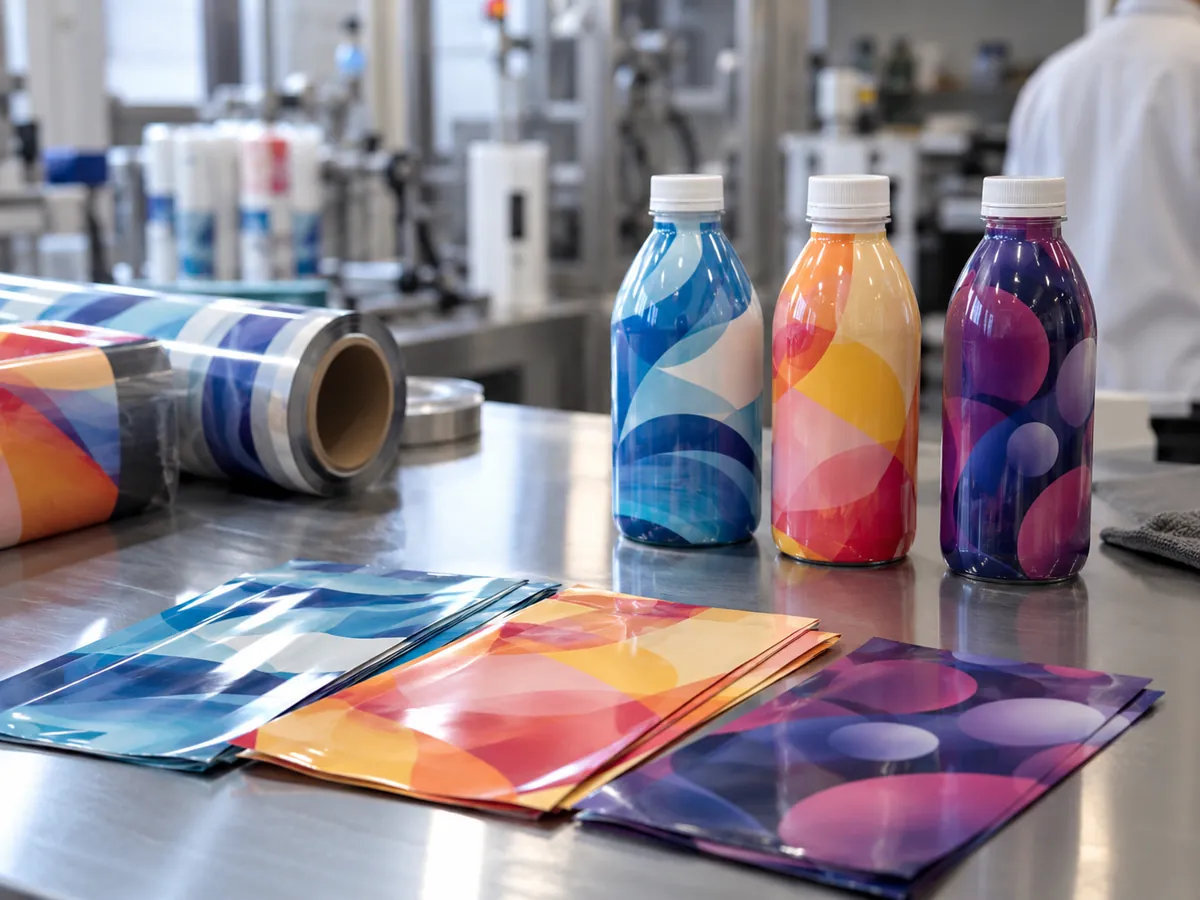
Most PETG heat shrink film is sold as roll stock, printed (often reverse-printed), formed into a tube with a seam and applied as a sleeve. The seam is typically made with solvent, which dissolves the overlap and bonds it without heat.
Properties of PETG shrink film
- Shrink capacity: record the grade, gauge, TD and MD results, temperature, heating medium and exposure time. A headline percentage without all these conditions is insufficient for selecting a sleeve.
- Directional behavior: confirm TD shrink and MD shrink or growth together. Check sleeve height and graphics position after the actual tunnel cycle.
- Clarity and print quality: the film is clear and takes high-resolution print well, which supports full-body graphics on glass and plastic containers.
- Stiffness and handling: it is a relatively stiff, dimensionally predictable film that feeds well on sleeving machines.
- Solvent seaming: sleeve tubes are bonded with solvent, which gives clean seams without heat.
- Shrink onset: the film starts shrinking at moderate temperatures, which suits steam tunnels.
Free shrink, shrink tension and onset temperature depend on gauge and grade. Confirm them on supplier data sheets and on your own samples.
Where PETG sleeves are used
- Full-body sleeves on beverage bottles, personal care containers and household products
- Partial sleeves and shoulder or neck bands, including tamper-evident bands
- Containers with irregular or tapered shapes, where flat pressure-sensitive labels would wrinkle
- Multipacks bound with a sleeve printed with promotional graphics
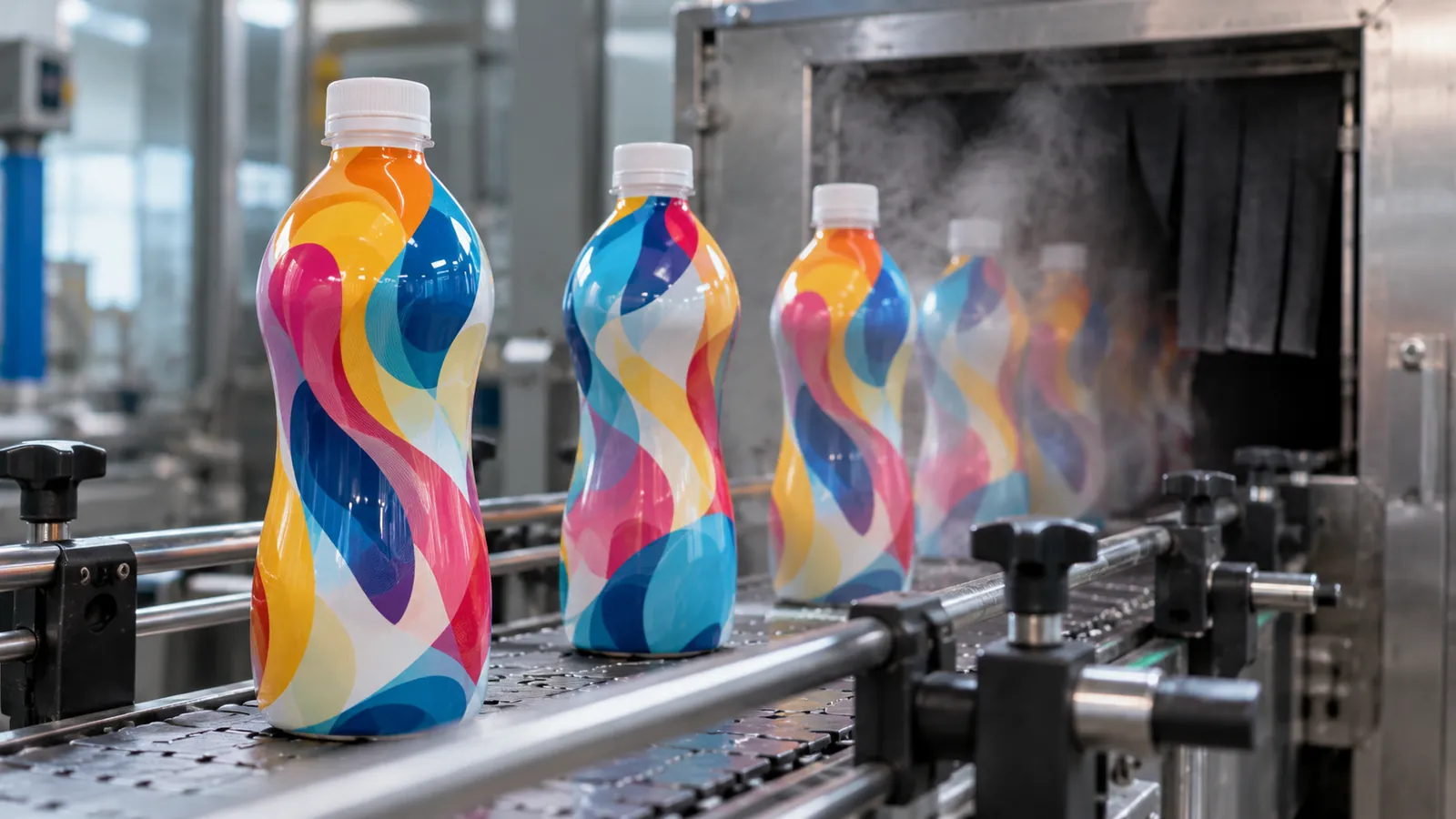
On a typical line, a sleeve applicator cuts a pre-seamed tube, drops it onto the container and passes it through a steam tunnel. Record the tunnel zones, medium, line speed and container temperature; steam and hot-air settings are not interchangeable. For matching film to equipment more broadly, see packaging film and machine compatibility. The shrink film overview explains how sleeve equipment compares with overwrap systems.
Recyclability: PETG sleeves on PET bottles
For North American PET bottle design, assess the complete decorated container under the APR PET rigid design guide, checked October 9, 2026. Label coverage affects sorting; sinking label material also needs compatibility evidence.
Treat these as separate paths:
- Perforation enables removal, but a perforated sleeve has not necessarily been removed. APR does not assume consumers take extra preparation steps before recycling.
- Partial coverage can expose more bottle surface to sorting. It does not change the sleeve polymer or establish compatibility.
- A floating polyolefin sleeve is a material change. Check the printed label’s float behavior, inks and adhesives as well as container sorting.
For a PETG grade, establish whether it sinks and whether the complete label is compatible with the PET process. Crystallizable polyester label options have their own conditions and are not evidence that any ordinary PETG sleeve is acceptable. Use the design-for-recycling guide to record market and structure.
Takeaway: neither perforation nor reduced coverage alone establishes a recycling claim.
PETG vs PVC shrink film
Both films have sleeve applications; compare the exact route and formulation rather than declaring one a universal winner.
Scroll horizontally to view all columns if needed. ↔
| Check | PETG candidate | PVC candidate |
|---|---|---|
| Shrink profile | TD/MD curves with medium and time | TD/MD curves with medium and time |
| Sleeve seam | Validated overlap and seam system | Validated overlap and seam system |
| Cold handling | Conditioned sleeve and slit-edge trials | Conditioned sleeve and slit-edge trials |
| Recycling | Complete PET-bottle label assessment | Complete PET-bottle label assessment |
| Cost | Quote date, gauge, area yield and rejects | Quote date, gauge, area yield and rejects |
The PVC shrink film guide covers heated-processing concerns. For overwraps on boxes and food, consider a POF trial as a separate route. Full comparisons are in PVC vs PETG and PETG vs OPS.
Choosing PETG shrink film
- Container shape: the more contour, the more the high TD shrink matters. Check how much the sleeve must shrink at its widest and narrowest points.
- Tunnel type and settings: match the film’s documented shrink curve to the installed tunnel, then validate on filled containers.
- Graphics: specify ink system, print coverage and opacity, and whether the sleeve covers the container fully.
- Seam: confirm solvent type, seam width and bond strength on your samples.
- Recycling: decide early whether the container is meant to be recycled, and assess removal, sorting and material compatibility separately.
- Compliance: for direct or indirect food contact, ask for documentation and confirm the rules for the destination market.
What to put in a PETG sleeve specification
Fill in the sequence from container shape to the finished sleeve.
Scroll horizontally to view all columns if needed. ↔
| Stage | Your record |
|---|---|
| Container contour / filled condition | ____ |
| Sleeve layflat / cut length / required TD and MD | ____ |
| Grade / gauge / free-shrink curves | ____ |
| Test temperature / medium / time / TD / MD | ____ |
| Tunnel zones / line speed / container temperature | ____ |
| Seam system / width / cured bond / post-shrink result | ____ |
| Coverage / print / ink / removal observation | ____ |
| Sorting / float-sink / compatibility evidence / market | ____ |
| Roll core / winding / food-contact declaration | ____ |
Compare these inputs with the film specification guide and the shrink film overview.
Sources and method
APR’s linked guide applies to North American PET rigid packaging; it does not establish acceptance in every collection system. The comparison is an input checklist, not this site’s trial data. No universal TD percentage, cold-handling ranking or material-price order is used.
Continue reading
Related articles
PETG vs OPS Shrink Film: Choosing a Shrink Sleeve Material
PETG vs OPS shrink film compared on shrink, toughness, stiffness, print, recycling and storage, with advice on choosing a shrink sleeve material.
OPS Shrink Film: Oriented Polystyrene Shrink Sleeves
OPS shrink film is oriented polystyrene used mainly for shrink sleeve labels. See its properties, trade-offs vs PETG and PVC, recycling and storage.
PVC vs PETG Shrink Film: Clarity, Shrink and Recycling Compared
PVC vs PETG shrink film compared on clarity, shrink behavior, sealing, cold handling, recycling and cost, with guidance on which sleeve film to choose.