
POF Shrink Film: Polyolefin Shrink Wrap Explained
Polyolefin shrink film (POF) is a coextruded, biaxially oriented chlorine-free wrap. Learn cross-linked vs non-cross-linked grades, machines and POF vs PVC.
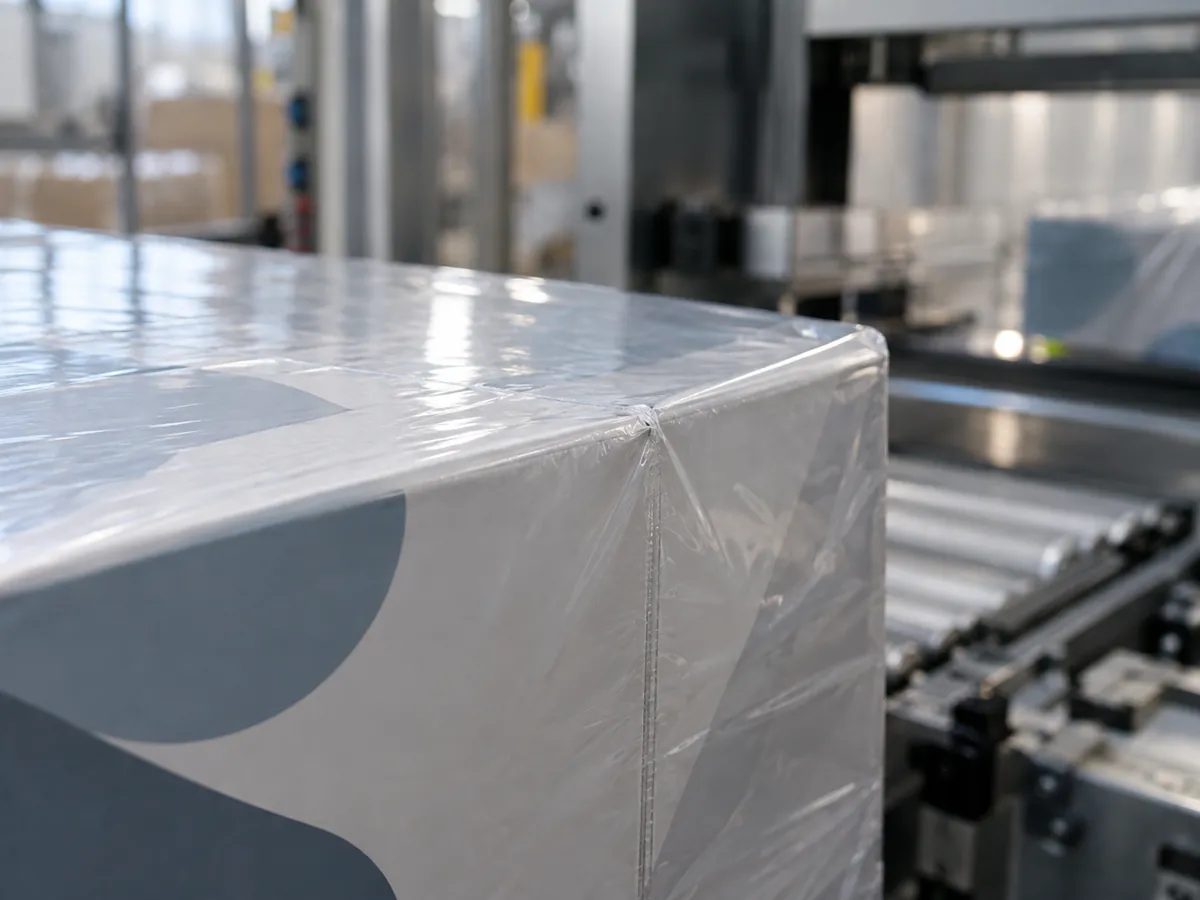
A shrink wrap can balloon or split if the seal and air-release setup do not match the product. Select POF by load, corners, seal method and a documented tunnel trial. Polyolefin shrink film, usually called POF shrink film, is a coextruded multilayer film made from polyethylene and polypropylene-based resins and biaxially oriented so that it shrinks in both directions when heated. Polyolefin resin is chlorine-free, but film formulation and processing still need a safety assessment. Grades differ mainly in whether they are cross-linked and in gauge, and both choices affect how the film runs on your machine.
What polyolefin shrink wrap is made of
Three-layer and five-layer coextruded POF routes are described in a manufacturer’s public process note. Layer count is grade-specific; neither route is established here as the market majority. The outer layers are tuned for sealing and surface properties, and the core carries toughness and shrink behavior. The structure is built on the same resin families discussed on the polyethylene film page, often blended with other polyolefin components to get the right shrink curve and clarity. After extrusion the film is oriented in both machine and transverse directions, then cooled to lock in the stress that is released as shrink in the tunnel.
Orientation is typically balanced, so a wrapped carton tightens evenly. That separates POF from the transverse-weighted sleeve films described under PETG shrink film.
Cross-linked vs non-cross-linked POF
Cross-linked and non-cross-linked POF are separate candidate groups, but the label alone does not establish a usable sealing or shrink window. A manufacturer’s public cross-linked grade description claims improved sealing and puncture performance; it is not a matched trial of every grade.
Scroll horizontally to view all columns if needed. ↔
| Product / process | Cross-linked candidate | Non-cross-linked candidate |
|---|---|---|
| Sharp corners | Check puncture at proposed gauge | Check puncture at proposed gauge |
| Heavy pack | Check load and seal retention | Check load and seal retention |
| Light, smooth carton | Compare gauge and distortion | Compare gauge and distortion |
| Hot-wire / knife / impulse | Validate actual seal window | Validate actual seal window |
Record weight, edge shape, speed and seal method for both. Do not approve a thinner gauge or faster cycle from the cross-linked label alone.
Takeaway: choose the grade that passes the load and sealing trial at the proposed gauge.
Why POF replaces PVC
POF offers a chlorine-free polyolefin route for overwraps, while PVC needs specific attention to hydrogen chloride when overheated. HSE PPIS13 (revision 1) also lists fumes from overheated PP and PE. Set ventilation and extraction from the film’s SDS, temperature, dwell time and workplace exposure assessment; absence of chlorine does not establish lower extraction needs.
The PVC shrink film guide covers the alternative. This table separates tasks without fixed seal, cold-flexibility or shrink-force rankings.
Scroll horizontally to view all columns if needed. ↔
| Film route | Pack task | Evidence to compare |
|---|---|---|
| POF | Retail overwrap or qualified multipack | Gauge, seals, shrink force and air release |
| PVC | Qualified overwrap, sleeve or band | Formulation, route, SDS and trial results |
| PE shrink | Qualified bundle or collation wrap | Load, gauge, seals and tunnel curve |
Applications
- Retail overwraps on cartons, board games, cosmetics, books and media
- Food items such as trays, produce, bakery items and chilled products, subject to food-contact checks for the destination market
- Multipacks of cans, cartons, bottles or pots
- Bundling with heavier gauges for light-to-medium loads
POF is not a barrier film. It protects against dust and handling and provides tamper evidence, but it does not substitute for barrier film where oxygen or moisture control is needed.
Gauge
Gauges range from thin retail overwrap to heavier bundling grades. Thin film is easier on light cartons and cheaper per pack. Thicker film carries more load and resists puncture. The right gauge depends on the product weight, corner sharpness and how much shrink force the pack can tolerate. Ask the supplier for a recommendation, then trial it. Record tensile method, MD/TD direction, gauge and conditioning when comparing samples.
Perforation
POF is often perforated with tiny holes so that trapped air can escape during shrinking. Without them, air pockets can balloon, leave bubbles or burst seals, especially on flat, tightly wrapped boxes. Perforation density and hole size are specified with the film. Too many holes can weaken the film, and too few leave bubbles. Illustrative air path: trapped air inside wrap → perforation → outside. A wrap with open perforations is not a hermetic moisture barrier; keep air-release design separate from the primary pack’s barrier task.
Machines and heat setting
POF runs on the main shrink wrapping systems:
- L-sealers with a hot-wire or hot-knife seal and a hot-air tunnel, for mixed product sizes
- Side sealers for continuous, higher-speed runs on uniform products
- Sleeve wrappers for multipacks and bundles, where film is wrapped around the group and shrunk with open ends
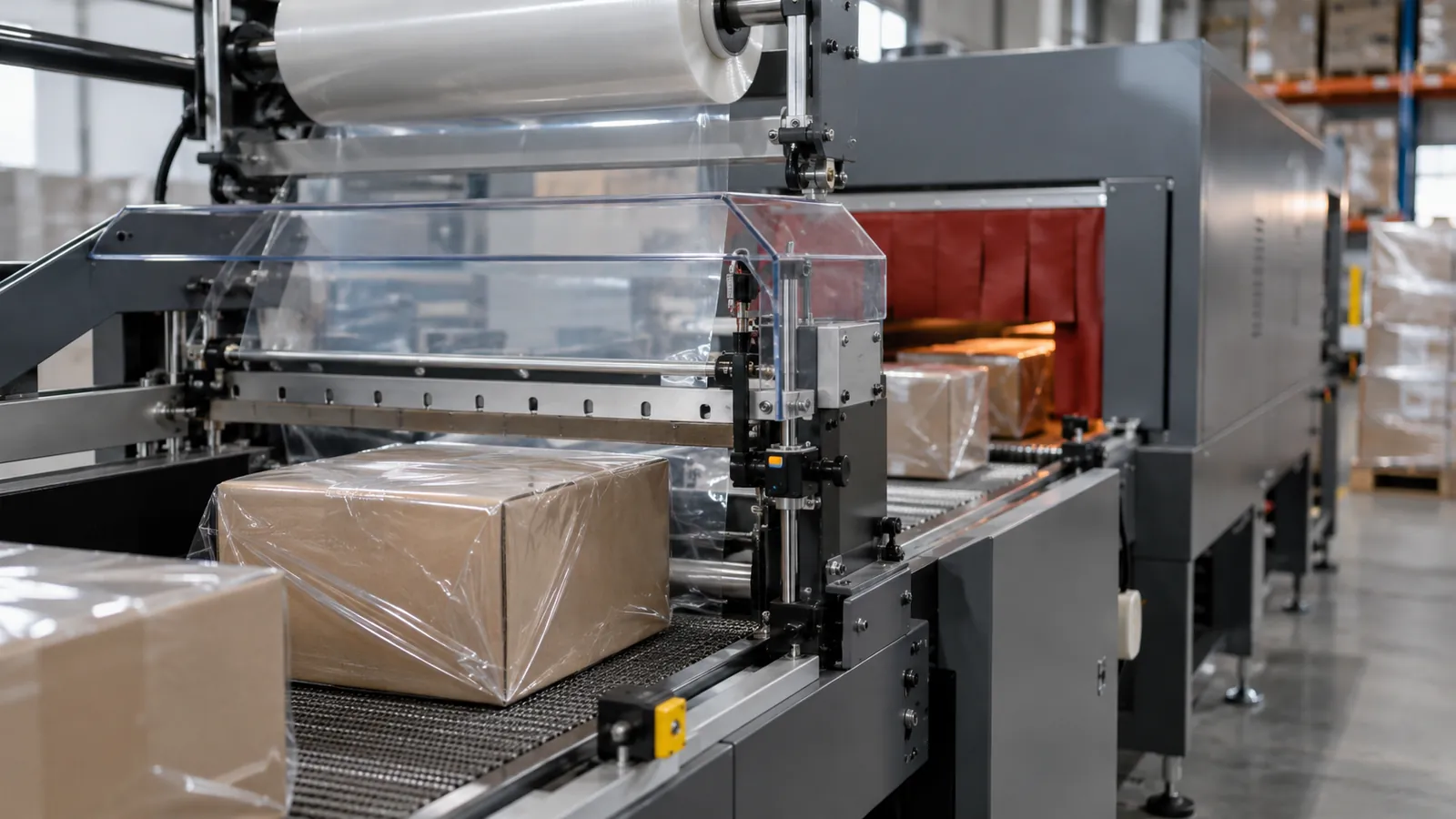
Heat setting is where most problems start. POF has a defined temperature window. Below it, the film is loose and wrinkled. Above it, the film sags, thins or melts holes. Tunnel temperature, air velocity, conveyor speed and the product’s thermal mass all interact. Establish the useful window for each candidate rather than assuming cross-linking makes it wider. ASTM F88/F88M-23 covers seal-strength testing on lab or production seals. For sealing temperature behavior in general, see seal initiation temperature, and for machine matching see packaging film and machine compatibility.
For other shrink types and when each fits, see the shrink film overview.
Choosing POF shrink film
- Product weight and edges: compare puncture and load retention for the proposed cross-linked and non-cross-linked grades.
- Machine and seal method: hot-wire, hot-knife or impulse sealing, plus line speed.
- Tunnel capability: check maximum temperature and air control.
- Optics: clarity and gloss for the shelf, and whether the film will be printed.
- Air release: specify perforation needs.
- Food contact and regulations: request declarations and confirm destination-market rules.
- End of life: polyolefin is generally easier to fit within polyolefin recycling thinking, but local collection and design guidance still decide the outcome. See recyclable flexible packaging.
What to put in a POF shrink film specification
Use this record during the machine trial.
Scroll horizontally to view all columns if needed. ↔
| Input or observation | Your record |
|---|---|
| Grade / layer count / cross-link status / gauge | ____ |
| Product weight / corners / heat tolerance | ____ |
| Free shrink MD/TD / force / test conditions | ____ |
| Seal method / temperature / dwell / pressure | ____ |
| Tunnel temperature / air speed / conveyor dwell | ____ |
| Perforation / trapped air / holes / seal failures | ____ |
| Load handling / appearance / accepted output | ____ |
| Roll / winding / contact declarations / market | ____ |
Carry the results into the film specification comparison guide before changing grade or gauge.
Sources and method
A manufacturer’s public coextrusion note describes three- and five-layer routes; its cross-linked grade information supplies manufacturer claims, not this site’s trials or a recommendation. HSE’s linked guidance covers heated-plastics controls, not a universal safe tunnel setting. Checked October 9, 2026.
Continue reading
Related articles

OPS Shrink Film: Oriented Polystyrene Shrink Sleeves
OPS shrink film is oriented polystyrene used mainly for shrink sleeve labels. See its properties, trade-offs vs PETG and PVC, recycling and storage.
PVC Shrink Film: Properties, Applications and Limitations
PVC shrink film for sleeves and overwraps: assess heated-process controls, grade-specific seals, cold handling and replacement trials against POF or PETG.
Shrink Film: Types, Properties and How to Choose
Shrink film is an oriented plastic film that tightens around a product when heated. Compare PVC, PETG, POF and PE types and learn how to choose.