
Vacuum Pouch Packaging: Materials and How It Works
Vacuum packaging pouch guide: nylon/PE structures, chamber vs thermoform-fill-seal machines, puncture resistance, barrier needs and how to specify.
A pouch that does not match the vacuum machine can retain air or fail to seal. A vacuum pouch is a bag evacuated before sealing; PA/PE is one documented construction, not the definition of the format. Select the evacuation route first, then confirm film barrier, puncture resistance and whole-pack integrity for the product.
Scroll horizontally to view all columns if needed. ↔
| Equipment route | Film/bag to confirm | Mismatch risk |
|---|---|---|
| Chamber | Compatible smooth premade pouch; open mouth inside chamber | Wrong sealant or thickness can give a leaking seal |
| Thermoform-fill-seal (TFFS) | Matched forming bottom web and lidding web | Premade bags cannot replace the tooling/web system |
| External edge suction | Embossed/channel bag specified for that machine | Smooth faces may block the air path |
| External nozzle | Bag/film approved for the nozzle and sealing system | Do not assume it needs the same channels as edge suction |
How a vacuum pouch works
Removing air reduces the oxygen available for oxidation, rancidity and color change. It limits the growth of aerobic spoilage bacteria and molds. It also shrinks the pack, which helps in shipping and refrigerated storage.
Vacuum packing does not make a perishable product safe by itself. The FDA Food Code 2022, sections 1-201.10 and 3-502.12, identifies reduced-oxygen packaging risks requiring control of C. botulinum and L. monocytogenes. Use product-specific food-safety controls and maintain the required cold chain; refrigeration alone is not a universal validation. Shelf life is set by the product, temperature and the barrier of the pouch, not by the vacuum alone. Packaging and shelf life covers this in more detail.
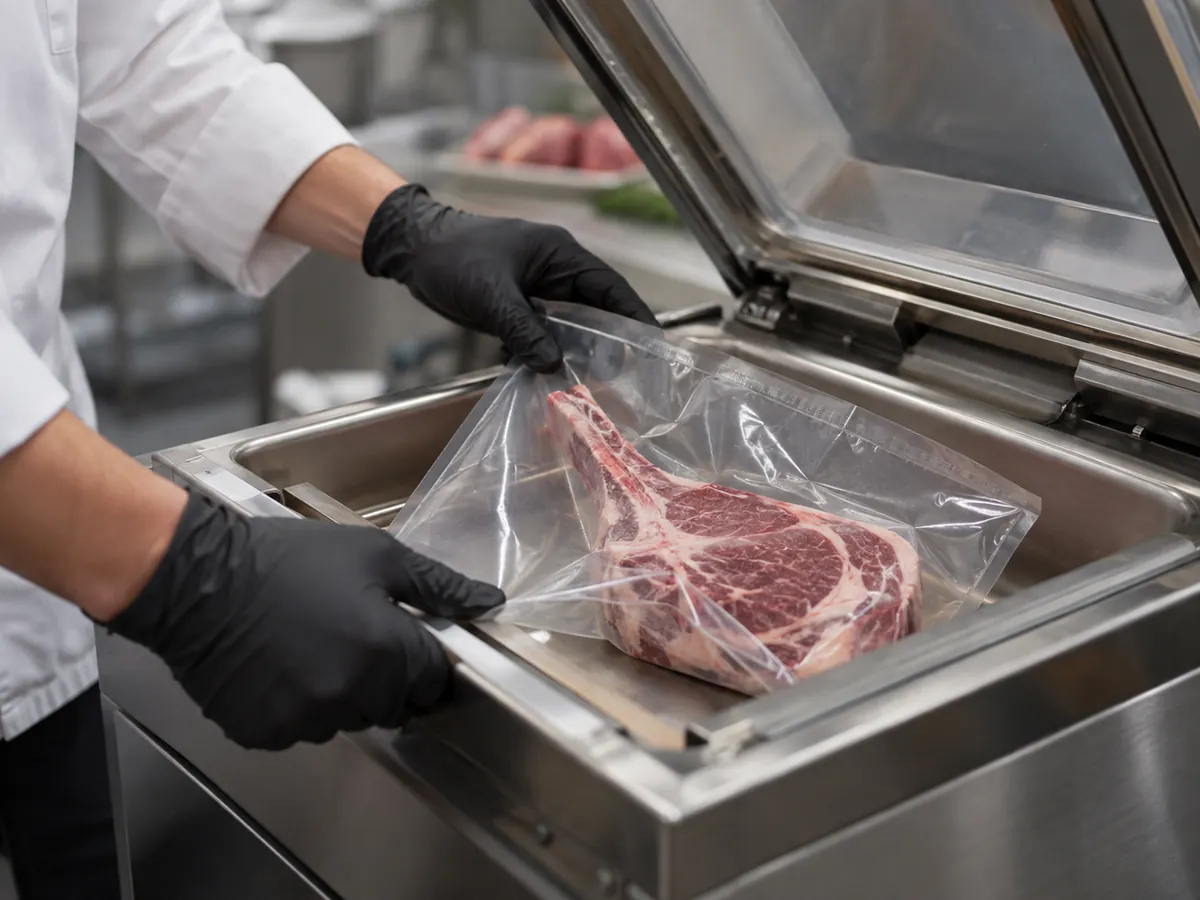
Vacuum pouch materials
A manufacturer’s public PA/PE pouch description identifies nylon for toughness/barrier and PE for sealing. Treat this as one candidate construction; exact layers and grades need confirmation.
- Nylon layer: can contribute toughness and gas barrier; confirm puncture results for the actual film and temperature. See nylon packaging film.
- PE sealant layer: provides a candidate sealant; obtain a food-contact declaration for the specific grade and intended use. Confirm requirements for your destination market. See PE film.
- EVOH layer: added in higher-barrier pouches for long shelf life, as in nylon/EVOH/nylon coextrusions. See EVOH barrier film.
- Aluminum foil or metallized layers: used in laminated pouches where light and extreme barrier matter, though these make the pouch opaque.
Coextruded vs laminated
Coextruded PA/PE pouches are made in one process, with the layers formed together. Laminated structures bond separate films with adhesive. Compare actual layer drawings and results rather than assuming a cost or stiffness ranking. Laminated packaging explains how the two approaches differ.
Many pouches are bought premade, with an open top, and the user fills and seals them. Others are formed from rollstock in a thermoform-fill-seal machine.
Chamber machines vs thermoform-fill-seal
The route table above separates bag requirements. Confirm chamber dimensions and seal-bar compatibility; TFFS needs its matched tooling, forming web and lid. External nozzle machines and edge-suction machines use different air paths. Verify liquid handling in the actual manual.
Puncture resistance
Bone ends, sharp edges, frozen crystals and metal parts push into the pouch as the air is removed and the film draws tight around the product. Nylon contributes toughness here, and thickness matters. Common approaches are:
- a thicker film, or a thicker nylon layer
- a bone guard, which is a protective patch or a sleeve over a sharp point
- a shrink bag, where the film is also heat shrunk to fit the product shape
- rounding or trimming sharp edges of the product or part
The public scope of ASTM F1306-21(2025) addresses slow-rate probe penetration of flexible films/laminates at room temperature; it does not substitute for a cold filled-pack trial. Puncture resistant film has more on this. Test results depend on test conditions, so compare like with like.
Barrier needs
How much barrier you need depends on the product and its shelf life.
- Fresh meat and fish: oxygen barrier is usually needed to limit browning and spoilage. Many applications use PA/EVOH/PE or similar. See meat packaging.
- Cheese: needs oxygen barrier to prevent mold and oxidation, and a seal that tolerates the release of gas from ripening cheese. See cheese packaging.
- Industrial parts: may need moisture or corrosion protection. Volatile corrosion inhibitor films are used for this, and the pouch material is chosen to hold them.
- Dry foods: need moisture and oxygen barrier, and sometimes light protection.
OTR and WVTR values depend on temperature and humidity, so make sure comparison numbers are measured under the same conditions. For oxygen, ASTM D3985-24 uses a coulometric sensor, while F1927-20 specifies controlled relative humidity. For water vapor, F1249-25 uses a modulated infrared sensor. Record method/edition, temperature, humidity and specimen thickness; OTR and WVTR explain the separate measurements.
Related vacuum formats
- Vacuum skin packaging: a thin top film is heated and drawn down over the product on a backing board or tray, hugging its shape. It gives a tight, glossy look and is used for meat, fish and hardware. It needs a different machine.
- Shrink bags: a vacuum pouch with a heat-shrinkable film. After sealing, the pack goes through hot water or a heat tunnel so the film shrinks tight. It is commonly used for primal meat cuts and whole cheeses.
What to put in a vacuum pouch specification
- Product: weight, shape, bones or sharp edges, moisture, fat and temperature during packing and storage.
- Shelf life and storage: chilled, frozen or ambient. Frozen storage requires a seal and film that stay flexible.
- Thickness: pouches are commonly specified in microns or mils. Compare the specified thickness and test results; thickness alone does not establish puncture performance.
- Barrier: ask for OTR and WVTR at stated test conditions. Select the candidate structure against verified barrier and shelf-life requirements.
- Seal: seal width, seal strength and seal through contamination such as fat or juice. Record the result and conditions for ASTM F88/F88M-23 separately from a finished-pack leak test.
- Machine: chamber size, nozzle or TFFS tooling, and whether the pouch has an embossed or smooth surface. Embossed channels help air flow in some external machines.
- End of life: PA/PE is generally not mono-material, which limits recycling. See recyclable flexible packaging.
- Pilot run: check puncture, seal integrity, leaks and shelf life on real product.
Method and sources
The FDA Food Code is a model for retail/food-service regulation; check the rules adopted in your jurisdiction. ASTM links above are public scope/edition references, not a claim to have performed those tests. A manufacturer’s public PA/PE description supports the candidate material roles; an equipment maker’s 2026 consumables catalog explicitly pairs smooth bags with chamber machines and embossed bags with external suction. Manufacturer URLs and catalog pages are retained in the evidence record, reviewed October 8, 2026. These supplier examples do not establish a universal puncture ranking or shelf life.
Continue reading
Related articles
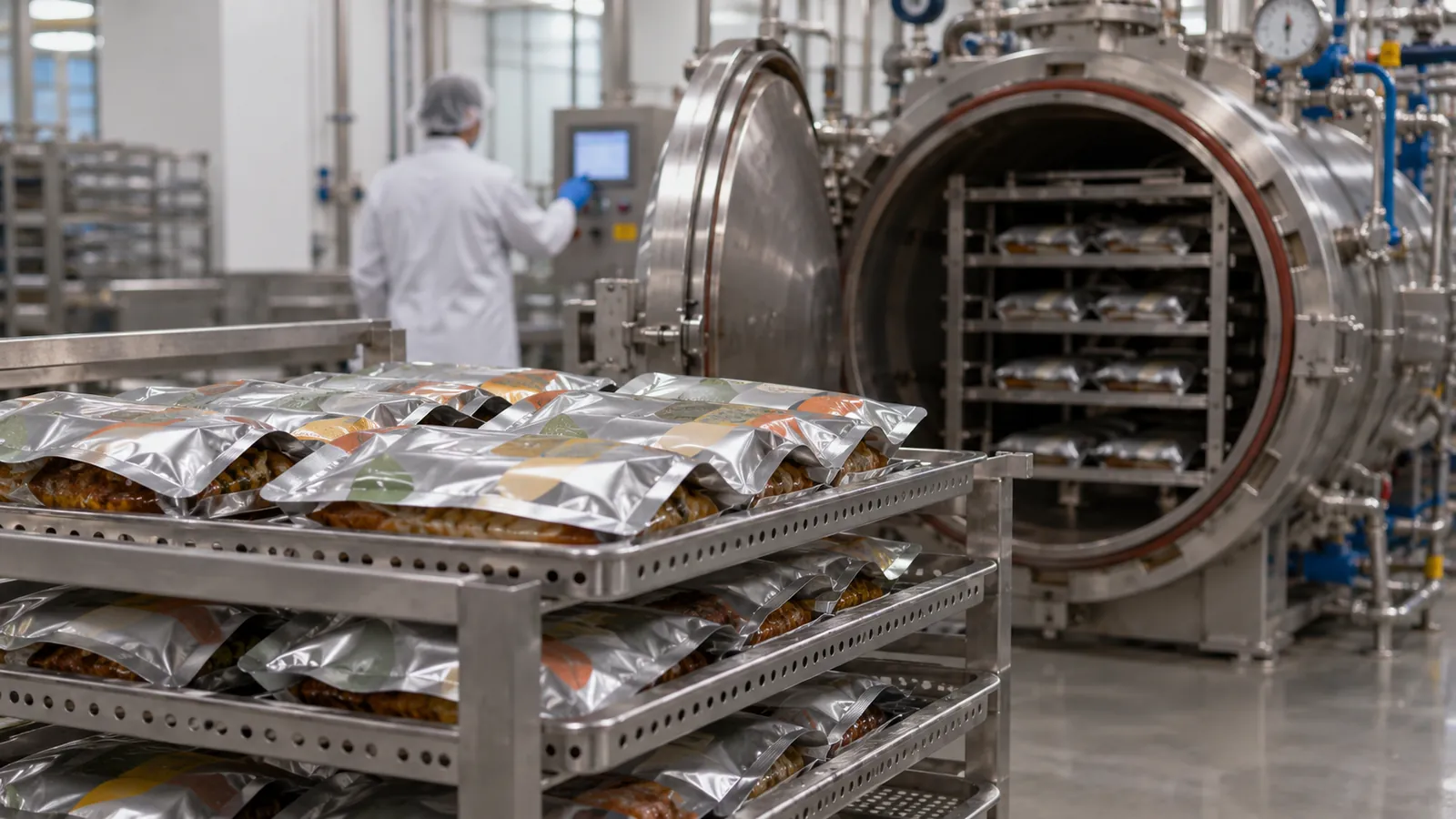
Retort Pouch: Structures, Processing and Uses
A retort pouch is a filled, sealed flexible pack sterilized in a retort. Learn the structures, seal integrity needs, regulations and typical uses.
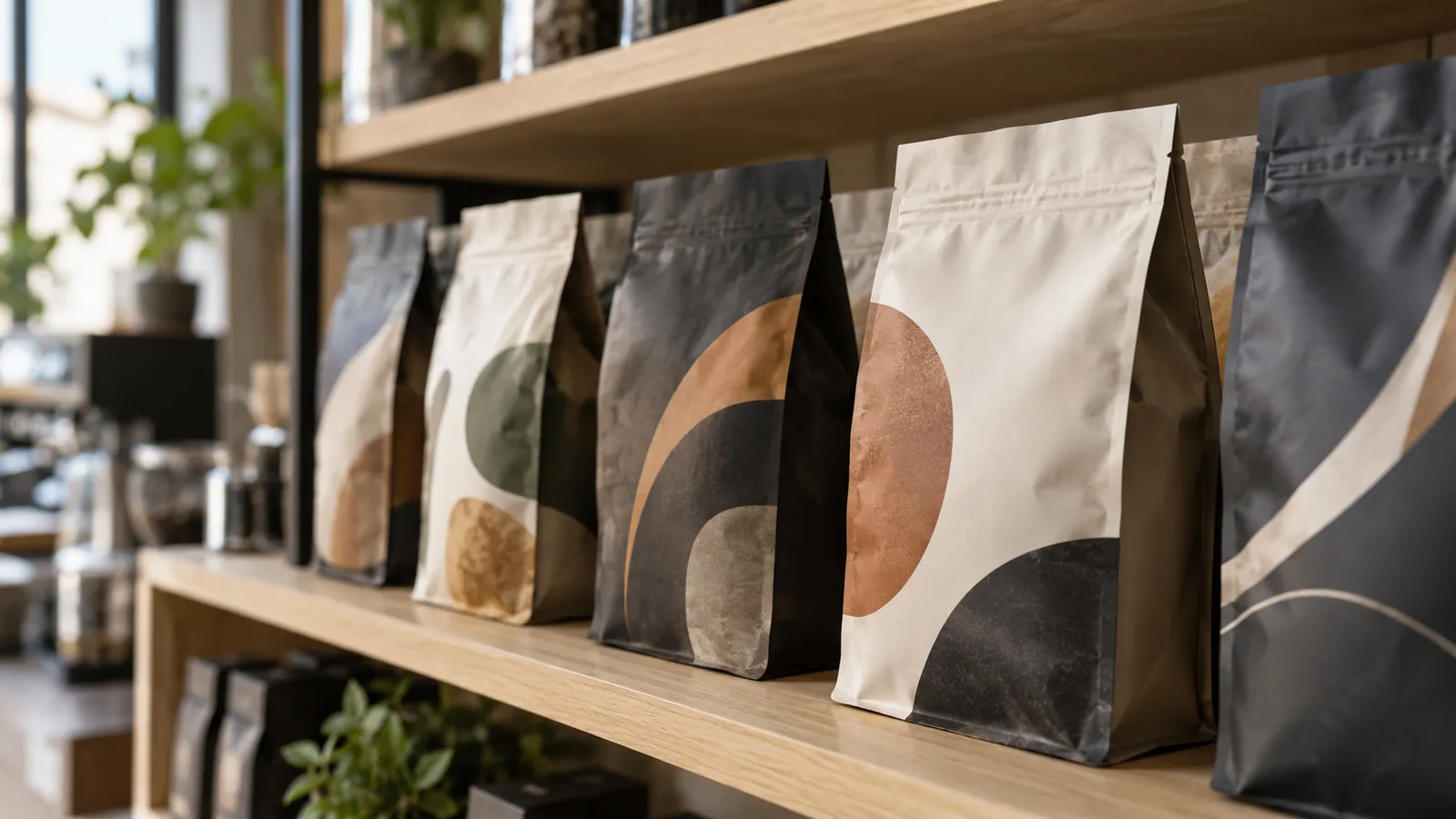
Flat Bottom Pouch: Box-Style Pouches Explained
A flat bottom pouch has a rectangular base and two side gussets that make a boxlike, self-standing pack. See construction, features and how it compares.
Pillow Bag Packaging: The Basic Form Fill Seal Bag
Pillow bag packaging is the simplest bag made on a vertical form fill seal machine: one back seal, two end seals, and a pillow-shaped pack.