
Meat Packaging Film: Vacuum, MAP and Shrink Bags
Meat packaging film explained: vacuum, MAP and skin pack structures, nylon and EVOH barrier layers, puncture protection, shrink bags and machines.
Film chosen for appearance alone can leave bone punctures or leaking seals unresolved. Choose vacuum, MAP or vacuum skin packaging by the product and color goal, then validate the complete chilled system.
Scroll horizontally to view all columns if needed. ↔
| System | Color / gas goal | Required package checks |
|---|---|---|
| Vacuum bag | Reduced oxygen; fresh red meat may appear purple-red | Actual bones, contaminated seals, leaks after shrink if used; specified cold chain |
| MAP | Defined atmosphere and retail color goal | Residual gas, tray/lid barrier, flange contamination, leaks; specified chilled storage |
| Vacuum skin pack | Low-oxygen contact pack; validate desired appearance | Bone contact, top-film draw and tray seal, leaks after handling; specified cold chain |
What goes wrong with meat
Meat is wet, fatty, perishable and often sharp, so the film has to deal with several problems at once.
- Spoilage from oxygen and microbes: aerobic spoilage organisms grow where oxygen is available. Lowering or controlling oxygen is the main reason barrier layers are used.
- Color: fresh red meat blooms bright red when its pigment is exposed to oxygen and turns purplish-red without it. Consumers read brown as old, so color drives the choice between vacuum and MAP.
- Purge and drip: fresh meat releases fluid in the pack. Absorbent pads, pack shape and seal quality all matter, and a seal contaminated with fluid or fat is a weaker seal.
- Puncture: bone ends, ribs and hard fat edges can cut through a thin film, especially under vacuum when the film is pulled tight against the product.
- Seal contamination: meat juice and fat in the sealing area are a standing problem on vacuum and thermoform lines.
- Cold chain stress: packs are handled cold and wet, and a package that was fine at room temperature can behave differently at refrigerator or freezer temperatures.
Fresh red meat: vacuum versus MAP
The two main approaches pull in different directions, so many retail and foodservice programs use both.
Vacuum packaging removes air and draws film against the meat. An industry association’s public beef-packaging sheet describes the darker purple color under vacuum and the brighter red associated with oxygen exposure. Color alone does not establish safety or a shelf-life duration. Vacuum therefore suits primal and sub-primal cuts shipped to a processor or butcher, and products where appearance in the pack matters less. The format is covered in vacuum pouch packaging.
Modified atmosphere packaging replaces the air in a rigid tray or pack with a gas mix. For fresh red meat, retail packs commonly use a high-oxygen mix to keep the bloom, often with carbon dioxide to slow microbial growth. Low-oxygen systems are another route, but gas selection needs product- and destination-specific review. FDA GRAS Notice 251 records a “no questions” response for a defined carbon-monoxide MAP use with fresh ground and muscle red meat. That record is not universal permission, a recipe or a safety guarantee for other products or markets. The lidding film in a MAP tray has to hold the gas mix, so its oxygen barrier and anti-fog performance both matter, and for long shelf life the tray must be barrier too.
Color and shelf life drive this choice, so decide the pack concept first and the film second.
Meat packaging materials: typical structures
Meat structures may combine a polyethylene-based sealant and barrier layers; test contamination tolerance on the actual sealant and line rather than ranking polymer families. Nylon adds puncture and flex resistance as well as some barrier. EVOH gives a much higher oxygen barrier but is moisture-sensitive, so it sits between other layers. Values vary by grade, so confirm OTR data and its test temperature and humidity with the supplier.
Scroll horizontally to view all columns if needed. ↔
| Meat product | Common structure | Why it is used |
|---|---|---|
| Fresh primals, sub-primals | Coextruded PE / EVOH / PE or nylon / EVOH / PE barrier shrink bag | Oxygen barrier, shrinks tight to the meat, seals through some contamination |
| Bone-in cuts, ribs | Thicker nylon-based barrier bag, or a bag with a puncture-resistant patch | Nylon layer and gauge resist bone puncture |
| Sliced processed meats (ham, bacon, deli) | Thermoformed nylon / PE or nylon / EVOH / PE forming web with matching lidding | Deep draw formability, clear display, vacuum or gas flush |
| Cooked sausages, hot dogs | PA / EVOH / PE forming web and lidding film; or high-barrier vacuum pouches | Oxygen barrier to hold color and flavor, and heat resistance if post-pasteurized |
| Fresh retail trays (MAP) | Anti-fog barrier lidding film, e.g. PET / EVOH / PE | Holds the gas mix, stays clear in the cold |
| Premium cuts, vacuum skin pack | Skin-forming top film, often ionomer or PE-based with EVOH, on a barrier tray | Film drapes over the meat for a tight, presentable pack |
The materials are covered in more detail on the pages for nylon film, EVOH barrier film and PE film.
Shrink bags
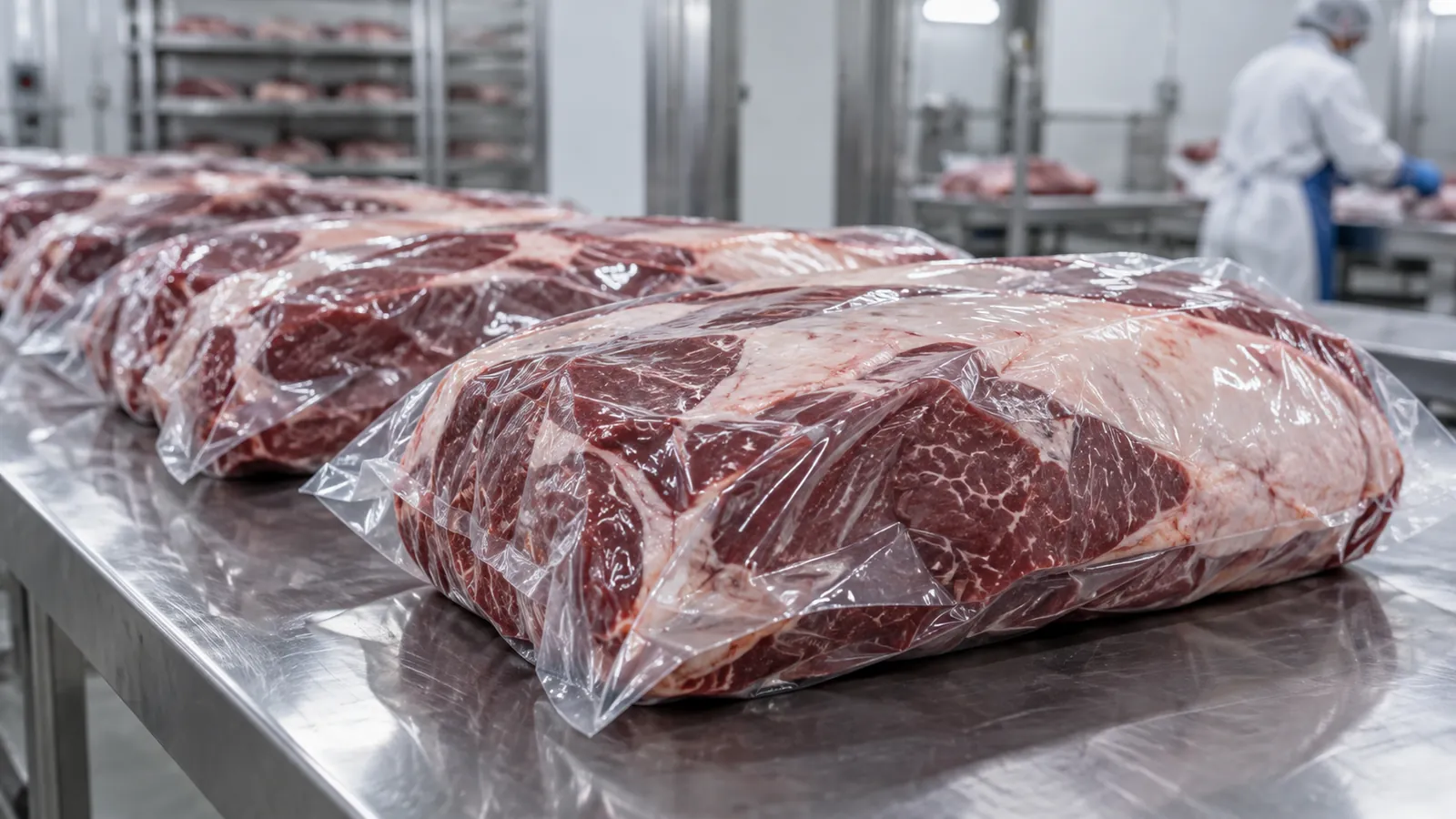
A barrier shrink bag is a vacuum pouch made from a heat-shrinkable coextruded film. After the vacuum chamber seals it, the bag passes through hot water or hot air and shrinks tightly around the meat. That removes wrinkles and the pockets where purge could collect, and a well-shrunk bag looks better and handles better in a case. Bags are made as end-seal or side-seal pouches with different shrink levels, which the film maker sets through orientation. The general shrink film page covers the shrink mechanism and tunnel settings.
Thermoform-fill-seal and vacuum skin packaging
For sliced meats, bacon and portions, a thermoform-fill-seal line heats a bottom forming web, draws it into a cavity, loads the product, then seals a top lidding film under vacuum or a gas flush. Two films work together: the forming web must draw evenly without thinning at the corners, and the lidding film must seal to it cleanly and, in many cases, peel. The sealing window and the forming temperature both depend on the web’s sealant and its nylon content.
Vacuum skin packaging is related but different. A heated top film is vacuum-drawn directly over the meat on a rigid or flexible bottom web, so it wraps the product like a second skin. It is common for premium cuts and retail display packs, and it needs a top film with good formability and a clean seal to the bottom.
Machines
- Chamber vacuum machines seal premade bags in batch and are widely used for primals and portions.
- Thermoform-fill-seal lines form, fill and seal in one machine for sliced products, and can add vacuum or gas flush.
- Tray sealers apply a barrier lidding film to preformed trays, usually with MAP gas flushing.
- Shrink tunnels use hot water or hot air to shrink the bag after sealing.
- Flow wrappers and vertical machines are used for some processed meat snacks and cooked products. Flow wrapper film explains how those machines treat film.
On any line, check seal quality at the contaminated end of the range as well as with clean seals, and confirm that the film’s seal strength holds with fat and juice present.
Food safety and cold chain notes
Vacuum and low-oxygen packs can allow some anaerobic organisms to grow if temperature control fails, so the pack is one part of a system that includes hygiene, temperature control and processing. Packaging does not replace a food-safety plan. Shelf-life claims should come from your own testing at realistic storage and abuse temperatures. Food-contact compliance depends on the market where the product is sold, so confirm the requirements with the supplier and your regulatory advisor for each destination.
What to define when specifying a meat film
Scroll horizontally to view all columns if needed. ↔
| Check | Record for each sample / time point | Result / action |
|---|---|---|
| System / product | Vacuum, MAP or skin; cut, batch, bone geometry; film / tray grades | Set color, gas and package criteria |
| Cold-chain trial | Temperature / time history, handling and actual fill mass | Assess within the food-safety plan |
| Bone / draw areas | Actual bone contact or formed-film thinning; puncture and leak locations | Hold punctured samples for investigation |
| Seal challenge | Clean and juice/fat-contaminated seals; line settings; force and leak results | Record each separately |
| Post-process integrity | Before / after shrink if used, then after cold-chain cycle | Check loss of vacuum, gas and leaks |
| Product result | Color, purge and validated shelf-life observations | Do not infer safety from color |
Use puncture resistance for film comparison and seal strength for force measurements; the real cut and package still need integrity checks.
Method and sources
Official descriptions support system and color explanations. No gas ratio, safe-storage duration or commercial shelf-life extension is prescribed. The beef-packaging sheet and FDA notice were checked 2026-10-08; the system checks contain no tested shelf-life outcome.
Continue reading
Related articles
Cheese Packaging Film: Ripening, Vacuum and MAP
Cheese packaging film explained: gas-permeable ripening films, vacuum bags for blocks, MAP for sliced and shredded cheese, reclosable packs and structures.
Bakery Packaging Film: Keeping Bread and Cakes Fresh
Bakery packaging film explained: how staling, moisture loss and mold shape film choice for bread, cakes, cookies and tortillas, plus formats and machines.

Candy Packaging Film: Twist Wraps, Flow Wraps and Cold Seal
Candy packaging film explained: twist-wrap and flow-wrap structures, cold seal for chocolate, moisture and aroma barrier, metallized and white BOPP.