
Rollstock vs Premade Pouches: Which Is Right for Your Line?
Rollstock vs premade pouch compared on material cost, inventory, changeovers, pack quality and features, with a checklist to pick the right supply route.
Choosing a supply form your line cannot handle wastes material and changeover time. Rollstock is printed or unprinted film on a reel that the line forms into packs; premade pouches arrive formed for their bag style, with an opening or spout channel left for filling. A three-side-seal pouch is one example, not the definition. Compare required features, machine compatibility and cost per good pack before choosing either route.
This page covers the material and format choice. The machine side is in VFFS vs premade pouch packaging. Related pages are rollstock packaging and premade pouch packaging materials.
Rollstock vs premade pouches at a glance
Scroll horizontally to view all columns if needed. ↔
| Factor | Rollstock | Premade pouches |
|---|---|---|
| What you buy | Film on a core | Formed pouches with a filling opening or channel |
| Who forms the pack | Your machine, during filling | The converter, before delivery |
| Material cost per pack | Enter quoted film cost and yield | Enter quoted pouch cost |
| Format range | Limited by forming tooling and film width | Wide: stand-up, flat bottom, spouts, zippers, shaped corners |
| Storage | Measure roll storage per usable pack | Measure carton storage per usable pack |
| Changeover | Film, tooling and recipe changes | Magazine, gripper, tooling and fill changes |
| Registered print | Repeat length and registration on the roll | Fixed at the converter, flexible per pouch design |
| Pack quality | Depends on film running and seals made on your line | Pouch formed and inspected before it arrives |
| Supply risk | Roll quality, splices, tracking | Dimensional consistency, stiffness, carton handling |
| Machine needs | Form-fill-seal or flow wrap machine | Premade pouch filler |
Entries are general tendencies. Actual cost, speed and quality depend on the structure, volumes and machine.
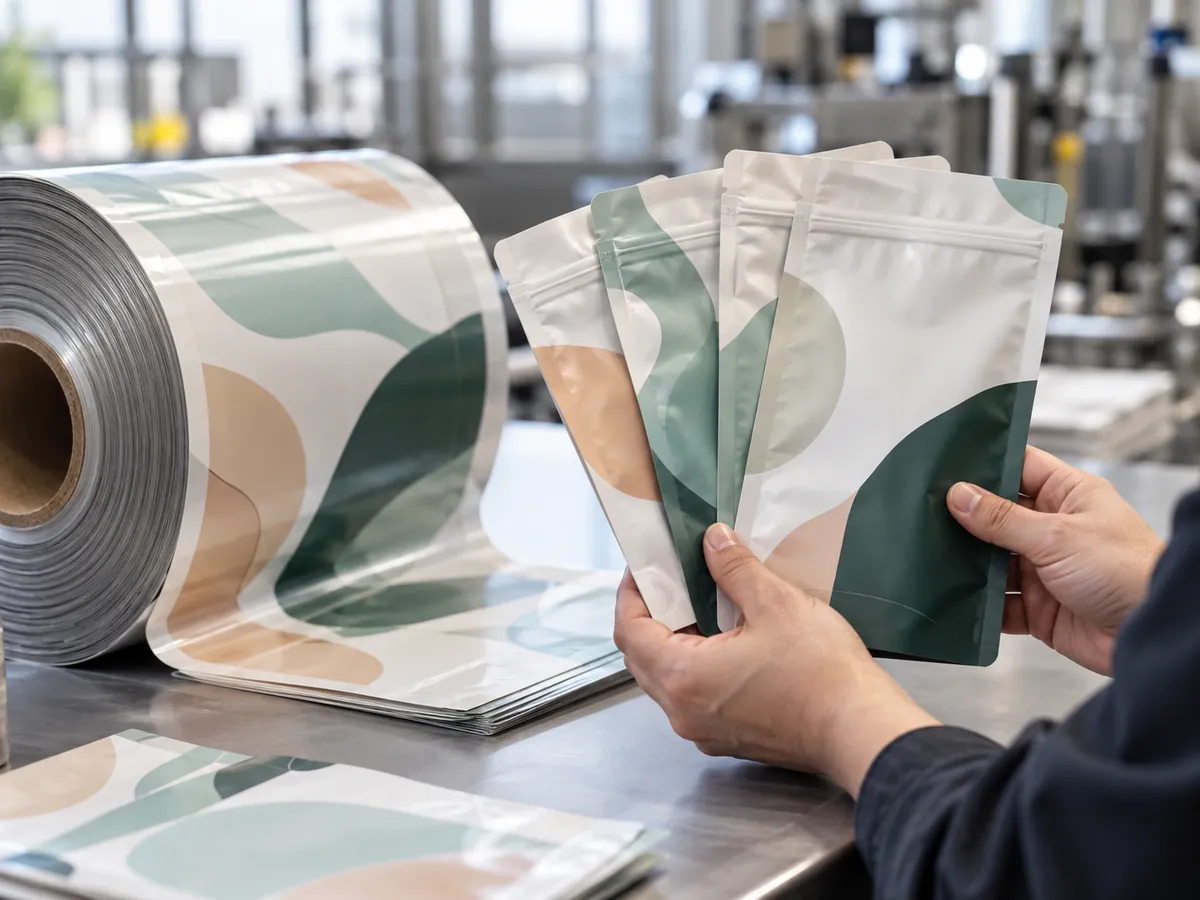
Material cost structure
Compare the same SKU mix, production period and number of filled, sealed, shippable packs. Record start/end dates and good-pack counts from line records. This worksheet allocates costs; it is not a claim that either route is cheaper.
Scroll horizontally to view all columns if needed. ↔
| Cost input for the period | Record for each route | Data source |
|---|---|---|
| Material used in good packs | ___ currency; film yield or pouch count ___ | Invoice, drawing and stock issue records |
| Losses | ___ currency; scrap and startup rejects ___ | Reject log and material reconciliation |
| Changeovers | ___ currency; downtime and setup labor ___ | Changeover log and site rates |
| Running | ___ currency; production labor, energy and maintenance ___ | Line hours, meters and accounts |
| Inventory | ___ currency; storage, carrying and obsolete stock ___ | Warehouse records and accounts |
Add these five allocations and divide by good packs in that period. Keep scrap material out of the first row and setup time out of running costs to avoid double counting. Use the cost per good pack guide to define your accounting boundary.
Inventory and storage
Measure space for the actual roll or carton dimensions and usable pack count, including handling access. Follow the material supplier’s storage instructions rather than assuming one route always needs less space.
Artwork changes can leave obsolete stock in either route. Registered printed rollstock is constrained by print repeat and eye-mark position: changing the machine’s bag-length setting does not change the printed pitch. Unprinted or random-print webs may allow different lengths within machine limits because artwork need not land at a fixed position. Confirm the repeat, tolerance and registration drawing using the rollstock specification checklist.
Changeovers and flexibility
Compare a timed changeover for the actual sizes. Roll-fed lines may need film, forming-tool, jaw and recipe changes; premade lines may need magazine, gripper, tooling and filling adjustments. Neither route has a universal time advantage. Include the first accepted pack after adjustment in the recorded changeover time.
Pack quality and appearance
Check which features the proposed line can actually make or handle: stand-up pouches with a bottom gusset, flat bottom pouches, spouted pouches, shaped corners and tear notches (see stand-up pouch and zipper pouch packaging). For premade pouches, agree incoming tolerances and inspection records for seal widths and zipper position.
Rollstock makes pillow bags, gusseted bags and wraps well, and registration depends on repeat accuracy and film tension. Quality on the finished pack depends on how well the film runs on your machine: seal window, hot tack, friction and tracking. VFFS film covers these.
Features: zippers, spouts and barrier
A converter can supply premade pouches with fitted closures. For a roll-fed route, confirm the actual line’s closure application and sealing capability rather than assuming every feature is available. Barrier depends on the laminate and works the same way in either form, so set OTR and WVTR requirements at stated test conditions (laminated packaging explains the structures).
Risk and supply
Rollstock risks are in the roll: width tolerance, winding, splices, eye-mark readability and unwind direction. Premade pouch risks are dimensional tolerance, stiffness consistency, static and the seal area at the zipper. The first-order risk checklist covers both. Agree specifications in writing, and run a trial on the real machine with real product.
When to choose rollstock
- Volumes are steady and the pack is a simple bag or wrap.
- Your worksheet supports the cost per good pack for the proposed run.
- Storage space is limited.
- You already own a form-fill-seal or flow wrap machine, or plan to.
When to choose premade pouches
- You need stand-up, flat bottom or spouted shapes, or integrated zippers.
- The pack look is part of the brand, as with premium or retail-facing products.
- You run many SKUs or short runs and want fewer forming changeovers.
- Your machine is a premade pouch filler.
Questions to answer before choosing rollstock or premade
- Which pack shapes and features do you need: zipper, spout, stand-up?
- What are annual volumes and run lengths per SKU?
- What is total cost per good pack, including scrap, speed and changeover?
- How much storage space do you have, and how fast does stock turn?
- How often does artwork change?
- Which machine do you have, and can it run each form?
- What tolerances and roll or pouch specs will be agreed in writing?
- Has a trial run been planned on the real machine with real product?
Method and sources
This is a public-document comparison and a blank cost worksheet, not our line test. A manufacturer’s public pouch-converting documentation lists spouted, gusseted and three-side-seal formats; its three-side-seal example leaves one side open for filling. A machine manufacturer’s maintenance glossary (v2018.1) defines registered film and photo-eye detection of product pitch. These are format/process evidence, not comparative cost data. Documents and URLs are retained in the editorial evidence record reviewed October 8, 2026.
Continue reading
Related articles

Flat Bottom Pouch: Box-Style Pouches Explained
A flat bottom pouch has a rectangular base and two side gussets that make a boxlike, self-standing pack. See construction, features and how it compares.
Quad Seal Bag: Four Corner Seals and When to Use Them
A quad seal bag has four vertical corner seals that give a squared, stable shape. Learn how it is made, where it is used and how it compares to side gusset.
Retort Pouch: Structures, Processing and Uses
A retort pouch is a filled, sealed flexible pack sterilized in a retort. Learn the structures, seal integrity needs, regulations and typical uses.